






An article exploring the latest trends in token economics in DeFi and GameFi


author:HIRAYAMA SHO
translate:@KP|Buidler DAO
Proofreading: @Han Yue
The full text is 3778 words, and the expected reading time is 12 minutes
present and past models
How does the dual token model of DeFi and GameFi work?
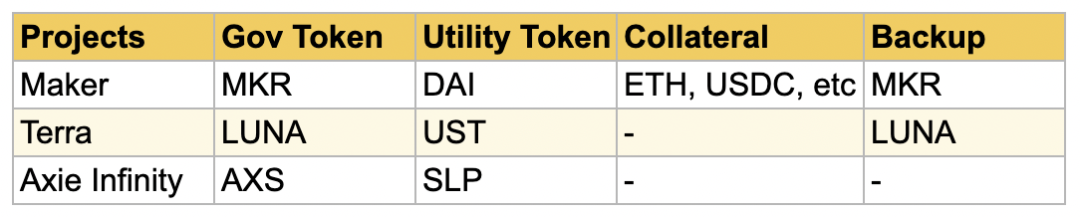
The above table lists the projects using the dual-token model, the key of which is the utility token (Utility Token). Maker and Terra peg $DAI and $UST at $1 respectively, and Axie’s $SLP is not a stablecoin, but an inflation-prone in-game token. $MKR and $LUNA don't have the same token economics as Axie, and both tokens are likely to issue additional tokens for their respective stablecoins.
Before Terra collapses, according to its token economics, if the price of $UST deviates downward, the agreement will issue $LUNA to buy $UST from arbitrageurs. Since the required amount of $LUNA is minted to buy $UST, the price of $UST is theoretically stable even if the price of $LUNA falls, no matter what the price of $LUNA is, as long as someone continues to buy $LUNA in the market . $DAI will be more stable because it uses $ETH as collateral. If the price of the collateral drops and the platform becomes insolvent, the platform will issue additional $MKR to buy $DAI. Both of these mechanisms transfer the price instability of utility tokens to the quantity instability of backup tokens.
Axie’s token model is slightly different. In order not to inflate $AXS, the Axie team transferred the inflation attribute to $SLP, so $SLP itself is designed to have inflation attributes. Then how to provide players with stable income will become challenging, because players mainly obtain stable dollar income by obtaining $SLP rewards. However, $SLP has the property of inflation. When the price of $SLP falls, if the platform wants to guarantee the player's income, the amount of $SLP given to the player needs to increase, which further aggravates the inflation. However, just like the mechanics of $LUNA and $UST, it is theoretically possible to reward players with a stable amount of $SLP as long as someone continues to buy $SLP in the market to stabilize the price. Axie differs from Maker and Terra in that it does not sell governance tokens to stabilize the price of utility tokens.
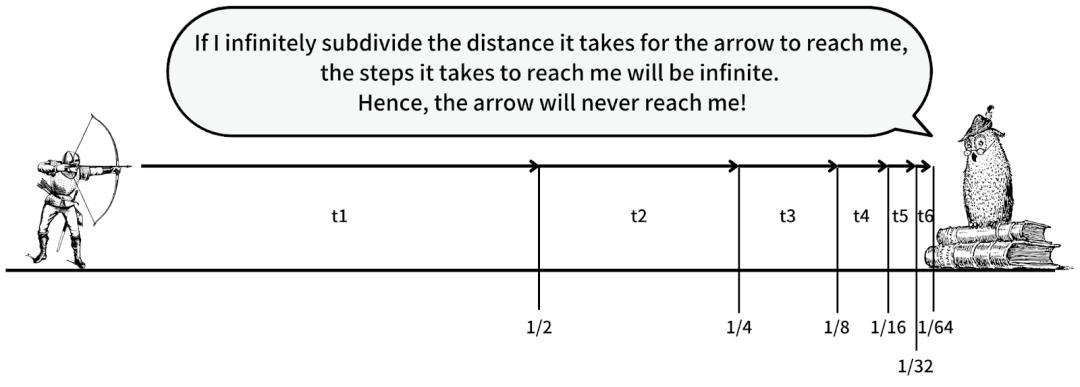
The endless inflation token model is somewhat similar to Zeno's paradox. This two-token model seems like an elegant solution, but once a certain tipping point is passed, uncontrollable hyperinflation emerges and destroys the entire system. Separately designing value and demand into two tokens as a dual-token model is full of contradictions and has no theoretical basis.
After all, token economics is not a panacea. Tokens without a well-designed game are tantamount to an unsustainable model. Once the inflow of funds stops, it begins to collapse.
Prudent token design and token economics are paramount for moving to a Web3 studio. If tokens are to be introduced, one should at least be aware that these tokens will not trigger a death spiral. Similarly, for GameFi's token economics designers, DeFi's token model has reference value, but they must also realize that GameFi and DeFi are two completely different combination forms and value cycles.
Researching DeFi cases is one way to prevent the unexpected from happening.
For example, The net positive gold sink is well-known as a way to delay inflation, but it is a very serious flaw in the DeFi token model, and if it is introduced into the game, it will cause serious damage.
The table below summarizes the token distribution of major DeFi products at the time of writing. Most inflation models are either very simple or use a delayed inflation model. However, Curve is unique in that its governance token pledgers will receive USD stablecoins, and the locking system achieves a temporary reduction in circulating CRV.
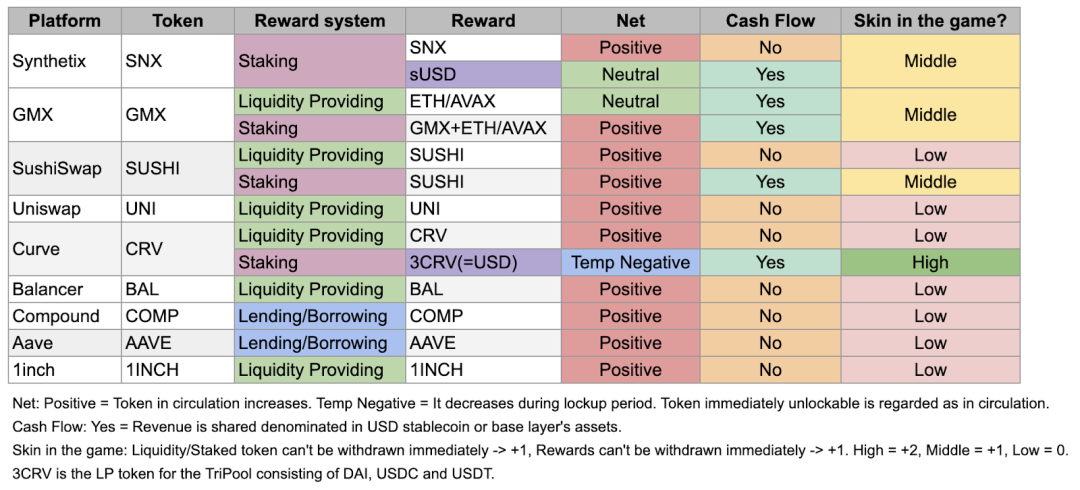
Unsustainable models we found
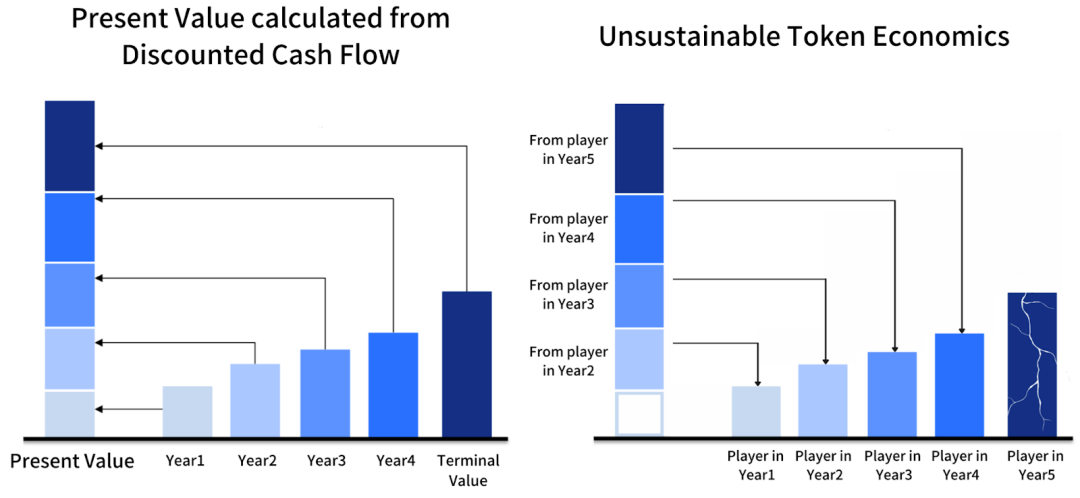
The above left figure shows the typical discounted cash flow method and net present value in the financial field. The net present value of the project is based on the discount of future income. The figure on the right above shows an unsustainable token economics model, which adjusts the distribution of tokens based on the existing funds in hand. These unsustainable token model designs have the exact opposite value generation loop as it requires creating something out of nothing.
When gamers develop their own Avatars or characters for a long time and use them as a source of income, token design becomes more difficult for the following reasons:
It is difficult to change the rules without objection from users.
It may happen that wealth transfers from later players to earlier players.
Positive feedback is too strong to allow the ecosystem to shrink, even temporarily.
The latest trends in NFT economics
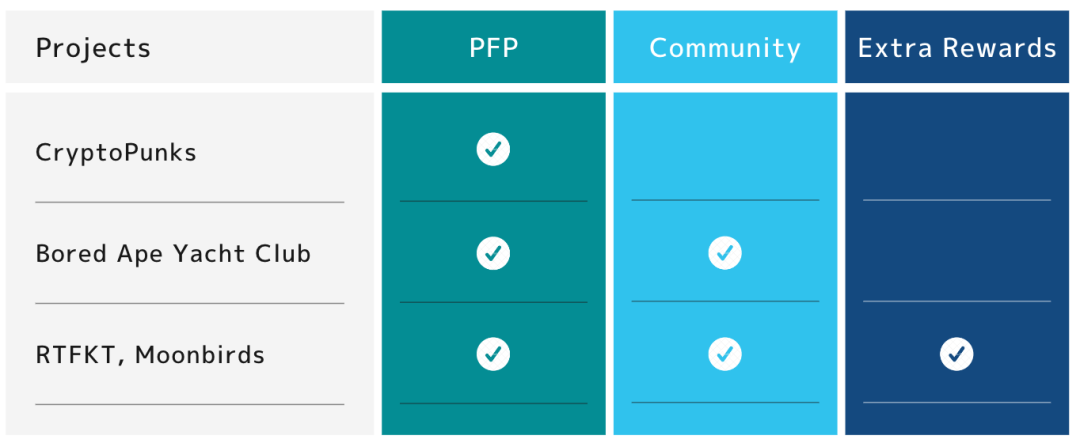
Yuga Labs, the developer of BAYC, has done a lot of exploration and innovation. They use NFT sales to raise specific funds, rely on secondary market royalties to generate continuous income, and develop social media marketing around narratives.
For example, Yuga airdrops MAYC to BAYC holders, establishes a narrative for MAYC and increases its value. If the airdropped items have value, the value of BAYC will increase even more. Yuga subsequently successfully airdropped BAKC, APE tokens, and Otherside land NFT in the same way. The success of Yuga has led more and more projects to adopt a similar approach, such as RTFKT and Moonbirds, who clearly promised to provide rewards to holders from the very beginning.
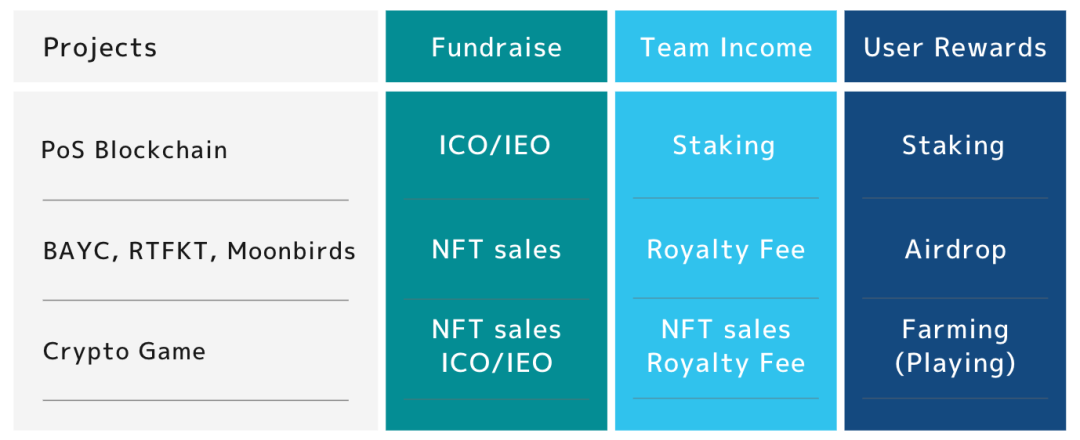
The above table lists the methods of fundraising, repeat sales revenue and user rewards in different fields.
An interesting point is the importance of royalty fees as an ongoing source of income for NFT projects. This phenomenon reflects that the market regards NFT as an investment product rather than a work of art, and the project team can obtain secondary transaction income. The following article also points out this phenomenon.
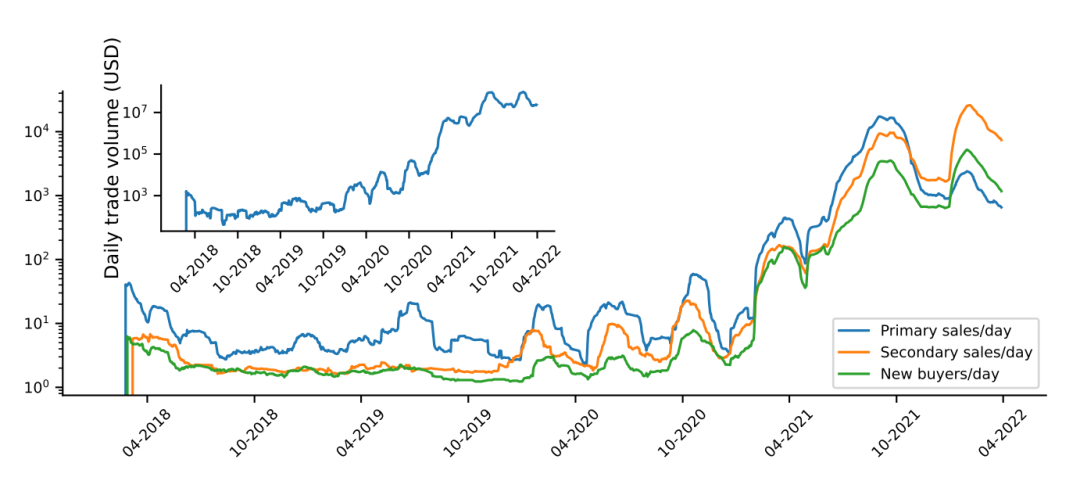
It should be noted that platforms like Sudoswap that do not support royalties are gradually rising, which will make it impossible to continuously obtain income from the secondary market. Imagine trading NFTs over-the-counter between friends, and you will find that there is no technical means to force a royalty fee.
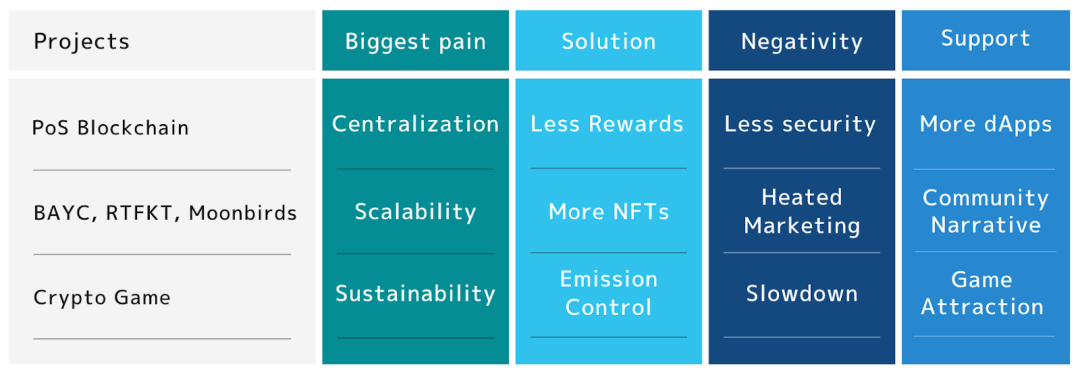
Yuga also solves the economic scalability problem. Even if high-end NFT projects are successfully issued, if the number of NFTs is only 10,000, the market share will inevitably be small. So Yuga created 19134 MAYC, 9602 BAKC, 1 billion APE and 98115 Otherdead consecutively. The value dilution caused by the growing number of issuances is also offset by preferential treatment for current holders and marketing in and out of the cryptosphere.
Towards Better Token Economics
Application-specific chains and L2 imperative
The ecosystem on the public chain is formed by the interaction between various products. However, games usually form an independent system. This is because games belong to the application layer and have limited compatibility in both vertical and horizontal directions. Imagine that the blockchain benefits from the products built on it, and the DeFi infrastructure also benefits from the products built on it. Poor compatibility limits the value inflow channels outside the blockchain.

We must understand that when NFT and FT in the game issue new tokens, it means that the top-level product increases the supply of circulating tokens in a way of Proof of Stake. This is why when we design a token that is tightly tied to the game economy, we have to run the utility (token) in a closed economic zone, we cannot add economic value to governance tokens that do not provide economic rewards.
When a well-funded game studio wants to develop a Web3 game without worrying about token design, one option is to start without issuing tokens and instead use stablecoins like BUSD and USDC.
The good news is that the application layer is closest to the end user, and the end user will be the largest source of value inflow in the future. In the tree diagram above, the ends of the branches appear to be the end points, but there are a large number of end users there.
Therefore, the application layer must establish a profit model different from other layers, and the token economics will naturally be different. The point is that products that operate independently and have DeFi functions have no compatibility, or do not need compatibility, and will inevitably migrate to their own developed blockchain or L2.
This is why application-specific chains such as BAS (BNB Application Sidechain) and zkBNB are constantly increasing. Needless to say, the token economics of specific Lisks will also become more important. In addition to being used as utility tokens for applications in the system, independent blockchain native tokens are also used as transaction fees and shared security fees (Shared Security Fees).
How to control the release speed?
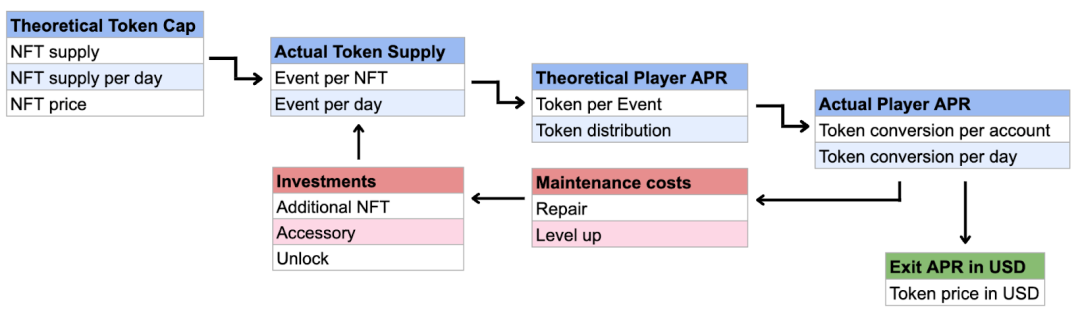
If the inflow of value is limited by Battle Pass purchases and NFT sales, we must be mindful of the initial token market cap and expected economic growth rate when designing the game economy. This is due to a lack of compatibility, and these numbers are unlikely to be better than expected in the long run, although they can be worse than expected.
A utility token issuance plan can be influenced by many factors, a simplified example is shown below.
The tokens in circulation are related to the number of tokens required for the event, further related to the number of events per day and the number of events per NFT, and finally related to the supply of NFT.
Why do we need to control multiple variables when we have a single clear target mint/burn ratio? This is because the utility (Utility) that players get from the game is not only the number of tokens, but also the experience of playing the game at various stages. Even if the number of tokens earned at a particular stage is small, players will be happy if the overall experience is worth the money.
Since a metaverse space itself has a complex structure similar to the real world, the issuance and distribution of tokens must be dynamically and spontaneously adjusted according to the behavioral data and satisfaction levels of gamers.
User awareness is important
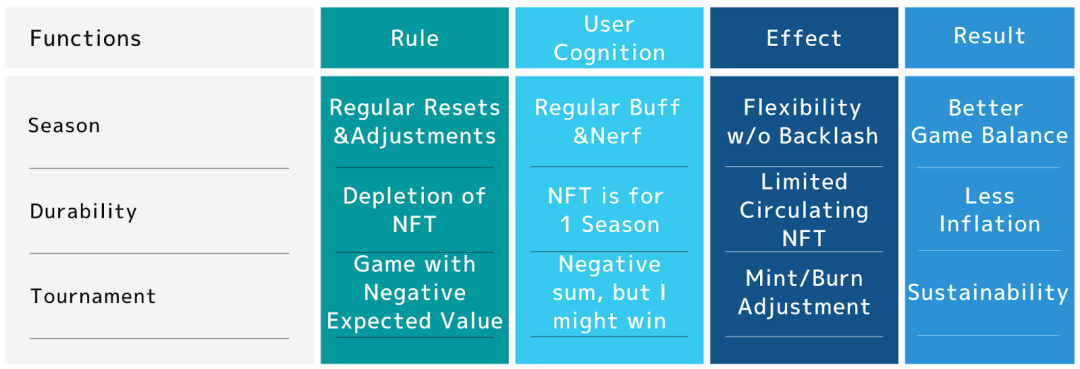
Some games introduce interesting mechanics.
the season
For players, the introduction of the season mechanism means that the game balance will be adjusted every season. Players understand this mechanism, and when they enter the game and find that characters and items have been adjusted, they will be less dissatisfied. The advantage is that there is no need to take special care of existing players, and the rules can be adjusted more fairly.
NFT durability
Players can use NFT characters to participate in play-and-earn games, but these NFTs can only be used a certain number of times, and once the number limit is reached, NFTs cannot be used to earn tokens. Even though the supply of utility tokens is infinite, we can still control the token issuance rate, or by limiting the NFT supply.
By introducing a season and durability mechanism, players will purchase specific NFTs in specific seasons. Development teams can extend the life of a game by separating game sessions.
Negative-Sum PvP
One of the most critical aspects of designing a sustainable economic model is how to make games with negative expectations popular with the public. Casinos and horse racing are good examples, that is, they are not just games of chance, but also have a mechanism that makes players willing to spend money in exchange for fun and excitement.
In a casino, players definitely have the chance to lose, but they really want to win. The source of revenue for casinos can be thought of as cognitive distortions and experiential consumption.
Many game models are negative expected value games. In order to control inflation, the team needs to make this model interesting, use data analysis to reach potential users, and expand game awareness through eSport and game live broadcast. Additionally, in order to increase and maintain player numbers, community funds should be distributed to invite potential users and provide favorable teammate structures for those who are consistently losing.
conclusion
conclusion
Two things are now obvious.
Gaming will become more and more important in many fields.
Many games will try to get into Web3.
However, the best economic model for Web3 has not yet been found, nor has it been proven that Web3 is better than traditional games in some ways.
The key is to understand that there is a huge gap between Web3 and what traditional games think is reasonable. For example, traditional games believe that it is reasonable to be supervised and protected, but Web3 believes that freedom, openness and transparency are necessary. Within this cognitive gap lies the social value and chance of success of Web3.
It's important to create user experiences that only Web3 can do and that anyone can understand. For this reason, simply introducing tokens into existing games or ignoring traditional games and trying to create entirely new mechanics may not work.
We need to be humble enough to imitate existing successful mechanisms, and be more familiar than anyone with the inherent differences between traditional games and Web3.
In this way, we will find the true value of Web3.





