






Must-read for DeFi players: Curve liquidity market business status, ecological development, moat and valuation comparison


first level title
I. Introduction
DeFi is an encrypted business track that Mint Ventures has been paying attention to and is optimistic about for a long time, and Curve is one of the projects we are most concerned about in the DeFi field.
Compared with other DeFi products, Curve has many features that make it of high research value:
Located in the largest and most competitive track in the market: 1. Asset trading; 2. Liquidity market, and has always been in the first-line camp in the track
A complex and exquisite "ve" economic model is designed to try to achieve coordination at two levels:
1. Business coordination: realize the coordination between multiple business demands such as "transaction", "liquidity procurement and distribution", "governance", "market value management", and "expansion of ecological partners"
2. Coordination of participants: Realize the coordination of interests between "trading users", "market making users", "liquidity purchasing users" and "token holders"
The protocol ecology has been formed, and layers of financial Lego have been built based on many Curve projects
Multi-chain layout, all mainstream EVM compatible chains have version deployment, and the business volume is in the front position
Since the project was launched, it has actively practiced the value capture of tokens, in contrast to many free public goods DeFi
We've been following Curve since 2020 and published our first in-depth report on Curve in September 2021:"CRV Under the Attack of Uni V3: In-depth Analysis of Curve's Business Model, Competition Status and Current Valuation". After one and a half years, Curve is still in the front line in terms of market size ratio of liquidity, transaction volume and other indicators, but its product mechanism, business composition, governance game have undergone many changes, and the protocol ecology around Curve has also become more complex.
Therefore, we try to re-investigate Curve and its ecology, looking for answers to the following questions:
1. Business: What is the current business situation of Curve, and where is it in the market?
2. Ecology: What are the ecological projects in the Curve ecology, their competition and cooperation relationship and their value to Curve
3. Moat: Does Curve still have a solid moat? Is the end of the DEXs track the monopoly of the top protocol, or the long-term competition?
4. Valuation: How is Curve's current valuation relative to similar protocols?
This report will focus on explaining and discussing the changes in Curve and its ecology since 2021. There is less focus on the basic business, token design and basic concepts of the Curve project. Readers who are interested in this can read"CRV Under the Attack of Uni V3: In-depth Analysis of Curve's Business Model, Competition Status and Current Valuation", Curve's core business mechanism and token design have not changed.
first level title
2.1 Project business scope
2.1 Project business scope
Curve is well known for its DEX service based on the AMM (Automated Market Maker) model. In the early days, compared with the traditional Uniswap V2 AMM model DEX, Curve focused on extremely low transaction slippage and handling fees, and mainly served the bill market, including stable coins, packaged assets (such as wbtc\renbtc), LSD assets (such as stETH) is its main transaction category. Today, the proportion of Curve's non-stable consideration asset transactions (V2 type transaction pairs) is also gradually increasing.
Another core business of Curve is the procurement, distribution and management of liquidity, which is also the main business that distinguishes Curve from Uniswap. In general, Curve purchases liquidity from the market uniformly by paying its own governance token CRV, and then through its own Gauge voting governance module, providing a liquidity "auction market" for liquidity demanders (each project side) ", so that they can purchase the liquidity they need in Curve. In this process, CRV (after pledge) is the payment currency used for bidding.
Around the two businesses of trading and liquidity services, Curve has also constructed the ecological participants' demand for CRV:
In order to obtain the transaction fee cash flow distribution of the agreement
Cash flow benefits of bribery for governance votes
Governance vote (veCRV) procurement for liquidity
To gain participation in Curve's governance for indirect rent-seeking or direct control over the protocol
2.2 Project History and Roadmap
2.2 Project History and Roadmap
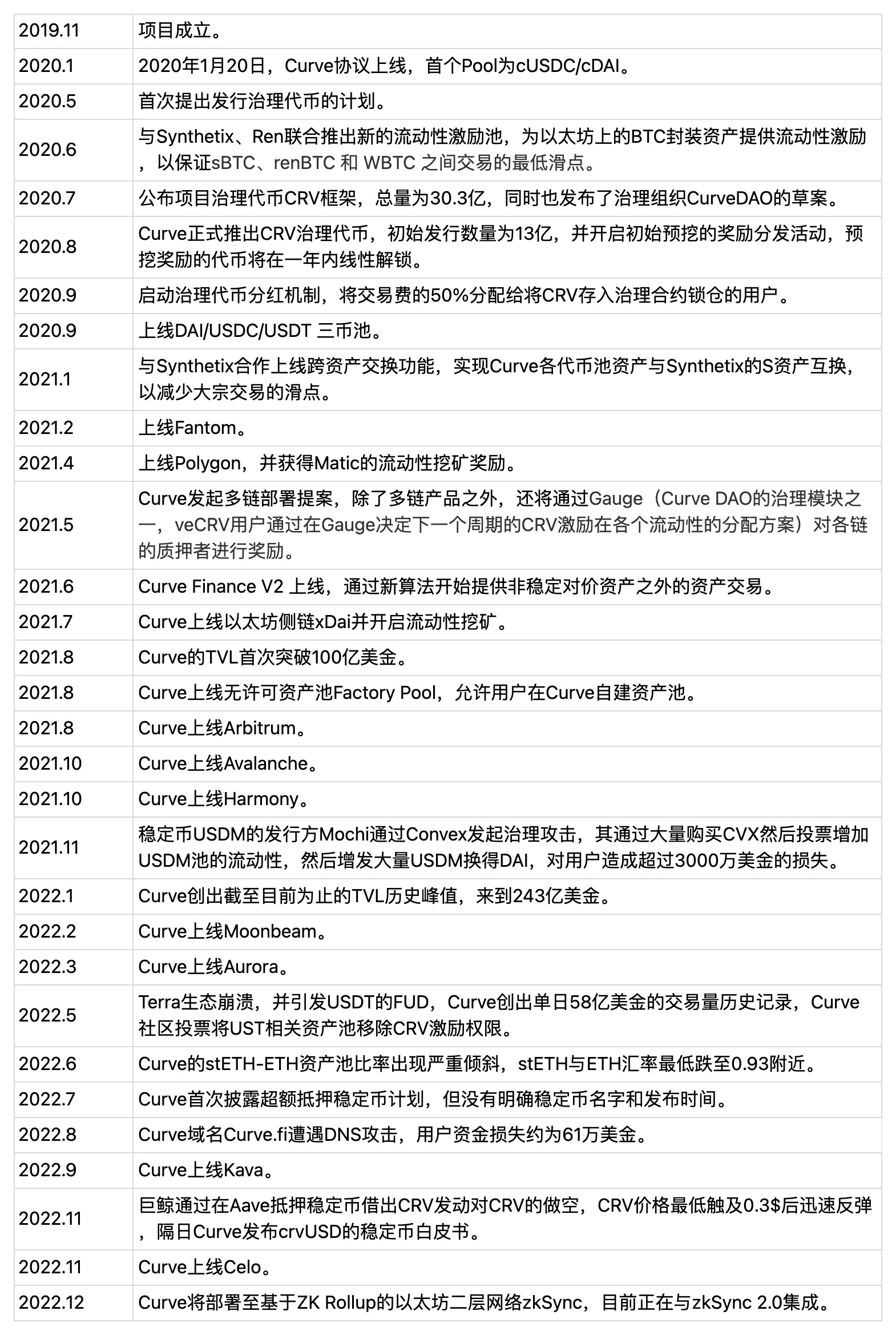
Here are the highlights of the Curve project since its inception, as of February 2023.
2.3 Core Team
2.3 Core Team
Curve is a real-name team, the founder is Michael Egorov (living in Switzerland), and another core team member is Julien Bouteloup (also the founder of Stake DAO, which provides income and governance aggregation services similar to Convex, and has a whitelist of Curve governance ). The Curve team is a relatively streamlined small team with about 8 core members.
first level title
3.1 Track Analysis
3.1 Track Analysis
As mentioned above, Curve's core business is: 1. Spot trading; 2. Liquidity procurement, distribution and management.
The users of the former are traders and market makers, and the core users of the latter are the issuers of project bills. The bills here include stable coins (such as BUSD, FRAX), asset depositary receipts (such as stETH, aUSDC), and encapsulated or synthetic Assets (eg renBTC, sETH).
Before sorting out and analyzing Curve’s specific businesses, let’s take a look at the overall market situation of these two types of businesses.
3.1.1 Spot Trading
Data Sources:
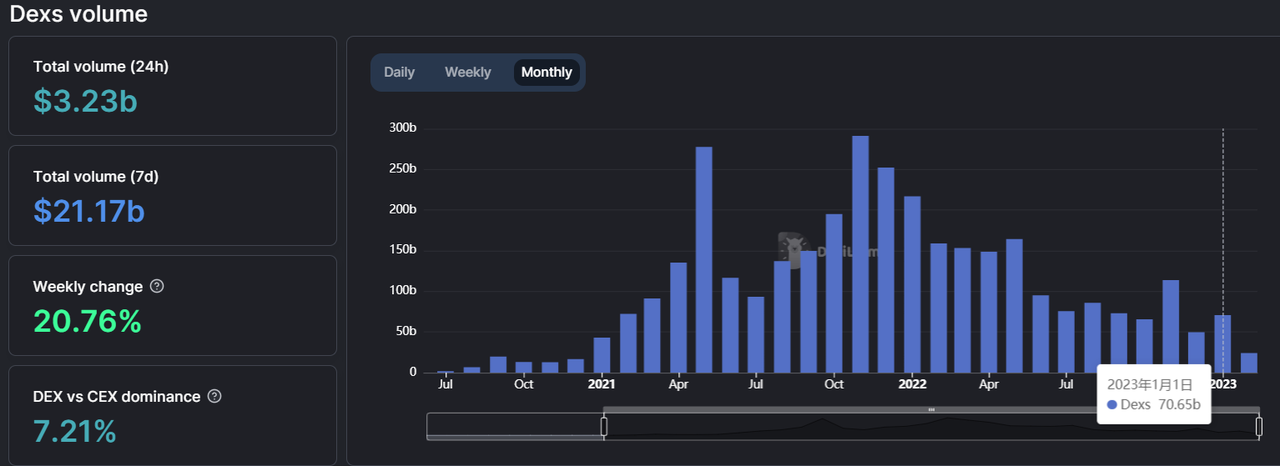
Data Sources:https://defillama.com/DEXs
On the one hand, this means that centralized exchanges are still the main place for trading, but it also shows that DEXs have a lot of room for market share expansion, and the driving force for DEXs to further increase the trading market share may come from:
Users' trust in centralized institutions is gradually lost, and the demand for asset autonomy and privacy is increasing. In 2022, the thunderstorm incidents on trading platforms such as FTX accelerated the migration of user trading scenarios to DEXs (the sales of hardware wallets increased significantly in the same period. It also confirms the trend of relocating user assets to the chain)
The composability of the DeFi ecology in which Dex is located has greatly improved the capital efficiency and freedom of users. For example, after Lido pledges ETH to obtain stETH, while obtaining Pos pledge income, put stETH into Curve market making to obtain fee income; or put stETH into Aave to lend ETH, and then exchange ETH for stETH to continue staking Lend ETH to amplify Pos income in this way of revolving loan
Most native Web 3 projects choose DEXs as the first stop for trading and arranging liquidity, while CEXs can only be reduced to follow-ups with hindsight
To sum up, DEXs have obvious advantages that CEXs do not have in terms of [listing assets], [trading], and [providing liquidity] without permission, user autonomy and transparency of assets, and free protocol composability.
This is the fundamental reason why DEXs have become the birthplace of liquidity for innovative projects (and of course a large number of low-quality projects), and the long-term migration direction of Web 3 users.
Therefore, in the long run, the track of DEXs will benefit from: 1. The increase in asset classes and transaction volume brought about by the development of encrypted business (industry Beta); 2. The gradual erosion of the market share of CEXs transactions (track Alpha).
3.1.2 Liquidity procurement, distribution and management services
a. The business nature of the liquidity service market
"Liquidity" has rich meanings in different scenarios. The liquidity mentioned in this section refers to the ability or degree of a certain encrypted asset to be exchanged for mainstream stablecoins or ETH and other mainstream assets quickly and with low loss. The better the liquidity of encrypted assets, the lower the difficulty of converting them into stable coins or ETH, and the less transaction wear and tear.
"Liquidity Sourcing, Distribution and Management Services" therefore means:
Procurement: Obtain liquidity from the market through its own token incentives + transaction fee rewards
Distribution: Distribute (usually paid) the liquidity acquired by purchase to other institutions\project parties\users who need to purchase liquidity
Management: Liquidity management tools are also provided for those project parties who purchase liquidity, so that they can plan their expenditure on liquidity costs
Take Curve and Lido as examples:
Procurement: Liquidity is actively gathered on the Curve platform, on the one hand because it can obtain transaction fees, but more because Curve provides incentives for liquidity through its own token CRV, which is used by Curve to purchase liquidity from the market currency.
Distribution: After the liquidity is collected in Curve, a project party such as Lido can obtain veCRV by purchasing CRV locks in order to obtain liquidity for the equity tokens (LDO) and bills (stETH) issued by itself to ensure the normal operation of their business , use veCRV to vote for your own asset pool stETH-ETH and LDO-ETH in the governance module Gauge to ensure that you can get more CRV rewards in the next CRV emission cycle, and CRV will guide liquidity to stETH-ETH and LDO - Two pools of ETH, so far Lido has completed the purchase of liquidity through Curve. Of course, Lido can also directly purchase the veCRV votes of the next Gauge on voting platforms such as Votium to achieve the purpose of liquidity procurement, but this procurement is one-time.
*There are also cases where project parties purchase liquidity in a more roundabout way. For example, Clever, the income aggregation & credit project of the Curve ecosystem, sells the token investment share in exchange for the comprehensive DeFi protocol Frax, which promises the Clever-ETH pool to conduct a 6-week veCRV vote, which is also a form of liquidity procurement. What I want to explain here is that there are actually various ways to purchase liquidity on Curve, but they are all based on Curve’s Gauge module.
Here we can make a summary.
Liquidity procurement, distribution, and management services are a special service generated around the demand that "the project party's tokens and bills need liquidity", where Curve plays the role of a liquid wholesale and transit market.
Of course, Curve is not the only way for project parties to solve the liquidity of their own equity tokens and bills. Before Curve appeared, there were other solutions, such as:
List your own equity tokens and bills on centralized exchanges that are actively traded, and cooperate with professional market makers to ensure the liquidity of your own tokens. For example, MakerDAO’s equity tokens MKR and bill DAI are available in many CEXs. The exchange is listed
Deploy the initial liquidity of your own tokens on DEXs such as Uniswap and Pancake, and then encourage users to make markets in DEXs, and issue project equity token rewards to LPs that users pledge in their own contracts to increase token liquidity, namely We often say "liquidity mining" or "second pool"
Rent liquidity from other PCV (Protocol control value, protocol control value) projects, such as cooperating with Fei protocol, and Fei will provide the liquidity controlled by Fei to the project side, but most of the projects using this kind of scheme have declined
The advantages of the Curve liquidity scheme over the above schemes are:
Compared with the CEX liquidity solution - whether there is permission, lower threshold and composability: the cost and threshold of listing on Binance, Coinbase and other first-tier large exchanges with better liquidity are very high, and most projects cannot afford or fail to meet the standards , second- and third-tier small firms have the problem of poor liquidity. However, there is no permission to list trading pairs in Curve’s factory pool (Factory pool). Of course, community votes are required to obtain CRV’s liquidity guidance through Gauge, but overall the cost is much lower. In addition, the liquidity of a project party in Binance is closed, and there is no external composability, while the liquidity on Curve can not only be routed by other DEX aggregation protocols, but also be combined by DeFi protocols such as lending , with positive externalities far exceeding that of CEX.
Compared with the project's self-operated liquidity mining - it has lower liquidity costs and flexibility: the project's self-operated liquidity mining and the second pool model used to be the mainstream method of DeFi projects, but later proved to have many problems ,include:
Liquidity management through Curve solves the above problems [to a certain extent]:
Therefore, no permission, low threshold, composability, low cost of liquidity, and flexibility of management solutions are the core values of Curve as a liquidity market for project parties, and the cornerstone of Curve’s business model.
When we analyze Curve's liquidity business in the future, we can also start from the above levels.
For the same project, the cost of raising liquidity on Curve will be lower than raising it directly. On the one hand, this is due to the fact that the liquidity gathered in Curve has relatively lower risk and return preferences (the apr of most pools is not high); secondly, to obtain the liquidity incentive authority of Curve gauge, Curve's community is required Verification and real money voting, which itself is a disguised "review mechanism". Compared with directly injecting liquidity into the second pool of the project side, people will be more assured to provide liquidity on Curve, or to provide Ask for lower risk compensation for the same liquidity.
Whether the project party uses CRV\veCRV as the medium to purchase liquidity, or purchases liquidity on the bribery platform with its own tokens, it is more circuitous than the self-operated second pool model, which can reduce the fluctuation of the main business and the currency price In addition, it is more flexible in terms of incentive schemes, and the overall cost is lower.
Users have higher risk concerns about the self-operated second pool of new projects, so they require higher liquidity APR subsidies, resulting in higher liquidity procurement costs
The project party uses equity tokens as liquidity incentives, which will cause an excessively strong positive correlation between the token price and the business, and there will often be huge fluctuations in the price-business spiral up and down, which is not conducive to the long-term stable development of the project
The project party directly adjusts the incentive strategy of the second pool mining, which is easy to be over-interpreted by the community, and lacks a richer liquidity management plan except for the adjustment of token incentives
b. Future development of liquidity service market
In my opinion, like the trading market, the increase in the size of the liquidity market is also driven by two factors: one is the growth of the total asset class and the total value of assets in the entire encrypted world; the other is the increase of user funds from centralized institutions The trend of custody shifting to on-chain self-management. Different from market making in CEX, it is easier for users to make markets in DEX and the threshold is lower, and the liquidity managed by the chain is also easier to enter the liquidity service market to obtain income.
secondary title
3.2 Business Status
Regarding the current business status of Curve, we also observe it from two perspectives: spot trading and liquidity market.
3.2.1 Spot trading business
a. Horizontal comparison of trading volume of DEXs
According to DefiLlama data, the current weekly trading volume of Curve is basically ranked among the top three DEX transactions. The author’s DEXs transaction data statistics for nearly 6 weeks are as follows:
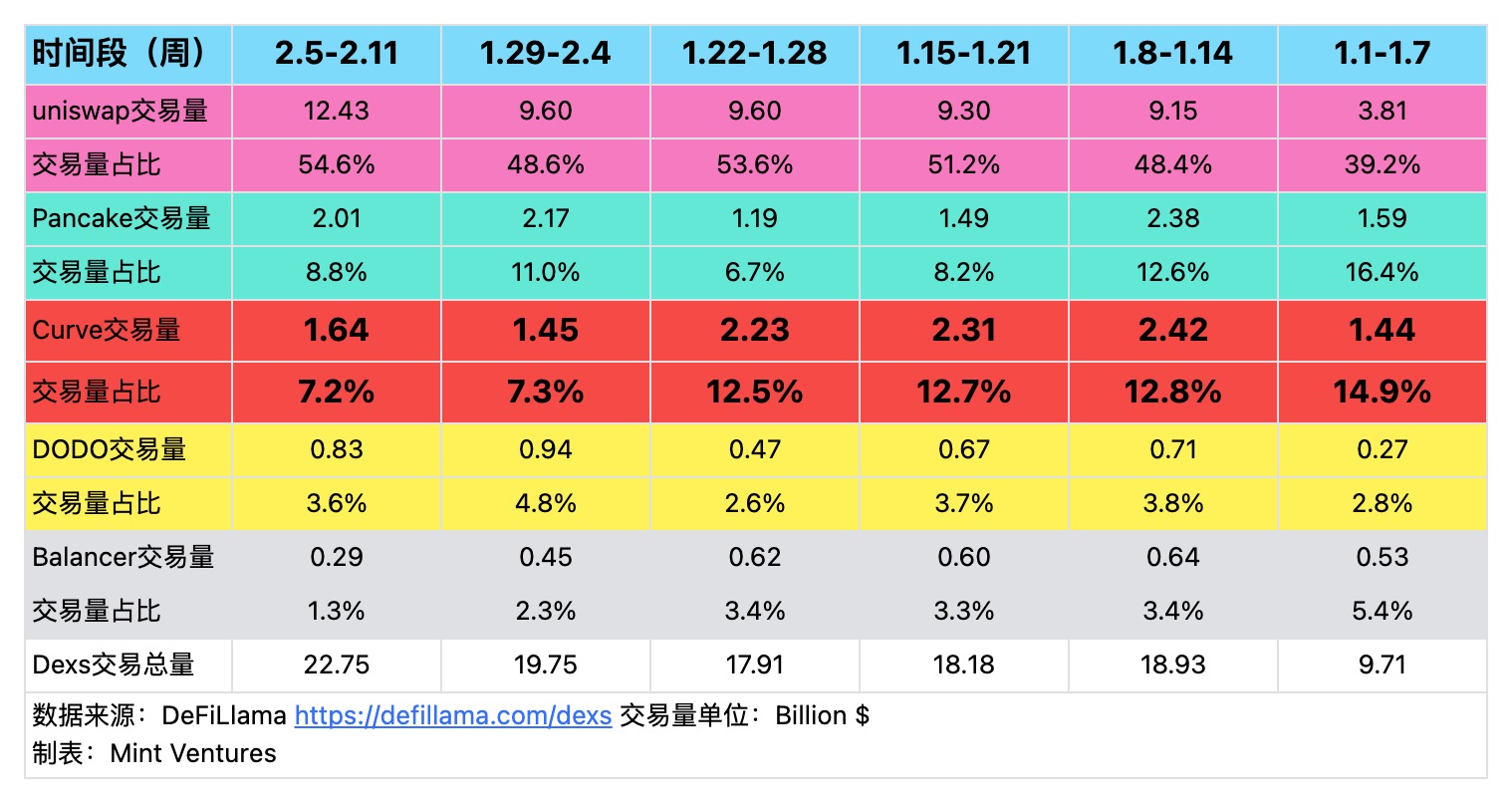
Due to the centralized liquidity mechanism of V3 and the low transaction slippage brought by the extremely low transaction fee gear, Uniswap can capture most of the transaction volume in the market, and Pancake occupies about 80% of the transaction volume of BNBChain. Let it remain in the top three positions in terms of total volume, and Curve is also in the top three positions in terms of transaction volume.
Of course, Uniswap, which ranks first in trading volume, is the only project among the top 5 DEXs that has no protocol income.
b. Curve volume and revenue breakdown
image description
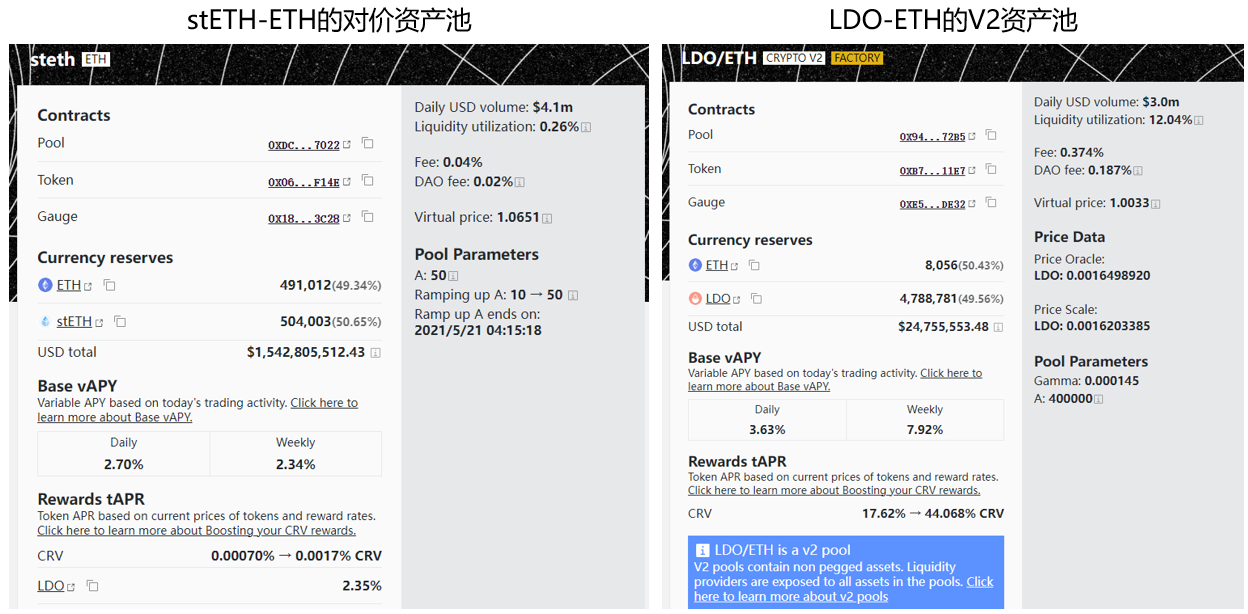
Image source: Pool details page for Curve products
The introduction of the V2 pool breaks through the previous perception that Curve is a "stable asset trading platform", which means that Curve can include more trading asset classes.
More importantly, the transaction fee rate of the V2 asset pool is much higher than that of the stable asset pool. As shown in the figure above, the transaction fee rate of the LDO-ETH V2 pool was 0.374% at that time, which was 9.35 times that of the stETH-ETH stable asset pool (the reason why At that time, it was because the V2 pool adopted a dynamic rate mechanism, which rises and falls with the volatility of asset prices), which was 37.4 times that of the 3 pool (USDT-USDT-DAI). So for Curve, transactions from the V2 pool have a very high fee contribution rate.
According to the transaction data on February 15, 2023:
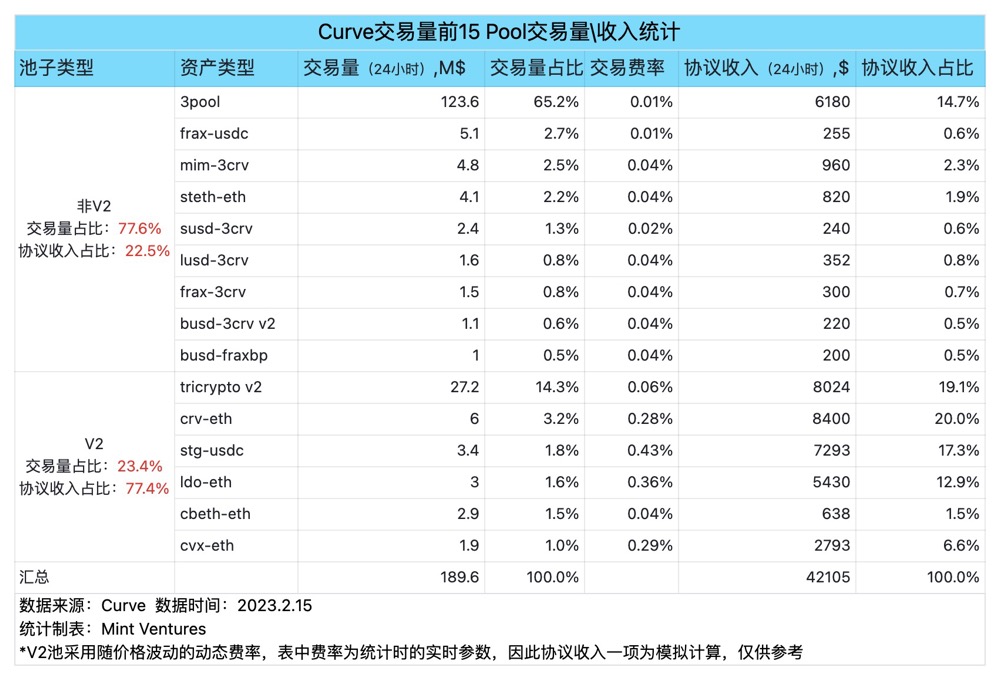
Although the transaction volume of the V2 pool only accounts for 21.9% of the top 15 pools by transaction volume, it contributes 75.9% of the protocol revenue. The core reason is that the V2 pool has a higher transaction fee rate.
Since the types and quantities of stable consideration assets are relatively stable, and the fee rate is directly competed by Uniswap, the future growth space of Curve protocol revenue will come more from the growth of the V2 asset pool.
Image credit: Curve
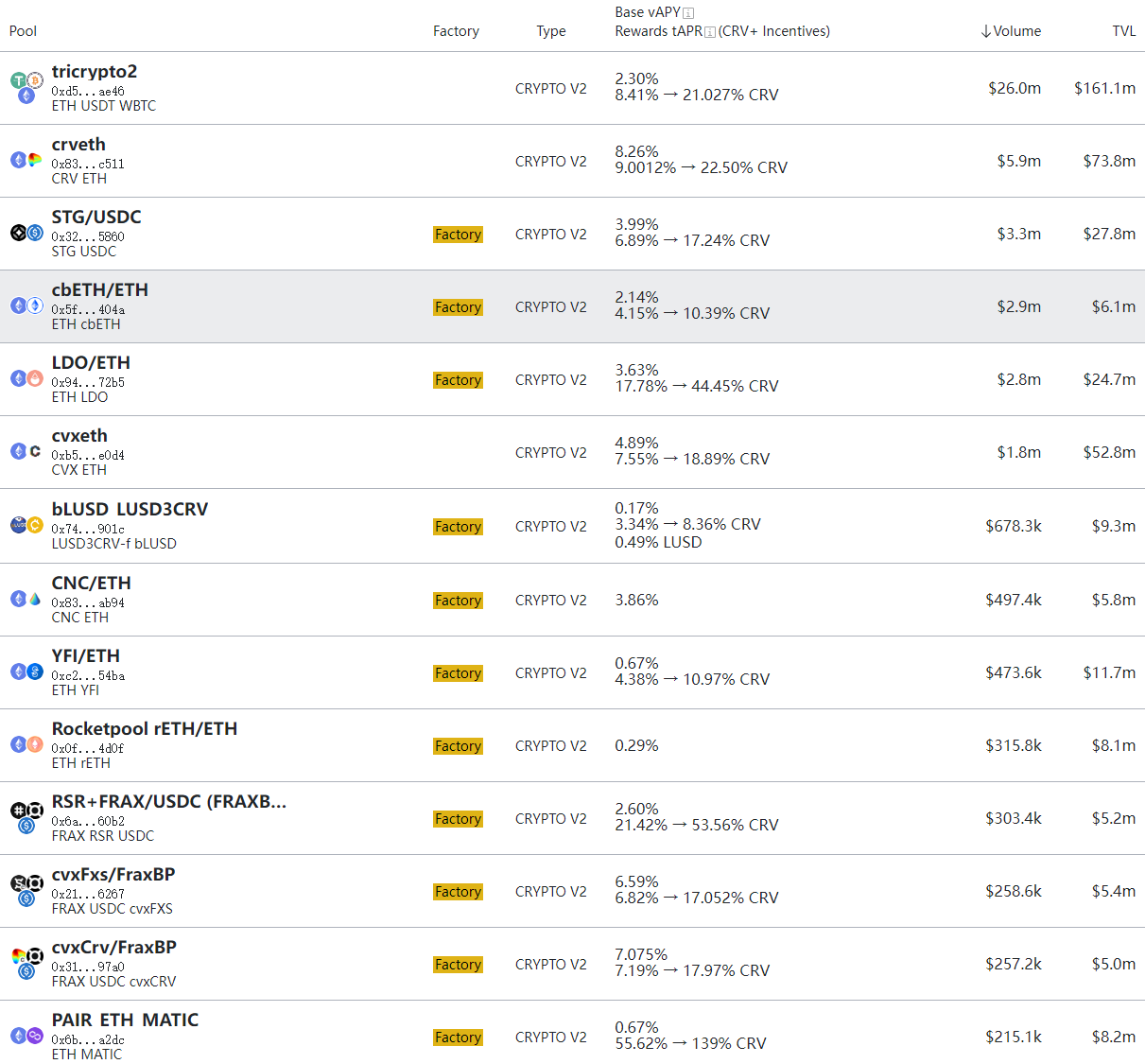
Image credit: Curve
In general, DEXs spot is an extremely competitive market.
Among the current top 5 top players, Uniswap's centralized liquidity + low handling fee + 0 protocol fee scheme allows it to occupy most of the market share in mainstream currency transactions, but in fact this has turned Uniswap into a A "public goods" that is difficult to make a profit, in the face of brutal competition from other DEXs represented by Curve, Uniswap has always been hesitant to turn on the protocol fee switch (otherwise it is worried about regulation).
Pancake, relying on Binance’s endorsement and resource advantages, as well as the advantages of user habits, has accounted for most of the market share in BNBchain, but it is difficult to expand this advantage to other competitive main chains (although the market maker module is added to improve liquidity. nature, but Pancake’s business on Ethereum is still dismal).
DODO has the highest LP capital efficiency through its PMM mechanism, but most of its transaction volume occurs in stablecoin transactions, and the protocol currently adopts a 0 fee rate for most stablecoin transaction pairs.
Both Curve and the upgraded Balancer follow the comprehensive model of spot trading + liquidity market, the business is more complex, and more ecological project portfolio coordination is required, and there are necessary liquidity procurement expenditures (token incentives).
3.2.2 Liquidity market business
Modules for Liquidity Business
As mentioned above, liquidity procurement, distribution and management services (referred to as liquidity market business) is a special service generated around the demand that "the tokens and bills of the project party need liquidity".
During the writing of the research report, the author also interviewed project parties with long-term liquidity procurement records on Curve. For liquidity purchasers (asset issuers, and project parties in most cases), what they value most is the comprehensive procurement cost of liquidity, followed by the maturity of procurement components and mechanisms, as well as the flexibility and liquidity of procurement. unity and so on.
Taking Curve as an example, a liquid market has the following core components:
Dex:Dex’s trading scenarios can make use of liquidity, and the resulting handling fee can be fed back to the agreement. If it develops smoothly, it can partially or fully cover the platform’s procurement cost for liquidity (that is, token incentives), which is also the main blood of the liquidity procurement platform. module
Staking and governance modules:The core part of the ve model, including staking and gauge functions, has multiple purposes:
Recycle the project equity token (CRV) released for liquidity purchase. While token holders obtain dividend rights, governance rent-seeking rights (used to obtain bribery income) or liquidity procurement rights through pledges, they also pay "fees" to the Curve system in a roundabout way, that is, because they lock CRV tokens The lost "liquidity value". The payment of this part of the "fee" actually plays a role in delaying the CRV expenditure purchased by the Curve system from becoming a direct token selling pressure
To a certain extent, the interests of participants and the Curve system are bound to ensure that it is difficult for participants to extract value from the system in a one-way and short-term without making contributions
image description
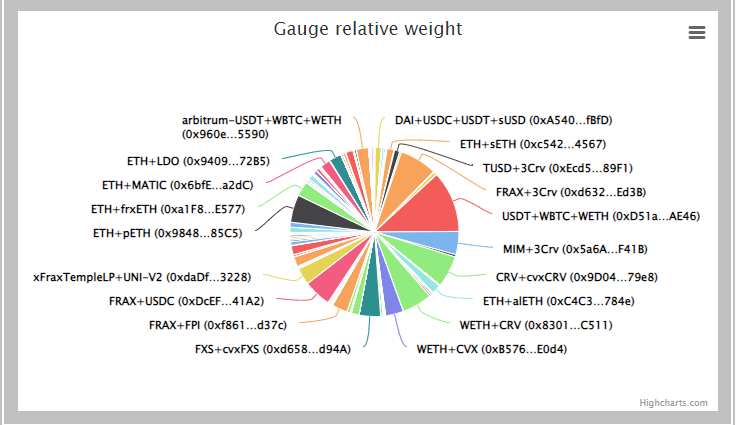
The gauge board of the Curve governance module provides game information on liquidity procurement, source: Curve
3. Bribery module:Through the combination of Convex+Votium, it is guaranteed that those liquidity purchasers who temporarily do not want to deeply bind Curve by purchasing and staking CRV can also purchase short-term liquidity for their own assets by purchasing veCRV votes, and at the same time provide for the holding of veCRV Somebody provided vote rent-seeking income
Of course, in addition to Curve's classic liquidity market model, there are other products that try to build a new liquidity trading model.
For example, Tokemak, a liquidity management platform that will debut in 2021, focuses on "Liquidity as a service" (Liquidity as a service), and eliminates the DEX module in the Curve model, hoping to directly purchase and distribute liquidity as a middleman. In this concept, Curve will also become the liquidity downstream of Tokemak. But at present, this model has not worked well. Due to the lack of cash flow generated by the Dex business, Tokemak's business model as a "liquidity dealer" is even more difficult, and it is difficult to achieve a balance of payments.
The Fei Protocol, which focuses on the concept of PCV (protocol control liquidity), has gradually withdrawn from the stage of history after several attempts. Although it is different from Tokemak's liquidity financing model (Fei raises funds by issuing stable coins), the reason for its failure is the same as that of Tokemak. similar, It is impossible to achieve long-term balance of payments simply by following the "purchase-lease liquidity" model without fully operating the liquidity obtained by the platform to obtain income.
text
competitors
image description
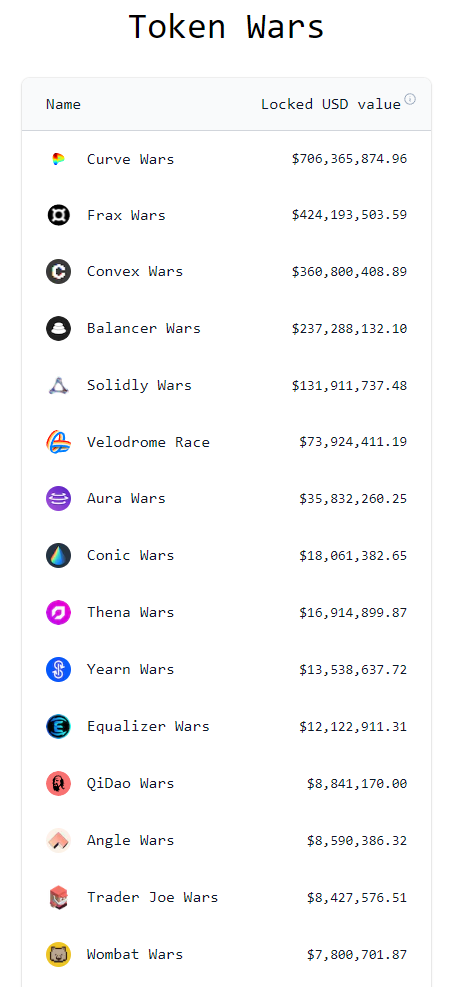
List of War concept items, source:https://www.defiwars.xyz/wars
This article only makes a business comparison between Balancer and Curve, which have the highest trading volume and TVL.
Among them, Balancer, like Curve, has both Dex and liquidity market functions, and Aura Finance, a revenue and governance aggregator built on Balancer, provides a bribery module.
As mentioned earlier, for liquidity purchasers, one of the most important factors in the liquidity market is the "purchase cost-effectiveness ratio" of liquidity, that is, the value of liquidity that can be exchanged for the amount invested. Under other conditions being the same, purchasers certainly hope to spend the same purchase fee in exchange for more liquidity.
We know that in order to purchase the liquidity of the platform, there are currently two main methods: 1. After purchasing platform tokens for a long-term and continuous pledge, vote through the gauge module, and you can vote for long-term liquidity; 2. By paying fees on the bribery platform, according to The governance cycle (14 days) buys one-time liquidity.
Method 1 is more complicated, and there are too many expected variables to consider, so it is difficult to make a direct cost comparison. Therefore, we use the scheme of buying liquidity by bribery to make a rough comparison of the liquidity procurement costs of Curve and Balancer.
For purchasers, there are two issues involved here:
1. How much value of platform tokens (CRV \ BAL + CVX \ AURA) can I buy for one unit of US dollars?
2. How much [liquidity value] can I create/maintain with a platform token incentive worth a unit of USD?
image description
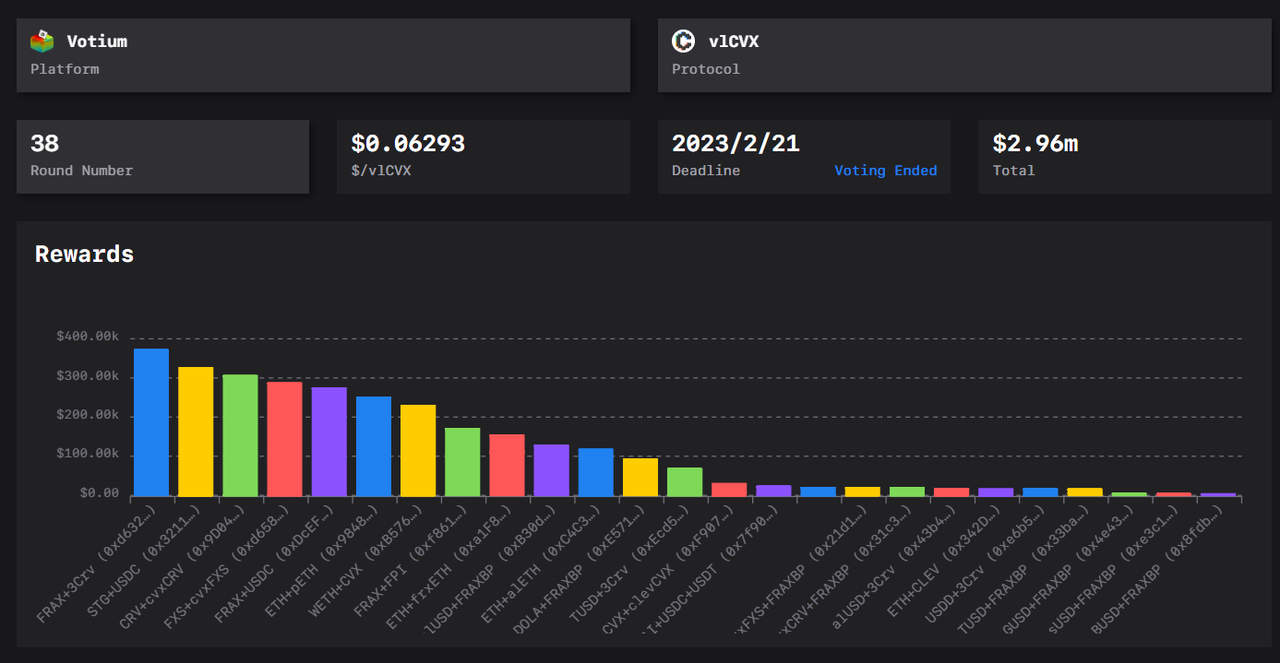
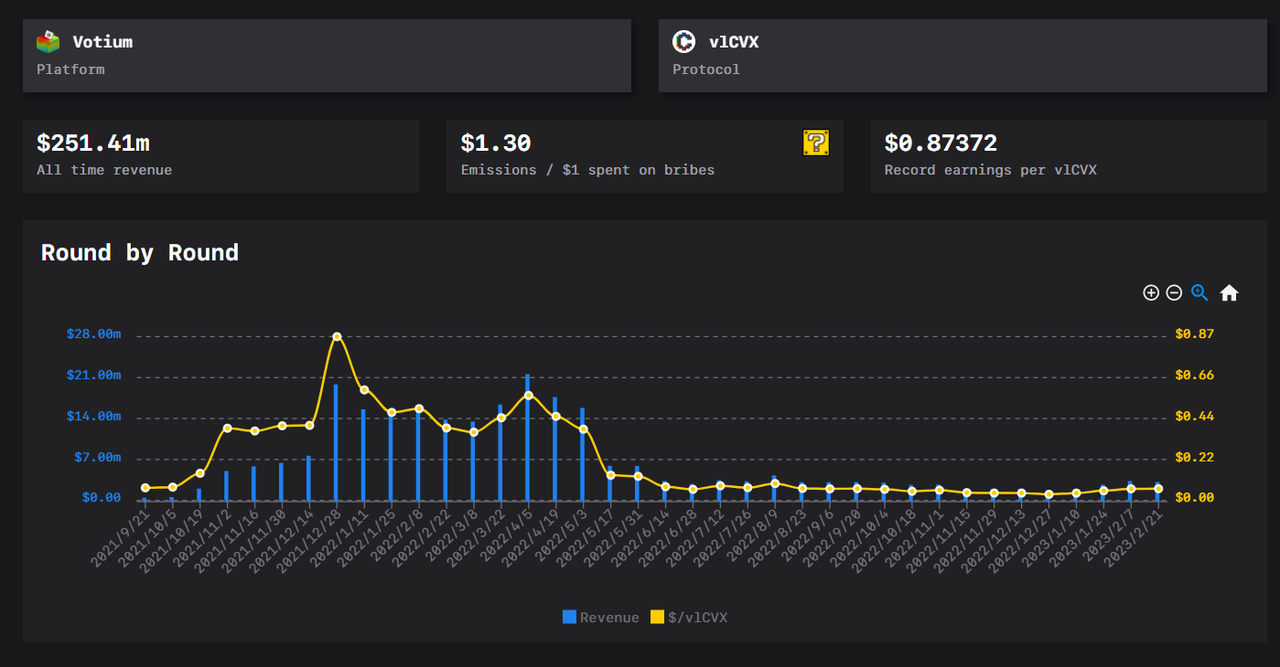
Image credit: llama.airforce
image description
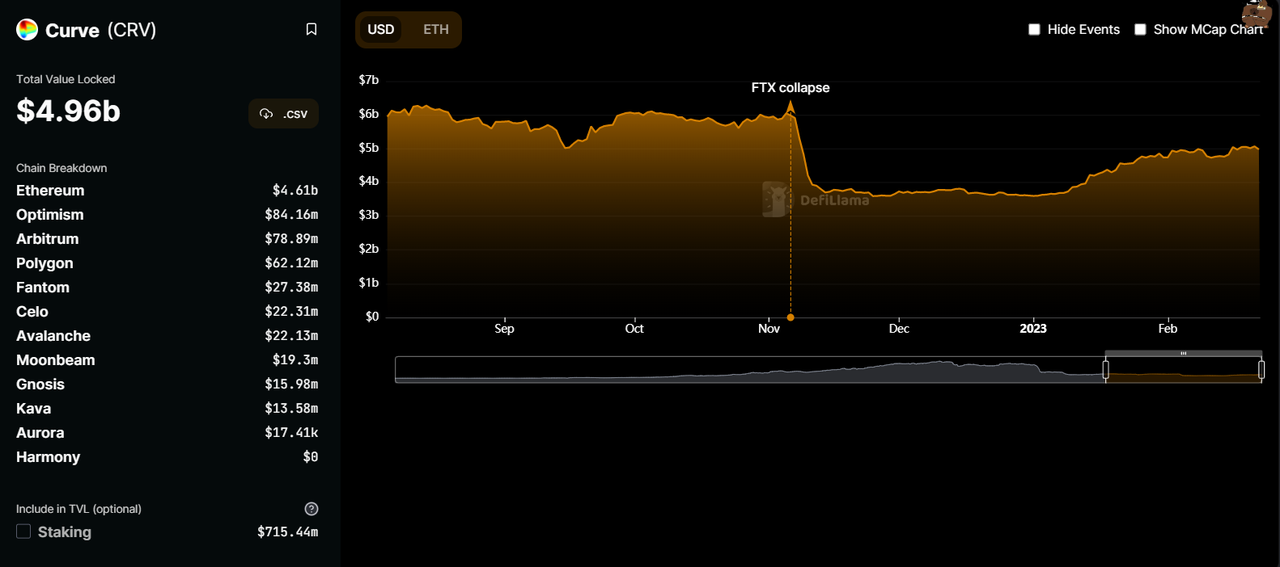
Image credit: Defillama
Image credit: Curve
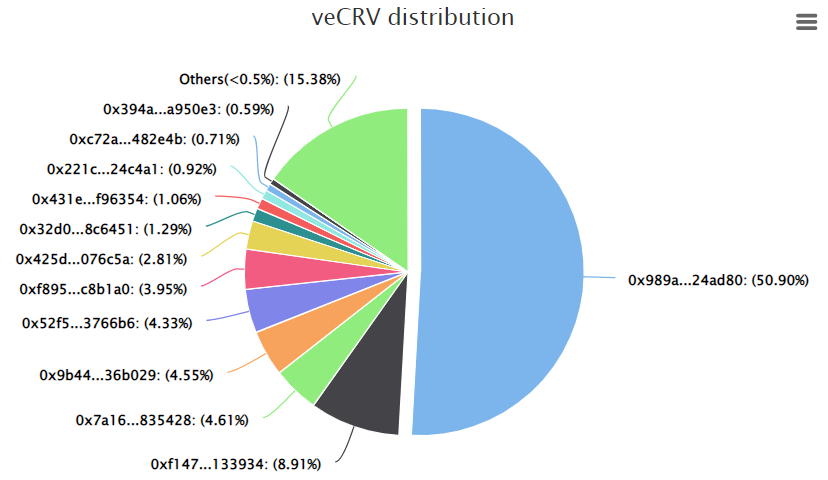
Image credit: Curve
Then, judging from the investment of 2.96 million $ in bribery, for the buyer of bribery, it is equivalent to [average] buying Curve liquidity worth 854.7 $ in 14 days with 1 $.
Let’s look at Balancer, Curve’s competitor in the liquidity market.
image description
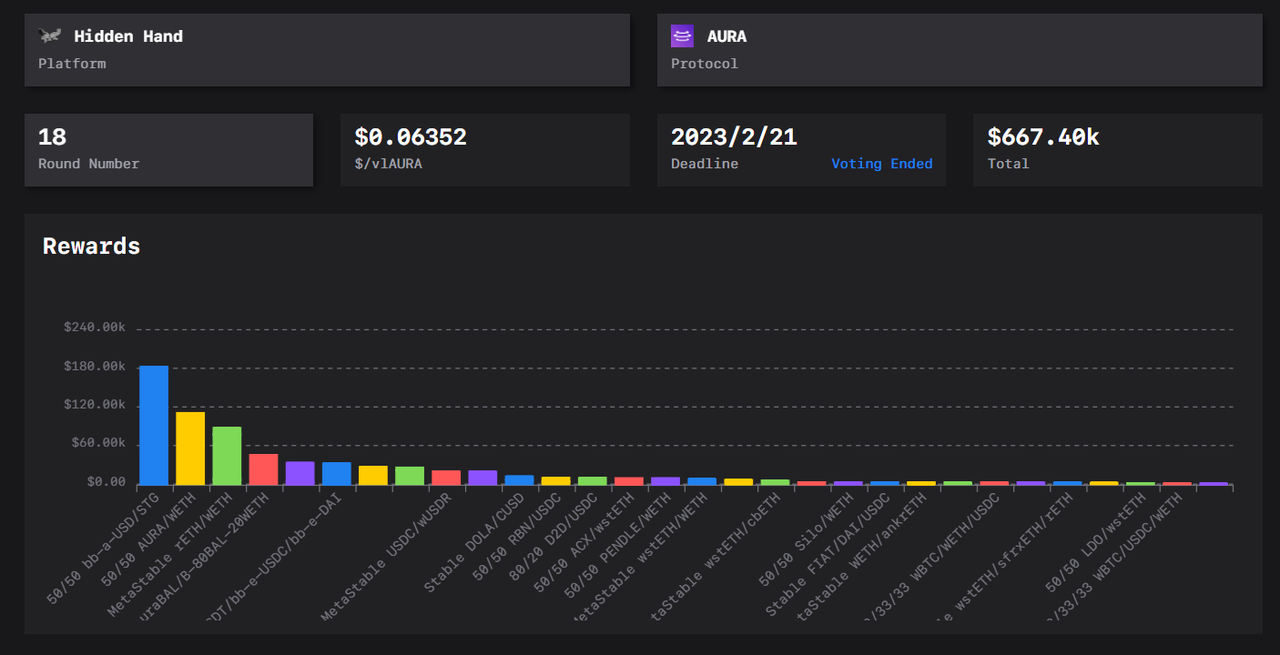
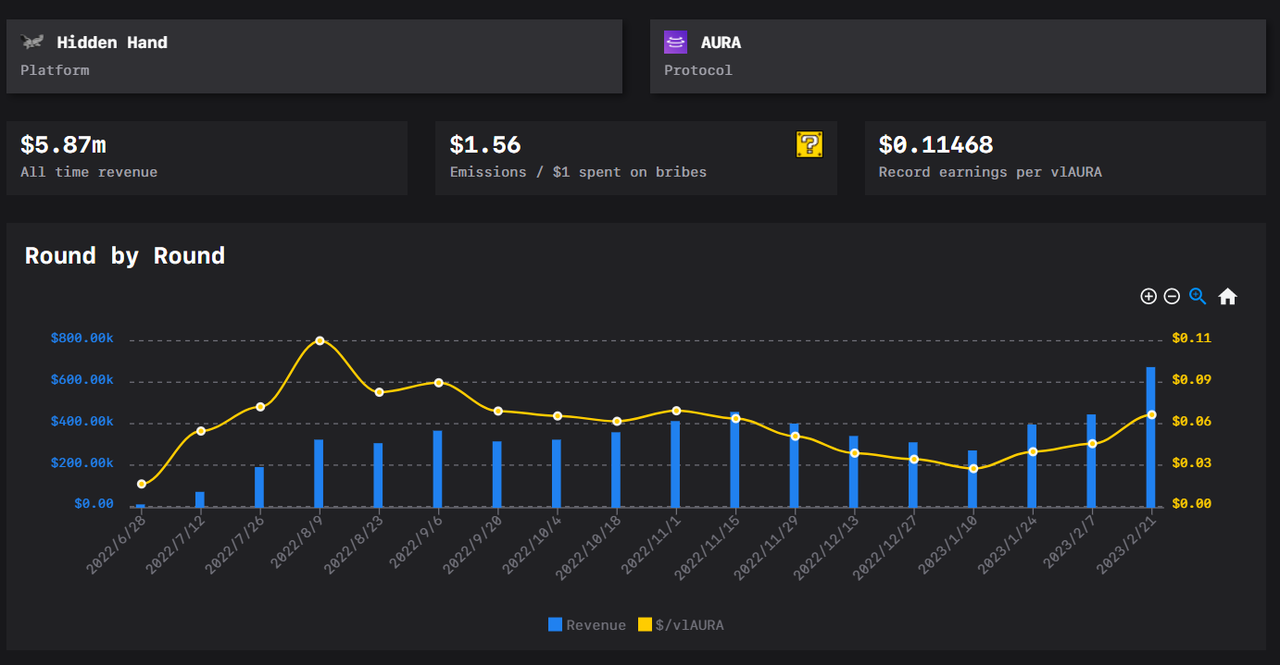
Image credit: llama.airforce
image description
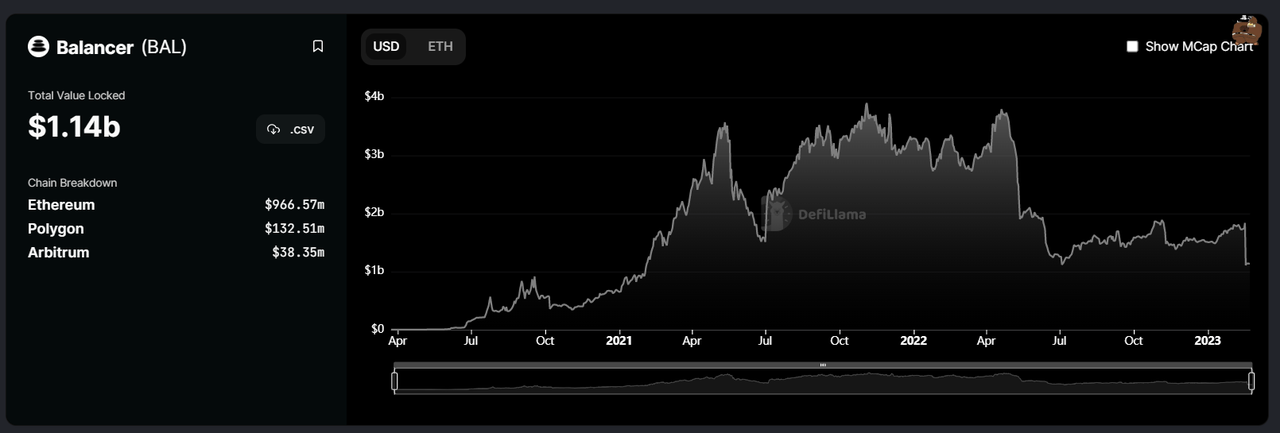
Image Source:
Image Source:https://dune.com/aura_finance/aura
Because Aura has 25.5% of veBAL voting rights, it corresponds to guide 25.5% of BAL emissions, and corresponds to guide 25.5% of Balancer's liquidity, that is, Balancer TVL* 25.5% = $290.7 million.
Then, judging from the investment of 667,000 $ in bribery, for the buyer of bribery, it is equivalent to [average] buying Balancer liquidity worth 435.8 $ in 14 days with 1 $.
It is more intuitive to compare through the table:
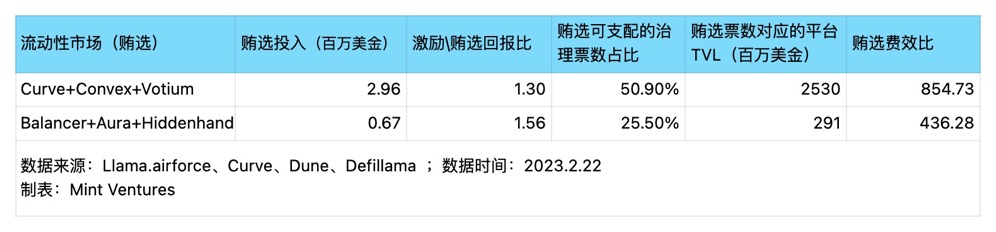
Judging from the data results of bribes invested in TVL, although the purchase cost can obtain higher value liquidity incentive emissions (CRV&CVX or BAL&AURA) in the balancer, from the perspective of finally obtaining TVL, Curve can provide more High TVL.
Of course, the author’s calculation of the cost-effectiveness ratio of liquidity procurement on the two platforms of Curve and Balancer is rough, and at least the following factors are not taken into consideration in the calculation:
The asset composition of the TVL of Curve and Balancer is different. Curve’s TVL contains nearly 80% of the stable consideration asset pool, while Balancer’s similar asset pool is about 50%.
image description
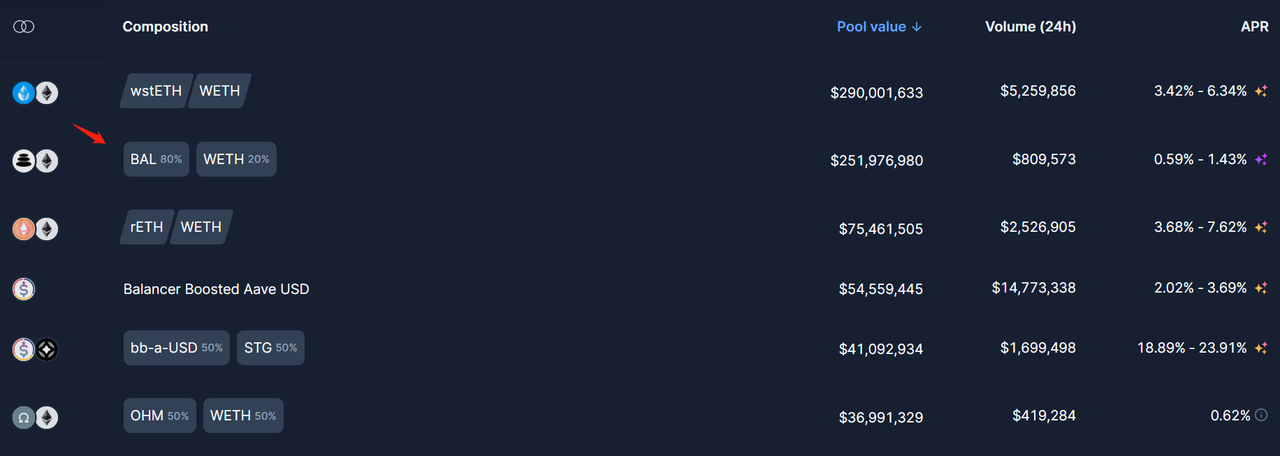
Image source: Balancer
image description
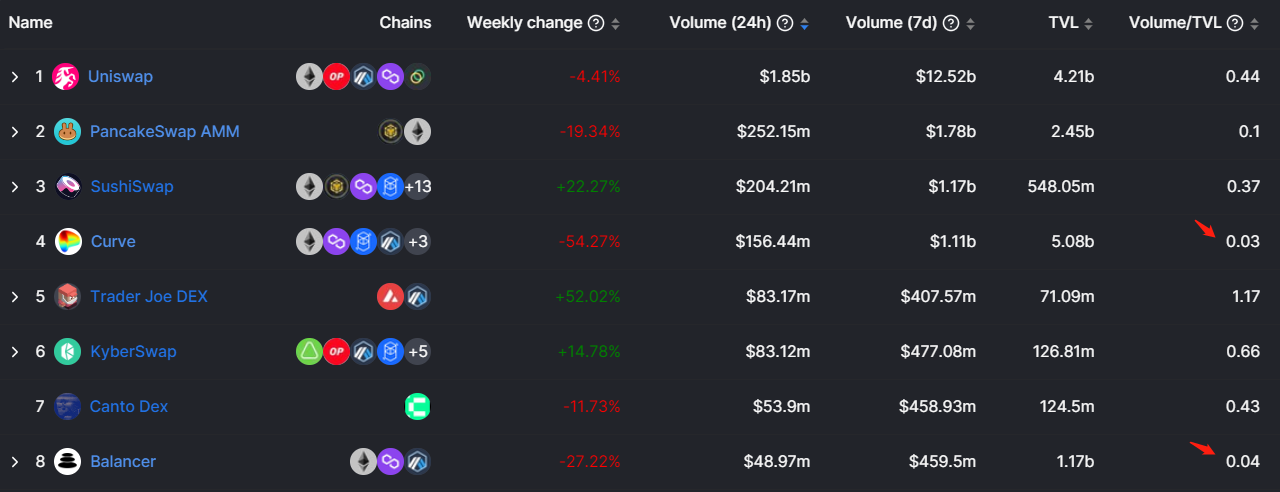
Image credit: Defillama
The bribery investment\TVL calculation in the table is only the [average], how much TVL can be harvested by the specific amount of investment, for liquidity providers, it is also necessary to measure the market-making asset quality, pool size and other factors
The incomplete TVL of the pool = liquidity value, the distribution of assets in the pool (centralized or decentralized) and various pool parameters will affect the value and efficiency of liquidity under the same TVL
But even if the above factors are taken into consideration, for liquidity purchasers, Curve can still obtain better liquidity with the same cost investment. Curve has a higher "cost-effectiveness ratio" than Balancer, and Curve is still the "first stop of liquidity" for most projects.
Of course, by imitating Curve’s liquidity business model, Balancer is also gradually closing the distance with Curve, specifically reflected in the fact that its incentive/bribe return ratio (Emissions / $ 1 spent on bribes) in each voting governance cycle is gradually decreasing , which means that liquidity purchasers are increasing their liquidity bids for Balancer.
In addition, the main participants of those Curve wars—such as Frax—also began to discuss the establishment and procurement of liquidity on Balancer. The Frax community officially launched the [FIP-191 ] proposal on February 26, which will contribute 100,000 US dollars Value of FXS or cvxCRV, bribes for veBAL or Aura to introduce liquidity to the BB-E-FRAX | BB-E-USDC pool on Balancer.
In addition to liquidity costs, the unique features of Balancer products are also factors considered by Frax:
Boosted Pools function: This type of pool can deposit the idle liquidity in the Pool into an external lending agreement (such as Aave or Euler) to provide LP with higher capital efficiency and income (BB-E- FRAX | BB-E-USDC pool will deposit idle funds into Euler)
Comprehensive liquidity: Stablecoins in Boosted Pools can be freely swapped with other interest-earning stablecoins in the lending pool, allowing stablecoins to enter more channels
Pool with custom asset ratio: Project parties can create liquidity with a custom ratio on Balancer. For example, many project parties will create 80%/20% pools for their governance tokens and ETH to ensure a certain degree of liquidity. At the same time, it can save market-making capital and increase market-making parties’ demand for their own governance tokens.
However, the proposal has yet to receive enough Frax community votes to support it.
In addition to Balancer, Wombat on BNBChain and Solidly (V2) also adopt the two-wheel model of the DEX+ liquidity procurement market.
Among them, Wombat and its income and governance aggregator Wombex will carry out IFO on Pancake in 2022, but Wombat currently only has a TVL of 53 million US dollars, and BNBChain's embarrassing positioning as a Binance CEX "side chain" has led to its ecology. DeFi has obvious ceilings.
Solidly was also born in 2022. Its core concept was proposed by AC, which integrated the characteristics of Curve, Uniswap and many (3, 3) projects. After the recent release of V2 version, TVL and transaction volume have increased significantly. With the function of bribery, the current TVL is 78 million US dollars, which is a rejuvenation project worthy of attention, but in terms of business volume, it is still far from Curve.
secondary title
3.3 "Infinity War" in the DeFi field
The brutal competition in the DeFi field where Curve is located is far more than a race for functional innovation and fierce competition for users, but also lies in the existence of a token issuance mechanism.
In the author's opinion, the introduction of the token mechanism in the Web3 project has multiple meanings. The most important value is that the project has flexible monetary policy options after issuing tokens, which can be used to rapidly expand its business.Strive to form a "leading network effect" earlier than competitors, so as to build competition barriers for latecomers.
The so-called network effect means that a certain product has the situation that "every new user in the product network will increase the value of other users in the network".
The DEXs track where Curve is located also has a network effect, but it is a cross-side network effect, that is: "The increase in the scale of users on one side will increase the utility of the other group's use of the platform, thereby forming a mutual promotion." In the Internet A typical case of cross-border network effects is an e-commerce platform. The variety of categories and price competition brought about by the scale growth of merchants will make the shopping experience of consumers better, and vice versa. On the DEXs track, the more market makers who provide liquidity and the deeper the asset depth, the more traders are willing to come here to trade, and the more traders, the greater the trading volume, and the higher the handling fee for market makers. It also reversely stimulates the further inflow of market-making funds.
Cross-border network effects are one of the most powerful moats for enterprises. Therefore, using your own tokens to stimulate the bilateral business and promote the formation of cross-border network effects as soon as possible has become the starting point for many Web3 projects, especially DeFi projects. Mode.
However, when all players do this, the track war that should have ended early continues. Due to too many choices for users, the subsidy war for liquidity (or transaction volume) continues, and no project can do it The monopoly is built in stages, which leads to a constant deficit of the project at the token level (protocol revenue - token incentives are negative).
At this time, whoever can ensure the expansion of the network and at the same time let the distributed market budget (token subsidy) be thrown into the secondary market later can keep the price of the incentive currency (token) stable or even upward, forming a better (3, 3) Network expansion effect.
This is also one of the main purposes of the ve model designed by Curve.
One of the endings of this war is that some projects (such as Curve or Uniswap) exhausted competitors, and other latecomers also gave up joining this war after assessing the situation, and the monopoly pattern of the market finally stabilized. At this time, projects in a monopoly position have a variety of means to start making profits:
Realize both small profits and large-scale operations through a market share that is much larger than that of competitors
Directly increase service charges (increase revenue)
Direct cuts in token emission expenses (reduced costs or selling expenses)
The other end of this war is that there is no end.
All projects are in the long-term bloody competition, and the monopoly position has become out of reach. Almost no project has a strong pricing power for users (liquidity providers, traders, and liquidity purchasers). The only way for the project to survive is to pursue the ultimate operational efficiency and continuous innovation race (just like Uniswap, Curve and Balancer's continuous innovation in business mechanisms), in order to expect to achieve phased success through better mechanisms and better experience. Favored by users (but often later caught up or overtaken by imitation or innovation of other projects). This is a situation that project parties and project investors are least willing to see, but it is a situation that users love to see.
Of the above two possibilities, which one is more likely to become the end of the DEXs track?
The author is currently more inclined to the latter.
Because of the encrypted business based on the blockchain, due to the independence and permissionlessness of accounts and funds, the cost of user migration between platforms is much lower than that of the traditional Internet. In addition, the creation, operation, and fork of DeFi projects currently have no traditional Strict approval restrictions in the financial sector, as well as diverse and convenient secondary market financing channels (xx to earn is also a form of disguised financing), all these factors determine that Web3 is a more powerful and cruel world of species diversity, vitality and competition : While you are evolving, your competitors are also evolving. At the same time, a large number of new commercial species are about to be born, and possible cross-border invasions are brewing.
It may be a delusional idea that the business leaders in the Web3 world want to rely on natural or administrative monopoly to settle down like Internet giants.
secondary title
3.4 Curve's LEGO ecosystem
The so-called Curve ecological project, in a broad sense, refers to Curve’s stakeholders, portfolio agreements, or simply major customers of Curve products. They can be classified from the perspective of product functions, such as Curve Chinese community's@Mr.BlockImage Source:
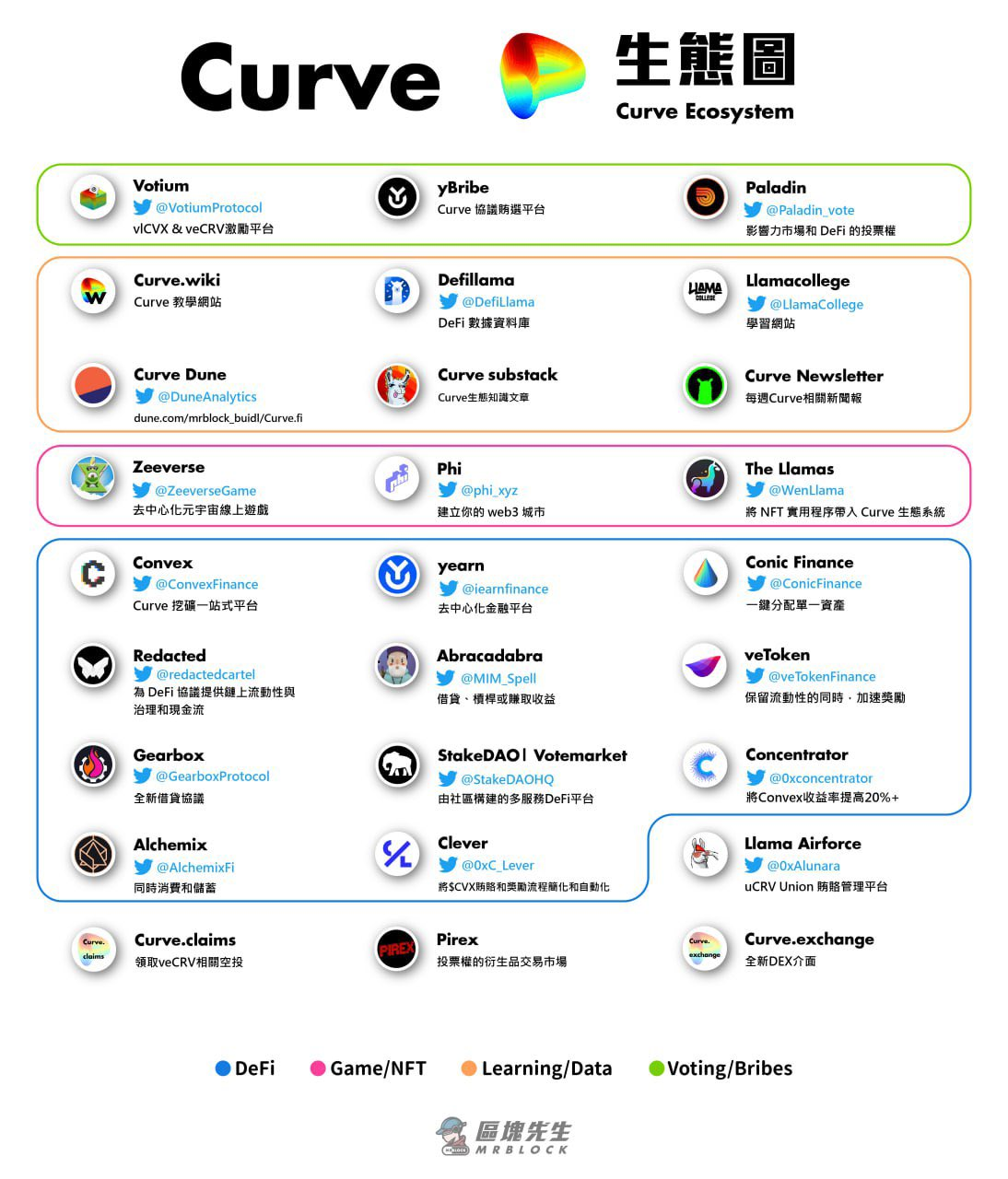
Image Source:https://twitter.com/mrblocktw
In the author's opinion, Curve ecological projects can be roughly divided into: core ecological projects, ecological projects, cooperation projects, and user projects in terms of ecological importance.
1. Core ecological projects
To be defined as "core", two conditions are required: 1. This type of project is based on Curve. Without Curve, it will not be able to maintain its main business or product operation, and it has a high degree of interest consistency with Curve; 2. The nature of this type of project Presence is also critical to Curve's core business.
The most typical project is Convex, and it is based on Convex and its derivative projects that Curve's liquidity procurement market has officially taken shape.
2. Ecological projects
Ecological projects are also based on Curve and have a high degree of interest consistency with Curve, but they are not as important as core ecological projects. Their existence has played a role in lubricating Curve's business to a certain extent, but without them Curve The core business can also run normally.
Among the more typical projects are the income aggregator Concentrator, the Convex income aggregation and the loan project Clever, and the liquidity guidance project Conic (the product is not online), etc.
3. Cooperation projects
This type of project has business-level agreement cooperation with Curve, and a small part of its business is built on Curve, and the combination of them and Curve's business has a driving effect on Curve.
For example, Abracadabra, a lending agreement, supports lending based on the collateral of Curve Pool LP. Similarly, MakerDAO also supports lending DAI with Curve's ETH\stETH LP as collateral. The revenue aggregator Yearn project also falls into this category, and its multiple revenue sources are built on top of Curve.
4. User Items
Such projects require Curve's services, such as market making and liquidity procurement on Curve. For example, Lido, a well-known LSD project, built its asset pool of depository notes on Curve, and has a long-term liquidity procurement record on Curve. However, the user project is only a client of Curve, and its core business is not built on Curve, nor does it depend on Curve to exist. Such projects are the mainstream of the Curve ecosystem.
According to the above classification, we can sort out the representative projects in the current Curve ecosystem with examples:
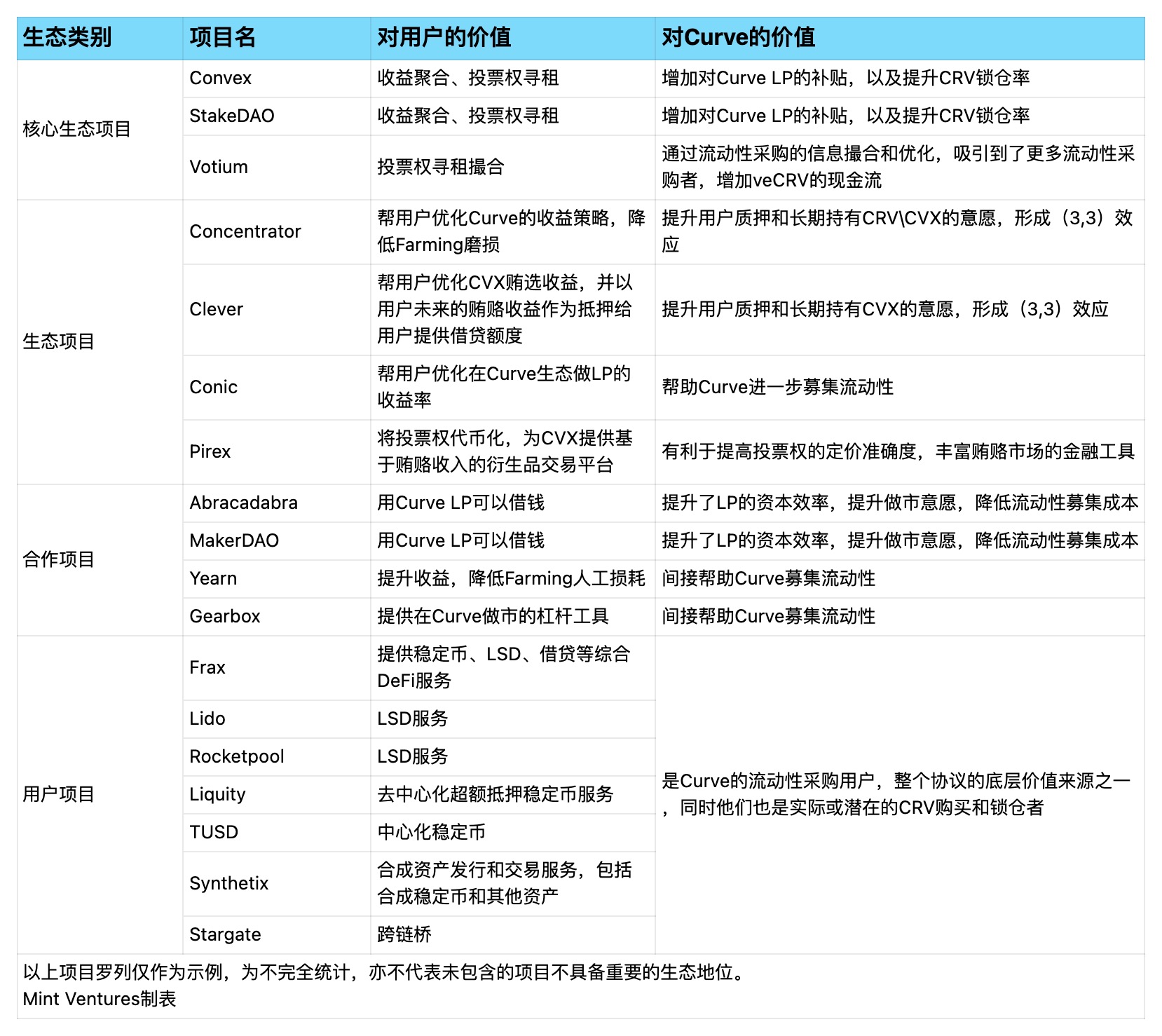
Through the above table, we can find that the main values of Curve's ecological projects are:
Provide Curve with direct protocol income, namely liquidity procurement fees
Provide experience optimization or assistance in liquidity raising or liquidity procurement for Curve's core business - liquidity market
Absorb and increase the lock-up of CRV (or CVX) to prevent CRV from flowing to the secondary market
From a higher level, in addition to the direct customer projects in the ecological project, which are the value sources that provide the underlying value for the agreement, the main functions of other projects are reflected in:
Subcontracted tools and product innovations of the Curve ecosystem, and as mentioned in the section [3. 3. Infinity War in the 3D eFi Field], functional innovation and continuous upgrade of experience are important conditions for Curve to maintain its leading stage
Through layer-by-layer nesting, Curve's relatively high liquidity procurement currency CRV is locked to avoid throwing it into the secondary market and causing a negative spiral in Curve's overall business. For example:
Convex guides users to lock CRV for a long time, and distributes Convex protocol revenue as an incentive to CRV locked users
Convex's protocol income comes from taking 17% of the income of LPs who make markets on Curve through Convex, and the reason why market makers are willing to make markets on Convex is because Convex provides them with CVX token rewards
Therefore, the price of CVX determines the motivation for people to make markets in Convex and provide liquidity. The higher the price of CVX, the more people are willing to provide liquidity to Curve through Convex, and the higher the agreement income of Convex is, which can be allocated to the Convex The higher the income of users who lock CRV, the stronger the motivation for people to lock CRV
So far, the price pressure of CRV has been partially transferred to CVX through this series of actions
b. Clever and Concentrator guide users to lock CVX in a long-term cycle, reduce the selling pressure of CVX, and maintain the price stability of CVX
secondary title
3.5 Risk
Curve has a good history of team performance, execution and safety records. Its main development risks come from increasingly fierce market competition and the coordination of interests within the ecology, and it is necessary to prevent the possibility of a negative spiral between currency price and business in a bear market .
Competitive Challenge: Spot DEXs
Spot DEXs are the most important and fiercely competitive track in the DeFi field. At present, two models have formed among the first-line competitors, namely Uniswap VS Curve. This is an excellent comparative experiment on whether a monopoly can be built in the DeFi field. Uni is currently a simple, free and open school, a typical public goods agreement, which has led to a delay in profitability; and Curve tries to combine its accompanying The project hopes to build a cash flow project with a moat, monopoly, and strong value capture, but the challenge of free public goods such as Uniswap leaves only limited space for Curve in the limited share of transaction volume in the bear market.
Competitive Challenge: Liquidity Market
Compared with spot DEXs, Curve has more obvious advantages in the liquid market. However, as more and more projects realize the benefits of the business model of DEXs + liquidity market, Balancer, Solidly, Velodrome and other projects have also adopted this model, and the subsequent competition for liquidity will further intensify.
The challenge of aligning interests
The continuous accumulation of Curve's ecological governance rights can provide direct benefits for ecological projects in terms of liquidity acquisition and rent-seeking of governance tickets, which has also become one of the direct sources of demand for CRV. But on the other hand, no permission, low threshold, composability, low cost of liquidity and flexibility of management solutions are the core values of Curve as a liquidity market for project parties. At present, for most new projects, the threshold to enter the Curve ecology is getting higher and higher. Although they can freely build factory pools, they need to get votes from the community to enter the Gauge. It is not easy to cross this threshold . It is also a big challenge for the subsequent Curve community to achieve a balance between "guaranteeing the interests of the existing major governance power holders" and "opening up the ecology to accept more participants" through internal coordination.
The decline in the price of CRV caused the negative spiral of business caused by the decline in liquidity incentives
first level title
4. Valuation comparison
Considering the similarity and closeness of business models and market positions, the author here chooses Balancer, which is also an old-fashioned DeFi, and currently also operates DEXs and liquidity markets, to make a horizontal comparison with Curve in valuation.
The specific comparison scheme adopted here is: use transaction fee + bribery income as the income item of the two projects, and compare the revenue multiples with the market value of the issued tokens and fully diluted tokens of the two projects. In addition, we also calculated the ratio of the token value of the two projects in terms of liquidity incentives to their revenue.

From the results in the table we can see that:
The two are very close from the perspective of earnings multiples, and the relative valuation of Curve is slightly lower (the market cap of issued tokens is more indicative, and we mainly use it as the basis)
Curve's income\incentive ratio is higher, showing that Curve currently has a higher comprehensive income under the same liquidity incentive amount
Of course, the above comparison between Curve and Balancer in terms of revenue multiples is relatively rough, and the following factors are not fully taken into account:
In the column of bribery revenue, the author only counts the bribery revenue data of Llama.airforce, which only covers the bribery revenue data of Votium (Curve’s main bribery platform) and Hiddenhand (Balancer’s main bribery platform)
The bribery income does not fully cover the payment of liquidity purchasers in purchasing liquidity, because there are still many project parties that do not use bribery to purchase liquidity, but choose to directly purchase CRV or BAL to lock the warehouse to obtain veTOKEN, and carry out long-term liquidity purchase
In addition to the part used to incentivize liquidity, Curve’s token emission has a weekly token incentive of 3,841,978 CRV (worth nearly $4 million) for the team, but most of these tokens have not entered circulation
first level title
5. Acknowledgments
The birth of this research report needs to thank the Curve Chinese community@HaowiWang Lots of information and advice shared, along with Curve community user @Stakeholder and our founding partner@fanyayun,researcher@lawrence_leeeereview and feedback. In addition, this paper also asks some questions@DeFi_Cheetahopinion, he and@WinterSoldierxzThe discussion about Uniwap VS Curve has inspired me a lot.
Additional reference information:
Election bribery information: https://llama.airforce/#
Curve Comprehensive Data Kanban (created by @mrblocktw): https://dune.com/mrblock_buidl/Curve.fi
Balancer Revenues: https://dune.com/balancerlabs/Balancer-V 2 -Revenues-Overview
DeFi data: https://defillama.com/





