






Okey Cloud Chain Research Institute:"explosion"ChatGPT and"cold"Web3


ChatGPT, released by OpenAI last year, has recently become popular all over the world, and was called an "epoch-making product" by Fortune. Google, Microsoft, Amazon, Baidu, JD.com and other domestic and foreign Internet companies have accelerated their deployment in related fields, and AI commercialization has entered a new stage. But while ChatGPT became popular, Web3, which had attracted much attention, was a little calmer.
secondary title
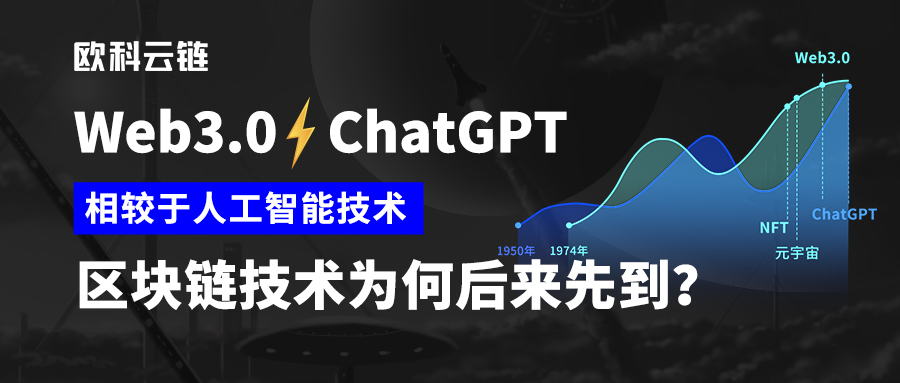
From the popularity of ChatGPT to see the pragmatism and long-termism of Web3
Looking back at the development of artificial intelligence, we will find that there will be a wave of upsurge every few years. Before ChatGPT, the last artificial intelligence that shocked us may be AlphaGO. After defeating many world Go champions, AlphaGO once amazed us with its powerful computing power and analytical power. But for most people, AlphaGO defeating human chess players is just a chat after dinner, and it is still too far away from real life. The key to ChatGPT’s ability to break through technical barriers and arouse heated discussions among the people is that it uses simple dialogue methods to allow users to obtain a relatively convenient real experience, and solves real pain points by creating scenes close to work and life. In this process, everyone is no longer a high-tech bystander, but a real consumer and user, feeling the shock and impact of generative AI in the interaction.
The data will not lie: ChatGPT has only been launched for 2 months, and the number of monthly active users has exceeded 100 million, making it the Internet product with the fastest growth rate of users in history. ChatGPT, which turns the most extensive users into consumers and users, not only realizes the first large-scale self-propagation of AI, but also accelerates AI innovation from the laboratory to the market and users.
But in reality, technological innovation tends to fall into the technical standard, ignoring the real market and user needs, so that many technological concepts that sound like unlimited potential eventually become "castles in the air". If technological innovation is always at the top, it will be high and low, and eventually become an unpopular game for a small group of people to entertain themselves, getting farther and farther away from the market and users.
We admit that technological innovation requires idealism, but users prefer pragmatism. Although it is difficult for most users to understand the technical logic behind high-tech products, this is not important. Usefulness and ease of use are the main criteria for users to judge whether a product is good or bad. Only by listening to the voice of the market at all times, meeting real needs, allowing the broadest user groups to perceive meaningful products and services, and continuously optimizing based on user feedback, can we form the most complete technological innovation transformation chain.
Just like 25 years ago, even if only a few people could understand the technological innovation behind Google search, this will not prevent Google search from becoming the most successful search engine product in the Internet age, because Google uses the simplest search box to satisfy users' expectations. The most basic search requirement for Internet content allows the widest range of users to experience the charm of search in the Web2 era.
Web3 also needs a super application that can really be implemented, just like Google search is to Web2, and ChatGPT is to artificial intelligence. As an important innovation that hopes to reconstruct Internet data ownership and value expression with distributed technology, Web3 is indeed expected to fully optimize the Internet from the dimensions of technology, industry, and economy. The development concepts of freedom, openness, and sharing it emphasizes are also in line with most people's expectations. But at present, its concept is greater than its substance, especially at the application level. We urgently need to create more products and services that users can perceive and use in the web3 world. Only by finding real user pain points and solving them in a simple way, and continuously lowering the threshold for users to enter the Web3 world, can Web3 services be within reach.
secondary title
text
The previous article discussed the reference value of the success of ChatGPT to the development of Web3, but pragmatism prompts us to further think about the real impact of generative AI tools such as ChatGPT on Web3.
The core function of generative AI is creation, which is essentially the improvement of productivity in the digital age. Although differences in users and usage scenarios will lead to large differences in the productivity that ChatGPT can improve, so far, it has indeed shown strong creativity as an advanced production tool.
Corresponding to productivity is the transformation of production relations. From blockchain innovation to the Web3 revolution, we are always looking forward to using technological means to reconstruct production relations in the digital world, but progress is slow. The reason is, on the one hand, the inherent defects of blockchain and Web3 technology, but on the other hand, it is because we lack production tools that can match the new production relationship - using previous production tools to build future production relationships is obviously a unattainable.
The generative AI represented by ChatGPT has the potential to become a productivity tool in the Web3 era. By learning and analyzing new production factors including on-chain data, it can provide more reliable and convenient services for Web3 creators and contributors. It is a productivity tool that solves the problems of data assets and content production in the digital world, and fills in the productivity shortcomings in the development of Web3, thereby accelerating the arrival of the Web3 era.
In the industry forecast for 2023 released by the Okey Cloud Chain Research Institute, we also proposed that "the collision between Web3 and AI 3.0 will trigger creative destruction, and stimulate more imaginative application innovations in 2023." Now this This trend is more obvious. We will see more integrated applications of generative AI and Web3 in specific scenarios such as content production, data security, and technology co-creation.
In the wider field of technology, we have also seen that many Web3+AI platforms have frequently won the favor of capital and completed large-scale financing in the near future. Among them are AI-driven digital human platform, chain game platform, digital marketing platform, as well as industrial supply chain solutions combining AI and blockchain technology, NFT generation authentication technology and encrypted asset trading strategy platform, etc.
Use AI to leverage the development process of Web3, use Web3 to expand AI business scenarios, and the integration of AI and Web3 may bring us more surprises.
(This article is produced by the Okey Cloud Chain Research Institute. The Okey Cloud Chain Research Institute is a professional research institution under the Okey Cloud Chain Group. It continues to pay attention to cutting-edge high-tech innovation fields such as Web3.0, blockchain industry, and metaverse, and jointly Promote the development and application of cutting-edge technologies such as blockchain technology.)





