


Quantitative Analysis: How Decentralized and Censorship-Resistant After the Ethereum Merger?


Original title: "Consensus at the Threshold》
Author: Takens Theorem
Original compilation: aididiaojp.eth, Foresight News
Original compilation: aididiaojp.eth, Foresight News
This is not a new debate. Even before the merger, there were already concerns about changes in validator concentration and censorship following the ethereum merger. Of course this problem is not unique to Ethereum, for example 60% of Bitcoin computing power used to be concentrated in China, but the distribution of Bitcoin mining has changed fundamentally in less than 2 years, and now the United States dominates (over 35% at the time of writing).
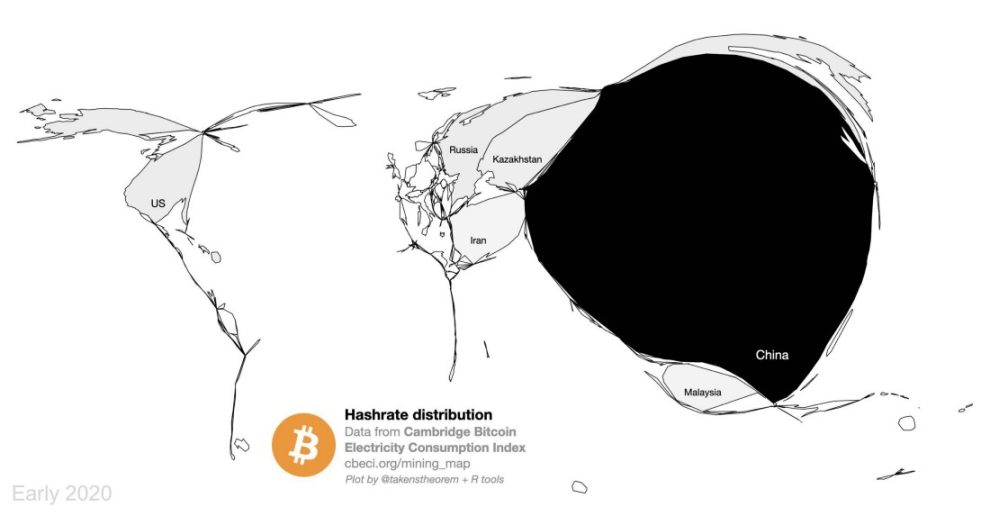
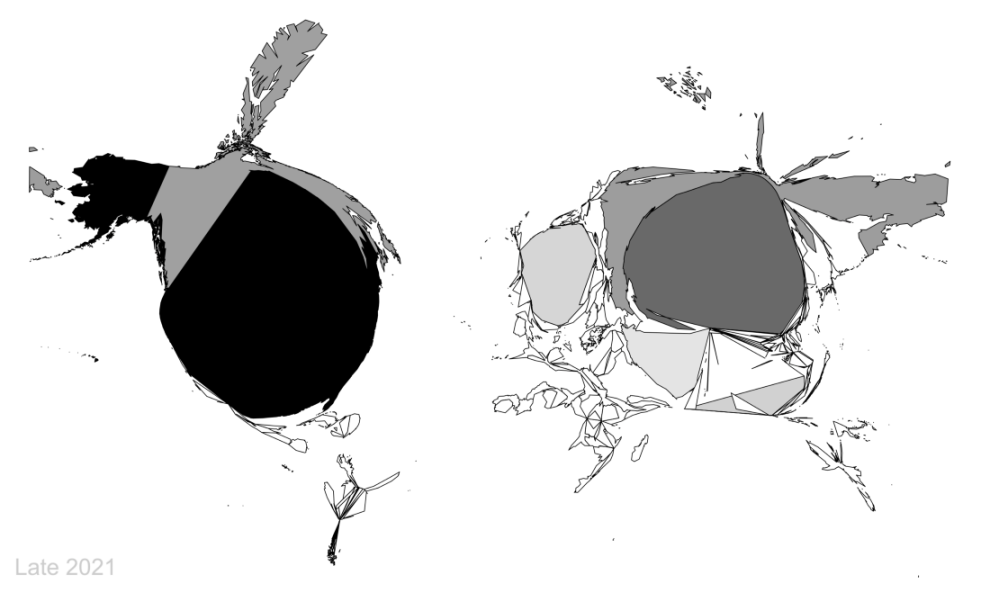
image description
Approximate Hash Rate Change for the Bitcoin Network in 2020-2021
There are legitimate concerns in these debates. The goal of cryptocurrencies is to create a system that is neutral, censorship-resistant, and decentralized, while having a sufficient number of participants to resist attacks. But even in this seemingly optimistic scenario, the network still has a theoretical risk of unknown attack vectors, and any centralization would make such attacks more likely to occur.
Next, do a simple quantitative analysis of the concentration of miners and verifiers before and after the merger.
Taking thousands of blocks before and after merging as an example, we can look at the block concentration of each associated block proposer address (miner and validator). Before the merger, only a dozen or so mining addresses were associated with rewards, including Ethermine and others. After the merger, thousands of addresses are associated with validators. After crossing a sharply changing threshold, the variance in the number of uniquely rewarding validator addresses becomes large.
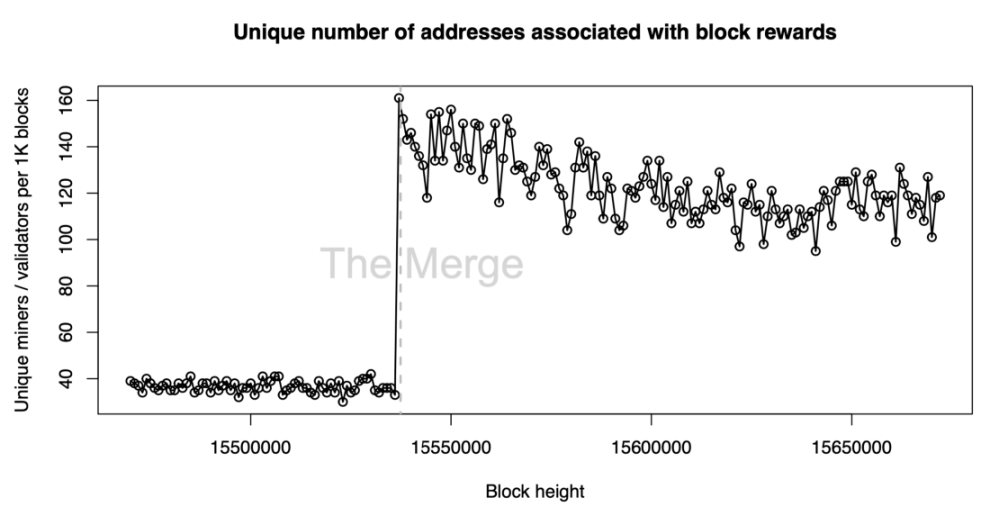
image description
Data source: Etherscan
After the merger, the concentration of reward recipients remains high. We try to reflect the concentration of rewards per 1000 blocks through Gini coefficient analysis (a measure of the distribution of personal income). The Gini coefficient ranges from 0 (fully shared blocks) to 1 (belongs to only one validator). We can also calculate what percentage the first 3 blocks related to the address took. The two lines in the graph below show how this analysis changes over time:
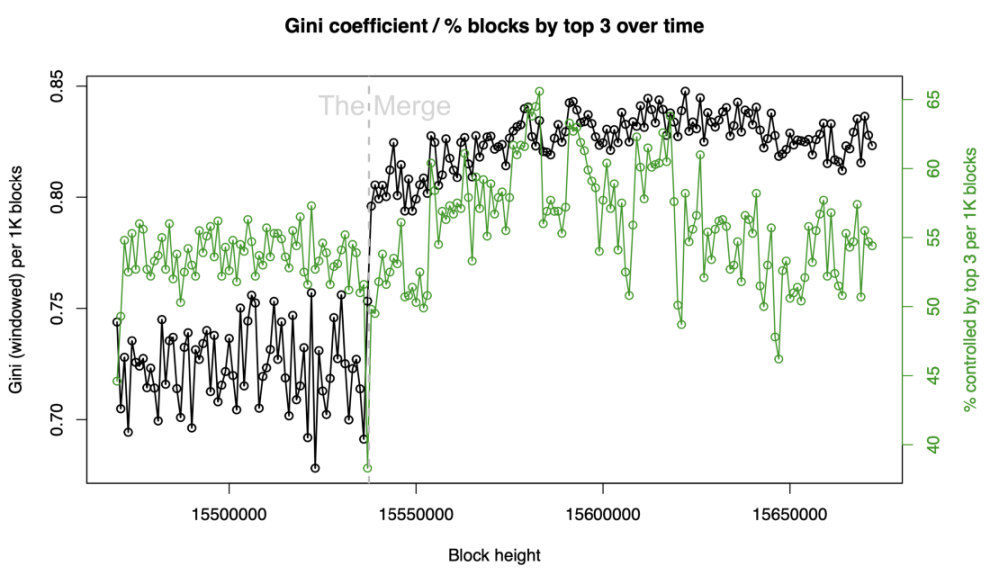
image description
Data source: Etherscan
The Gini coefficient is not a perfect measure, but it has certain reference value. While there are more validators, it is also more centralized in some proportional way. The top 3 control percentages appear to be similar, but there is a statistically significant difference between the left and right sides of the plot, with an ~2% increase in combined concentration (p < 0.005). Despite the trend toward decentralization, there is considerable concentration under both metrics.
How do we ensure that the centralization of the block building service does not unduly affect the operation of the network? Jon Charbonneau provides a detailed analysis of this decoupling and how it can be optimized in protocols in his Delphi Analysis report. One approach, as summarized in a recent post by Vitalik Buterin, is a balance between optimizing constraints on block builders and reducing the burden on block proposers.
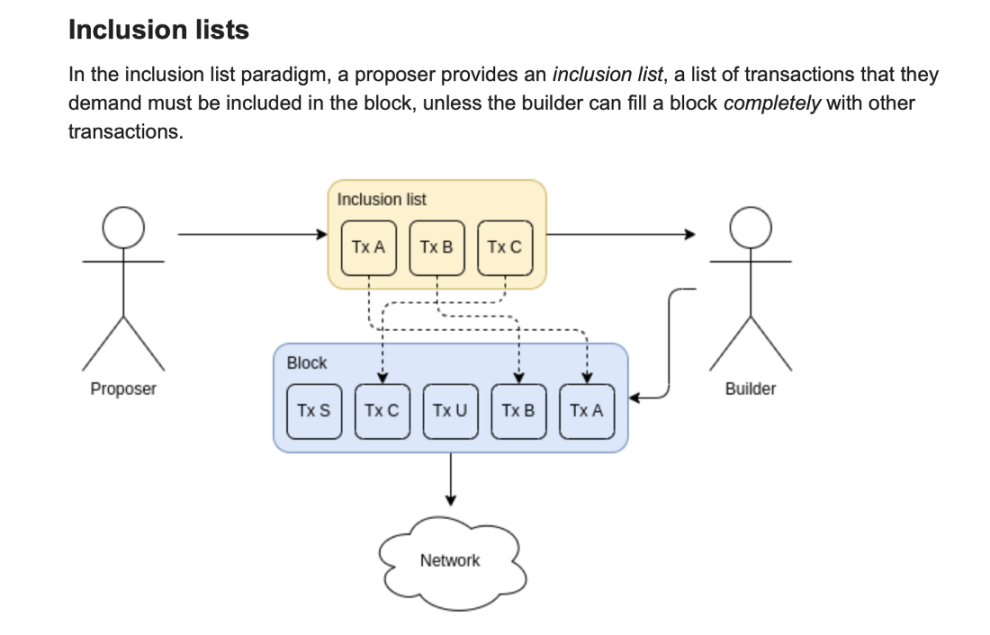
image description
Vitalik considered several designs to achieve this balance, such as "include list"
anti-censorship
The Etherscan data shows a recent breakdown of validators by percentage of blocks produced and percentage of transactions proposed for the Tornado router ( 0xd90e2f9 ). You can see Flashbots on the far left, the largest block generator, validating 0% of Tornado transactions. Others may also use Flashbot's repeaters.
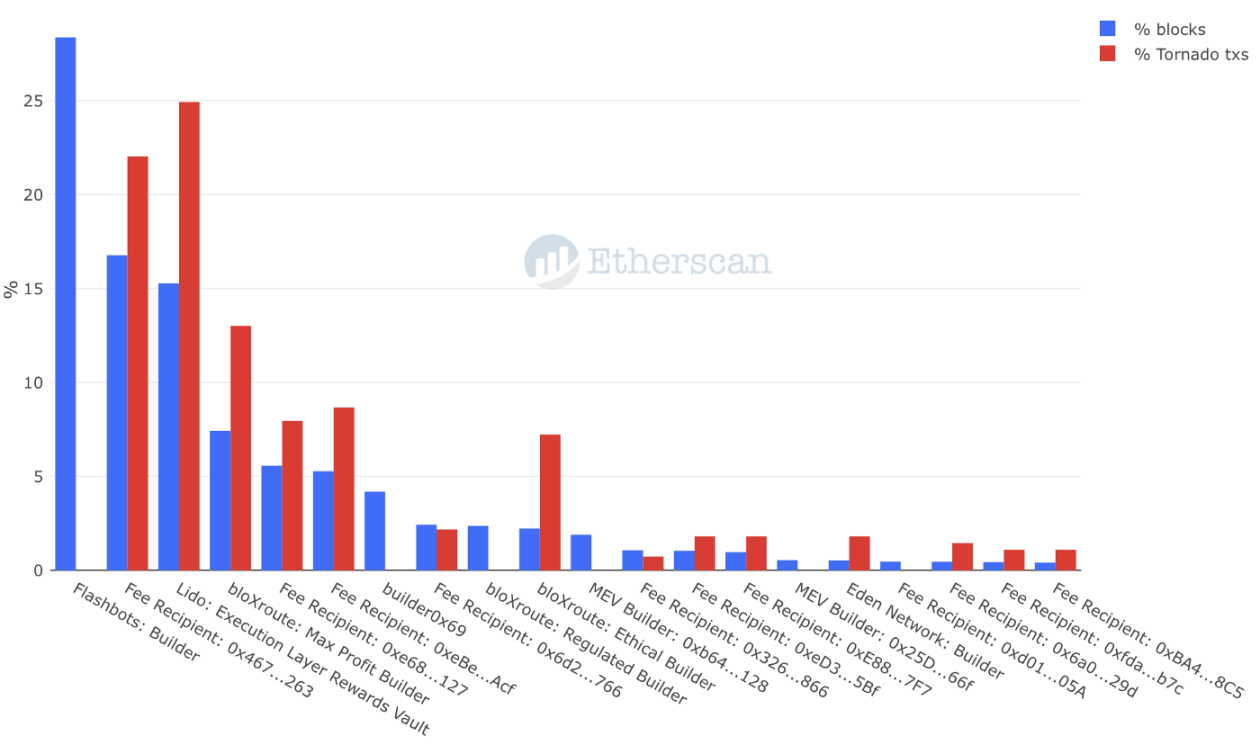
image description
Data source: Etherscan
Charbonneau emphasized the importance of this problem, and said unabashedly: “Ethereum can survive on higher fees, but it cannot survive on censorship.” One existing tool for the network to solve this problem is Slashing. Validators may penalize others for such practices. Slashing happens occasionally on the web these days, and is part of the solution provided by Eric Wall and others.
Note: Slashing aims to deter malicious validator behavior and incentivize the network to participate in the blockchain.
Conclusion: decentralization
As mentioned above, PoS introduces considerable liquidity into consensus that GPU and Proof-of-Work did not have before the merger. But liquidity is also a double-edged sword: if you can pivot quickly to decentralization, you can also pivot quickly in the opposite direction.
These highly “mobile” validating networks have two types of decentralization: potential and realized. All networks share this property, but PoS may have a higher rate of change on this gradient, i.e. has the potential to move rapidly between extremes. In other words, validators can easily move their operations physically and across block building services. While the network of physical validators and corresponding nodes can remain the same, the wiring of the network can theoretically be centralized very quickly: from independent block construction to relying on centralized builders.
But the decoupling of proposers and builders brings in a second source of centralization: block builders. Builders affect the profit margins of node operators, there are incentives between builders and proposers, which means that a very successful builder can reduce the decentralization of the network, e.g. validators can flock to beautifully designed build tools . As can be seen from the graph of the past 2 weeks, Flashbots (red band) have begun to dominate block building, accounting for more than 30% of their main fee addresses alone. This somewhat reduces the decentralization that Ethereum has achieved.
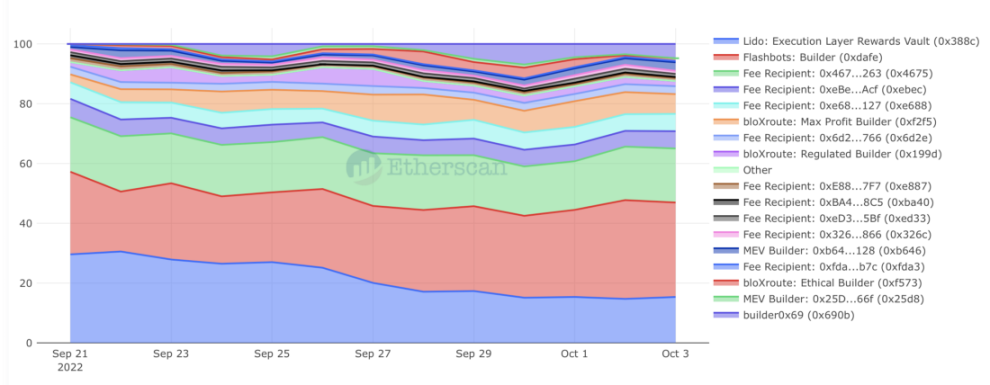
image description
Flashbots share a transparent dashboard reporting all relay and build activity. (They also recently announced goals to share infrastructure, create grants around transparency, and eventually contribute to more decentralized block building.) At the time of writing, the total dominance of their services is about 40%, and One can get more clarity on why they are an attractive resource for validators:
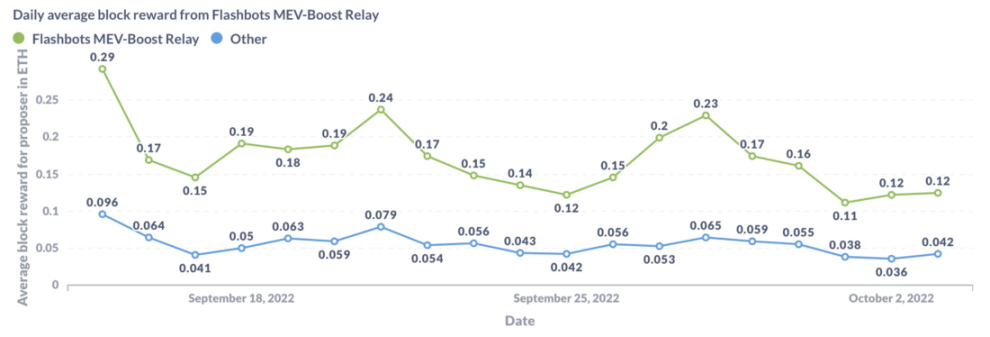
image description
Expect these ideas shared by Charbonneau, Buterin, and many other developers to be further realized, not only for energy efficiency and flexibility in protocol adjustments, but also for the potential decentralization of Ethereum at scale after the merger.





