


Why is the reversible transaction standard ERC20/721R a step backward?


Compilation of the original text: The Way of DeFi
Compilation of the original text: The Way of DeFi
Traditional finance (TradFi) is considered safe because we have centralized intermediaries to reverse wrong transactions, and crypto is described as dangerous because there is no undo button, transactions are final, like what if someone screwed up? manage? This is a common thinking among people steeped in traditional finance.
Credit cards have chargebacks, ACH payments take several business days, and Amazon allows you to return the package. If a bank accidentally transfers a million dollars into your account, you also have no right to keep it. When people screw up, we need systems to correct it. Atomic Finance is only applicable to the purely digital field.

Yet people turn a blind eye to the dark side of the credit system. How can a business trust it to pay for goods and services that have long since disappeared if the payment is not truly final but can be reversed after up to 90 days?
hidden danger
Society has a crumbling scaffolding around these systems — KYC credit scores, opaque intermediaries, and finally, legal recourse. This cure is worse than the disease itself! Since most people in privileged circumstances have not experienced these injuries, let's look at the unfair and ineffective situations that occur frequently. Don't worry, experiential learners will have plenty of first-hand experience for years to come, even if they don't encounter it now.
Credit scores are a serious barrier to housing and employment, even among individuals who don't need credit! They're run by stupid people, like Equifax which leaked 147 million people's personal information in 2017 (don't worry, they let you check your credit report for free as compensation). Or maybe you're one of the 45 million Americans who are "credit invisible" and don't have enough information to create a credit score in the first place. You can't opt out of sending data to these agencies, and there are errors in the reporting of one fifth of the population. For those at the bottom, the system is broken, and those at the top don't care.
Opaque intermediaries can deny you access to the platform for no reason. Whether it's the creator of Uniswap getting locked out of a bank with no explanation, or PayPal stealing/escrowing your business income for six months while reviewing suspicious activity (no recourse, that's the terms of service!), The algorithm is both inaccurate and irritating. But don't we need to stop the bad guys? If so, KYC would be a total failure, affecting less than 0.1% of criminal finance, while imposing ridiculous compliance costs on the average financial business owner.
Legal recourse is a pay game, and most people can't afford it. Even under the most optimistic scenario, the case drags on for years. Mt Gox suspended trading in 2014, and even 8 years later, users have not been refunded their money. Maybe a healthy and thriving business can ignore these losses, but for ordinary people, money seems to be gone.
The phasing out of cash and the huge reversibility risk in transactional systems means consumers are often forced to use centralized credit intermediaries even if they have the ability to prepay. The credit platform takes advantage of a certain degree of reversibility, de-platforms consumers and businesses based on an opaque risk algorithm, and captures a huge spread at the same time. When you make bearer asset transactions as painful as possible, you force ordinary people into a debt-ridden world of centralized middleman KYC.
Reversible Token Proposal
We just discussed how the status quo in traditional finance is not good enough, and how a system that relies on reversible credit rather than bearer assets is causing deep “invisible” harm to the underclass. Now, let's pay special attention to what is proposed in a recent Stanford paper by renowned cryptographer Dan Boneh's research group.(Additional note: Dan Boneh's discovery of more efficient BLS signature aggregation in 2018 was a key breakthrough that allowed Ethereum's PoS implementation to move forward)
The main idea of Dan Boneh's research team's proposal is to create a new reversible token standard, namely ERC20R and ERC721R. In the case of token theft, the victim has a very short time to ask the "decentralized judge group" to freeze the token , and then there is a trial on whether to return the Token to the victim.
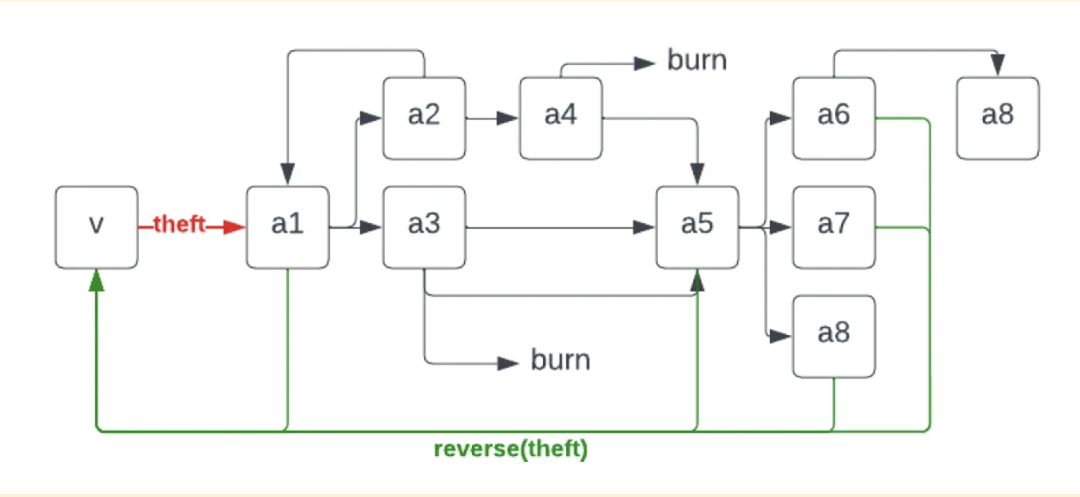
The picture comes from the reversible transaction paper. Through the ingenious DAG method, the "judge" can track the movement of Token through the attacker's original address and return the Token to the victim, no matter where they end up.
The paper also proposes an algorithm in which stolen tokens can be traced to their final destination even if the attacker tries to disguise their movement through complex trajectories.
While the intent to fix the theft is noble, the implementation is worrisome for several reasons: (1) reversibility hurts innocent bystanders, not attackers; (2) reversibility is incompatible with most DeFi ; (3) Unnecessary governance is an attack vector that can be abused.
Reversibility is incompatible with DeFi and NFTs
OpenSea’s delisting of stolen NFTs can be seen as a “soft” form of reversibility. This isn't completely reversible, as victims won't get their NFT back, but it will hurt the NFT's resale value until it's returned. This is a controversial policy, as hackers often dump NFTs at reserve prices before they are blacklisted, so when the blacklist goes into effect, it only hurts an innocent buyer excited to buy an NFT asset. For example, the figure below is a real example.
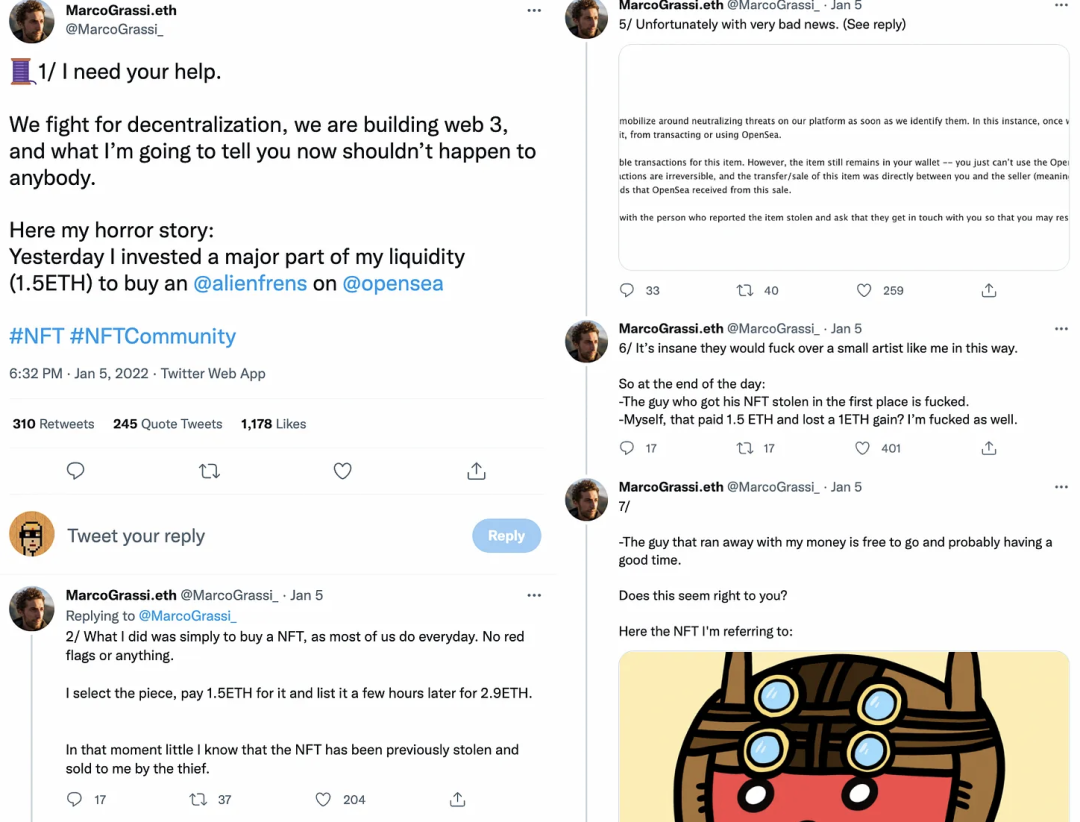
After OpenSea took down the stolen NFT, it was complained. Be aware that when real hackers get away with it, innocent buyers are affected.
Today, this has less of an impact on uninformed buyers, as they can trade on truly permissionless platforms, or at least choose marketplaces that don’t adhere to OpenSea’s blacklist. But the harm is non-zero, as people are often forced to sell these tainted assets at prices well below their pre-hack market value.
And full reversibility, will have a stronger effect. When a Bored Ape (BAYC) is yanked out of your wallet by a decentralized monkey judge, you lose it completely and you have no recourse. This doesn't make much sense, why should random NFT or Uniswap users bear the full consequences? Of course, we all want the hackers to be held accountable, but that's not an option as they would immediately dump for censorship resistant tokens.
It gets worse when you start talking about Uniswap instead of OpenSea. If an attacker obtains reversible tokens, they will simply exchange them for censorship resistant tokens! Then, when the "judges" start freezing assets, the entire pool ceases to function. Innocent LPs will suffer when they reverse the trade. This makes reversible tokens completely unusable in DeFi and NFT transactions.
The paper's authors sidestep this utter incompatibility with a catchphrase: "Reversibility is viral." Because reversible tokens cannot be used together with irreversible tokens, they believe this will result in an entire ecosystem consisting entirely of reversible tokens.
“Once a few key tokens become reversible, other tokens are incentivized to do the same to eliminate this delay. In other words, reversibility goes viral.”
But I believe that few people would be interested in such a bizarre setup where no one really knows who owns what until days or weeks after the fact. Imagine opening your portfolio and not knowing if you will have 10 reversible NFTs or 1 because someone somewhere is buying and selling assets with stolen funds.
Hosting solves this problemWhile the proposed solution makes no sense, the paper does touch on a practical problem: how would you adapt atomic payments to handle non-atomic transactions, such as buying physical goods online or trading houses? Counterparty risk is real in many transactions, and no Chainlink oracle can prove that an Amazon package was delivered. The solution is actually quite simple: hosting.
Both buyers and sellers entrust a trusted third party to act as your "oracle", buyers automatically send funds to their accounts, and when receipt of non-atomic items is confirmed, escrow agents automatically send funds to sellers to close the transaction.

Escrow is not the same as a reversible transaction. Reversible transactions allow funds to continue to flow while there is still a risk of reversal, implicating innocent bystanders. Escrow will lock the funds until the payment is completed, and there is no risk of recovering the funds at this time. This key distinction means that custody is compatible with composable applications like Uniswap and OpenSea, while reversible transactions are not.Escrow also does not implicate innocent bystanders like reversible transactions do. Escrow is an optional system built on immutable primitives, while reversible transactions are a proposal to replace immutable primitives with destructible arbitrators.
What we need is less centralization
Some people say that we should accept reversible transactions, because elements of DeFi and NFT are already centralized today. For example, most NFTs can change metadata, and some DeFi contracts have administrator keys or proxy upgradeability, which allows development teams to change arbitrary data at will. USDC also has an active blacklist feature, which is widely adopted, so what is the problem?
While I will always advocate immutable decentralized primitives over dangerous centralization, the key is to recognize when a feature is an unfortunate edge case that issuers wish they didn't have, and when a feature is a A key component, which is the main product focus. If USDC reversed transactions every time a user was phished, then user acceptance would drop dramatically. We've seen this already, with MakerDAO discussing extreme measures to limit exposure to USDC. We need less centralization, not more.
Why finality?
Finality matters, and decentralized blockchains that offer true bearer assets are a revolution few appreciate, completely doing away with the touted norm that everything must be held by a custodial intermediary with a counterparty risky debt.
Is code the law? Of course not, theft is theft, whether it happens at a CVS pharmacy in San Francisco or on the Ethereum blockchain. A fully decentralized blockchain, however, is a supranational entity intertwined with various traditional sovereign jurisdictions, neither fully subject to nor completely free from the influence of any single nation-state. I thought to myself that the blockchain state transition function is similar to the laws of physics. Enough concerted effort can change the social consensus around blockchain rules, and enough concerted effort can unlock new capabilities in the physical realm, but at the local level, these settings are largely fixed environments in which individuals and groups operate.
Original link





