


An article comparing ETH pledge platforms: the negative premium of derivatives on liquid pledge platforms is lower


After the merger of Ethereum, the energy consumption has been reduced by 99.95%, and the ETH issued each year has been reduced by about 90%. In PoS blockchains, validators lock up native tokens to provide security to the network. As of September 26, according to the data of Staking Rewards, among the major PoS networks, Ethereum’s 12% pledge rate appears to be relatively low, followed by BNB Chain, Cardano, and Solana’s native tokens, which all have a pledge rate of 70%. % and above.
There is still room for several times the amount of ETH pledged to rise, and because there are certain technical and hardware thresholds in building nodes by themselves, third-party operators that provide "Staking as a service" (Staking as a service, SaaS) may become Ethereum pledgers. key to the narrative.
After analyzing data from major Ethereum staking service providers, PANews found that:
As of September 25, the number of currently pledged ETH is about 13.96 million, and the number of validators is 436,247. The pledge rate of ETH is only 12%, which is relatively low.
The fork did not immediately attract a large number of new pledges of ETH. In the week of the fork on September 15, the newly pledged amount of ETH was 155,206 ETH, an increase of about 1.13%. Although the amount of new ETH pledges has increased in the last three weeks, the increase is not high compared to before.
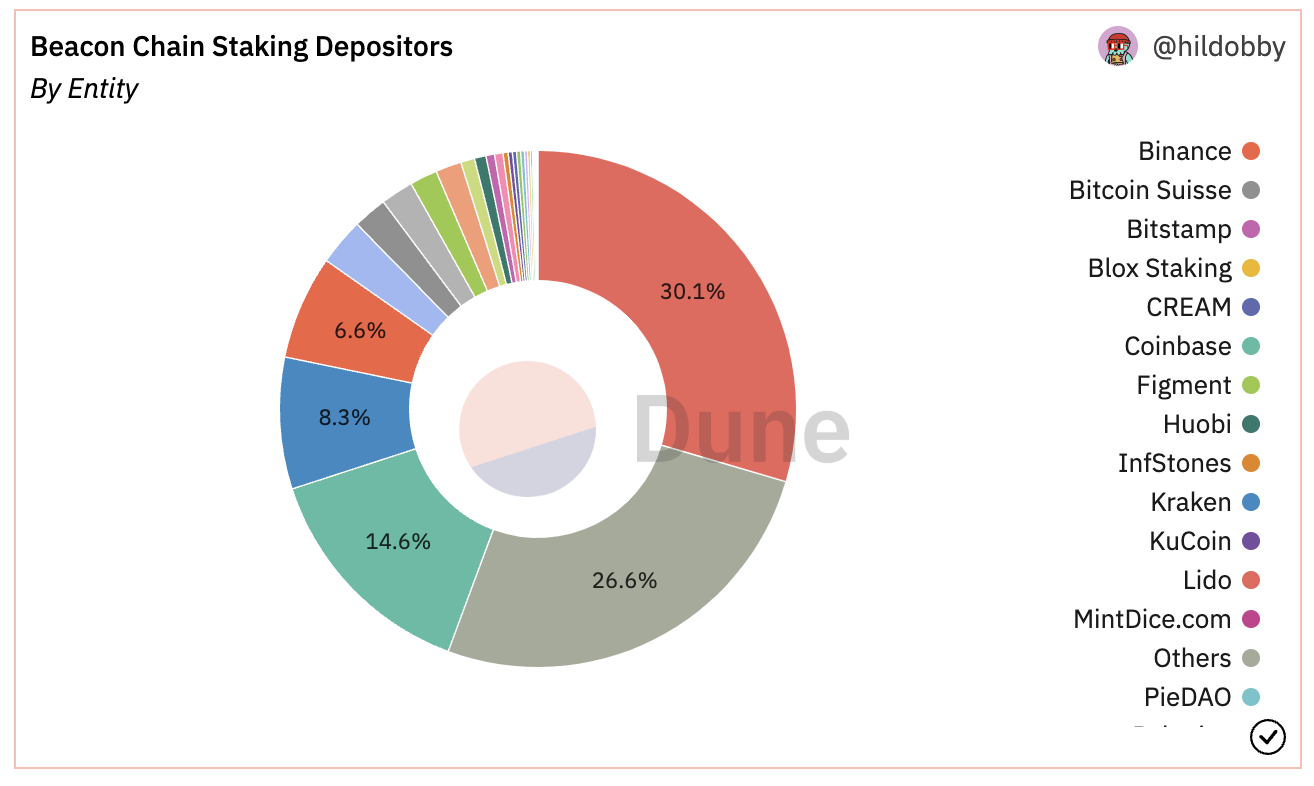
The pledge of ETH faces the problem of centralization. The top three entities Lido, Coinbase, and Kraken accounted for 30.1%, 14.6%, and 8.3% respectively, with a total of 53%. All activities on the Fang network have jurisdiction.
The vast majority of ETH is pledged through third-party service providers, of which liquid pledges accounted for 33.2%, centralized exchanges accounted for 30.9%, and pledge pools accounted for 9.3%, totaling 73.4%.
Since the pledged ETH cannot be redeemed, representative liquidity collateralized derivatives all show negative premiums, among which Lido’s stETH has the lowest negative premium of 0.48%; Coinbase’s cbETH has the highest negative premium of 3.45%.
first level title
The Growth of ETH Staking
Shanghai upgradeShanghai upgradeAfter opening the redemption function, the number of pledged ETH has continued to rise since the opening of the pledge.
According to the data compiled by DuneAnalytics @hildobby, as of September 25, the number of pledged ETH was about 13.96 million, and the number of validators was 436,247.
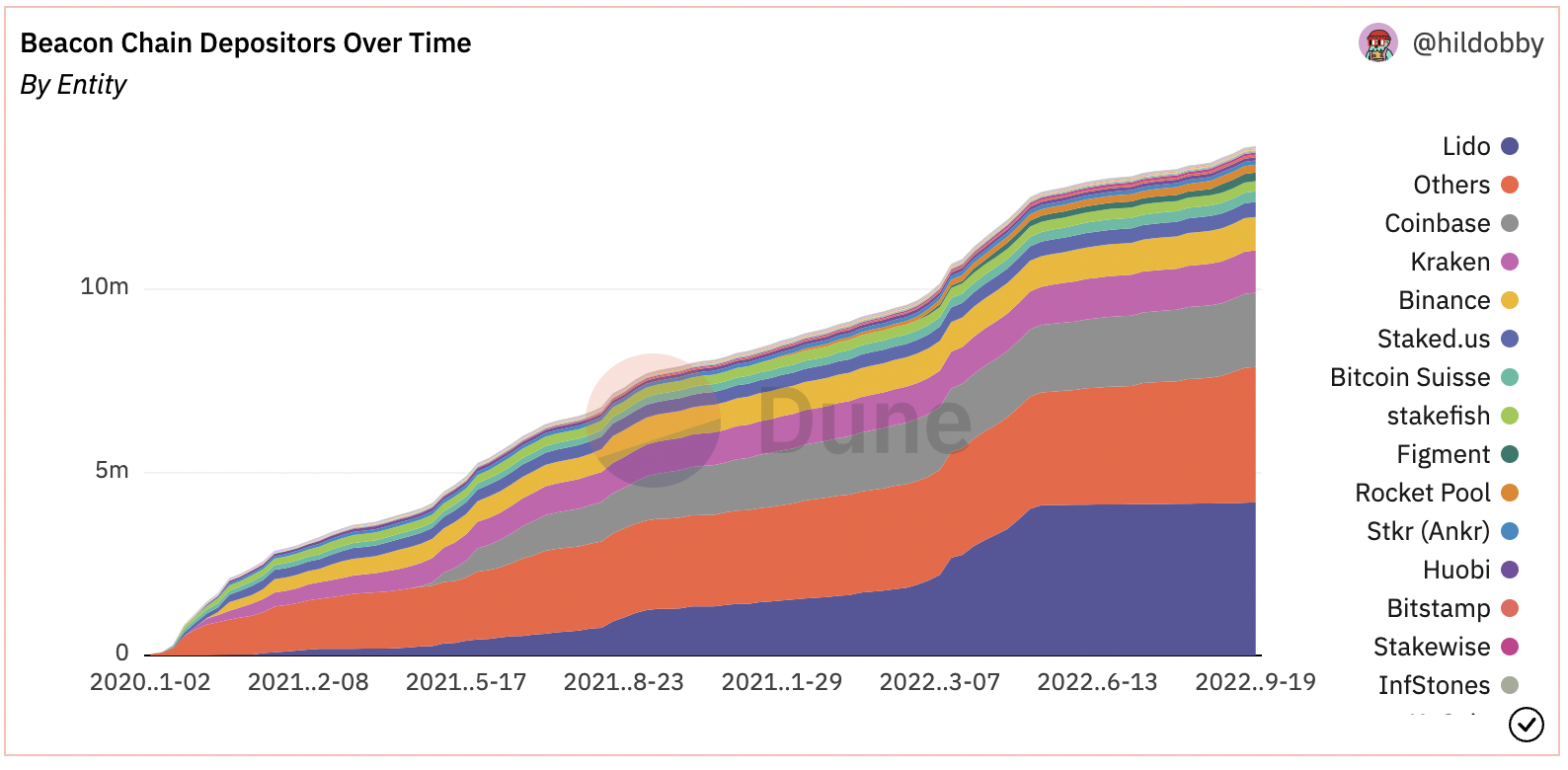
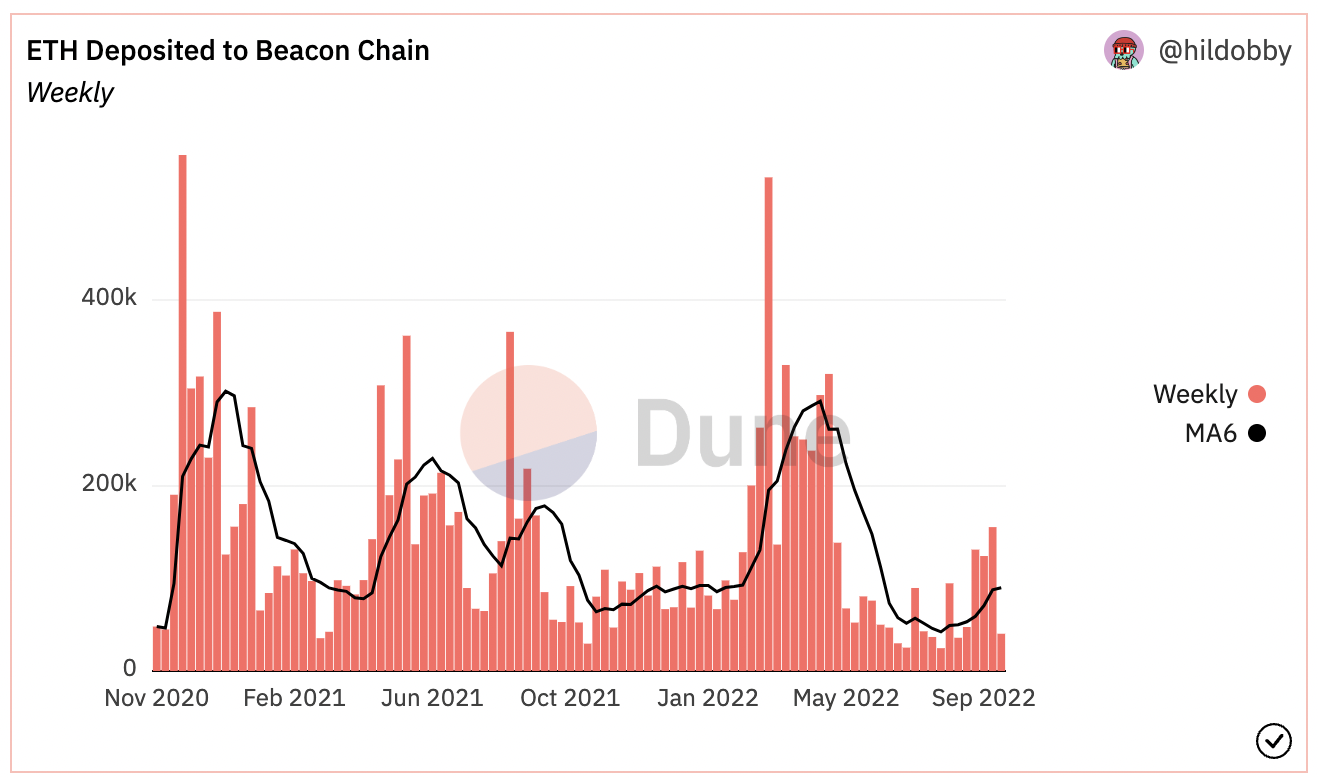
The growth rate of the number of ETH pledges slowed down after the market went down in May this year, but the number of ETH pledged in the last three weeks (August 29 to September 19) increased by 130,937 ETH, 124,018 ETH, and 155,206 ETH each week. The amount of pledges increased by about 1.13% during the week of the fork on the 15th. Although the recent pledge amount has increased significantly compared with May 19th to August 29th, the growth amount is still relatively small compared with the time nodes from November to December 2020, May 2021, and March to early May 2022. Low. This shows that the implementation of PoW to PoS did not bring a large amount of new pledges of ETH.
Distribution of ETH pledge amount
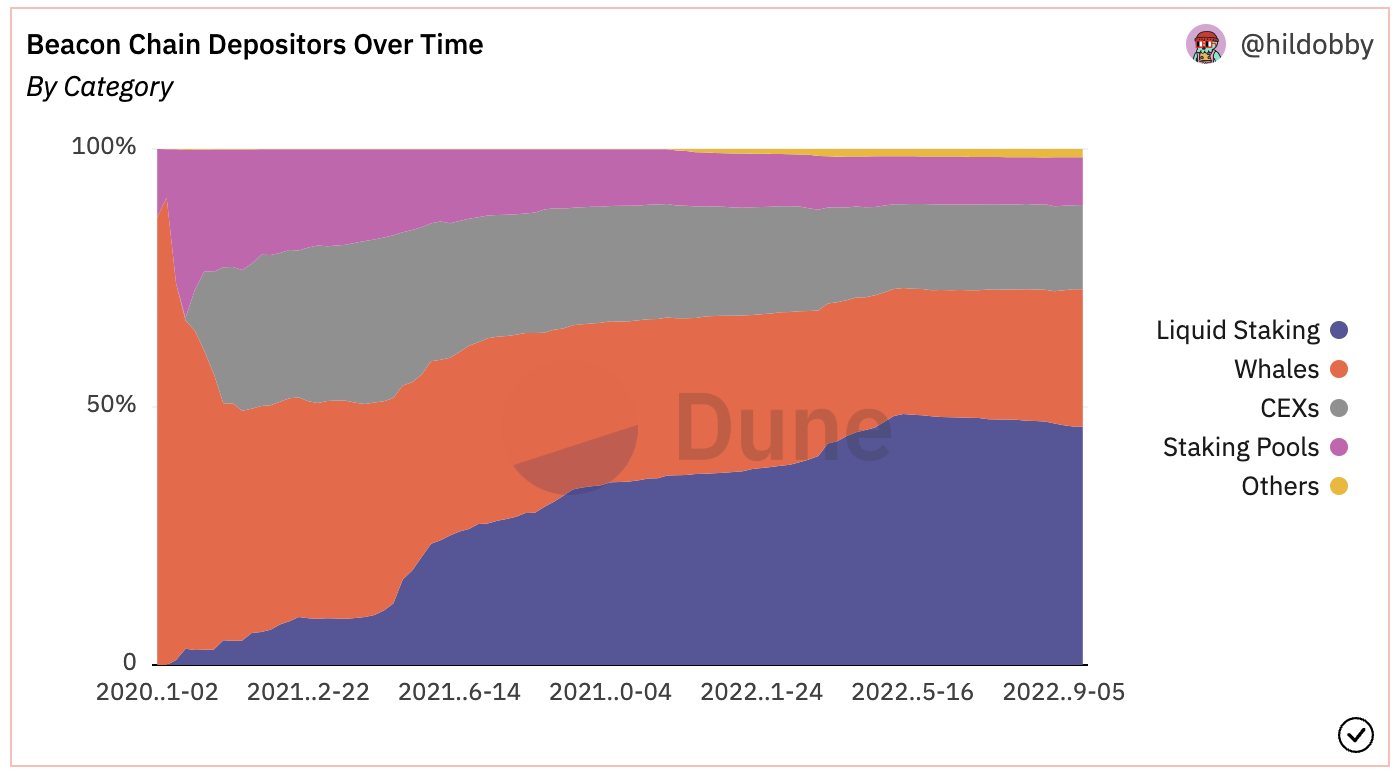
According to the current distribution of ETH pledges, most of them are pledged through third-party service providers, of which liquid pledges accounted for 33.2%, centralized exchanges accounted for 30.9%, and pledge pools accounted for 9.3%, totaling 73.4%. For the rest, giant whales accounted for 22.2%. For example, Vitalik pledged 6,976 ETH, ranking around 20th among all pledged entities; others accounted for 4.4%.
As the growth of Lido slowed down, the proportion of liquidity pledged to ETH also dropped from 48.7% on May 9 to 46.2% on September 19. Meanwhile, the share of giant whales rose from 24.4 percent to 26.6 percent.
The growth rate of ETH pledge volume began to decline in May, mainly reflected in the fact that the growth of Lido pledge volume has almost stagnated, and investors are also concerned about the high proportion of Lido pledge volume. Starting from May 10, the market downturn caused Lido's ETH pledged derivative stETH/ETH to start to have a negative premium. In this case, continuing to pledge ETH through Lido is obviously not as good as buying stETH directly from the secondary market. On May 13, the negative premium of stETH/ETH exceeded 10%. Although it recovered, on June 13, as a large number of stETH collaterals faced liquidation, the negative premium of stETH/ETH reached 10% again. Later, as the merger proceeded, it gradually recovered, and the current negative premium is less than 1%.
first level title
Staking Centralization and Regulatory Issues
The high proportion of staking through liquid staking projects and centralized exchanges has also made users aware of the current centralization of ETH. The top three entities Lido, Coinbase, and Kraken accounted for 30.1%, 14.6%, and 8.3% respectively A total of 53%, there is a possibility of breaching network security.
The centralization of ETH pledges also brings potential regulatory jurisdiction issues. The US Securities and Exchange Commission pointed out in an indictment that the cluster density of Ethereum nodes in the United States is higher than that of any other country, so all Ethereum transactions in the world should be censored. Deemed to originate in the United States, the SEC has jurisdiction over all activity on the Ethereum network.
first level title
ETH pledge platform comparison
Given that the current ETH pledge entities are mainly liquid staking projects and centralized exchanges, PANews selected two liquid staking projects with the largest number of ETH pledges and three centralized exchanges for comparison, and the price data was taken from September 23. , the pledge amount is taken from September 19.
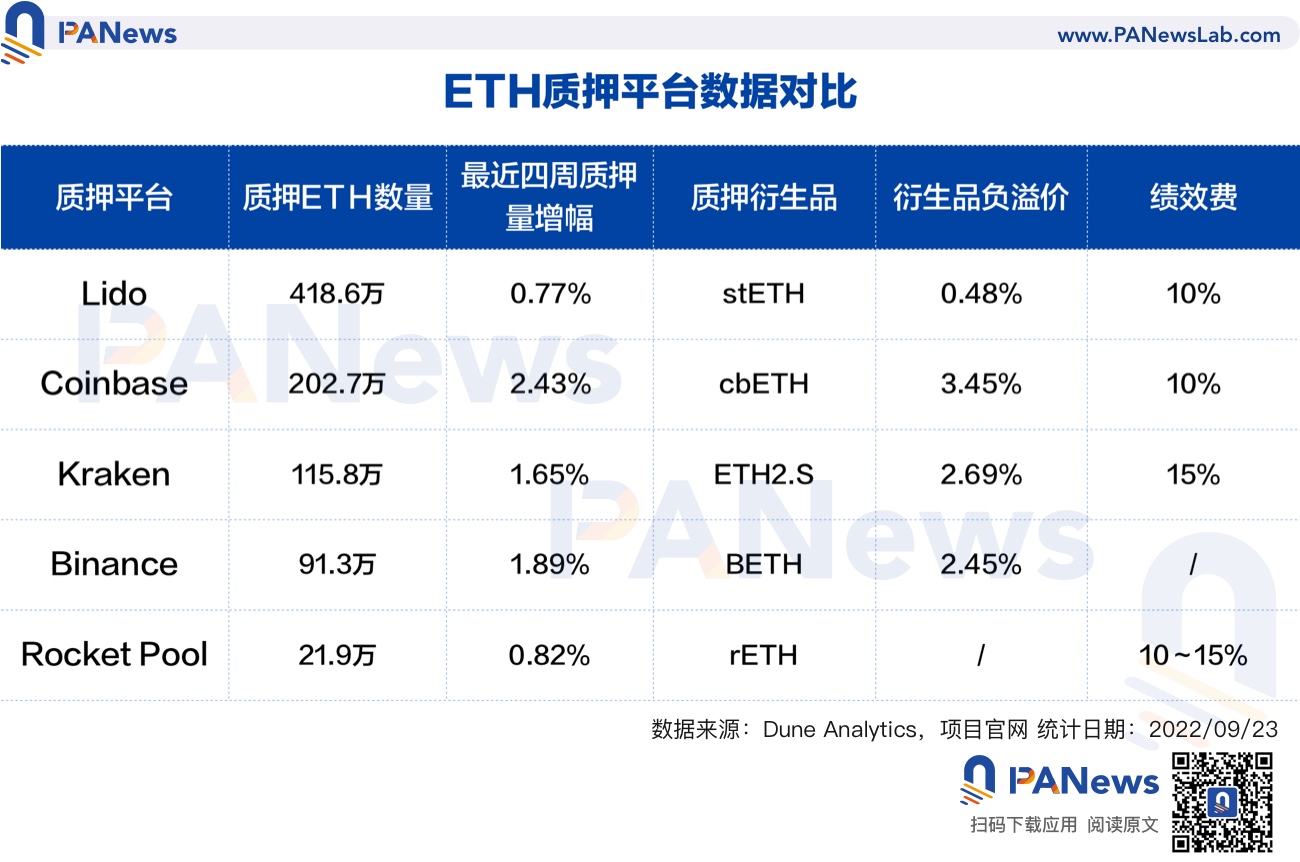
These five projects have issued liquid staking derivatives for pledgers, including Lido’s stETH, Coinbase’s cbETH, Kraken’s ETH2.S, Binance’s BETH, and Rocket Pool’s rETH. The performance fees charged are also between 10% and 15%, which is relatively reasonable. Although Binance data is not public, the current pledge APR is consistent with Lido, both at 5.2%.
Due to the inability to redeem in time, their derivatives/ETH prices all showed a negative premium. StETH with the best liquidity had the lowest negative premium at only 0.48%; Coinbase’s derivative cbETH had the highest negative premium at 3.45%; rETH may have already Included in the pledge reward, the price is higher than ETH, no comparison is made.
The derivatives provided by the liquid staking platform have a wider range of use, and the derivatives of the centralized exchange may only be used on its own platform. Binance’s BETH can only be earned in the spot wallet, and if it is used for activities such as mining on the BNB chain, it will lose its benefits.





