






Closing curtain and new chapter: Where will graphics card computing power go in the "post-Merge era"?


Author: Joe, Waterdrip Capital
index:Table of contents:
Table of contents:
1. The golden age of "bull and bear forever" miners
2. What is PoS, why should ETH switch to PoS?
3. Several assumptions about the coping methods of the Ethereum miners
4. To solve problems in the way of blockchain, decentralized computing power may be promising
5. References
image description
first level title
1. The "Gold Miner" Era of Bull and Bear Winning
image description
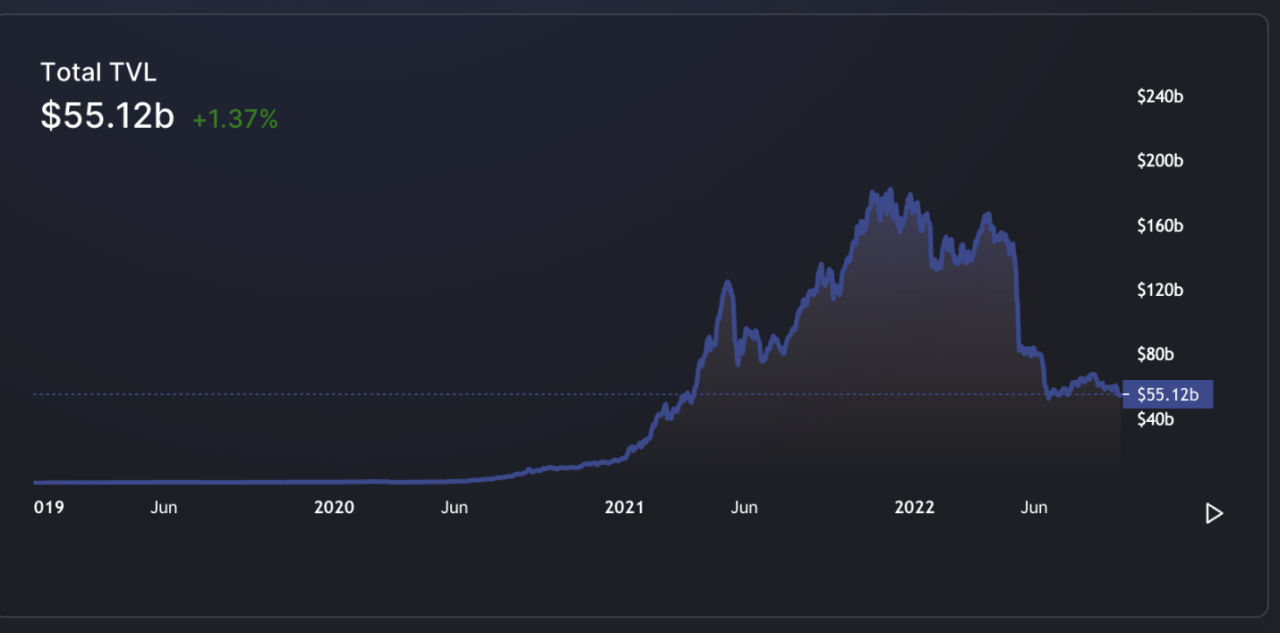
Source of DeFi protocol TVL statistics: DeFiLlama (ps: TVL in 2020.06 is only 1.1B and 2021.05 is 123B)
image description
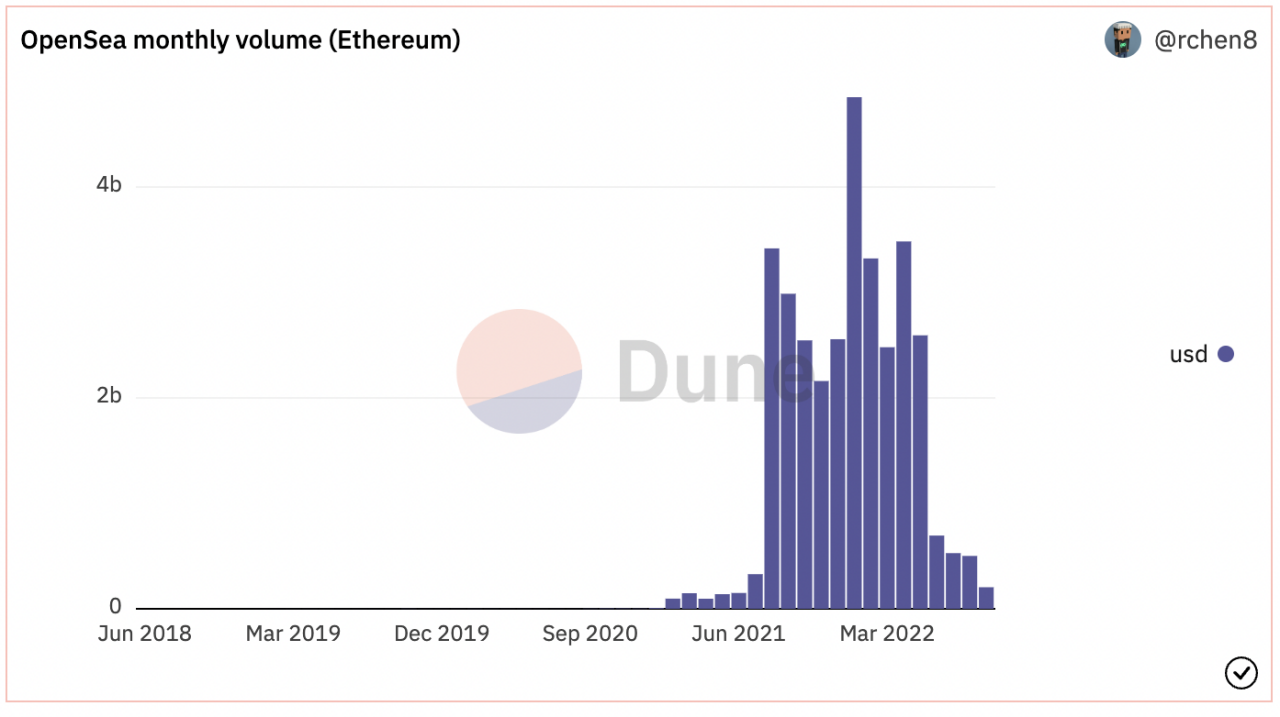
Monthly Volume of NFT trading platform Opensea Source: Dune@rchen8
In the past year, a large number of myths of wealth creation have been born in the industry. There is no doubt that the protagonists of these stories are more or less lucky. And there is a group, regardless of bulls and bears, regardless of price rises and falls, they can obtain relatively stable income every day (in terms of currency standard). In the glorious days of the past, there was a word that can accurately describe this group, namely "bulls". Xiong Yongcai".
Before the birth of Bitcoin (2009.1.3), people usually thought of hard work, underground mines and non-ferrous metals when they talked about the word mining. Compared with mining in the real world, mining in the encrypted world also requires hard work, but the main body of the work is replaced by machines, that is, PoW-the proof-of-work mechanism.
image description
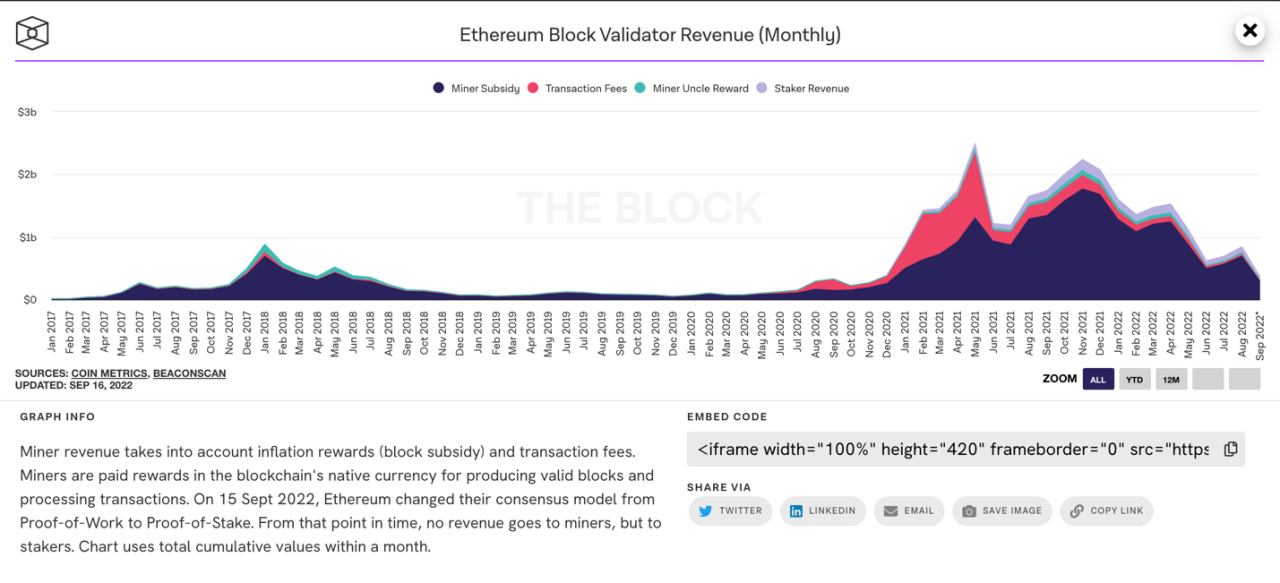
Ethereum network block verifier Monthly income source: The Block
image description
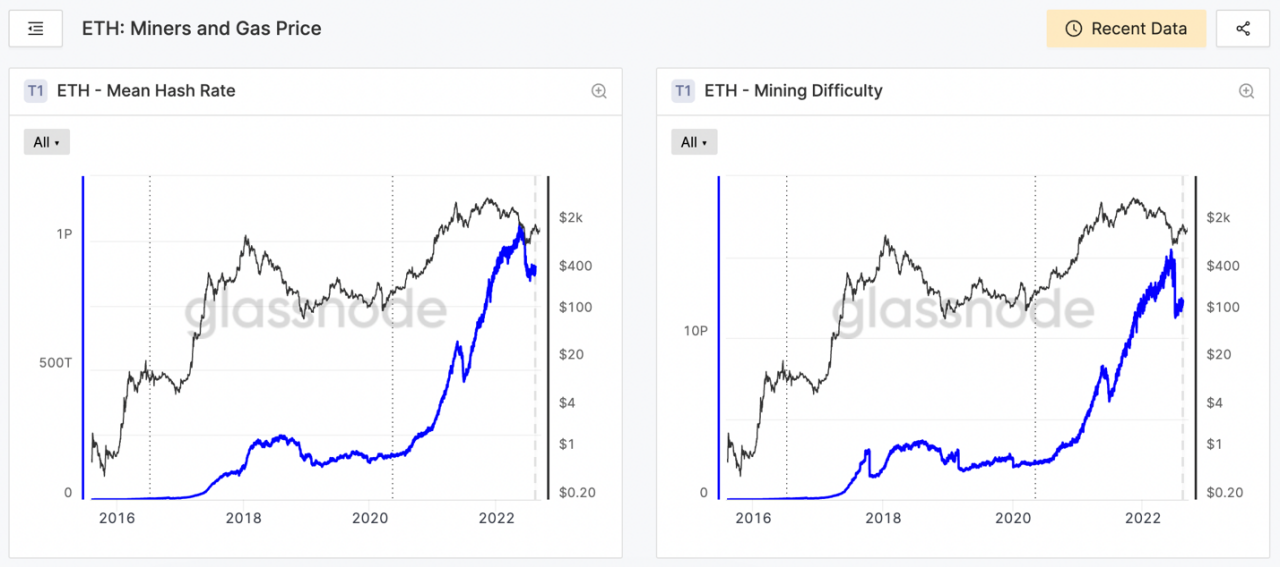
Glassnode: 2016-2022 ETH Hash Rate and Mining Difficulty Statistics
Today's Ethereum has become half of the world of cryptocurrencies. DeFi protocols, NFT applications, Metaverse, chain-based data analysis tools, and wallet applications derived from this are countless. At the same time, due to the existence of EVM, many excellent teams have been guided to develop other EVM-Compatible Blockchains. The new chains carried out the mighty "public chain war" last year under the title of the next Ethereum-Killer, and the applications are flourishing. The contention of a hundred schools of thought with the public chains is almost one of the brightest performances of this round of bull market.
Ps: How to describe the real income cycle of miners - many large miners have a path to cooperate with manufacturers, configure machines by themselves, and generally three or four months are enough to pay back the cycle, and retail investors encounter one that pays back quickly. When you buy a machine, the price of the machine or the price of the currency will rise, and the payback cycle will be shortened. The other is an old machine that others don't want, and it happens that the cost will be paid back in more than a month. In short, just like a landlord with several buildings in the real world, his monthly life is to collect rent regularly, and the life of miners is to withdraw and sell regularly (or someone chooses to hoard coins). profit. (A narration from a senior miner)
image description
first level title
2. What is PoS, why should ETH switch to PoS?
Just like every fairy tale, the boy who slays the dragon eventually becomes a dragon. When Ethereum was born, the founder Vitalik once bluntly stated that he was inspired by Bitcoin and aimed to create "the next generation of cryptocurrency and decentralized application platform". Over the years, today's Ethereum has not lost to the "dragon" Bitcoin at the time in terms of waste of resources (power consumption), over-centralization of large mining pools, and excessive inflationary selling pressure. This giant encryption ship is about to turn.
In the original Ethereum PoW mining method, there is a fatal flaw. Once someone accumulates more than 51% of the computing power of the entire network, they can launch an attack on the entire network. In order to obtain more bookkeeping power, this is As a result, miners have to centralize their machines or host them in a large mining pool, which not only increases the risk of 51% control attacks, but also violates the core spirit of decentralization at the beginning of the cryptocurrency.
The PoS consensus mechanism was first proposed in the Bit-CoinTalk forum in 2011. In the earliest Ethereum white paper, V God also expressed the desire of Ethereum to use PoS as a consensus mechanism, but due to the current technological maturity The problem, PoS at that time was still in the discussion of the concept.
PoS is Proof of Stake, a proof of rights mechanism, which can be simply understood as "mining" by holding coins. Another description with financial meaning, every token holder is a shareholder, and the tokens held are equity. Therefore, the more equity you hold, the more dividends you can get. From the most fundamental output mechanism, the PoS mechanism does not need to consume a lot of electricity to obtain ETH.
image description
first level title
image description
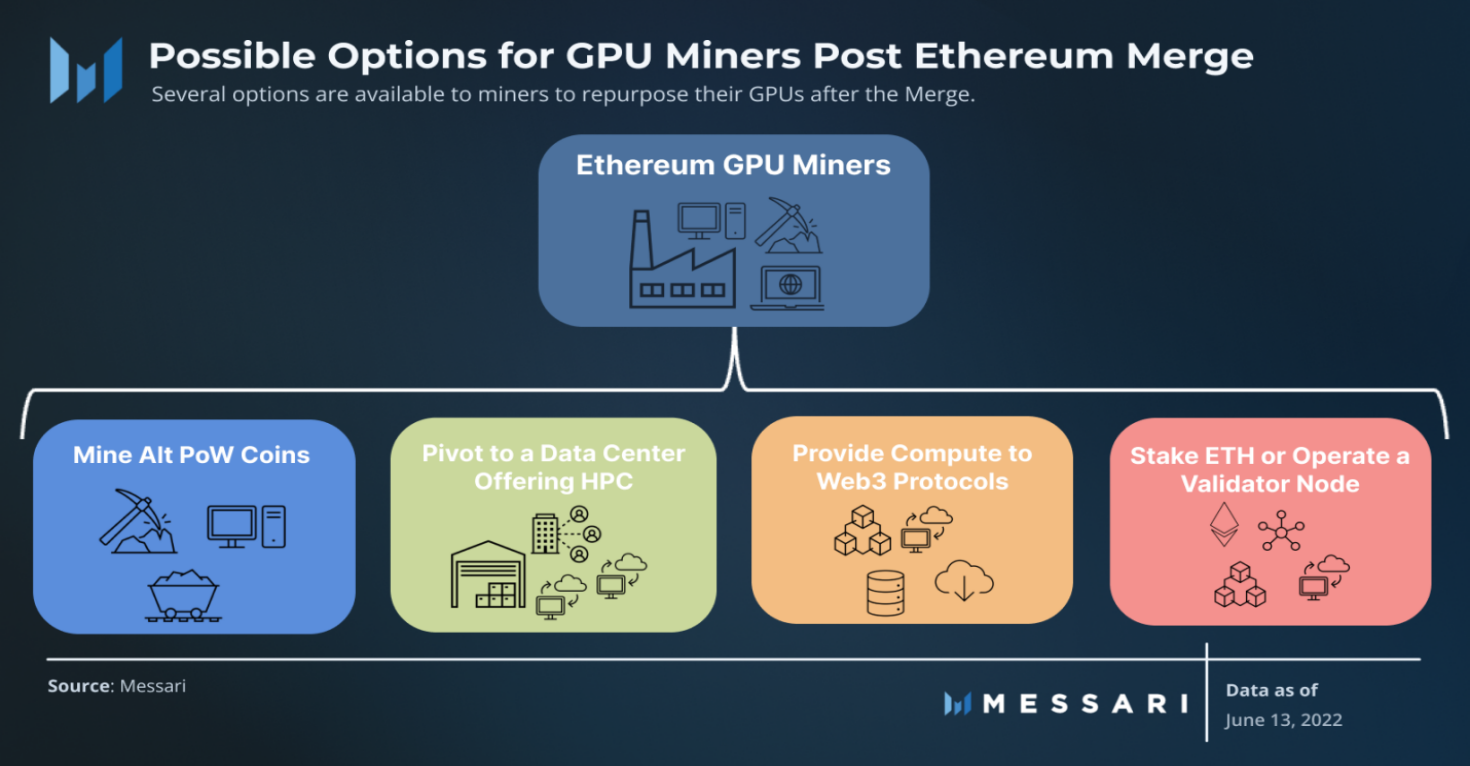
Miners' "way out" source: Messari
"The real problem facing the miners is not only going to sea, but also a way out." As early as June this year, Sami Kassab published an article on Messari describing the major directions of the miners after Merge. Here is a brief explanation of the major directions:
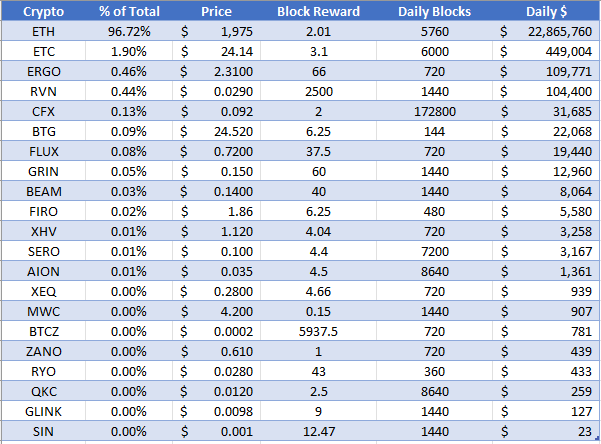
1. Transfer to other PoW tokens such as ETV/ERG/RVN.
image description
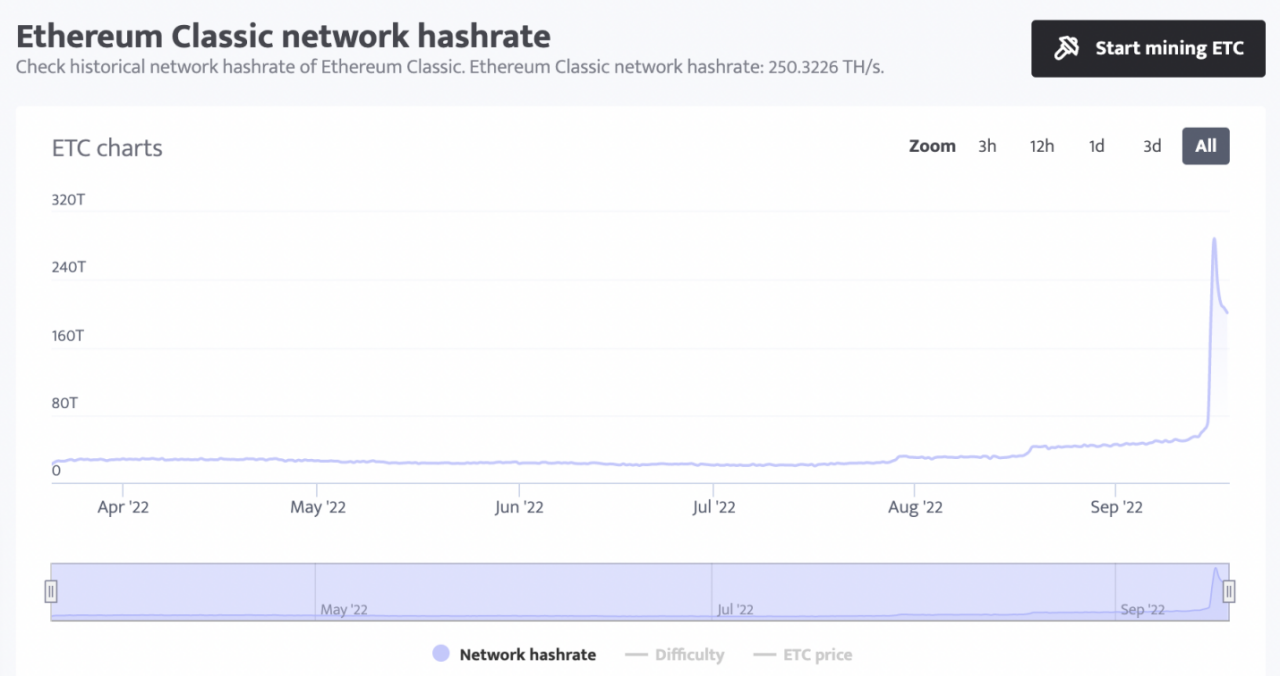
ETC network hash rate statistics source: Minerstat
image description
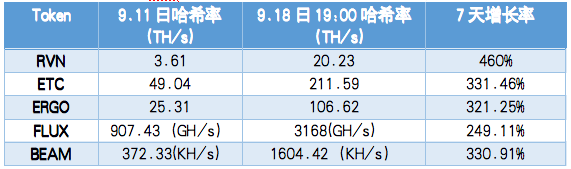
Seven-day hash rate growth statistics of some PoW currencies Statistical source: f2pool, etc.
2. Access to a centralized high-performance computing center.
Two large publicly traded miners, Hut 8 and Hive Blockchain Technologies, have outlined their post-Merge strategies in advance. Both companies will provide their own computing power to high-performance data computing centers. Of course, for such a "behemoth", the transformation will be long. Acquiring data centers and quickly finding alternatives is one way they are finding their place in this struggle.
3. Provide computing resources for some Web3 protocols that are native to the blockchain.
It will be introduced in detail later, so I won’t go into details here. Simply put, it is to provide computing power for some decentralized computing power trading platforms or matching platforms, and solve problems in a more blockchain-based way.
4. Stake ETH to operate the verifier node.
Running an Ethereum validator node would also be an available option, but like the next option, is not a long-term solution in terms of revenue.
5. Clear and leave.image description

Graphics cards for sale on shopping site Amazon
first level title
4. To solve problems in the way of blockchain, decentralized computing power may be promising
secondary title
1.Render Network
secondary title
2.Livepeer Protocol
secondary title
3.Akash Network
Akash Network claims to be the first decentralized cloud computing market, challenging several highly monopolized cloud computing giants such as AWS, Azure, Google Cloud and Alibaba Cloud, aiming to reduce the cost of cloud computing.
secondary title
4.RunOnFlux (formerly ZELcash)
secondary title
5.Hamster Network
secondary title
6.CUDOS Network
secondary title
7. CCN(Pekka)
secondary title
8. Scroll
secondary title
9.Aleo
secondary title
10.Starkware
As mentioned above, the mining of the ZK system has not yet been officially launched, but due to the great difference in the working speed between the two major architectures of Starkware, Sequencer (executing transactions) and Prover (generating ZK proofs), it also requires a group of miners extensive participation.
Judging from the current application examples and prospects, most projects do not have direct competitive attributes, which fully demonstrates that excellent domestic and foreign teams are exploring different perspectives in the computing power undertaking market and blockchain application direction. The cake is still in the stage of continuing to grow.
first level title
5. References
1.What Will Ethereum Miners do After The Merge?——Sami Kassab
2. Will GPU mining end after the Merge (formerly called ETH 2.0)?——bitproit
3. The last miner: 4D review of the 8-year mining history of Ethereum
first level title
6. Appendix - Interviews with several miners
At the end of this article, the author interviewed several Ethereum miners, including their machine size before Merge, payback or not, mining time, current state selection, and Concern, FYI.
Miner A:I used to have more than 200 rx588 and L3+ units. I disposed of these machines in March this year, but it is not considered an escape. Although the L3+ is a second-hand mobile phone bought last year, it has already paid back its cost in two or three months (and all investments have been made. The cost has already been paid back, and now it is pure profit) The probability of failure is about 10%. At present, there are more than a dozen pineapple v1s left, and most of the machines have been shipped out. Most of the friends who are still waiting for the right target (ETF, ETHW, etc.) have switched to the more secure ETC. Although the income has plummeted, it is very stable. For ta and his friends, stability is a more important choice.
Miner B:I used to have more than 300 rx598s. I felt that the situation was wrong and I cleared 90% of the machines in December last year. The ETH I dug out did not return the cost, but counting the price when the machine was sold, it escaped the top and made a profit. Now there are some profit-generating machines left to dig ETC for fun, but he said that ETC can’t handle that part of the computing power. After learning about some suitable blockchain native protocols for access, for him, he doesn’t plan to continue digging other PoW generations. Tokens, prepare to connect to some degen-enabled Web3 protocols to earn related tokens, and bet on the next round of bull market bets.
Miner C:A senior big miner, after May 19, 2021, all machines will be cleared, and he does not plan to buy mining machines again.





