






Don't count on CeFi to save Ethereum


Original title: "Don't count on CeFi to protect the Ethereum network"
Original compilation:
Original compilation:Jack(0x137),BlockBeats
Nothing is absolute, we must evaluate the pros and cons of Ethereum PoS and PoW from different perspectives. But if we compare security with decentralization, it’s like comparing apples to oranges, and the discussion will be meaningless.
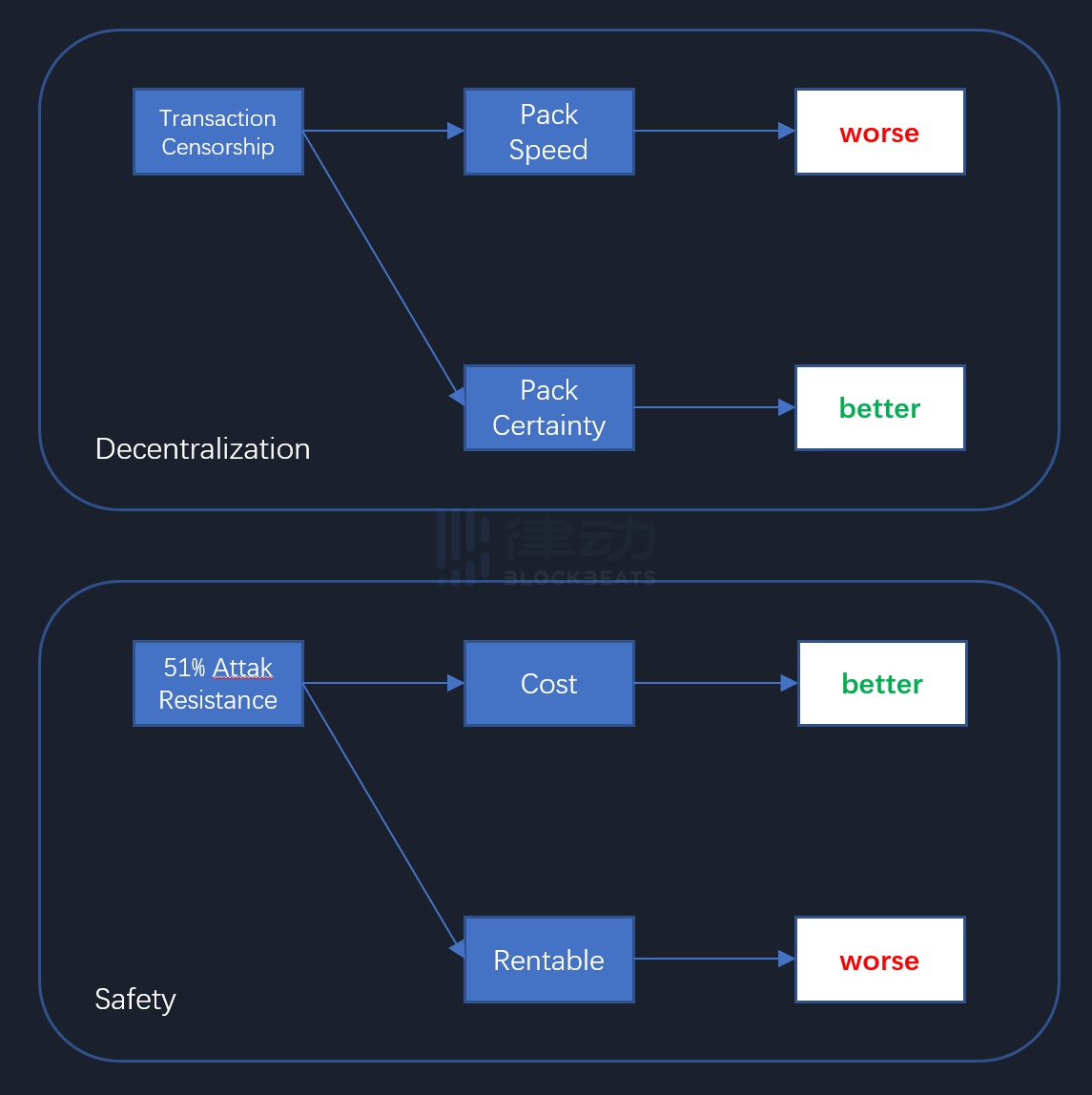
We can think about censorship resistance from at least two perspectives:
1. If it is censored, how long will your transaction be blocked on the chain?
2. If it is censored, can you guarantee that your transaction can still be packaged on the chain in the future?
And to prevent 51% attack, let us consider the following two aspects:
1. How much does it cost to hack?
2. How likely are they to rent enough mining equipment?
For the Ethereum merger, we should not simply say that the decentralization and security level of PoS is "higher" or "lower" than that of PoW, the scope of these problems is too broad. So, let's dissect them one by one.
Let's talk about security first. There is no doubt that the cost of attack under PoS has indeed become higher. This has been discussed many times. If you try to attack a PoW network with your insane hash rate, your actual cost is just your electricity bill. Attacking the network won't change your hashrate, especially when there is a high percentage of GPU miners on the market. Even if your attack fails, you can dismantle the crypto mining facility and sell those graphics cards.
But if you attack the PoS network, you risk losing all the pledged ETH. This increases the cost of the attack hundreds of times. We must be aware that the cost of attacking PoW is temporary, whereas with PoS it is permanent.
However, PoS fares a little less well when it comes to renting mining equipment. In view of the physical characteristics of PoW mining, miners are scattered all over the world, which makes it difficult for you to rent 51% of the total computing power of ETH. This is not a cost issue, but a "one or zero" issue.
PoS is different. There are currently 120 million ETH in circulation, of which more than 13 million are pledged on the beacon chain. In theory, as long as you can "borrow" 5% of the circulating ETH, you can carry out a 51% attack. Of course, I'm not saying it's easy, it's still very difficult, but not as hard as PoW.
In a centralized world, borrowing and lending may require some collateral, or may rely on reputation, or even power, such as regulators, so here comes our second problem - censorship resistance, which is a decentralized feature part.
At least 2/3 of the Ethereum beacon chain nodes are under the jurisdiction of US regulators, which may lead to compromised censorship resistance. Discussion on the issue started with this tweet:
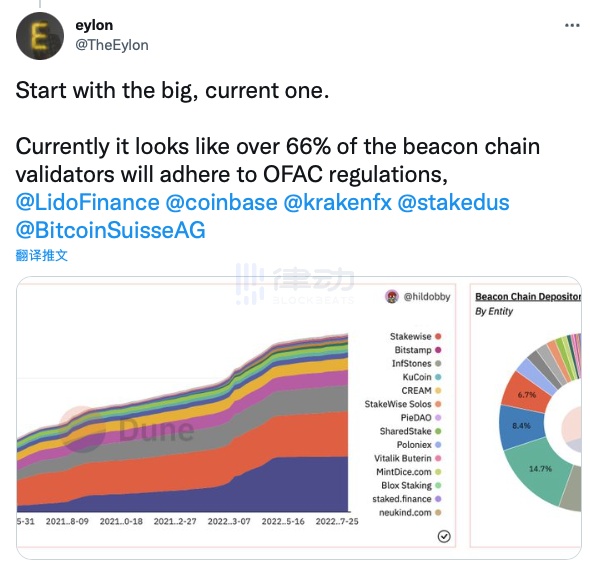
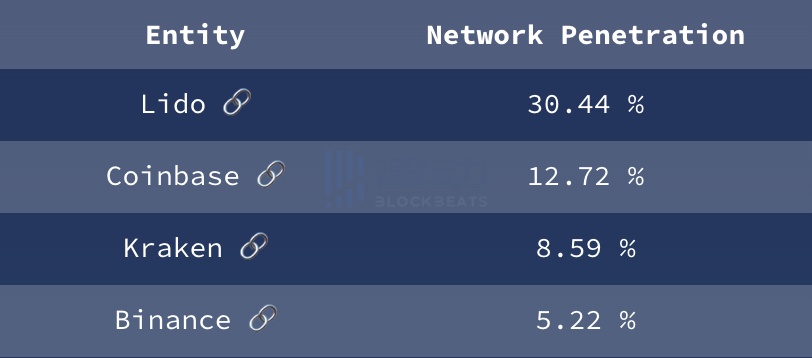
After the merger, the top four entities are Lido, Coinbase, Kraken, and Binance, accounting for more than 55% of the total.
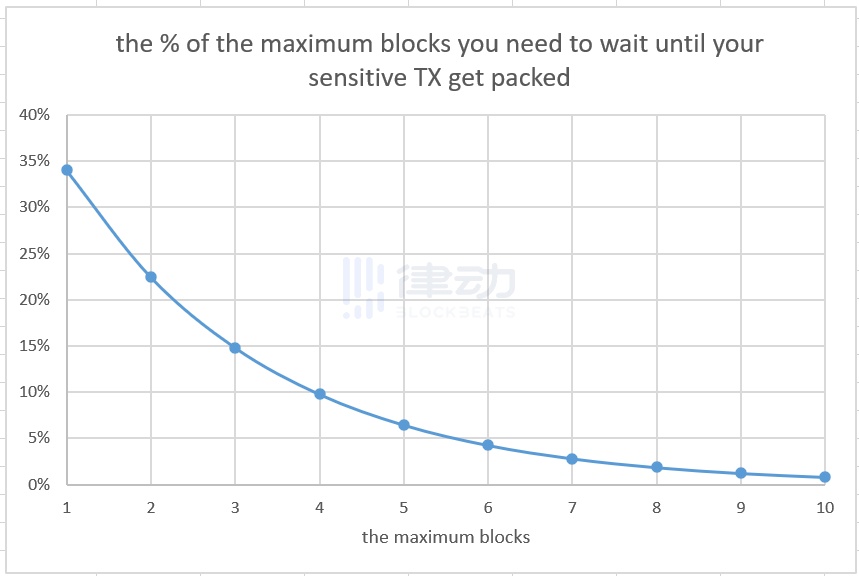
Let's take Tornado Cash as an example. If US regulations require 2/3 of the mining pools to ban a transaction, it will take longer for Tornado-related transactions to get on-chain. It used to take about 12 seconds, but in the future it could take 30+ seconds, or maybe even a minute or two if you're unlucky.
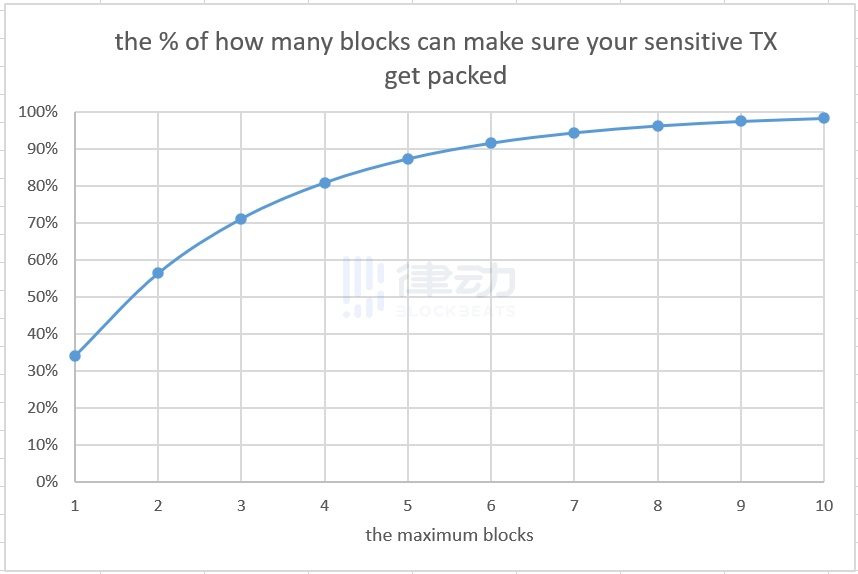
As you can see from the curve below, the probability of banning a trade for 1 minute in a row is about 7%, which is a bit disappointing.
But in fact, this is not a PoS consensus problem. This is about miner changes. In the past, the top 10 mining pools in PoW accounted for 78% of the computing power. In theory, they could also collectively censor your transaction and prevent it from being uploaded to the chain.
Many of these are mining pools with a continental background, some located in Russia and Central Asia. China and Russia are the few regions in the world that the United States cannot directly sanction. Therefore, censorship resistance is not about the technology, but about the location of the miners.
Today's PoS pools, whether it's Lido, Coinbase, or Kraken, are based in the US and are therefore heavily restricted. Although they are all making positive statements now, it is only a matter of time before regulators scrutinize illegal transactions in the future. PoS is actually worse than PoW in terms of censorship resistance.
Another metric to evaluate PoW vs. PoS is the worst case scenario, which is whether you can guarantee that your transaction will at least be on-chain. Let's continue the calculation above, if we still assume that 2/3 of the nodes are in the review state, then the probability of a transaction being on-chain within 10 blocks is still 98%. You can always find mining pools that ignore US regulatory requirements, the only thing you have to do is wait.
So what if the government in power decides to roll back your deal after discovering that you can always get out of sanctions by waiting longer?
First, the issue is no longer within the scope of censorship resistance discussions. It's almost like a direct attack on the network. The probability of this happening is extremely small, but not zero.
For example, a Tornado Cash-related transaction ended up on-chain through a node that is not regulated by the government. At this time, the supervisor who controls 2/3 nodes can directly fork the network, remove the block containing this transaction, and make it never go on the chain. Although they cannot delete the transaction, they can simply discard the block, which can be done in a single Echo under PoS.
In this case, some Ethereum community members have proposed "Social Slashing", which means confiscating the ETH pledged by these nodes. However, this may lead to a new totalitarianism. Ethereum should not adopt those rules that do not exist on the blockchain.
Additionally, current pool nodes are often connected to MEV tools such as Flashbot. However, Flashbot is also regulated. This means that transactions that do not meet regulatory requirements will not appear in the Flashbot transaction list at all, and the nodes containing these transactions will be affected. Therefore, nodes also require more MEV tools.
Last month, Coinbase came out and said they would rather get out of the ethereum staking business than censor the network to comply with sanctions. However, the pledge service is very profitable. It is estimated that the pledge annual interest rate can reach 6-8%, and the commission can be charged at 10%-20%. If Coinbase stops providing staking services, based on the 1 million ETH in their cold wallet, they will lose at least tens of thousands of ETH every year.
So this business will definitely continue. Of course, regulators will continue to monitor.
Therefore, we can't really count on CeFi to save the Ethereum network, whether it's Coinbase, Lido (half CeFi) or Flashbot (centralized tool). Instead, we have to make technical improvements and optimizations to the chain itself. there's still a long way to go.
Original link





