当 800 萬枚 ETH 開始「搬家」:後 Pectra 時代,Staking 迎來結構性巨變?


- 核心觀點:文章解析了 Lido 正將其管理的 800 多萬枚 ETH(約 160 億美元)的驗證器,遷移至以太坊 Pectra 升級後引入的「複利驗證器」(0x02 憑證),此舉旨在透過合併驗證器、降低營運成本,而非顯著提升收益,標誌著以太坊質押生態從標準化產品向精細化基礎設施競爭的結構性轉變。
- 關鍵要素:
- Lido 計劃將超過 26.5 萬個舊版 0x01 驗證器合併為 0x02 驗證器,使以太坊全網驗證器數量從約 88 萬個降至約 62.8 萬個,降幅近三分之一。
- Pectra 升級中的 EIP-7251 將單個驗證器最大有效餘額從 32 ETH 提高至 2048 ETH,允許獎勵自動複投,減少了為管理更多 ETH 而不斷創建新驗證器的需求。
- 論文模擬顯示,0x02 驗證器的共識層 APR 相比 0x01 有小幅提升(約 4.7% 的相對提升),且對小規模質押者效果更顯著,因其原本難以歸集零散獎勵進行複投。
- 對於 Lido 等大型機構,遷移的核心價值在於透過合併驗證器降低節點、金鑰和共識層訊息的管理成本,而非追求 APR 的微小增長。
- 遷移至 Curated Module v2 後,Lido 的節點運營商首次需鎖定 ETH 作為保證金,增加了真實資本約束,標誌著競爭標準轉向資金管理與風險控制。
Recently, there has been a major piece of news overlooked by the market: Lido is in the process of "moving" over 8 million ETH (worth approximately $16 billion).
Of course, this does not mean transferring funds from Lido to another new protocol, but rather gradually migrating the hundreds of thousands of legacy validators backing stETH to the new validator architecture introduced after the Pectra upgrade.
According to Lido's plan, over 265,000 validators using the old 0x01 withdrawal credentials will be progressively consolidated into fewer 0x02 validators with higher balances. Upon completion of the migration, the total number of validators on the Ethereum network is expected to drop from about 880,000 to approximately 628,000, a reduction of nearly one-third. The number of attestation messages required to propagate in each Epoch may also decrease by about 29%.
This will not directly reduce the Gas fees paid by ordinary users, nor will it suddenly speed up transaction confirmation times. Furthermore, to complete the migration, Lido estimates the temporary loss of rewards will be equivalent to approximately 0.28% of the protocol's annual staking rewards.
So, given that the yield improvement is limited and the migration itself incurs costs, why is Lido still pushing this multi-billion dollar "move"?
The answer lies in a key change brought by the Pectra upgrade in May 2025 – the compounding validator.

1. Lido's "Move" of 8 Million ETH: What Exactly Is Being Moved?
On May 7, 2025, the Pectra upgrade officially went live on the Ethereum mainnet.
Among its changes, EIP-7251 increases the maximum effective balance of a single validator from 32 ETH to 2048 ETH and introduces withdrawal credentials starting with "0x02". Validators using the new credentials can keep their consensus layer rewards in their beacon chain balance, gradually increasing their effective balance and generating new returns. Hence, they are also called "compounding validators."
On the surface, this merely encodes "automatic reward reinvestment" into the protocol. However, the deeper change is that it breaks Ethereum's long-standing fixed 32 ETH validator structure.
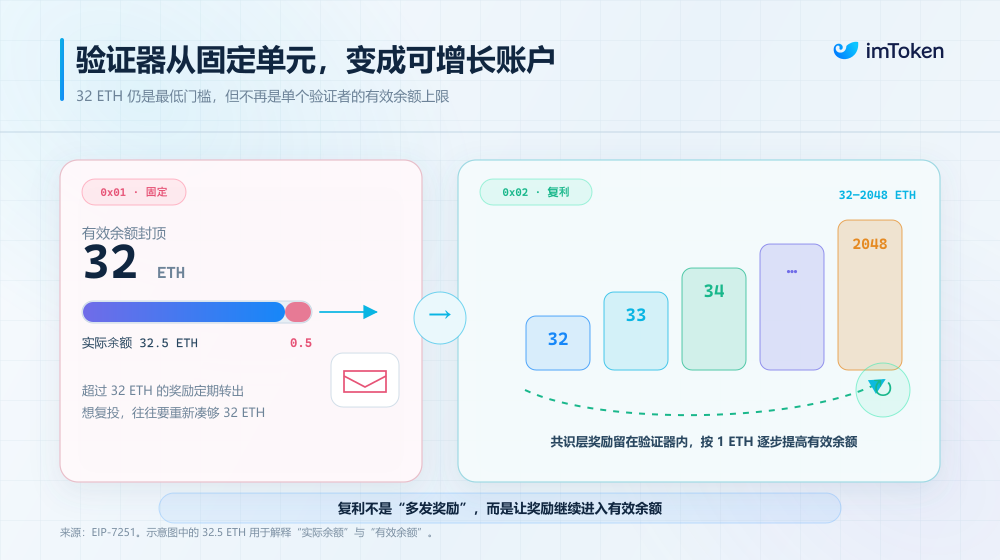
As is well known, the effective balance cap for Ethereum validators has always been fixed at 32 ETH. Regardless of whether the balance grows to 33 ETH or higher, the effective balance used for calculating consensus rewards remains capped at 32 ETH. The excess portion does not increase the validator's weight. Instead, it is periodically transferred to an execution layer withdrawal address.
For individual stakers running only one or a few validators, to get their rewards to participate in native staking again, they must accumulate the scattered rewards from different validators to reach another 32 ETH. The reinvestment threshold is high, and small balances remain outside the staking ecosystem after being transferred to the withdrawal address.
Simultaneously, for Lido, large exchanges, and professional staking service providers, while they can aggregate the small rewards generated by many users to form new 32 ETH units more quickly, they face another kind of cost – every time 32 ETH is accumulated, a new validator typically needs to be created and maintained.
One must realize that as Ethereum's staking scale continues to grow, the number of validators also expands, accompanied by increasing indices, keys, signatures, and attestation messages, driving up operational and maintenance costs.
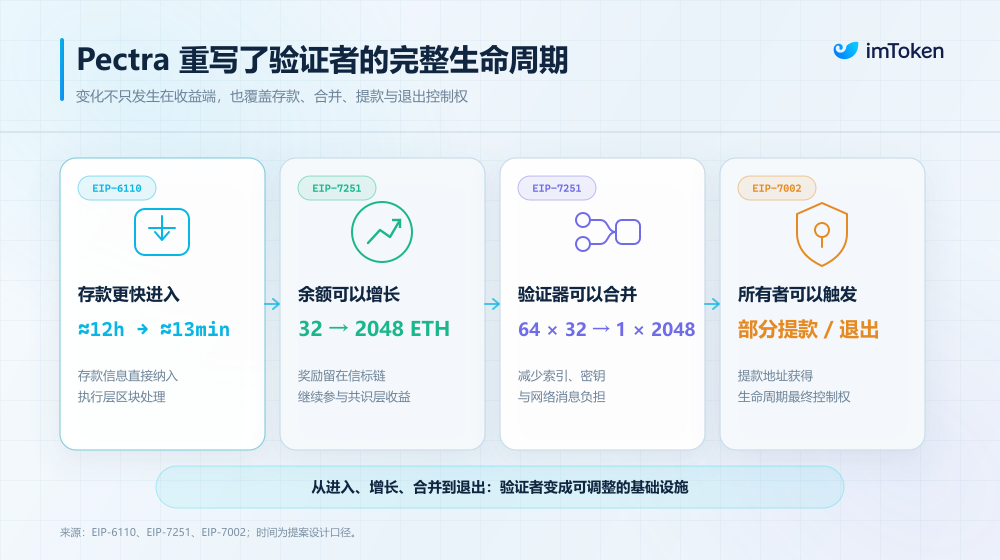
EIP-7251, introduced by Pectra, aims to change this structure.
In the new 0x02 model, the minimum threshold to launch a validator remains 32 ETH, but the maximum effective balance for a single validator is raised to 2048 ETH. This means rewards no longer have to be automatically withdrawn. Instead, they can remain in the validator, continuing to increase the effective balance and generate new returns.
Moreover, multiple existing validators can be consolidated. For example, 2048 ETH previously spread across 64 validators can be merged into a single high-balance validator. Total staking weight remains unchanged, but the number of validators, keys, and network messages required for maintenance is drastically reduced (see extended reading: "A Year On, 'Lean Ethereum' Sets Sail Again: What Answers Does Ethereum Aim to Deliver?").
In essence, funds are not leaving Ethereum, and the economic security provided remains the same, but the operational burden is significantly reduced.
This consolidation is precisely what Lido is pushing forward.
So, strictly speaking, 'compounding' in 'compounding validator' only explains half of its value. The other half lies in the fact that validators can finally be restructured from numerous standardized 32 ETH units into a more streamlined infrastructure better suited for large-scale operations.
2. What Kind of Yield Improvement Can Be Achieved?
Interestingly, from a purely yield perspective, the improvement from compounding is not uniformly distributed.
Theoretically, both individual stakers and large institutions can use 0x02 to reduce idle balances, allowing rewards to participate in subsequent staking more directly. However, since different participants have different capabilities for managing funds, the marginal benefit from the upgrade varies.
A paper published in June 2026, "When Staking Rewards Compound: Measuring the Impact of Ethereum's Pectra Upgrade", compares the yield performance of 0x01 and 0x02 validators.
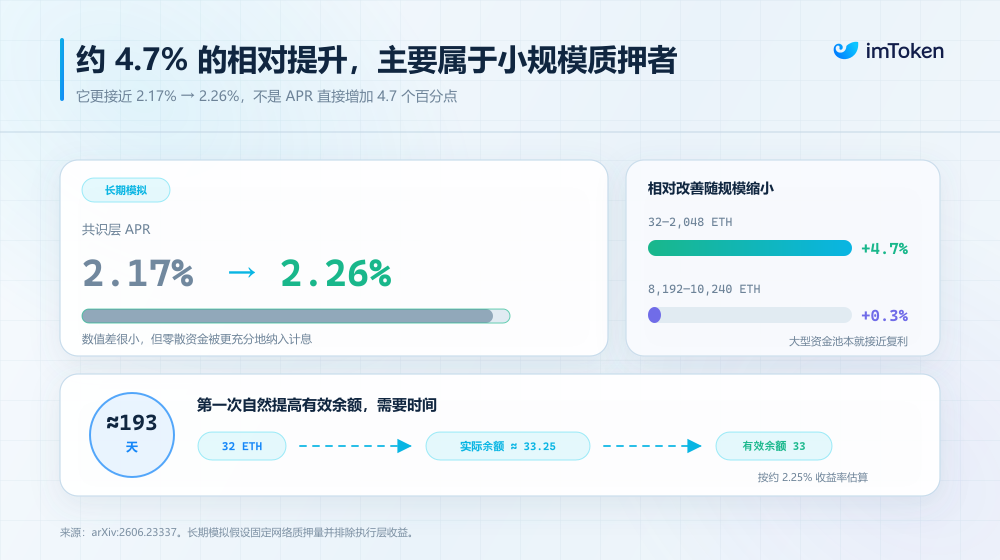
Simulation results show that for balances between 32 ETH and 2048 ETH, the average consensus layer APR for 0x01 validators was approximately 2.17%, while for 0x02 validators it was about 2.26% – a relative improvement of roughly 4.7%. However, when the staking scale reaches 8192 ETH to 10240 ETH, the relative gap narrows to about 0.3%.
It's particularly important to note that the "approximately 4.7%" mentioned in the paper is not a direct increase of 4.7 percentage points in APR, but rather a relative improvement of about 4.7% on top of the original ~2-3% consensus layer APR.
The reason smaller stakers see a more significant improvement is not that they have access to some exclusive benefit, but rather that they historically found it more difficult to compound their rewards.
For instance, if a user has only one 32 ETH validator, the rewards are automatically transferred to a withdrawal address. The user must then accumulate for a long time or merge with other funds to reach another 32 ETH and launch the next validator. Furthermore, any amount less than 32 ETH remains scattered across different addresses, making the willingness to consolidate very low.
However, the 0x02 validator allows these funds to continue increasing their effective balance within the same validator, thereby reducing idle funds formed by "under 32 ETH" amounts. In short, what small-scale stakers lacked in the past was not just the willingness to reinvest, but also the ability to effectively redeploy scattered ETH back into native staking.
Large staking service providers can also benefit from native compounding, but they originally had stronger capital aggregation capabilities. They can quickly accumulate new 32 ETH units and launch the next validator. From the perspective of the entire fund pool, they could achieve a capital allocation effect close to compounding even before the upgrade.
Therefore, the larger the staking scale, the lower the proportion of idle balances in total funds, and the smaller the marginal improvement brought by 0x02.
However, this does not mean 0x02 is unimportant for large institutions.
Quite the opposite, the core problem facing large institutions is shifting from "how to make rewards generate further returns" to "how to manage more ETH with fewer validators."
For them, the value of 0x02 is more apparent in two aspects. First, rewards can remain in the validator to compound, reducing the operations of frequent aggregation, re-depositing, and creating new validators. Second, the vast number of existing 32 ETH validators can be consolidated, significantly lowering the management overhead for nodes, keys, and consensus layer messages.
Of course, this change also brings new trade-offs.
Traditional 0x01 validators automatically transfer rewards exceeding 32 ETH to the withdrawal address without needing an active on-chain action. The 0x02 model, by default, retains rewards in the validator. Large service providers needing to meet user redemptions or schedule liquidity must proactively initiate partial withdrawals and redesign their accounting, reward distribution, and capital buffer mechanisms.
Therefore, for small-scale stakers, the most direct value of 0x02 is lowering the reinvestment barrier and reducing idle funds. For large institutions, while the yield improvement is smaller, the consolidation of validators and improvement in infrastructure efficiency are more critical.
Both benefit from the same mechanism, but the source of the benefit and its priority differ.
3. What Changes and What Stays the Same in Ethereum's Staking Ecosystem?
So, if viewed solely from the perspective of APR, Lido's migration doesn't seem like a particularly attractive business proposition.
After all, the yield improvement for large service providers from compounding might be less than 1%, there are temporary reward losses during the migration process, and the existing accounting, withdrawal, and liquidity management systems need adjustment.
Yet, Lido decided to push forward with this largest core architecture upgrade since the V2 upgrade in 2023. The reason is that when the protocol manages over 8 million ETH, sheer validator count itself becomes a cost.
Especially after the Pectra upgrade, a single 2048 ETH validator can carry the staking weight equivalent to 64 traditional validators. This means using fewer validators to manage more capital efficiently.
In fact, Lido's upgrade is not just about consolidating validators.
With the migration to Curated Module v2 (CMv2), its professional node operators are, for the first time, required to lock ETH as collateral. If operational interruptions, slashing, reward mismatches, or other attributable issues occur, this collateral can be used to cover losses.
Previously, Lido's curated node operators primarily relied on historical performance and reputation to build trust. Now, while reputation remains important, an additional layer of real capital constraints has been added. All 34 existing curated node operators are expected to migrate to CMv2, with none opting out due to the collateral requirement.
This change might be more noteworthy than compounding itself. It also signifies that the competitive benchmark for staking Post-Pectra is undergoing a structural transformation.
This implies that future differences between staking services will likely manifest more in how they improve effective capital utilization, manage withdrawals and liquidity, distribute validator risk, and balance asset control, operational complexity, and yield.

For user-facing interfaces like wallets, the value proposition is no longer just about displaying a yield number to users. It increasingly involves helping users understand the capital pathways and risk structures behind different staking methods. Taking imToken Stake as an example:
- Currently, users can directly access staking features from their ETH asset page and choose services based on their capital size and needs. Users who want to participate with smaller amounts can do so through the staking services integrated into the wallet.
- For users holding over 32 ETH who wish to retain control over their assets, they can also opt for non-custodial validator solutions. This allows them to participate in native Ethereum staking while avoiding the need to run their own node.
As compounding validators become more common, the information these entry points need to present will also grow. This includes details like whether rewards are auto-compounded, when rewards can be withdrawn, which type of withdrawal credentials the validator uses, who controls the funds, and the technical and liquidity risks associated with different solutions.
This also means that a wallet no longer simply connects to a staking yield page. Instead, it connects to a set of validator services that are continuously differentiating.
Concluding Thoughts
Overall, from The Merge to the Shanghai upgrade, and now the Pectra upgrade, Ethereum is progressively completing the lifecycle of staking.
The Merge established validators as the core of network security. The Shanghai upgrade solved the problem of how staked funds could be withdrawn. The Pectra upgrade begins to further optimize how funds enter, accumulate, and are reorganized.
Of course, compounding validators will not grant equal yield improvements to all participants:
- For small-scale stakers, it can reduce idle balances, allowing long-held ETH to more fully participate in consensus.
- For large institutions, its more critical value might not be increasing APR, but rather reducing the number of validators and lowering operational burdens.
Therefore, the migration to 0x02 validators is destined to be gradual. Different participants, based on their capital size, liquidity needs, and operational structure, will choose whether to keep existing validators or gradually shift to the compounding model.
However, the way Ethereum organizes staking capital is already undergoing a step-by-step structural transformation. Especially now that validators are no longer fixed at 32 ETH, the staking ecosystem is moving from standardized yield products towards more granular capital management and infrastructure competition.
This is a significant paradigm shift in Ethereum staking worth tracking over the long term.