悬崖边盖楼,谷歌Meta们不敢公开的债


- 核心观点:美国五大科技巨头(微软、谷歌、亚马逊、Meta、甲骨文)利用SPV、融资租赁、信用担保等复杂金融工具,将高达2.13万亿美元的AI数据中心建设债务隐藏于资产负债表之外,形成可能威胁全球金融体系的“影子借贷”风险。
- 关键要素:
- 截至2026年第二季度,五大科技公司通过影子借贷隐藏的“数据中心债”规模达2.13万亿美元,是其表内总负债(1.35万亿)的1.6倍;一年内,表外债务总额从1.02万亿飙升至2.86万亿美元,增长近两倍。
- Meta为路易斯安那州Hyperion数据中心集资273亿美元,通过80/20股权结构的SPV(Beignet项目)隔离债务,使其不出现在自身资产负债表上,仅记录23.7亿美元投资。
- 微软通过融资租赁负债隐藏债务,该负债从271亿美元翻倍至629亿美元,未计入“债务”项;谷歌使用信用担保(名义规模半年内从169亿升至438亿),但表内仅确认8.15亿美元估值。
- 国际清算银行(BIS)在2026年报告中,将科技巨头的“影子借贷”与主权债务并列,列为全球金融体系首要风险;标普对甲骨文降级至BBB-,使其债券距垃圾级仅一步之遥。
- 私募资本接棒银行成为主要资金方(如Blue Owl、贝莱德),数据中心贷款成为华尔街最抢手资产;但基金面临赎回压力,如Blue Owl基金连续两季收到近40%赎回申请,实际兑付仅一成多。
- 核心风险在于:60%计划中的数据中心尚未动工(如Hyperion预计2029年完工),而债务已售出;GPU等硬件寿命通常5-6年,而债券期限长达24年(如Meta债券至2049年到期)。
In August 2025, someone registered seven companies in Delaware, all incorporating the word "Beignet" in their names.
Beignet is a deep-fried pastry popular on the streets of New Orleans, generously dusted with powdered sugar that inevitably falls onto one's clothes with every bite.
No matter how hard you try, you'd never guess this pastry has any connection to AI.
A month after the Beignet companies appeared, Meta built a data center in Louisiana called Hyperion, covering an area equivalent to four New York Central Parks.
To construct this massive data center, Meta borrowed a total of $27.3 billion.
But if you carefully review Meta's financial reports, you'll find that the entire record related to this project on its balance sheet is just a $2.37 billion investment.
The remaining two hundred billion in debt has vanished.
This is not an isolated incident.
On July 22nd, the Nikkei published an article stating that US tech giants have hidden up to $1.65 trillion in debt out of sight. This figure even exceeds their total liabilities of $1.35 trillion listed on balance sheets.
We combed through the filings these five companies submitted to the SEC and found the actual situation to be even more exaggerated than that report suggested.
On July 23rd, the day after the report was published, Google's parent company, Alphabet, submitted its quarterly filing. Its purchase commitments jumped from $332.4 billion three months prior to $811 billion. A year earlier, that number was $62.1 billion.
An increase of thirteen times in one year. This also pushed the $1.65 trillion figure from the Nikkei report up to $2.13 trillion.
Over the past year, the debt created by the five companies — Microsoft, Google, Amazon, Meta, and Oracle — related to data centers rose from $710.8 billion to $1.55 trillion. If you include procurement and construction contracts for hardware like GPUs, it surged from $1.02 trillion to $2.86 trillion. Nearly a twofold increase in one year.
And the portion actually sitting on their balance sheets is only a quarter of that final figure. A staggering $2.13 trillion in "data center debt" has vanished from the balance sheets of these tech giants.

Where did this debt go?
The Bank for International Settlements (BIS) noticed this phenomenon early on. In a quarterly report from March 2026, it gave this practice a name: "Shadow Borrowing." The report stated that these arrangements are economically equivalent to debt yet largely remain off the companies' balance sheets.
Three months later, in its annual report, the BIS took the unusual step of listing the AI bubble and circular financing alongside sovereign debt as a primary risk to the global financial system.
By going through the various filings of the five companies, at least five different methods can be identified: SPVs, credit enhancement derivatives, finance leases, residual value guarantees, and leases that have not yet commenced.
And the people helping create these shadow debts are turning this into a completely new business.
Tech Giants' Collective 'Return to Poverty'
For the past two decades, tech giants have been among the most comfortable companies in the US capital market. They generate significant profits, hold ample cash on their books, and consistently buy back their own stock.
In Q4 2021, the five giants — Microsoft, Google, Amazon, Meta, and Oracle — collectively repurchased $48 billion in shares, with Meta alone spending $20 billion. With such abundant cash, shareholders didn't need to worry about potential funding shortages.
But by Q1 2026, the total buybacks for the five companies plummeted to just $4.6 billion.
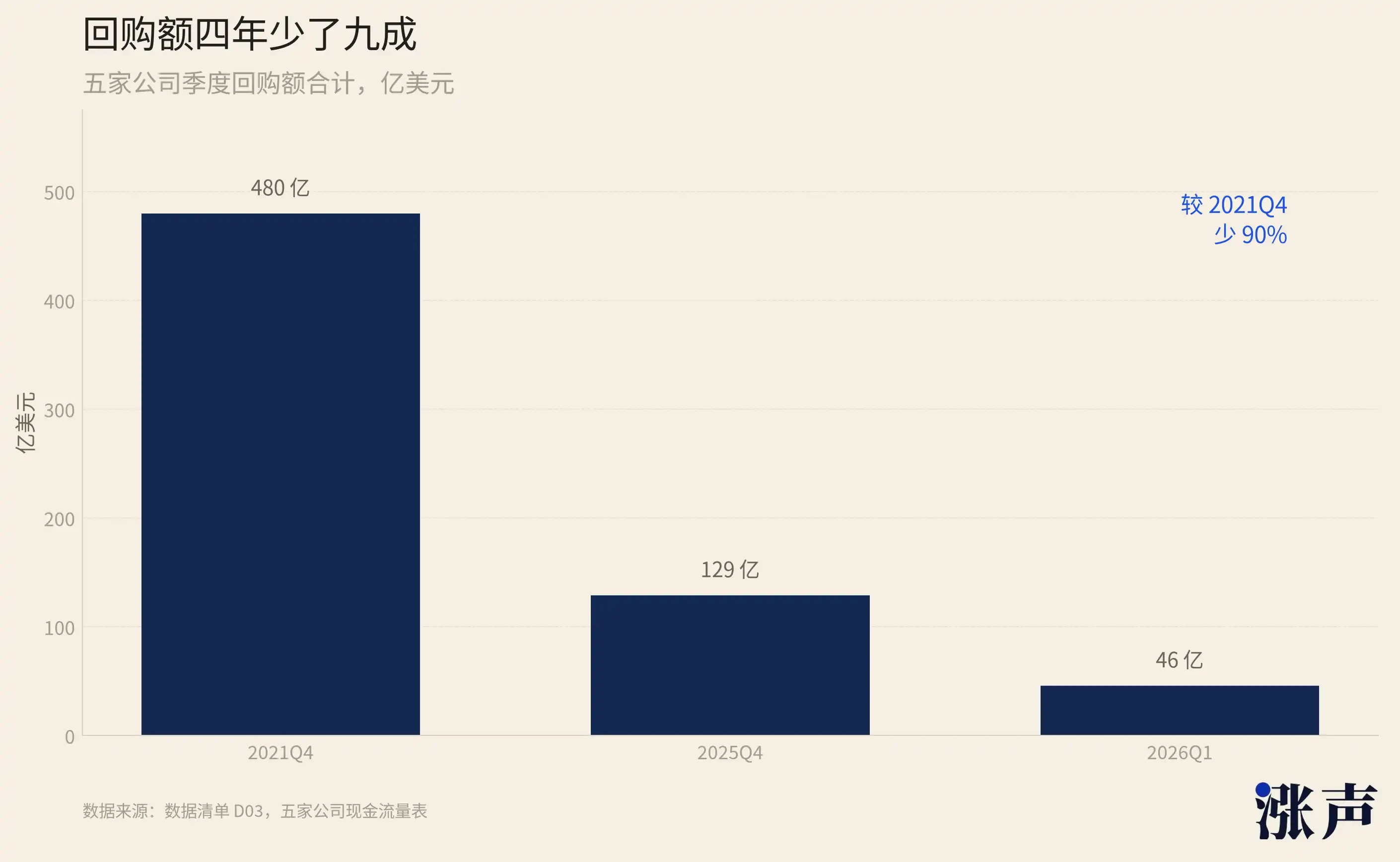
Over the past two years, tech companies' AI-related capital expenditures have more than doubled, while operating cash flow growth has been less than 60%. At this growth rate, by mid-2027, tech giants are projected to "collectively return to poverty," falling back into an era of operating losses.

Morgan Stanley estimates that by 2028, tech companies will need to spend approximately $2.9 trillion on AI, but their internally generated funds will only be around $1.4 trillion. The $1.5 trillion gap must be sourced from outside their cash flows.
So, they started borrowing. Between 2020 and 2023, the five companies issued an average of about $31.3 billion in bonds annually. By July 2026, that figure had reached $189.7 billion, six times the historical average.

The massive wave of corporate bonds is starting to strain the market. Over the past nine months, Amazon's bond oversubscription ratio has been steadily declining. In November 2025, it was 5.3 times; by July 2026, it had dropped to just 1.6 times.
The cost of issuing debt is also rising. Across the entire investment-grade bond market this year, paying an average of 4 basis points more is enough to sell a new bond. But for Amazon's July issuance, they had to offer 18 to 21 basis points extra to get it done.
Google and Oracle went even further, raising nearly $80 billion through equity offerings and subsequently announcing an additional $60 billion in ATM (At-The-Market) issuance plans.
Financial media outlets collectively complained that tech giants had broken the "implicit contract" with investors. Historically, the market bought these stocks assuming net cash, low debt, and continuous buybacks. Now, they have to resort to heavy borrowing and halt buybacks.
But the real trouble is written on the balance sheets of the giants.
More debt on the balance sheet makes rating agencies more cautious, thereby shrinking the pool of potential bond buyers. The first among the five to hit this wall was Oracle. Its capital expenditure jumped from $21.2 billion to $55.7 billion within a year. In July 2026, S&P downgraded Oracle from BBB to BBB-, just one notch above junk status. If it gets downgraded again, global insurers and pension funds would be forced by regulations to sell Oracle's bonds.
So, the giants don't just need more money; they need money that is more discreet, longer-term, and carries less responsibility. And this kind of money simply cannot be found in the public markets.
After SaaS 'Failure,' Wall Street Searches for New Business
Just as tech companies were worried about funding, another part of Wall Street was also seeking an exit.
In the first half of 2026, a fund managed by Blue Owl received redemption requests for nearly 40% of its assets for two consecutive quarters, but only fulfilled a little over 10% each time. The company's stock price fell from $24 to $9.

Blue Owl is one of the world's largest private credit institutions, managing over $310 billion in assets. The fund facing redemption pressure specializes in the software sector, with software loans comprising over 60% of its portfolio.
And in 2026, software loans are precisely what Wall Street wants least to hold onto.
Since its peak in October 2025, the software sector has fallen nearly 40%. The market's explanation is simple: AI will kill software. Previously, investors were willing to give software companies high valuations based on annual customer renewals, seemingly guaranteeing continuous revenue streams. Now, whether customers will continue to renew has suddenly become a question mark.
In reality, the fundamentals of software companies aren't that bad. Microsoft's 365 subscription revenue growth rate increased from 15% to 19%. Revenue growth for software firms like ServiceNow, Salesforce, and Snowflake accelerated for five consecutive quarters. Gartner even raised its forecast for global software spending.
But in the financial world, confidence often matters more than fundamentals.
In a shareholder letter, Blue Owl acknowledged that market concerns about AI disrupting software companies have significantly impacted how investors view software credit exposure.
Wall Street desperately needs a new narrative to get investors back on board. And that narrative is the data center.
Software loans bet on whether customers will renew next year. Data center loans bet on whether AI companies will need computing power. The former question is becoming increasingly difficult to answer, while the latter seems almost rhetorical. The stronger AI becomes, the more valuable the server rooms.
Currently, data center loans are the hottest commodity on Wall Street. In December 2025, Blue Owl rejected Oracle's data center project in Michigan, citing it didn't meet underwriting standards. But soon, Pacific Investment Management Company (PIMCO) snatched the deal by offering a higher price. This kind of poaching happens almost monthly on Wall Street now.
On one side, you have cash-strapped tech giants; on the other, asset managers with no place to put their money. So, the two sides quickly found common ground.
Their first major creation is Beignet, the dessert mentioned at the beginning.
How Did Meta Hide $28 Billion in Debt Behind a Pastry?
The Hyperion hyperscale data center in Louisiana, co-built by Meta, was initially registered under Laidley LLC. This entity operates the campus and signed the 15-year power supply agreement with the local utility company.

Side-by-side comparison of Hyperion's footprint versus Manhattan. Source: Bloomberg
Laidley belongs to Project Beignet Holdings, a joint venture. The ownership of the data center resides here.
The majority owner of this joint venture is Beignet Investor. The $27.3 billion in bonds were issued from this entity.
The debt is not placed on the company that owns the data center, but on its shareholder.
Further up, there is Beignet Pledgor. In English, a pledgor is the person giving the pledge. It wholly owns Beignet Investor and pledges all of Beignet Investor's equity to a trustee.
This provides creditors with a very straightforward form of collateral. In case of default, the trustee doesn't have to go to Louisiana to appraise a data center, sell a data center, and wait through a lengthy lawsuit. They can simply execute the equity according to the contract. The campus keeps running, the lease keeps running, only the recipient of the rent changes.
Above Beignet Pledgor are four more companies, one of which is called Beignet Net Lease Aggregator. At the very top are Blue Owl's net lease REIT, OSNL, and its co-investors.
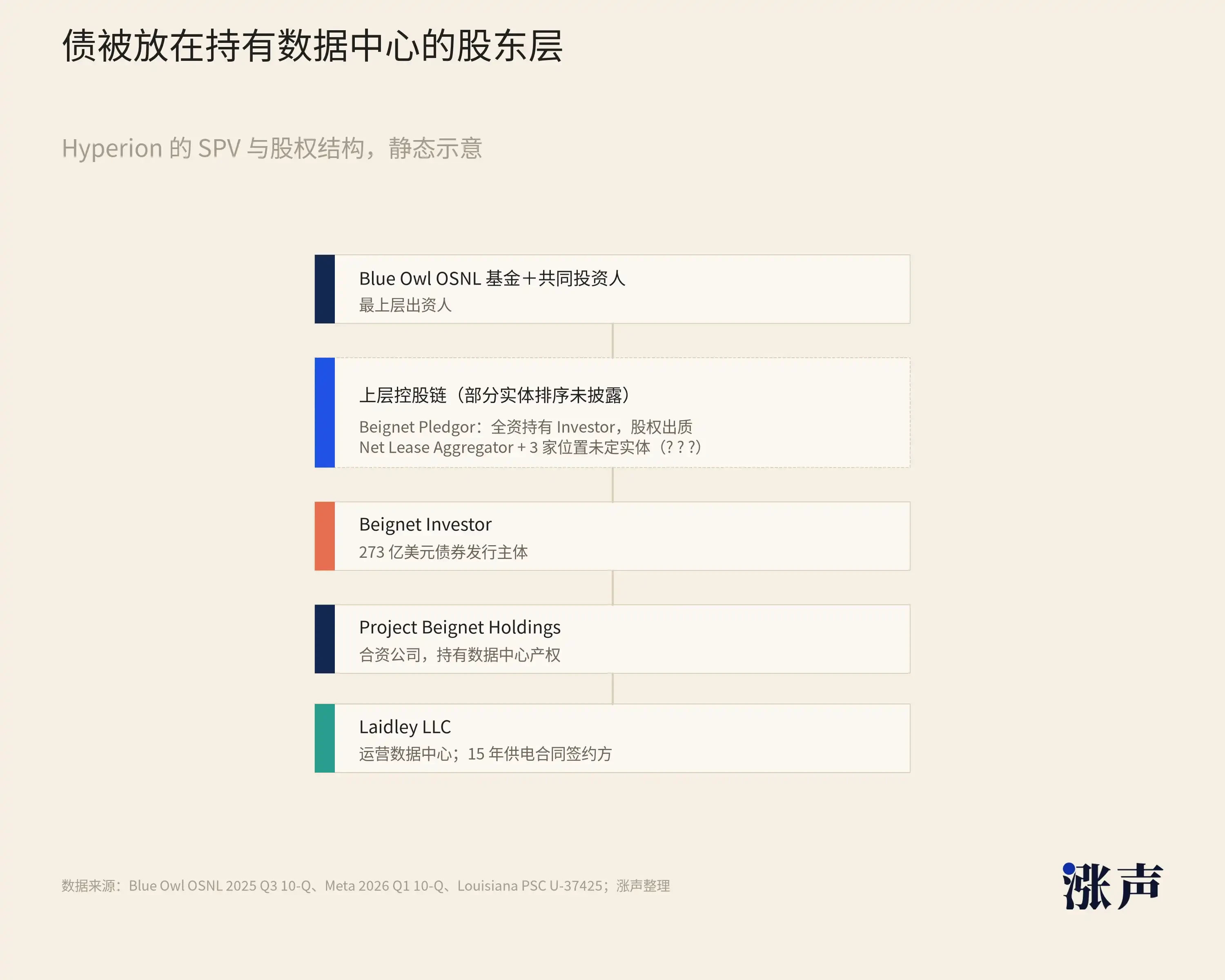
All seven companies are registered in Delaware, where LLCs are not required to disclose their members or ownership percentages.
The $27.3 billion in bonds were also not issued publicly. They were sold under Rule 144A, exclusively to qualified institutional buyers, without a public prospectus. To view the terms of the deal, one must sign a confidentiality agreement. It's also a "life-of-loan" 144A, meaning it will never be converted into a registered public bond.
Searching the SEC's EDGAR system for "Beignet" yields only one narrative hit: a footnote in Blue Owl's quarterly report regarding subsequent events. By the annual report, the name disappears along with "Meta" and the parish name, leaving only an aggregated line item for "net lease data centers."
This is already bewildering enough, but it's just the legal separation.
SPVs aren't new. Real estate and infrastructure have used them for decades. Accounting standards have long been aware that people try to park debt here and have set up two thresholds. Whether a special purpose entity (SPE) should be consolidated into a company's financial statements depends not just on ownership percentage, but also on who controls its most significant activities and who bears most of the risks and rewards.
Meta is Hyperion's sole tenant, providing funding, credit, and handling construction and property management. By this standard, this debt should logically be consolidated onto its own books.
But it kept 20%.
Blue Owl's OSNL fund and co-investors, via Beignet Pledgor and four other holding companies, own 100% of Beignet Investor. Beignet Investor then holds 80% of the joint venture. Meta holds the remaining 20%.
80 and 20 are recurring numbers in this story.
Meta's explanation in its financial report is that the company doesn't have the power to direct the activities that most significantly impact the joint venture's economic performance, therefore it is not the primary beneficiary and does not consolidate. The joint venture doesn't enter Meta's books, so naturally, the $27.3 billion in debt doesn't either.
The debt hasn't vanished. It has just changed its storage location.
The 'Debt Repayment Art' of Silicon Valley Giants: Mortgage-to-Lease
The debt not being on Meta's books doesn't mean Meta doesn't have to pay.
Meta has a subsidiary called Pelican Leap that acts as the tenant. It signed a four-year lease with Laidley. Starting in 2029, Pelican Leap will pay rent to Laidley monthly. The money flows from Laidley to the joint venture, then to Beignet Investor, and finally to repay the bondholders' principal and interest.
After all these loops, the rent still ultimately comes out of Meta's pocket.
The coupon on the $27.3 billion bond is 6.581%, maturing in May 2049, with a fully amortizing structure. Unlike a typical corporate bond that repays principal in a lump sum at maturity (in 2049), this one chips away at it gradually over twenty-four years.
It looks more like a mortgage.
Meta's total rent for the first four years is $12.3 billion, averaging $3.08 billion annually. This amount just covers the principal and interest payments for the year, with an extra 12% left over for the equity holders.
The real magic trick lies in the lease term.
The bond lasts twenty-four years. The initial lease is only for four years. It starts in 2029, with attached renewal options that can extend it for up to twenty more years. In theory, Meta could choose not to renew the lease starting from 2033 and simply walk away.
What happens to the remaining two hundred billion plus dollars that hasn't been paid off yet?
The answer is hidden in another part of the lease agreement. Besides the monthly rent, Meta provided a residual value guarantee capped at approximately $28 billion, slightly more than the debt itself, with the amount decreasing over time. If Meta doesn't renew the lease and the campus value falls below this threshold, Meta must make up the difference.
Seeing $28 billion and $27.3 billion together, it's hard not to connect the two.
So, the bond doesn't just rely on the building or the machines inside.
It relies on Meta's credit.
This also explains the credit rating. S&P rated the bond A+, while Meta itself is rated AA-. The rating agency didn't price the bond based on a building yet to be operational; instead, it effectively marked down Meta's credit by one notch.
Meta provides the money, the credit, handles operations, and is the sole tenant, yet it writes in its financial report that it is not the primary beneficiary.
This clean balance sheet doesn't come cheap. If Meta issued a bond with the same maturity in the public market, the cost would be around 5.5%. Through this structure, the cost rose to 6.581%. For the same amount of money, Meta pays almost $300 million more in interest annually.
What Meta is willing to spend so much to buy is clearly more than just a building.
In July 2026, a second similar project emerged, named Sopaipilla, another fried pastry from the Southwestern US. The project is located in El Paso, Texas, with an initial bond issuance of at least $12 billion, also following an 80/20 split. The difference this time is that the 80% holder switched from Blue Owl to BlackRock.
Meta has used two internal codenames for its next-generation large models: Avocado and Mango. The naming on the financial side is clearly more appetizing.
Meta's structure is the most intricate, but it's not the only approach.
Microsoft doesn't use a shell company, nor has its book debt grown significantly. Over the past two years, its total debt decreased from $44.9 billion to $40.3 billion. However, during the same period, finance lease liabilities surged from $27.1 billion to $62.9 billion, more than doubling and exceeding its total debt by over $20 billion.
The $62.9 billion is indeed on Microsoft's balance sheet, but it's not under the "Debt" line item. It's broken down into "Other current liabilities" and "Other long-term liabilities." Looking at the most prominent line, it appears very quiet.
The meaning of a finance lease is quite