






跨界難,預測市場和Perp DEX龍頭都沒複製出第二個自己


- 核心觀點:預測市場與永續合約DEX(Perp DEX)兩大交易賽道的頭部平台相互跨界擴張,但結果均不理想,核心原因在於難以複製原有賽道的用戶習慣與流動性,守住主場優勢比追求「萬物交易平台」更重要。
- 關鍵要素:
- Hyperliquid 透過 HIP-4 切入預測市場,峰值活躍市場達125個,但近期已不足20個,縮水超85%;交易量也從高峰的3000萬美元跌至百萬美元級別。
- Polymarket 推出永續合約後,早期日交易量約4800萬美元,但7月下旬已回落至約1820萬美元,未平倉量僅約2640萬美元,僅為同期Hyperliquid的0.3%。
- Kalshi 推出受CFTC監管的加密永續合約,上線六週累計交易量達161億美元,但近期日交易量從4.48億美元暴跌至約8000萬美元,未平倉量仍僅千萬美元級。
- 用戶習慣差異是跨界失敗主因:Perp DEX用戶偏好高頻槓桿交易,預測市場用戶圍繞體育、政治事件交易,平台難以同步改變用戶原有交易方式。
- 事件合約與永續合約的流動性結構不同:永續合約交易持續圍繞核心資產,而事件合約隨結算不斷結束,需反覆重新聚集流動性。
Original Article: Odaily Planet Daily (@OdailyChina)
Author: Asher (@Asher_0210)

In the past six months, prediction markets and Perp DEXs, the two hottest trading sectors, have been penetrating into each other's core territories.
In April, Polymarket announced it would launch Perp trading, covering cryptocurrencies, US stocks, and commodities. At the end of May, Kalshi officially launched CFTC-regulated crypto perpetual contracts. On the other side, the leading Perp DEX Hyperliquid, through HIP-4, has moved in the opposite direction to enter prediction markets, aiming to extend its mature order book, account system, and liquidity advantages to real-world event trading.
Prediction markets have gathered a group of users keen on trading sports, esports, politics, and trending events, while Hyperliquid has accumulated a base of crypto-native traders more inclined toward high-frequency and leveraged trading. The crossover essentially represents an attempt by each to leverage their core user and trading scenario advantages in the other's original domain.
However, months later, the results have been less than ideal. The user habits and liquidity accumulated in the original tracks have not naturally migrated with the expansion of product boundaries.
Hyperliquid: Active Prediction Markets Drop from 125 to Under 20
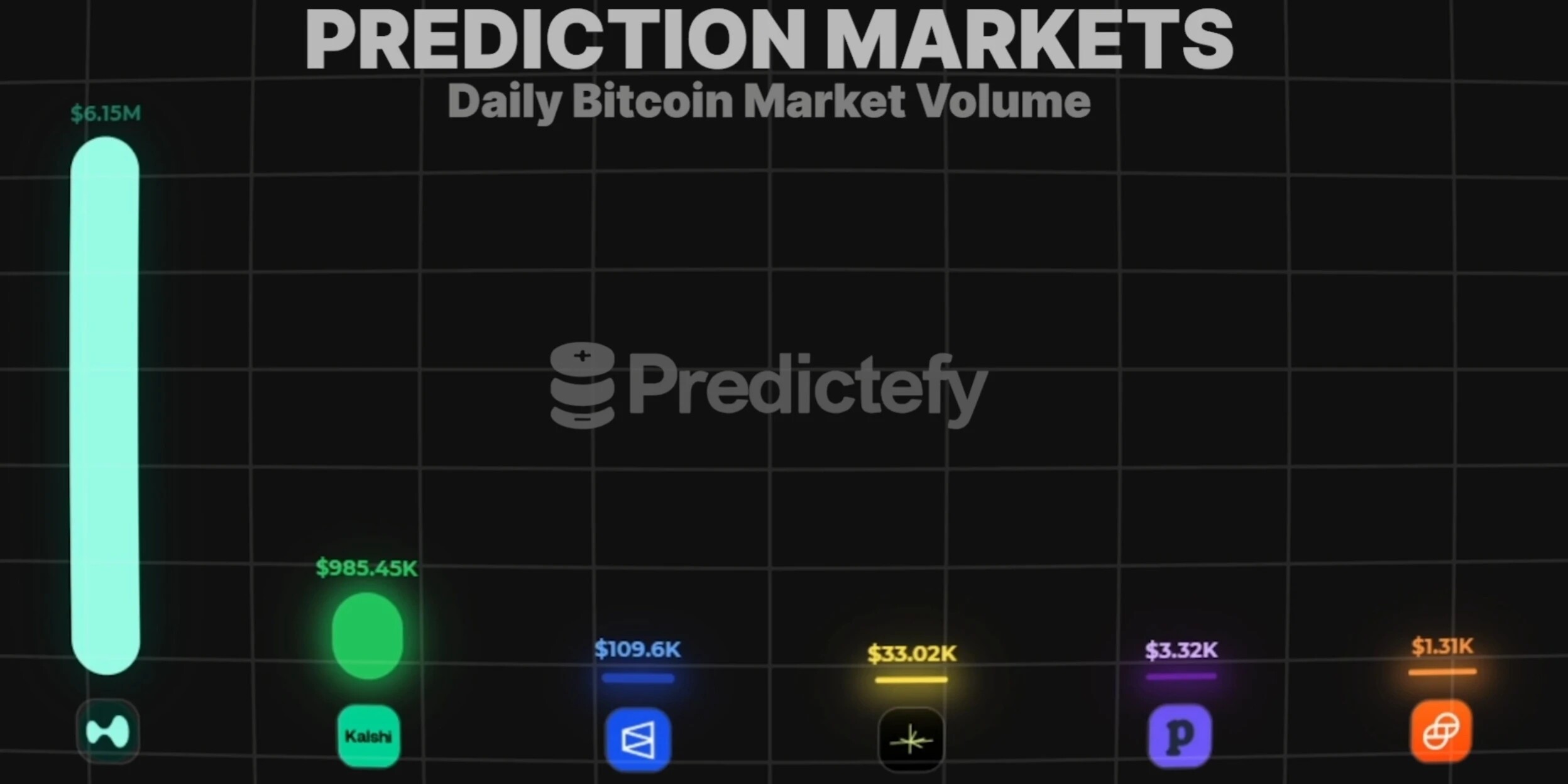
On May 2, Hyperliquid launched HIP-4 Outcome Markets on its mainnet, formally introducing result markets into its on-chain trading system. The first batch consisted of BTC intraday binary outcome contracts, achieving a first-day trading volume of up to $6.15 million, far surpassing similar prediction events on Kalshi and Polymarket. Additionally, over 54,000 transactions were completed that day, with more than 3,000 active traders.
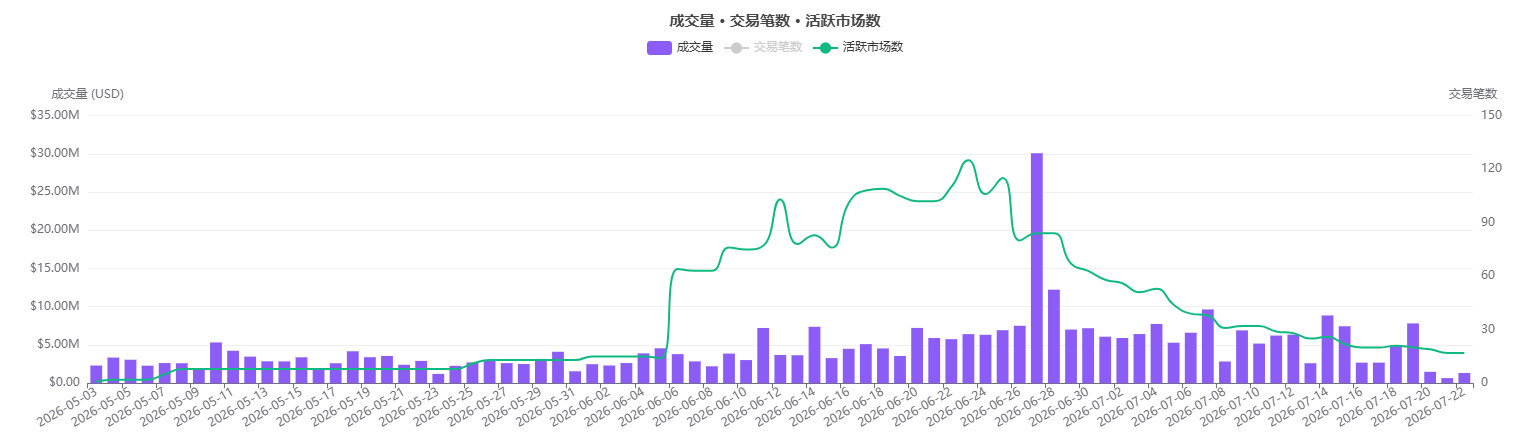
The World Cup further amplified this growth. In early June, HIP-4 had only a few dozen active markets, which quickly rose to over 100, peaking at more than 120. Trading volume also surged, reaching nearly $30 million in a single day on June 27, and staying above the $10 million level the following day. With the continuous addition of sports events, macroeconomic data, and crypto price events, HIP-4 briefly moved away from its early reliance on BTC short-term contracts, beginning to expand towards a more comprehensive event trading platform.
However, the rapid increase in the number of markets did not translate into sustained trading demand. As the World Cup entered its later stages, the number of active HIP-4 markets began a steady decline, falling from a peak of 125 to around 50, further dropping to just over 20 by mid-July, and recently falling below 20—a contraction of over 85% from the peak. Trading volume has also weakened, mostly returning to the multi-million dollar range, and recently even dipped below $1 million.
This reflects the fundamentally different liquidity structures of Perp and event contracts. Perpetual contract trading revolves around core assets like BTC and ETH over the long term, allowing market makers, capital, and traders to continuously accumulate within the same set of markets. Event contracts, however, are settled upon the conclusion of a game, release of data, or occurrence of a political event, meaning new markets often require rebuilding liquidity and trading interest from scratch. While Hyperliquid can reuse its matching engine, account, and capital infrastructure, it cannot directly replicate the liquidity and user trading frequency already established in its Perp markets onto HIP-4.
Polymarket: Daily Perpetual Contract Volume Below $20 Million
Polymarket announced its foray into the perpetual contract market in April and began opening its Perps product to more users in July, supporting up to 20x leverage. Access currently requires an invitation code or joining a waitlist. The product covers crypto assets like BTC, ETH, and SOL, and has also extended to some stocks and commodities.
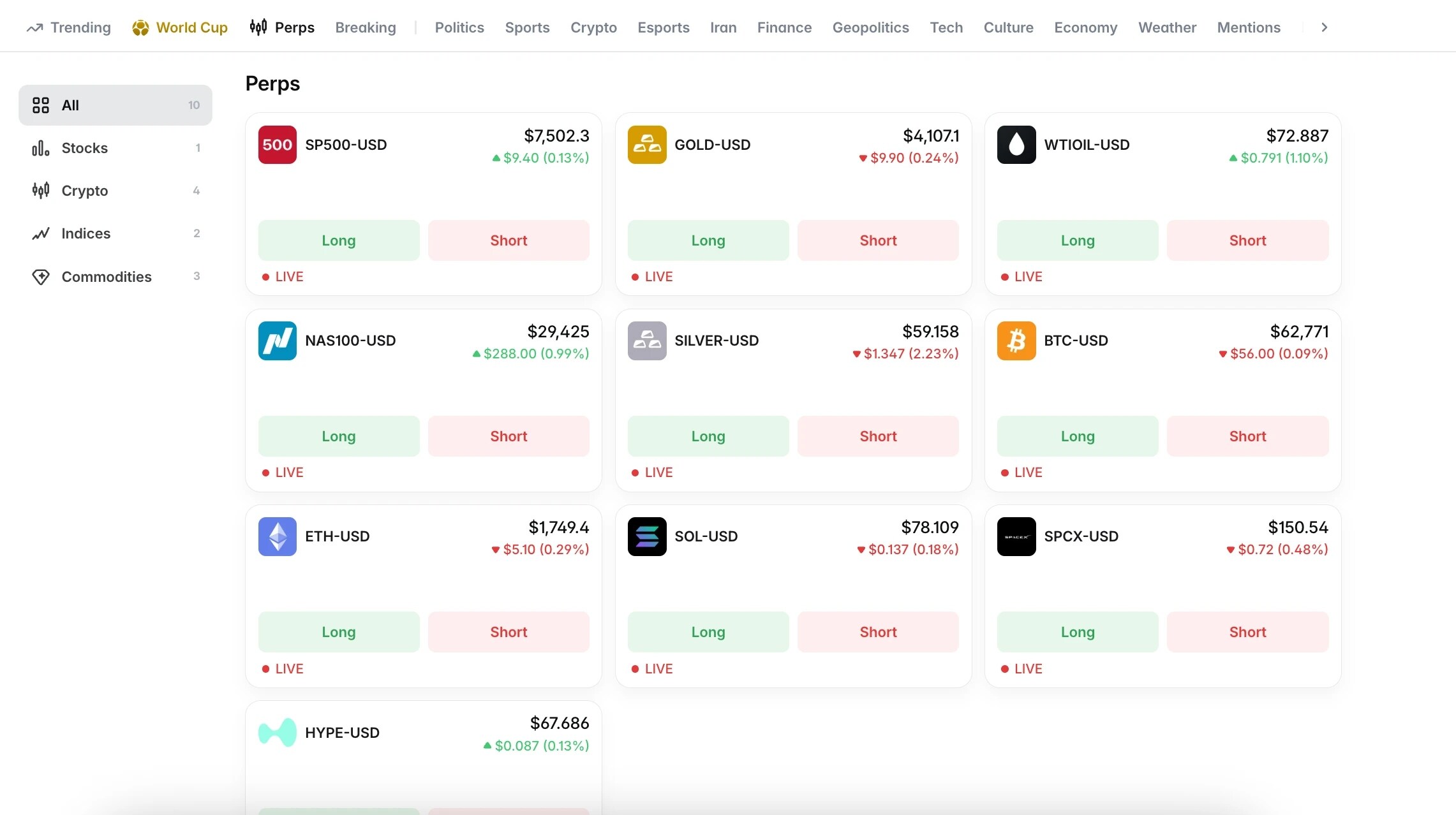
In the initial period following the launch of Polymarket Perps, the 24-hour trading volume briefly reached around $48 million. However, this level was not sustained. By late July, daily volume had fallen to approximately $18.2 million, with Open Interest (OI) around $26.4 million. The OI for core trading pairs like BTC and ETH was only in the low millions. Compared to its launch phase, trading activity on Polymarket Perps has clearly cooled down.
It's worth noting that Polymarket Perps is still in an early stage requiring invitation codes to trade, so a direct comparison with mature Perp platforms may not be entirely fair at this point. However, even considering this, the disparity in scale is stark. During the same period, Hyperliquid's Open Interest was approximately $7.7 billion, with a 24-hour trading volume of about $1.58 billion. In contrast, Polymarket Perps' OI was only around $26.4 million, roughly 0.3% of the former; its daily trading volume represented only about 1% of Hyperliquid's.
Currently, Polymarket's Perps trading volume seems more like early users experimenting with a new product rather than reflecting established trading habits and sustained discussion. Based on the current data, at least, the user base and brand advantages Polymarket built in prediction markets have not successfully transferred to the Perp track. This crossover attempt cannot yet be considered a success.
Kalshi Perps: $16.1 Billion in Volume After Six Weeks, But Momentum Cooling
Compared to Polymarket, Kalshi's Perps launch was faster. At the end of May, Kalshi officially launched CFTC-regulated crypto perpetual contracts, covering assets like BTC, ETH, SOL, and XRP initially. By July 9, approximately six weeks after launch, Kalshi Perps had accumulated a total trading volume of $16.1 billion.
Following the rapid volume surge post-launch, the current trading activity on Kalshi Perps has noticeably cooled. According to Loris Tools data, the Perps segment on Kalshi saw a daily volume of $448 million on July 20. However, in the last two days, volume has dropped to around $80 million, plummeting over 80% in just a few days.
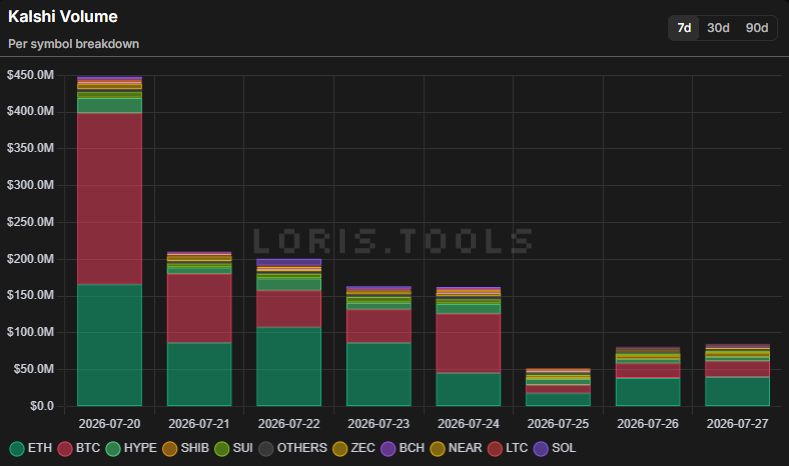
Simultaneously, Hyperliquid's daily Perp trading volume remains in the billions. Even using Kalshi's recent high of $448 million on July 20 as a benchmark, its trading scale still shows a significant gap compared to Hyperliquid. With Kalshi's daily volume retreating to around $80 million in the past couple of days, this gap has widened further.
The disparity in Open Interest is even more pronounced. Kalshi's Perps OI currently remains in the tens of millions, while Hyperliquid's stands at approximately $7.5 billion. Kalshi's cumulative $16.1 billion over six weeks indicates a decent start for its Perps product. However, the rapid decline in volume and persistently low OI suggest it is still far from competing in the league of mainstream Perp platforms.
Kalshi's "US-compliant gateway" remains its clearest differentiating advantage. However, this advantage currently solves more of the "can US users trade Perps" problem rather than addressing the "why would professional Perp traders choose to stay long-term on Kalshi" question.
Crossovers are Difficult; Holding the Home Turf Might Be More Important Than the "Everything Exchange" Slogan
The crossover attempts by Hyperliquid, Polymarket, and Kalshi highlight a fundamental truth: what is truly difficult to replicate are the deeply ingrained user habits and liquidity built up over time in their original tracks. Hyperliquid's core users are accustomed to high-frequency, leveraged, and on-chain derivatives trading. Polymarket and Kalshi users are oriented towards making judgments on sports, politics, and trending events. Platforms can quickly add new categories, but getting users to change their established trading methods is much harder.
For Hyperliquid, deepening its Perp and on-chain asset trading might be more important than proving it can trade everything. For Polymarket and Kalshi, what is truly scarce remains event supply, user mindshare, and prediction market liquidity. Crossover can offer new growth narratives, but if new categories fail to generate independent demand, they risk diluting the resources where the platform originally held its greatest advantages.
The so-called "Everything Exchange" will ultimately be determined not by who covers the most categories, but by who can sustainably accumulate users, liquidity, and market depth in their core tracks. For these platforms with clear existing advantages, making their home court deep enough might be more critical than continuously expanding boundaries.





