火幣大咖講堂| HTX Research首席分析師 Andy:拆解Q3加密市場投資邏輯


- 核心觀點:2026年第三季度,加密市場將由全球流動性重定價、真實現金流及監管確定性共同驅動,而非單一敘事,比特幣成為全球流動性代理變量,具備現金流和合規路徑的資產將獲得市場獎勵。
- 關鍵要素:
- Q2比特幣從82000美元高點回調至59000美元,最大回撤約24%,系全球美元流動性收縮下的集中重定價。
- Q3市場判斷三大核心:流動性比地緣政治更重要,現金流比敘事更重要,基礎設施比價格更重要。
- 資產配置建議:比特幣(超配)為全球流動性代理變量;以太坊(中性/戰術性做多)面臨L2削弱主網收入的挑戰;DeFi(選擇性超配龍頭)進入現金流估值時代;RWA(持續超配)為穿越週期的最確定性賽道。
- 監管正從風險折價轉向市場催化劑,清晰的規則比寬鬆更重要,將為以太坊、DeFi、穩定幣及RWA帶來更大彈性。
- 「四年週期論」未失效但已弱化,只有當減半供給收縮與美元流動性擴張共振時,才可能爆發超級牛市。
- 山寨幣流動性枯竭的四大原因:機構資金通過ETF進入BTC不再輪動、穩定幣使用場景已拓展、巨額解鎖壓力、市場對無價值捕獲的「敘事幣」免疫。
On July 20, Andy Liu, Head and Chief Analyst of HTX Research, appeared as a guest on the fifth episode of the Huobi Think Tank. With the theme "2026 Q3 Outlook: A New Order in the Crypto Market Under Global Liquidity Repricing," he conducted an analysis focusing on global liquidity repricing, structural changes in the crypto market, trends in core assets, and future investment opportunities.
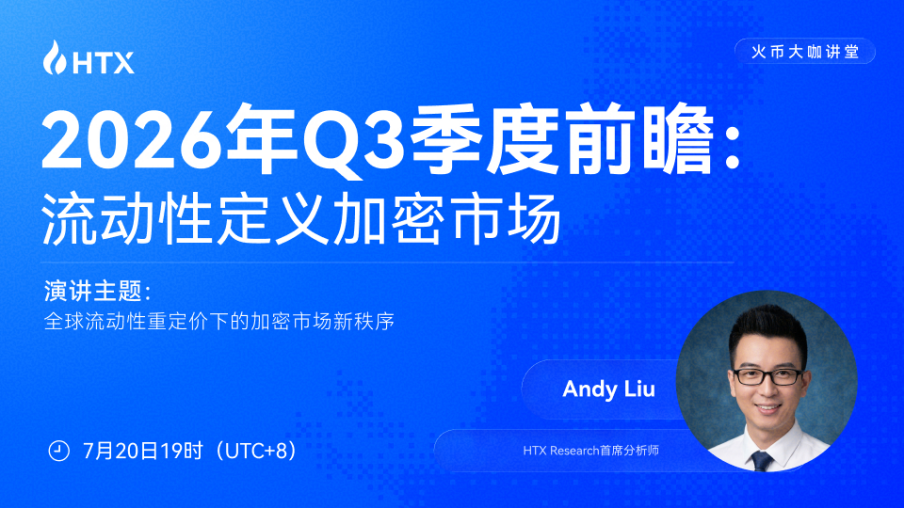
As the guest speaker for this session, Andy Liu has long been deeply involved in the crypto industry, possessing a composite background in investment management, institutional services, on-chain data analysis, and industry research. He currently oversees the construction of HTX Research's overall research system, covering multiple dimensions such as macro-market linkages, industry trends, and CEX asset strategy research.
Q2 Market Adjustment: Repricing Amid Changes in Global Capital Costs
When reviewing the market performance of the second quarter of 2026, Andy stated that Bitcoin's price fell from a high of approximately $82,000 in mid-May to a stage low of around $59,000 in June, a maximum drawdown of nearly 24%. However, this is not "the end of the crypto industry cycle" but rather a concentrated repricing event triggered by the contraction of global dollar liquidity.
Regarding the Q3 crypto market, Andy put forward three core judgments:
1. Liquidity is more important than geopolitics: Short-term events may affect market sentiment, but the real determinants of trends are energy prices, inflation, Federal Reserve policy, and the movement of the US dollar.
2. Cash flow is more important than narrative: The market no longer rewards grand narratives and inflated TVL figures. Protocols must generate real revenue, have token burn mechanisms, and effective value capture mechanisms.
3. Infrastructure is more important than price: Price corrections have not halted infrastructure expansion. RWA, stablecoins, on-chain securities, AI Agent payments, and institutional compliance channels are all still advancing. The long-term direction of Crypto is shifting from a market for native asset trading to becoming a part of the global financial infrastructure.
Comprehensive Analysis of Popular Assets: Where is Institutional Capital Flowing?
Regarding the performance of core crypto assets that the market is focused on, Andy Liu provided a detailed analysis of key sectors including BTC, ETH, DeFi, and RWA, considering the liquidity environment, institutional capital allocation, and asset value capture capabilities.
BTC (Overweight): Has become a proxy variable for global liquidity. BTC is no longer just a crypto-native asset; it is a core expression tool for global liquidity. The key variables for Q3 are whether spot ETF flows can get back on track, the direction of Fed policy, and the pace of Treasury issuance. BTC remains the primary entry point for institutional allocation, possessing strong defensiveness and resilience.
ETH (Neutral/Tactically Long): Faces challenges in value capture. While Layer 2 has improved network efficiency, it has eroded Layer 1 fee revenue. ETH's current pain point is that ecological growth has not effectively translated into token value. Valuation recovery for ETH in Q3 requires monitoring three catalysts: a rebound in L1 fees and token burns, net inflows into ETH ETFs, and positive catalysts from regulatory clarity.
DeFi (Selectively Overweight on Leaders): Entering the cash flow era. The days of valuing projects solely based on Total Value Locked (TVL) are over. "Quality DeFi" protocols that feature a mechanism for returning real revenue to token holders, possess strong risk isolation capabilities, and are deeply integrated with compliant capital are set for a revaluation.
RWA (Persistently Overweight): A structural theme that traverses market cycles. In a high-interest-rate environment, RWA assets like tokenized U.S. Treasury bonds provide a natural yield outlet for on-chain capital. Their growth does not depend on bull market sentiment but is based on real institutional compliance allocation demands, making it one of the most certain sectors at present.
Long-tail Altcoins (Underweight): In the context of insufficient stablecoin expansion, significant unlock pressures, and limited liquidity, long-tail altcoins lack the foundation for a broad-based rally.
Andy concluded that the Q3 Crypto market will not be driven by a single narrative. Instead, it will be determined by two main axes: whether global liquidity improves marginally, and whether regulatory clarity is sufficient to reopen institutional risk budgets.
Regulation: From a Risk Discount to a Market Catalyst
Regarding regulatory trends, Andy believes that in recent years, regulation has been largely viewed by the market as a risk factor, affecting asset valuations through a risk discount. However, as the industry matures, regulatory clarity is becoming a new market catalyst.
He emphasized that the market cares less about the degree of looseness in regulation and more about clear rules. "The clearer the rules, the easier it is for institutions to determine which assets and businesses can be included on their balance sheets."
In the Q3 market outlook, Andy believes that regulatory progress is more critical for assets like Ethereum, DeFi, stablecoins, and RWAs. Compared to Bitcoin, which already has established ETF products and mature institutional entry points, these areas may have greater potential for improvement driven by regulatory clarity.
At the end of the livestream, Andy concluded the session with a memorable statement: "The Q3 market will not reward all risks; it will only reward risks backed by liquidity support, genuine cash flow, and a clear regulatory path."
Hot Topic Q&A: ETFs, The Four-Year Cycle Theory, and the 'Altcoin Struggle'
During the interactive Q&A session of the livestream, Andy provided in-depth answers to the audience's most pressing market phenomena:
● On the "Double-Edged Sword" of ETFs:
Regarding Bitcoin's recent significant volatility driven by ETF outflows, Andy believes ETFs are not the sole determinant of market trends but act as "market amplifiers." The introduction of ETFs has increased Bitcoin's sensitivity to macro liquidity, allowing traditional institutions to quickly rebalance their portfolios. The true engine of the market remains the improvement of global liquidity. Furthermore, ETF inflows do not necessarily represent blind bullish bets, as they include a significant amount of basis trading and hedging operations.
● On Whether the 'Four-Year Cycle Theory' is Invalidated:
Andy believes the four-year "halving cycle" has not become obsolete. However, it has transformed from a "rule of thumb" into a "reference point for supply rhythm." With Bitcoin's current massive circulating supply and deep integration into the global asset allocation system, the conditions for a super bull run require a resonance between the supply contraction from the halving cycle and the liquidity expansion cycle of the US dollar.
● Unveiling the Truth Behind the 'Altcoin Liquidity Crisis':
Stablecoin market capitalization has hit new highs recently, yet most altcoins continue to slide. Why? Andy pinpointed four reasons: First, institutional capital entering BTC via ETFs no longer "trickles down" to altcoins as it once did. Second, the use cases for stablecoins have greatly expanded (e.g., cross-border payments, RWAs); stablecoin issuance doesn't necessarily mean "queueing up to buy altcoins." Third, the supply of altcoins is enormous, facing massive unlock pressures and exits by early investors. Finally, the market has developed an immunity to "narrative coins" without real value capture.
The Huobi Think Tank is a long-term educational program created by the Huobi Growth Academy. It aims to invite top global scholars, industry leaders, and seasoned practitioners to engage in in-depth discussions on cutting-edge fields such as the crypto industry, artificial intelligence, and Web3. The goal is to help users understand the underlying logic behind market trends and build an independent thinking framework.