Sharp Critique of Base Co-founder's "Mea Culpa"


- Core Viewpoint: Base co-founder Jesse Pollak reflected on strategic missteps over the past two years, admitting overcommitment to the social sector (such as Farcaster, creator tokens) failed to drive mass adoption, while affirming that betting on application developers to produce quality products is a sound direction. He wrote off the social sector as a failure, but suggested he isn't fully responsible for lagging in areas like Perp DEXs, and acknowledged the success of the AI narrative is commendable.
- Key Elements:
- Social Sector Bet Failed: Native on-chain social features did not improve the user experience, and the logic of creator tokens was disconnected from the meme coin model, resulting in zero impact on mass adoption.
- Lagging in Perp DEXs is Not Entirely His Fault: The leadership of Hyperliquid and Polymarket stems from their own sector innovations. Base has already established an advantage in AI and Agent payments (e.g., $vvv, Virtuals, x402 protocol).
- Insufficient Developer Support: Base's slow response to innovative projects outside its core focus, coupled with a reliance on an "inner circle," has weakened its competitive edge in innovation.
- Reflection and Adjustment: Jesse believes mass adoption will be driven by stablecoins, prediction markets, RWA, and AI Agents, not social features. The future focus should be on trading, payments, and AI Agents.
- Meme Coins Overlooked: Platforms like pump.fun remain key for attracting the masses, but industry leaders have failed to standardize them. An idealistic retreat raises questions about the depth of this reflection.
Yesterday morning, Base co-founder Jesse Pollak posted a lengthy thread on X, reflecting on the strategic missteps and successes of Base over the past two years.
This was a remarkably candid thread, both for himself and the public. Acknowledging one's own mistakes is never easy. Jesse believes that his bet on social applications for Base—hoping that native on-chain social experiences would drive mainstream adoption of Base and even cryptocurrency—was a mistake. However, his other bet, that application developers on Base would also drive mass adoption by producing good applications, was correct.
Now, he has handed over Base App (Base's super app, not the Base chain) to Cobie, while he returns to focus on developing the Base chain itself. From the perspective of an on-chain user, while I highly commend the candor of this 'self-criticism' in reviewing his actions over the past two years, I also believe there are points in his understanding that are debatable.
Betting on Social: 0 Points
Native on-chain social interaction fails to enhance the social experience for the masses; in fact, it complicates things further. Honestly, I wish Jesse had thoroughly analyzed in his 'self-criticism' what new social enjoyment or form of social content users could gain from building a new social app like Farcaster. Or what novel pathways for forming social networks the app itself provides users, that made him and Base believe it could challenge the traditional social media market to drive Base's mass adoption...
If it's for the ideal of decentralized social networking, one might give some credit. But if the goal is mass adoption, it's a pure zero out of ten.
Let's continue. On the social front, Jesse also mentioned creator tokens, specifically pointing to the recent hype around $ANSEM on Solana. He expressed uncertainty whether his push for Zora was poorly timed or if the concept of creator tokens was fundamentally flawed from the start.
This understanding also gets zero points. First, the very concept of 'creator tokens' is odd. As seen in his past debates with Toly, Jesse argued that 'content' has value, and creators, as personal brands, have value. Therefore, unlike meme coins, these tokens have fundamentals, and he wants to promote things with fundamentals.
But who does this logic convince? Jesse himself launched $JESSE, and after nearly 240 days, the situation is as follows:
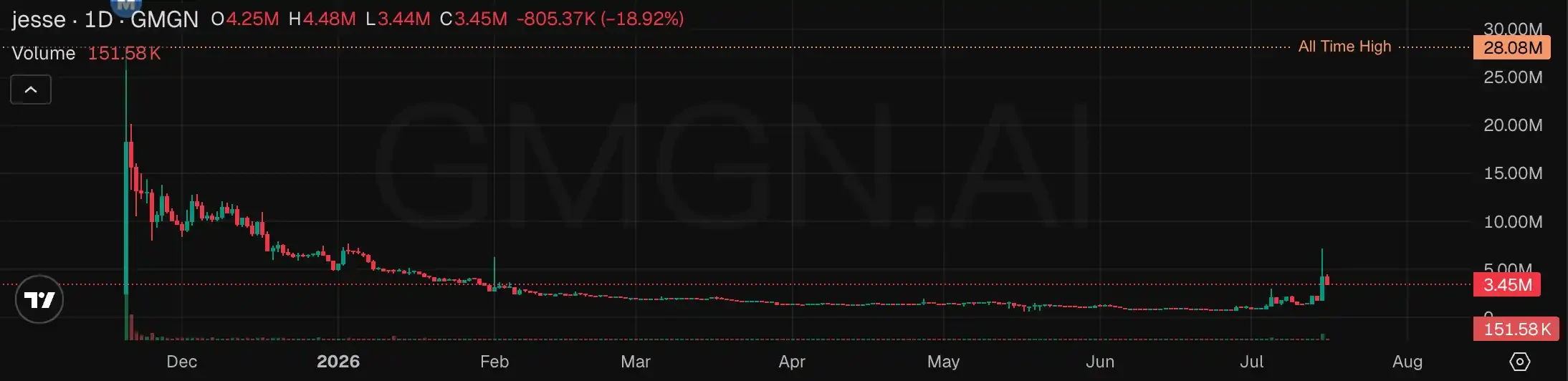
Content and personal IP certainly have value, but is issuing a token a unique monetization channel? What caliber of creators can you attract? How can you ensure a logical chain for the value you emphasize? There are too many unresolved issues here, but Base's approach feels like, 'We built the stage, people will come.'
In this regard, Jesse's understanding is completely outmatched by Toly, who at least pointed out that 'meme coins have no value, but mobile game items and skins also have no value, yet people worldwide are willing to spend hundreds of billions of dollars annually on things with no value.'
$ANSEM is also not the 'creator token' Jesse promotes. It wasn't issued by Ansem nor created to monetize his personal IP; it doesn't fit the criteria at all.
In summary, Jesse, you were wrong about the social aspect, but you haven't fully grasped why. In reality, the best reference model for Crypto + Social so far would be the socialized trading app, FOMO.
Lagging in Perp DEX and Other Areas: 80 Points
The score could actually be higher. Comparatively, Solana hasn't shown much stronger competitiveness in Perp DEX or prediction markets against Hyperliquid and Polymarket, not significantly better than Base.
Jesse's regret stems from his belief that 'because we bet too heavily on social, we fell behind in these two areas.' This might be overly self-critical. With the benefit of hindsight, Hyperliquid is a competitor that completely mastered the Perp DEX track. Without its emergence, the space would likely remain like GMX or dYdX. As for prediction markets, Polymarket had a first-mover advantage; it's not a major failure.
Moreover, Base has been quite successful in the AI sector, boasting a leading on-chain narrative within the entire market. In terms of specific targets, there's $VVV, a major asset that captured market-wide attention, and launchpads like Virtuals with significant scale. The x402 protocol leads in Agent payments, establishing USDC as the dominant stablecoin for inter-agent payments.
Base's success in the AI narrative has also spilled over into other tech narratives related to AI. For instance, successful projects in the robotics track are more frequently found on Base. Regarding RWA, before Solana dominated on-chain stock token spot trading with $SPCX, on-chain users often thought of Base first, such as $LFI for tokenizing property tax liens.
If Jesse has a shortcoming here, it ties back to the article's beginning: his bet that 'application developers on Base would also drive mass adoption by producing good applications.' In reality, Base's support for its own developers isn't as robust as claimed. From an on-chain user's perspective, when selecting projects on Base, it's crucial to see if the project team has any connection with the Base team—you need to be 'in the circle.' Instances of a developer sparking an idea outside Base's favored tracks, creating a hot project, and receiving rapid support from Base are truly rare.
Earlier this year, a developer complained about this in an article titled 'A Developer's Three Years Wasted on Base.' I believe that insufficient engagement with the developer community and market dynamics may be as much a reason for weakness in innovating within new narrative tracks as the overemphasis on social.
Jesse's Reflection: 60 Points
Does cryptocurrency need social interaction to drive mass adoption at a billion-user scale? Jesse previously thought yes, and it was the only path. Now, he believes that stablecoins, prediction markets, Perp DEX, and RWA can all drive adoption; social is not the sole route.
Thus, he stated that Base will now focus on winning in three areas: trading, payments, and AI Agents. Base aims to become an indispensable part of global finance on-chain.
Jesse has realized that the arduous task of personally attracting users and acting as a pioneer for cryptocurrency education pales in comparison to a single policy shift favoring or even supporting stablecoins, RWA, prediction markets, and similar tracks. No matter how much you promote Bitcoin/stablecoins for real-world payments, you might only attract users from places like Venezuela or Africa with real inflation-hedging needs. This is a national-level direction, not something a company can easily achieve.
But I only give a passing score because neither Jesse, nor Solana's Toly, nor Ethereum's Vitalik, has realized that, over the years, meme coins have become a significant pathway for mass adoption.
They have regressed from 'having a mission to actively drive cryptocurrency's global dominance' to 'national-level forces have already entered the field favorably; we just need to follow the trend.' Jesse now says social is no longer the only path to mass adoption. He still doesn't understand that, while cryptocurrency certainly needs word-of-mouth and active discussion among billions of people globally, an on-chain social platform you provide isn't the way to achieve it.
When people use Polymarket to bet on World Cup outcomes, they don't discuss what stablecoins they use for betting. Similarly, users paying with Agents or trading US stocks on-chain don't care about stablecoins or blockchain technology. After all these years, the only concept that has re-entered the public's mind to the level of NFT or the metaverse is the one everyone hates—pump.fun—persistently promoting lottery-style meme coin rags-to-riches stories.
Whether it's Jesse, Toly, or Robinhood's Vlad, everyone knows meme coins are excellent tools for user acquisition, but they are mostly discarded after use. Everyone pays lip service to liking meme coins, but no one has ever stepped up to guide them into a more regulated industry.
While exhibiting smart and rational business acumen and choices, the retreat from idealism and the insufficiently grounded thinking about mass adoption lead me, from the humble perspective of an on-chain small fry, to give Jesse's reflection on the past two years a barely passing score.