Meta「賣算力」砸崩AI硬體?華爾街解讀:別慌,這不等於算力過剩,這不是行業拐點


- 核心觀點:Meta計畫出租過剩算力並非行業算力過剩信號,而是巨頭在AI投入與財務回報間的務實平衡;這直接衝擊CoreWeave等新雲公司,但對Meta股東構成EPS緩衝,AI硬體需求趨勢需待財報季確認。
- 關鍵要素:
- Meta考慮提供託管模型/API訪問或「原始算力」出租,消息導致CoreWeave股價跌13%、Nebius跌15%,反映市場對競爭和資本開支下修的擔憂。
- 摩根士丹利模型顯示,Meta 2027年資本開支(1750億美元)不會因臨時算力出租下修,若做大全雲業務反而可能推高支出。
- Meta的算力「餘量」與全行業過剩不等同;伯恩斯坦指出,Google因容量限制限制Meta計算使用的消息,暗示算力屬「再分配」而非「用不完」。
- 瑞銀認為外租算力可為Meta提供近期收入,緩解2027年EPS持平預期;每出租250MW算力可帶來約8%的EPS上行空間。
- CoreWeave面臨最大風險:Meta是其合同占比超過三分之一的客戶,未來續約時可能從需求方變為直接競爭者,長期議價能力承壓。
- 硬體板塊下跌主因是交易擁擠和去槓桿,AI需求拐點需看7-8月財報季中雲廠資本開支和AI應用ARR是否加速。
- 三家投行維持Meta買入評級(目標價775-865美元),均未基於賣算力調整估值,核心仍依賴廣告和AI產品創新。
Original Author: Long Yue
Original Source: Wall Street CN
A piece of news about Meta selling off its excess computing power has simultaneously brought several of the most sensitive issues in the AI trade to the forefront: Is there really a computing power shortage? Will Meta revise down its capital expenditure? How much longer can Neocloud keep profiting?
Wall Street CN mentioned that Meta is developing a cloud business plan, potentially offering two types of services: one is managed model/API access, similar to AWS Bedrock; the other is "raw computing power" leasing, akin to Neocloud.
Upon the news, shares of CoreWeave, a prominent next-generation GPU cloud service provider, plummeted 13%, Nebius fell 15%, and the broader AI hardware sector subsequently suffered heavy losses. If Meta starts selling computing power, investors will naturally ask three questions:
First, did Meta buy too much computing power?
Second, is Meta no longer heavily investing in models and AI products?
Third, is the demand curve for AI hardware and Neocloud about to change?
According to sources from the trading desk, on July 1, Wall Street banks including UBS, Morgan Stanley, and Bernstein quickly dissected this event. This might not be a collapse of AI fundamentals, but rather a pragmatic move by the tech giant to find a balance between computing power constraints and financial returns. This matter also cannot be simply equated to "Meta no longer needs computing power." However, the implications differ for various asset classes.
For Meta, leasing out computing power could serve as a revenue and EPS bridge. UBS judges: "Selling cloud computing power or model access rights could theoretically generate near-term revenue faster than waiting for Meta Business Agents and the Meta AI chatbot to scale, and could alleviate concerns about flat or contracting EPS in 2027."
For Neocloud companies like CoreWeave, this represents potential competitive pressure.
For the chip and server supply chain, the market is more concerned about whether the pace of subsequent capital expenditure will change.
"Having Surplus Available for Lease" ≠ "Industry Computing Power Glut"
The market's shortest logical chain being traded is: Leasing computing power = Computing power glut = Capital expenditure downgrade.
Meta may have periodic computing power available for lease, but this does not automatically equate to a glut across the entire industry. Different institutions use different capacity metrics, and these cannot be directly added together.
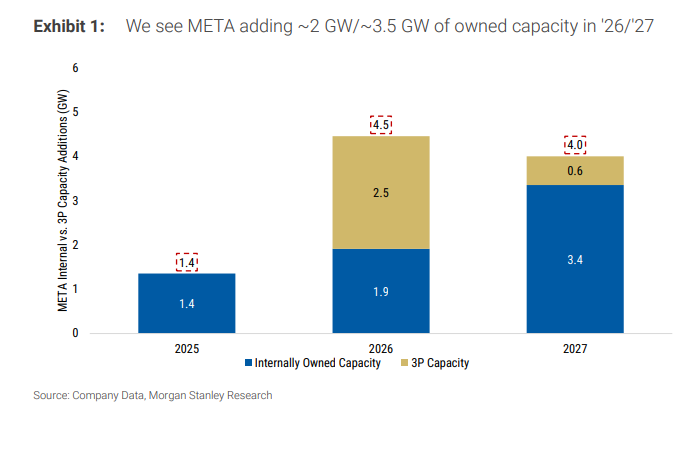
In Morgan Stanley's model, Meta is expected to add approximately 2GW and 3.5GW of self-operated IT capacity in 2026 and 2027, respectively, against a baseline of about 3GW by the end of 2025. In comparison, hyperscale cloud providers like Amazon and Google are expected to add IT capacity in the order of 5GW and 9GW, respectively, in 2027. In other words, even if Meta leases out a portion of its self-owned capacity, it alone is unlikely to change the overall scale of cloud provider construction over the next three years.
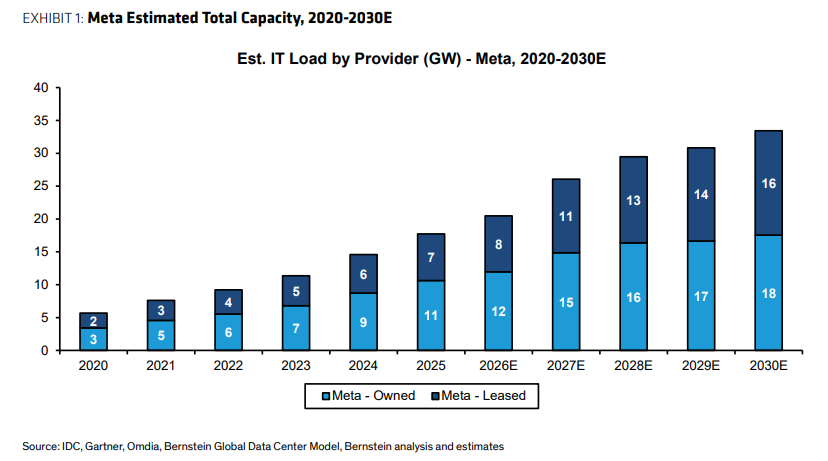
Bernstein uses a broader total data center footprint metric: Meta's current global capacity is estimated at about 20GW, with an additional approximately 14GW expected to come online over the next few years, including a mix of owned and leased facilities. While this number looks large, it is not "all leasable AI computing power," nor does it represent the same generation of GPU, the same type of workload, or the same price curve.
Market calculations also include a more aggressive reverse-engineering: using contracts and capacity planning like Google and Anthropic, AWS and Anthropic/OpenAI, and Microsoft and OpenAI as anchors, the total AI computing power for several cloud providers in the future could be around 20GW or even higher. OpenAI's own Stargate, along with the 10GW-level arrangements related to Nvidia and Broadcom, are also factored into the demand-side observation. The purpose of this metric isn't for precise forecasting, but to illustrate one point: Meta's localized leasing is insufficient to prove a global glut in AI construction.
Even more counterintuitively, Bernstein also noted that over the weekend there were reports suggesting Google was limiting Meta's computing usage due to its own capacity constraints. If this is true, the fact that Meta is simultaneously seeking external computing power while preparing to sell some of its own in the future points more towards a "reallocation across different generations, use cases, and time windows" rather than simply having "too much to use."
This Isn't the First Time Meta Has Put "Selling Computing Power" on the Table
On May 27, 2026, a shareholder asked whether Meta would build a cloud business to compete with AWS, Azure, etc. Zuckerberg replied:
"Sure, it's definitely on the radar... We haven't done it yet because we think we can use this compute ourselves. But obviously, if we ever get to a place where we think we've overbuilt, then that's an option we have, and it's part of the reason we're confident continuing to invest and build."
Earlier, on October 29, 2025, Zuckerberg discussed a similar logic:
"Any compute we don't need, we're pretty confident we can absorb a very large portion of it... Of course, it's possible to overbuild. If we do... we see a lot of new demand both internally and externally. Almost every week, people outside the company come to us wanting us to set up an API service or asking if they can get different types of compute from us. We haven't done that yet. But obviously, if you get to a place where you've overbuilt, it can become an option."
This explains why UBS calls it "not new news."
For Meta Shareholders, Selling Computing Power Acts More Like an "EPS Bridge," Not a New Main Business
For Meta, the most direct benefit of leasing out computing power is converting long-term AI investment into near-term revenue.
In UBS's table, Meta's diluted EPS for 2026 and 2027 is approximately $32.6 and $33.0, respectively. The market's concern is that EPS in 2027 will be roughly flat or even compressed compared to 2026. Leasing out computing power or selling model access rights could at least provide a revenue and profit buffer before Meta Business Agents and the Meta AI chatbot truly scale up.
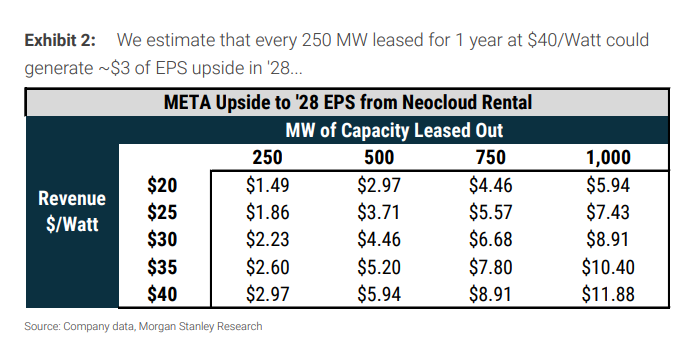
Morgan Stanley's sensitivity analysis is more intuitive: Leasing out 250MW of computing power for a one-year term at a price of $40/Watt could potentially add about $2.97 to Meta's 2028 EPS, representing an upside of roughly 8%. If capacity expands to 500MW, 750MW, or 1000MW, or if the price changes, the EPS elasticity would continue to amplify or diminish.
This is why the market hasn't solely interpreted it as bearish. From a Meta shareholder's perspective, Zuckerberg essentially has an additional fallback option: if internal AI products can't consume all the computing power in the short term, they can sell it to external AI labs to recoup some of the investment.
The market also draws an analogy to xAI leasing computing power to Anthropic: 500MW corresponds to $1.25 billion per month, translating to approximately $300 billion/GW/year. If this pricing holds, the implied return is very high, suggesting that high-quality computing power remains tight in certain scenarios. It's not evidence that "nobody wants computing power," but rather that "idle capacity windows can be swept up at high prices."
However, this is only a bridge, not the main storyline. Morgan Stanley still places the key to Meta's valuation on front-line product innovation: whether Meta AI, business agents, messaging, diffusion offerings, subscriptions, etc., can generate more sustained engagement and revenue growth. Selling computing power can supplement EPS but won't automatically lift valuation multiples.
Capital Expenditure May Not Be Revised Down; Building a Full Cloud Could Be More Expensive
The market's biggest fear is a downward revision to Meta's 2027 capital expenditure, dragging down the entire AI hardware chain's expectations.
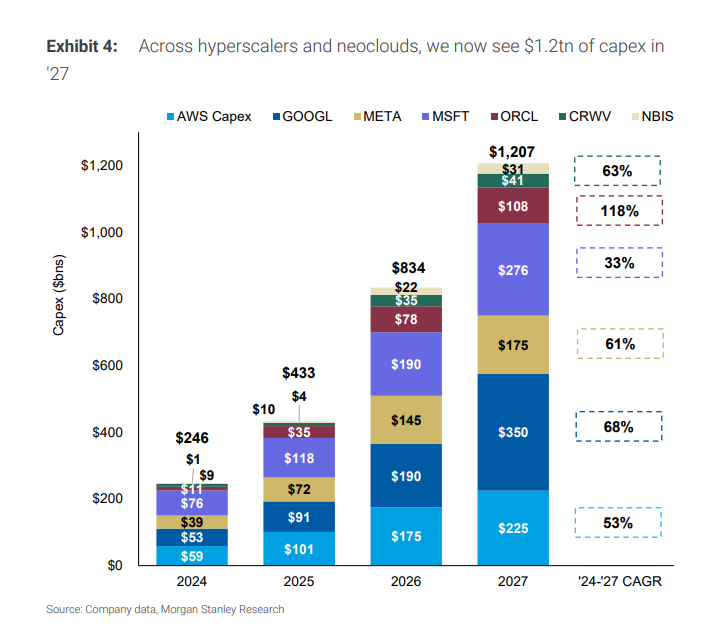
However, Morgan Stanley's current model assumes Meta's capital expenditure rises from $145 billion in 2026 to $175 billion in 2027 and $205 billion in 2028. The premise of this model is that Meta is primarily building capacity for its own front-line products, rather than creating a full-scale hyperscale cloud service provider.
If Meta truly scales up its external cloud services, especially building a model/API platform rather than temporarily leasing bare-metal computing power, capital expenditure could actually face upward pressure. This is because a full-fledged cloud business requires longer-term data center capacity, more complex software platforms, and the ability to deliver to enterprise clients.
Bernstein also sees this issue as relevant post-2027. Meta is one of the most important "checkbooks" in the AI market, and any change in its construction pace will impact the supply chain. But "temporary leasing" versus "permanent cloud business expansion" has different implications for capital expenditure and should not be conflated.
The larger demand side remains inference and agent applications. HY Computer & AI Power's market analysis cites OpenAI's weekend article on Codex/agentic AI as a demand signal: individual non-developer users grew 137x, organizational users grew 189x, and OpenAI's internal users grew 12x. This perspective emphasizes that the expansion of new applications may continue to drive up inference computing power demand.
Therefore, the key point of contention this time is not "whether Meta will sell computing power," but whether the AI demand curve is still steepening. If overseas ARR accelerates, inference applications grow, and cloud provider CapEx continues to be revised upward, then Meta leasing out computing power looks more like a periodic asset monetization. If the collective CapEx guidance gets revised downward in the upcoming earnings season, then this event will become a signal of a turning point for the industry.
Selling Bare Metal Is Easy; Building a Full AI Cloud Is Hard
Meta's potential business involves two paths with vastly different difficulty levels.
The first path is selling "bare metal" or raw chip capacity, similar to a neocloud. Customers buy GPU/compute resources, and Meta doesn't immediately need to provide a complete suite of enterprise software, developer tools, model platforms, and sales systems.
The second path is offering managed model/API access, similar to AWS Bedrock or Google Vertex AI. This is a business that requires more than just "having data centers and chips." It demands capabilities in models, software stacks, developer experience, enterprise sales, and service support.
Morgan Stanley's model is more cautious about the second path. It notes that Meta's Muse model family's performance on TerminalBench and SWE Bench Verified is not outstanding, and these tests are related to coding capability and third-party use cases. If Meta wants to compete with frontier models like Gemini, subsequent models will need significant improvement.
This is also why the inference that "Meta selling computing power = Meta exiting the model race" is shaky. Potential plans already include model/API access, and front-line products like Meta AI, business agents, messengers, diffusion offerings, and subscription revenue remain the core of long-term valuation. The question isn't whether Meta will do models, but whether it can develop model capabilities into a cloud service compelling enough for external customers to pay for.
In market discussions, some point to Muse Spark, the closed-source strategy, and management adjustments as evidence that Meta is still at the model table. However, these are better as follow-up items. At least based on the three banks' frameworks, the more certain conclusion for now is: the execution threshold for selling bare-metal computing power is low, while the threshold for building a full-fledged AI cloud is high.
Is CoreWeave the Biggest "Victim"? Clients Become Potential Competitors
The most direct impact falls on new cloud/GPUaaS companies like CoreWeave.
Bernstein assigns CoreWeave an Underperform rating with a target price of $67, while Meta gets an Outperform rating with a target of $850. Its logic is straightforward: If Meta offers cloud infrastructure externally, it could directly compete with CoreWeave.
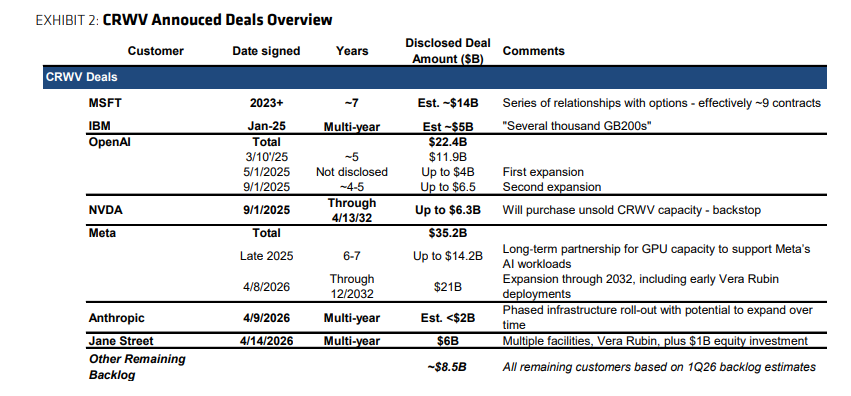
Compounding the issue, Meta itself is a major customer of CoreWeave. According to Bernstein, Meta currently has a $35.2 billion contract with CoreWeave, representing over one-third of CoreWeave's order backlog. Combined with Microsoft's approximately $14 billion contract, nearly half of CoreWeave's orders come from clients who might become competitors when contracts come up for renewal.
Short-term risk is less direct. Existing contracts are binding and difficult to exit immediately, so CoreWeave's short-term revenue and debt obligations might not worsen instantly.
The long-term problem is harder to manage. If clients build their own clouds and sell their own computing power, the bargaining power of new cloud companies will decline. Especially at renewal time, CoreWeave will face not just a demand-side party, but a potential supply-side rival with money, technology, and data center experience.
JPMorgan's trading desk notes that the market's reaction to CRWV falling 13% and NBIS falling 15% is relatively easy to understand: Meta overnight transformed from a client into a potential competitor. For chip hardware, the impact is more indirect; for GPUaaS, the impact feels more like a business model stress test.
Why Hardware Fell First: Fundamentals Aside, There's Crowded Positioning
From a short-term trading perspective, the market isn't just trading fundamentals.
JPMorgan's trading desk debate splits into two sides: one side asks if the Meta news represents a narrative shift in CSP CapEx and AI computing demand; the other side points to overly crowded positioning, deleveraging, and profit-taking amplifying the decline. Its leaning is that the latter carries more weight, and determining whether the fundamentals have truly shifted requires waiting for the upcoming earnings season commentary.
Positioning was not light. Just past major index rebalancing, total flow volumes and leverage starting points were on the high side. Long and short additions over the past four weeks were at levels of +2 standard deviations; hedge fund deleveraging is common in July, typically ranging from -1 to -3 standard deviations over the past five years. Semiconductor and memory stock holdings are near the 100th percentile.
This explains why one piece of Meta news could impact the entire AI hardware chain. A crowded trade encountering the "computing power might not be scarce" narrative leads to a "sell first, ask questions later" reaction. The fact that software, heavily shorted stocks, and Chinese ADRs rose more than 1.4 standard deviations that day is also consistent with short-covering as a feature of the deleveraging process.
Key reversal signals the market is watching for include: whether Meta provides clarification; whether overseas AI application ARR accelerates; whether cloud provider CapEx continues to be revised upward; and whether Q2 results beat expectations. These events are concentrated in July and August. Currently, it looks more like an observation period rather than a concluded consensus.