近期鏈上回顧:沒有主線,只有拉扯


- 核心觀點:當前Solana鏈上Meme幣市場呈現「注意力PvP」與「社群有機增長」兩股力量拉扯的格局,前者依賴名人喊單和熱點事件,後者依靠真實社群共識和項目持續交付,而後者正展現更強的韌性。
- 關鍵要素:
- 注意力PvP慣性:市場習慣於依賴名人喊單搶跑,如$JOTCHUA因KOL Ansem言論市值近900萬美元,但社群質疑其「有機性」,同類項目在不同鏈上表現分化明顯(Solana的$WORLDCUP漲至1200萬美元,Base的$PITCH跌至70萬)。
- Pump.fun極端案例:新功能「Pump Fun GO」允許發布有償懸賞,導致$Bountywork項目以40 SOL懸賞紋身製造熱點,參與者最終獲利4.8萬美元,但代幣隨後歸零,揭示了純粹流量驅動的投機性。
- 社群型代幣回歸:$neet、$troll、$buttcoin、$triplet等代幣存活410-107天,市值穩定在660萬至6500萬美元之間,其共同特點是擁有長期自發社群,不依賴單一KOL。
- 關鍵推手觀點:KOL Ansem明確指出,健康的Meme幣應依靠社群忍耐虧損並持續宣傳理念,而非依賴名人喊單或拼手速出貨,市場數據(社媒、成交量、持有者)才是判斷信號。
- 鏈遊$KINS案例:通過瀏覽器MMORPG遊戲建立信任,從4萬美元市值和243名持有者起步,持續更新內容並整合社群型代幣,吸引KOL成為玩家,而非依賴打金宣傳。
After the ETH mainnet market gradually quieted down, degens have returned to activity on Solana. Even so, it's hard to identify a clear trend on Solana. To summarize, it might be best described as a "struggle between returning to community and engaging in attention PvP."
Attention PvP
Since Trump launched his coin, the meme coin market has long been accustomed to a playbook relying on celebrity callouts, hot events, and who has the fastest hands.
Everyone is used to it, so even with poor liquidity, players still follow this playbook to find opportunities, creating a strong inertia for this style of play.
$JOTCHUA is a dog meme that gained popularity in Spanish-speaking and English-speaking circles back in 2021. On January 24, 2021, Instagram user @_kingorange uploaded a motivational poster featuring a rough-looking dog image with the text "JOTCHUA," which received over 29,000 likes within three months.
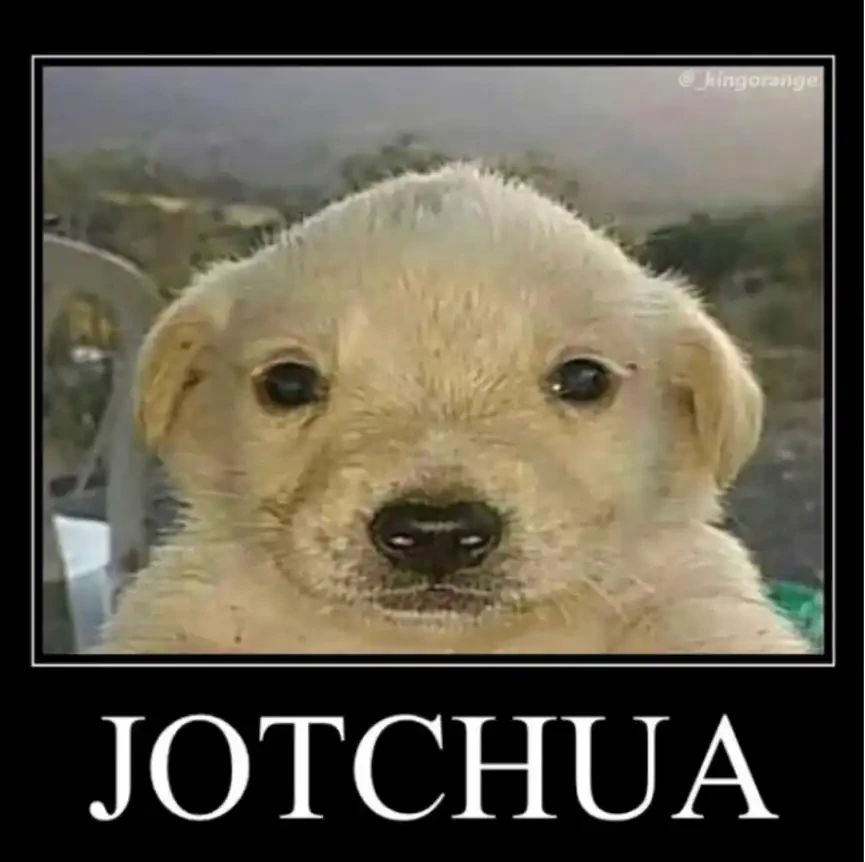
The coin's market cap briefly peaked at nearly $9 million. There's significant controversy within the community over whether this coin is "organic," as its launch didn't follow the meme's creator @_kingorange claiming it, making it nearly impossible to say that "claiming" was the direct cause of the price surge.
Many players believe this coin is another "set-up," partly due to KOL Ansem claiming on June 9 that he was returning to buy Solana meme coins for the first time in over a year, sparking market speculation that his purchase was linked to this coin.
The same concept, even the same ticker, but your coin just won't pump. $JOTCHUA on the ETH mainnet was deployed as early as December 2023 and had sustained content and community, but it couldn't compete with getting the creator to just come and click a button to claim it.
A similar situation played out with the World Cup concept. $WORLDCUP on Solana, boosted by bonkguy's purchase and detailed analysis, surged from a market cap of around $5 million to over $12 million. Meanwhile, the World Cup concept project $PITCH on Base has dropped from a peak market cap of about $7 million to nearly $700,000.
While $PITCH certainly has its own issues, mainly in communication. The project isn't idle; updates are being made regularly, but the dev rarely speaks up, and their X (Twitter) account keeps getting suspended without a new one established. However, it must be admitted that without someone making callouts, similar concepts and gameplay lose out in the battle for attention.
Pump.fun's recent new feature, Pump Fun GO, allows anyone to post paid bounty tasks on pump.fun.
This has indeed attracted attention from mainstream media, but unfortunately, it has reached the public in a negative light again.
$Bountywork's market cap briefly approached $2.5 million. Its dev, @ayushquantt, focused on continuously posting new tasks on pump.fun to generate hype for the coin.
And he succeeded—by offering a bounty of 40 SOL for someone to tattoo $bountywork on their forehead.

An Indian man actually did it, strictly following a typo the dev made in the description—missing an 'n' and incorrectly writing the ticker as $boutywork.
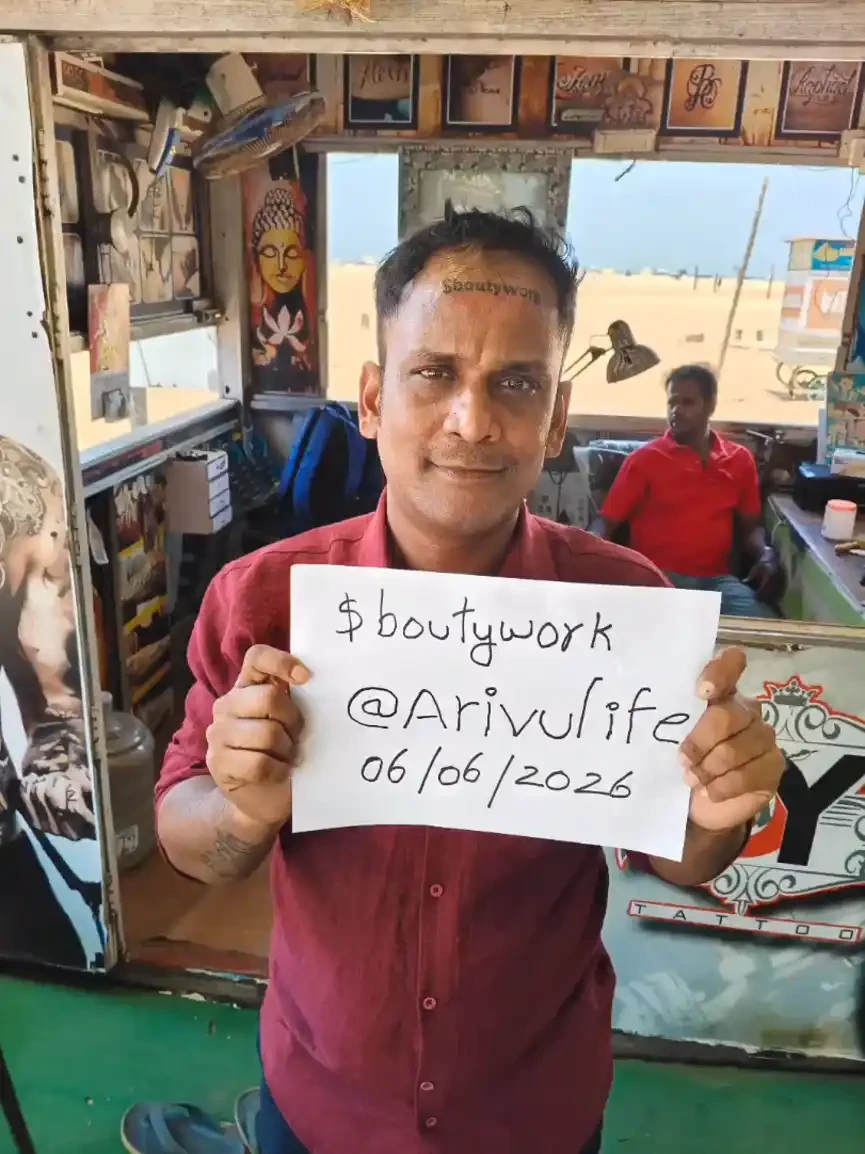
Initially, his bounty claim was rejected, with the reason being that the tattoo was missing the letter 'n'. The dev demanded he fix the tattoo. Then, someone launched a new coin using $boutywork as the ticker, based on the incorrect tattoo.
In the end, the 40 SOL bounty reward was still given to him, plus the income from the creator of the new coin, totaling about $48,000.
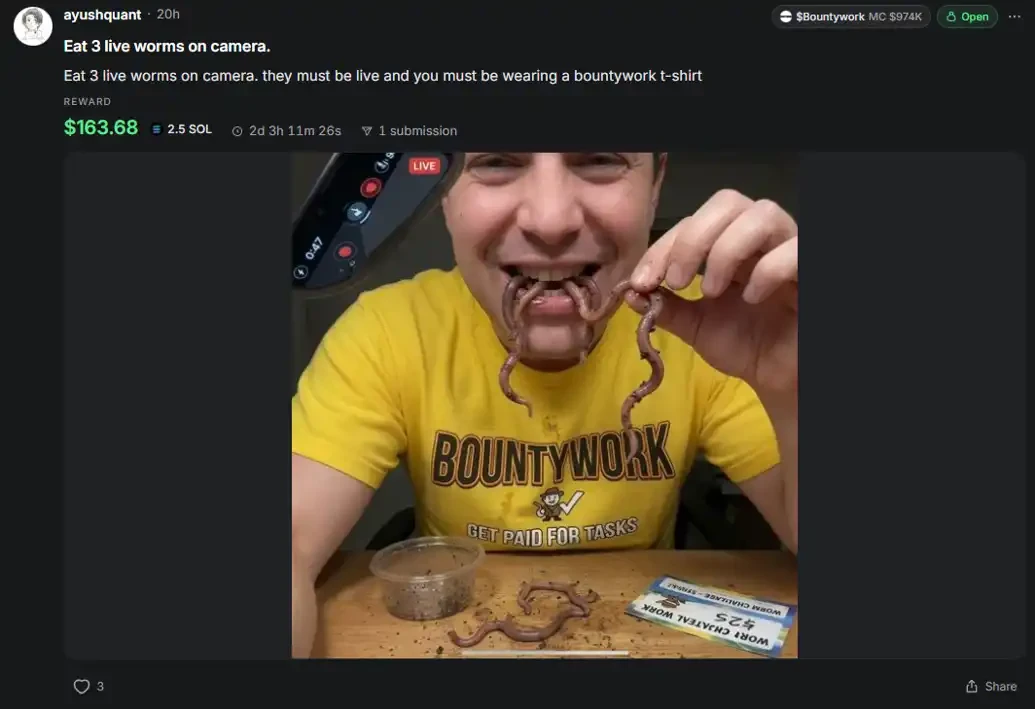
Then, as the event's hype faded, $boutywork has essentially gone to zero, while the $Bountywork dev continues to post new bounties attempting to replicate this "success," such as offering a bounty for someone to eat 3 bugs on camera while wearing a shirt with $Bountywork on it.
Tattoo tasks are plentiful on pump.fun, with some people having received up to 200 SOL for getting tattoos on their faces.
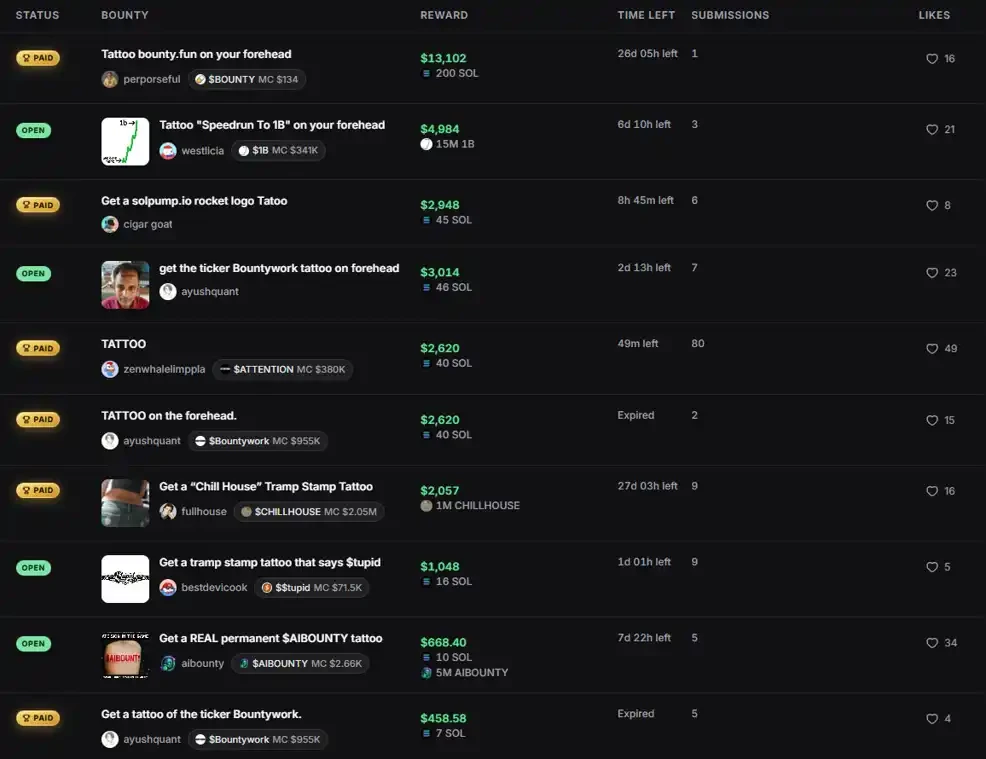
To be honest, this isn't much different from the old days on Kuaishou where big spenders would send gifts to get streamers to eat raw eggs or chug hard liquor...
The Return of Community
Let's continue discussing pump.fun's new feature. Almost all bounty tasks are related to generating attention and hype for specific tokens. The only one not treated as a spectacle might be this bounty for $neet—organizing a gathering of people who reject work in New York.
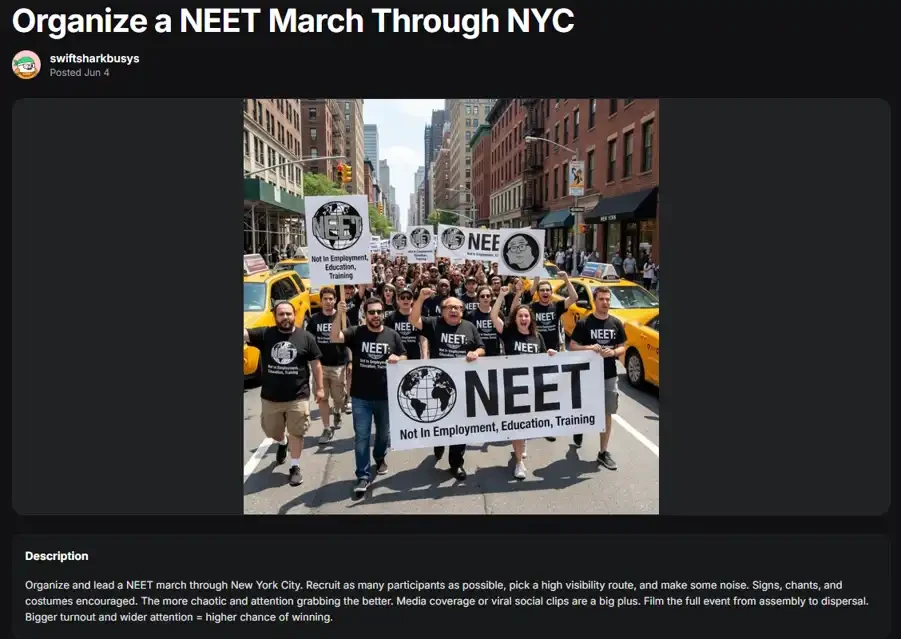
This bounty is paid in $neet, with rewards worth over $15,000. The $neet community has already spontaneously organized two offline "No Work Gatherings" in the US. If this bounty is completed, it will be the third.
While the exact intention of pump.fun in supporting community-based meme coins is unclear, their official tweets often feature promotions for community tokens. Although the performance of these tokens varies—for example, $chillhouse's price has been sluggish for a long time—the ones pump.fun officially selects tend to be quite community-driven and organic.
Currently, those with relatively stable volume and price performance, besides $neet, include $troll, $buttcoin, and $triplet. Here's a brief introduction to the survival status and themes of these community tokens:
- $neet: Deployed 410 days ago, peak market cap ~$51 million, current market cap ~$27 million. The community's mission is to make more people realize that dedicating most of one's life to work is losing one's own life.
- $troll: Deployed 416 days ago, owns the copyright to the classic Troll meme, listed on Coinbase. Peak market cap ~$290 million, current market cap ~$65 million.
- $triplet: Deployed 107 days ago, an abbreviation for the viral "Italian Shan Hai Jing" character "Stickman Tung Tung Tung Sahur" from last year. Peak market cap ~$13.6 million, current market cap ~$6.6 million.
- $buttcoin: Deployed 153 days ago, originated from a joke on a Bitcoin forum in 2011, a pun on "Bitcoin" becoming "Buttcoin." Peak market cap ~$68.6 million, current market cap ~$27 million.
Mentioning these coins and the return of community tokens brings us back to Ansem. After he mentioned returning to buy Solana memes, someone told him to just drop the CA (Contract Address), promising to immediately buy 1% and go all in.
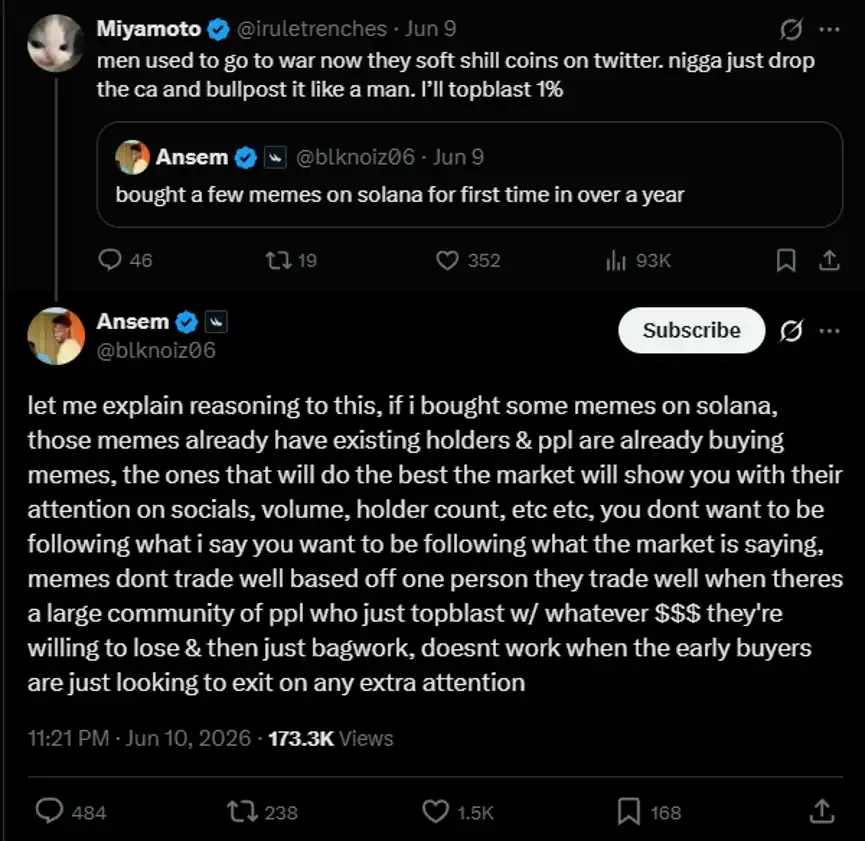
Ansem's response sparked much discussion:
"Let me explain why I don't drop the CA. If I buy some Solana meme coins that already have good holders, the market will tell you which coins are good through social media performance, volume, holder count, and other data. You shouldn't listen to me; you should listen to the market. Meme coins relying on holders who just chase fast hands and wait for callouts to dump won't do well. Only coins with a large community, where people are willing to endure losses and spread their holdings' narrative day in and day out, will succeed. Coins dependent on a single celebrity won't."
Besides these older coins with long survival times and relatively stable prices, a new coin has indeed emerged following Ansem's view: $KINS.
$KINS is the token for Kintara, a chain game. Interestingly, Kintara didn't boost Solana's gaming sector because its rise wasn't due to the game's sophistication, but rather a standard step-by-step approach of building community trust through action.
Let's briefly introduce the $KINS mechanism. It's an MMORPG playable in a browser. To enter, you need 1000 $KINS in your wallet, after which you can chop wood, mine, fish, buy houses, fight monsters, battle bosses, and engage in PvP.
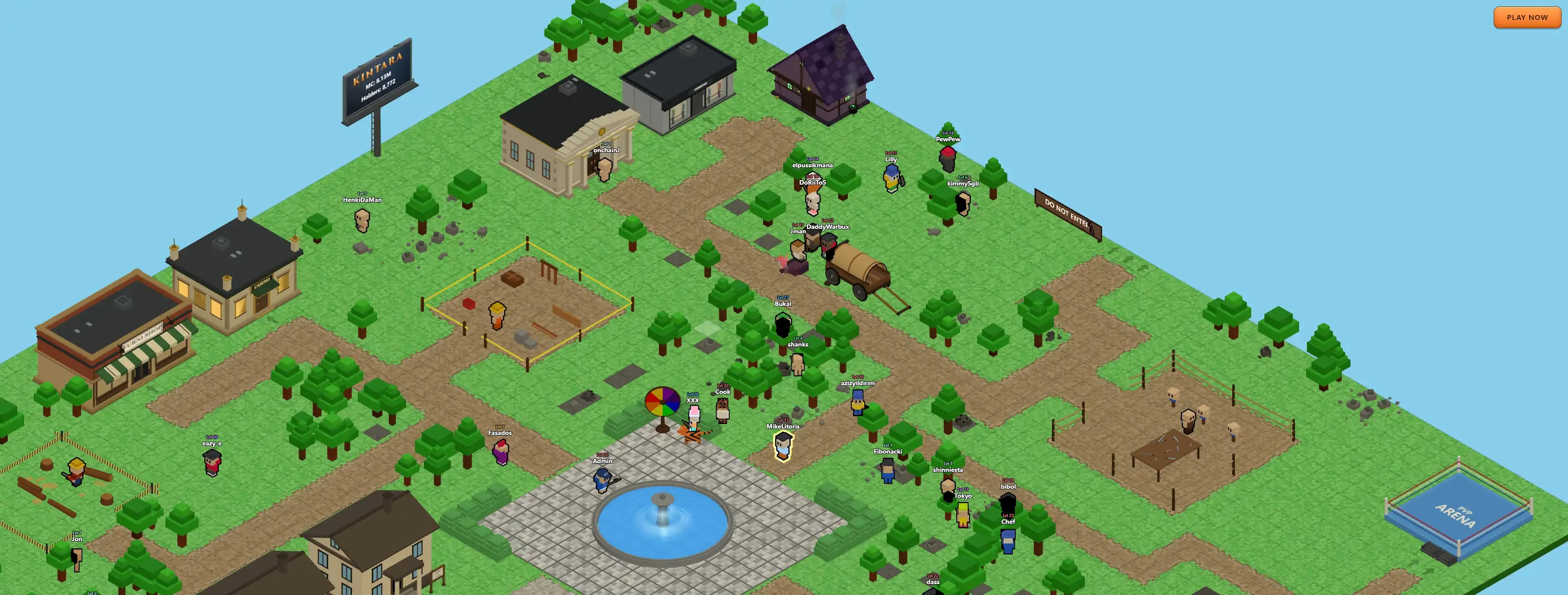
There are no other extra fees in the game except for a reward wheel. If players don't want to be limited to one spin per day, they can spend $3 worth of $KINS for more spins. Of this revenue, 50% goes to token buybacks and burns, and 50% funds project maintenance and development.
The core gameplay loop involves collecting resources -> crafting items -> challenging tougher monsters. If players lack resources, they need to use the in-game currency "Gold" to buy from other players. Players can sell "Gold" in the game priced in $KINS, with 5% going to the treasury and 95% to the player.
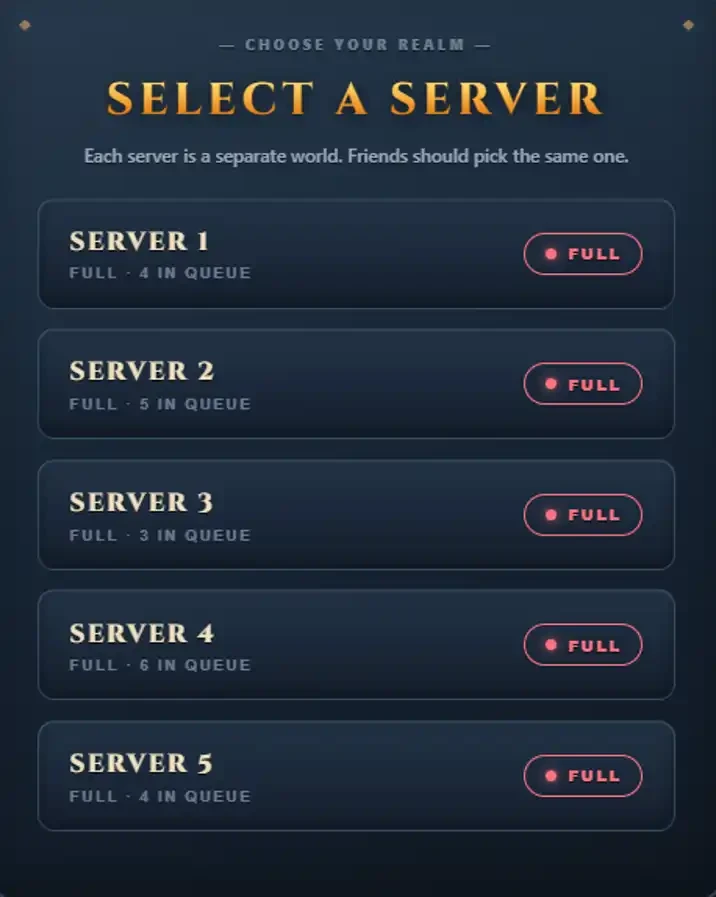
It sounds quite ordinary, and the data isn't particularly impressive (they've bought back only 0.5% of $KINS so far), but the project's consistent delivery has built strong trust. Maybe because the market is so disappointing, quite a few players have genuinely gotten into it, with the number of daily fishers growing steadily. The project team has expanded to 5 servers, but there are still queues...
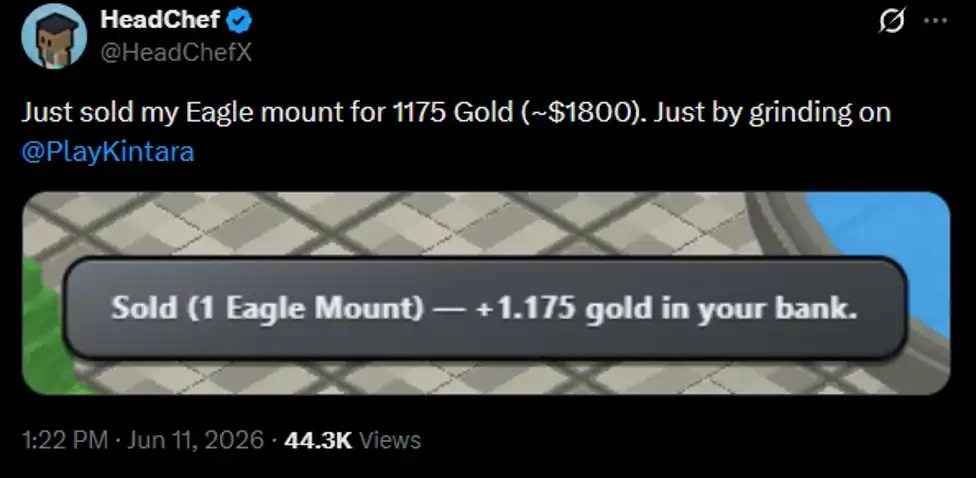
One player successfully sold a rare fishing mount for $1,800:
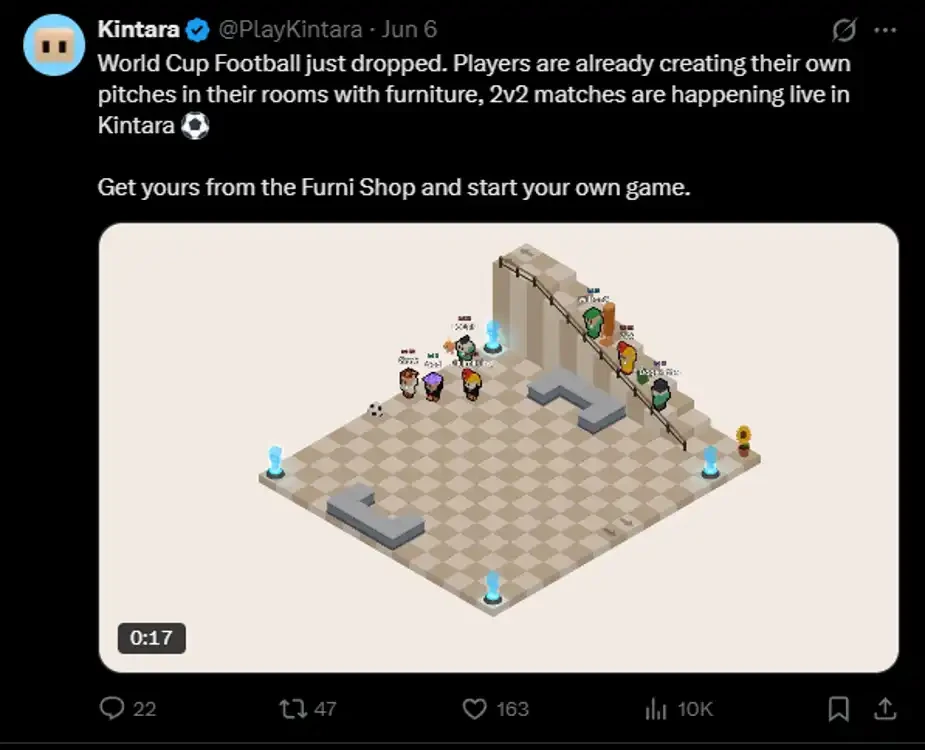
The project team behind this game almost never promotes "earning gold"; instead, they focus heavily on "building network effects and a sense of belonging for players." For example, they integrate various Solana community meme coins or new hot tokens into game elements, auction in-game mansions, etc.
Another example is promoting World Cup football competitions held in players' houses:
When it was still obscure, with a market cap under $40,000 and only 243 holders, this early "unheard and unknown" phase was already recorded on the main game map's statistics board. Everyone watched Kintara persist with rapid game content updates, slowly building confidence, and gradually attracting KOLs like Gake and Ansem to become part of the player base.
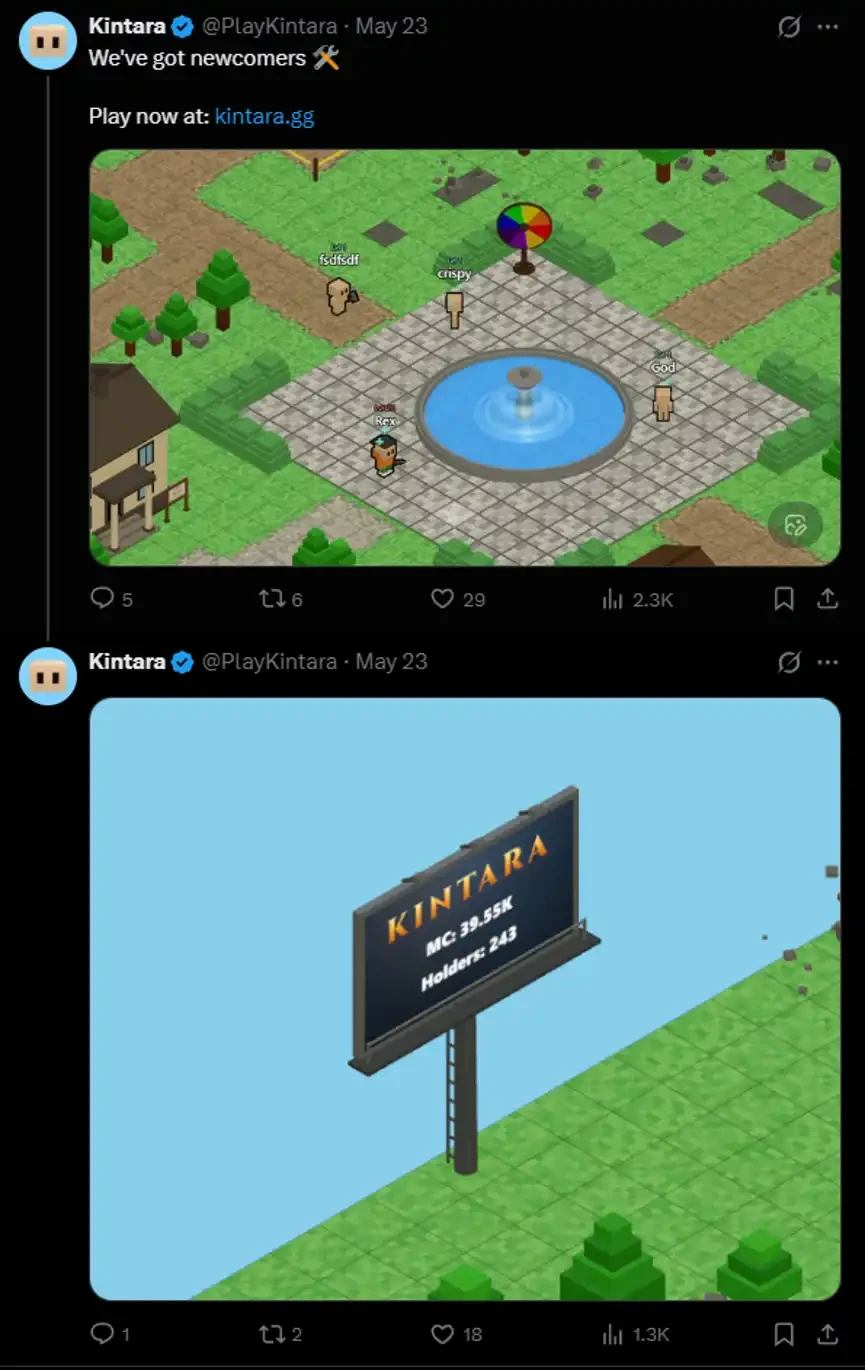
Kintara on May 23rd, like a newly born, silent, and empty world
So no one would call this project a "set-up."
"What we are constantly chasing—is it a game of mutual trust, or a game of mutual deception?"
This is Trench's recent self-questioning.
Hopefully, such introspection will continue, ultimately guiding the market towards a healthier state.