






Strategy's First Bitcoin Sale: Why Did It Spark a Settlement Dispute on Polymarket?


- Core Viewpoint: The dispute over the Polymarket prediction contract "Has Strategy sold Bitcoin?" is essentially a stress test of the rules caused by the misalignment between "the time an event occurred" and "the time information was disclosed," revealing the need for prediction markets to define their settlement basis more precisely.
- Key Elements:
- Strategy sold 32 Bitcoins (approximately $2.5 million) between May 26-31, 2026, but the 8-K filing was submitted on June 1. This led to a dispute involving approximately $14.65 million in Polymarket contracts over whether settlement should be based on the transaction fact or the disclosure time.
- The "Yes" side argues that the sale occurred before the deadline and should be settled; the "No" side insists that there was no publicly verifiable information until May 31, highlighting the ambiguity of the rules.
- The controversy brings to the forefront the priority question of on-chain data, corporate announcements, and media reports within the evidence system, exposing the inherent contradiction of public companies' disclosures lagging behind transaction facts.
- The event prompted the MEXC prediction market to launch related activities, guiding users to focus on rule design, information source transparency, and user education, aiming to promote the development of prediction markets from entertainment towards professionalism and standardization.
The controversy surrounding the prediction market focused on "whether Strategy will sell Bitcoin" is becoming a typical case for the crypto industry to observe prediction market mechanisms, on-chain data credibility, and event settlement rules. The core of the event is not complicated: Strategy, formerly known as MicroStrategy, was revealed to have sold some Bitcoin at the end of May 2026. However, the complexity lies in the misalignment between the time of the transaction, the disclosure of the document, and the deadline of the Polymarket contract, leading to intense disagreement among market participants over "whether this sale should be counted towards the prediction contract ending on May 31."
According to a CoinDesk report, Strategy disclosed in an 8-K filing that it sold 32 Bitcoins, valued at approximately $2.5 million, between May 26 and May 31, 2026. However, the filing was submitted on June 1, 2026. This time lag sparked a dispute in a prediction market worth approximately $15 million on Polymarket. Meanwhile, community media quickly focused on the event, with BlockcastNews posting about it on X, further fueling the discussion on prediction market settlement standards.
Subsequently, the MEXC Predict also launched related activities around this event, expanding the discussion from a single-platform dispute to a broader industry conversation via an official X post from MEXC Predict.

1. What Happened?
1.1 Strategy's First Public Disclosure of Bitcoin Sale
Strategy has long been regarded as one of the representative publicly traded companies holding Bitcoin. Due to Michael Saylor's past frequent public expressions of long-term bullishness on Bitcoin, the market generally viewed Strategy as a "buy-and-hold" institutional benchmark, or at least one that rarely sells its Bitcoin. However, according to a CoinDesk report, Strategy disclosed in an 8-K filing that the company sold 32 Bitcoins, worth approximately $2.5 million, between May 26 and May 31, 2026. This was seen by the market as Strategy's first public disclosure of selling Bitcoin, quickly attracting attention.
1.2 Controversy Over Related Polymarket Prediction Contract
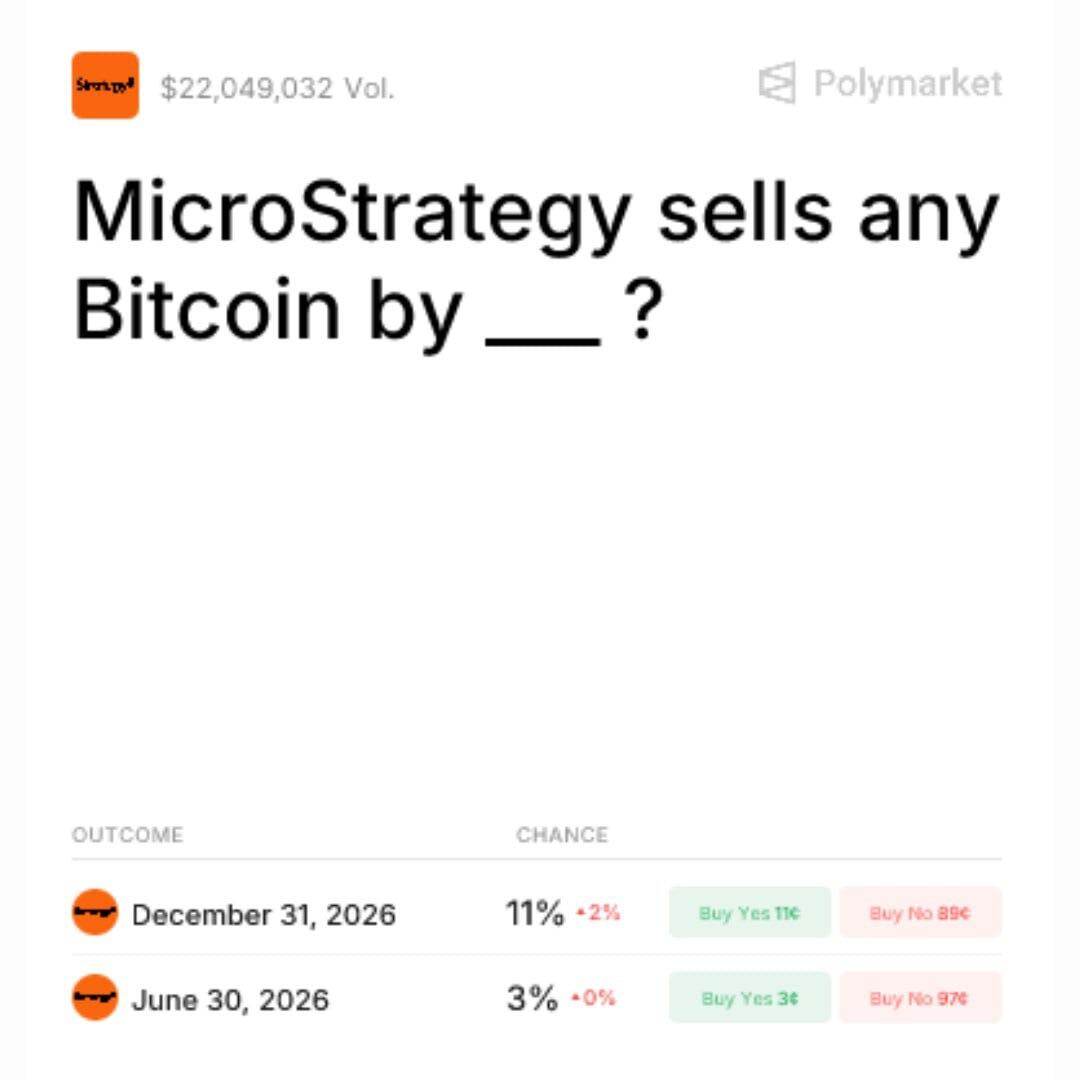
The original prediction activity on Polymarket was "Will MicroStrategy sell any Bitcoin?", which involved predicting whether Strategy would sell any Bitcoin. This market set up contracts with different deadlines, and the contract expiring on May 31, 2026, became the focus of this controversy. The basic settlement logic of this prediction activity was: if Strategy, controlled by Michael Saylor, sells any Bitcoin before the specified deadline, then the relevant contract should settle as "Yes." The dispute arose over the contract expiring on May 31. According to CoinDesk's description, this contract's deadline was May 31, 2026, at 11:59 PM Eastern Time. Strategy's sale occurred between May 26 and May 31, but the 8-K filing was only formally submitted on June 1.
Therefore, the question became: When determining the outcome of a prediction market, should we use the "actual transaction time" or the "public disclosure time"?
1.3 Core Arguments of the "Yes" and "No" Camps
The "Yes" side argued that Strategy's sale did occur before May 31, and the 8-K filing itself disclosed the transaction dates. Therefore, as long as the transaction fact occurred before the deadline, the contract should settle as "Yes." The "No" side argued that before the document was made public on June 1, there was no sufficiently public, verifiable information in the market proving the sale had occurred. Since the disclosure was after the May 31 deadline, the sale should not be counted towards the May 31 contract. This creates a classic prediction market rules dispute: The outcome fact has already occurred, but the public confirmation of that fact came after the contract deadline.
2. What Were the Consequences?
2.1 High-Value Financial Dispute on Polymarket
According to a CoinDesk report, the cumulative trading volume for the prediction markets covering the May 31, June 30, and December 31 timeframes was approximately $24.7 million. The May 31 market alone accounted for about $14.65 million. This means the event is not just a community discussion topic but involves a significant amount of real capital in a market settlement dispute. For prediction markets, the larger the capital involved, the clearer, more stable, and more enforceable the settlement rules need to be. Otherwise, if the interpretation of the result has any ambiguity, the platform's credibility and user trust can be affected.
2.2 May 31 Contract Entered Verification Status
According to the CoinDesk report, the May 31 contract briefly showed approximately 81% favoring "Yes" and was marked as "under review." This indicates that while the market price leaned towards "Yes" as more likely to win, the final result still needed to be confirmed through a dispute resolution mechanism. Polymarket typically relies on UMA's Optimistic Oracle mechanism for resolving such disputed markets. For relevant UMA mechanisms, one can refer to its official documentation: UMA Optimistic Oracle. Simply put, the optimistic oracle allows market outcomes to be proposed, challenged, and arbitrated, thereby handling events with interpretive ambiguity.
2.3 Prediction Market Rule Design Under Scrutiny Again
This event exposed several common problems in prediction markets:
- Does the contract clearly distinguish between "event occurrence time" and "information disclosure time"?
- How should the priority be ranked among on-chain data, company announcements, and media reports?
- If a fact occurs before the deadline, but supporting evidence appears after the deadline, how should it be settled?
- When multiple credible sources provide different interpretations, how should the platform protect market participants?
These questions are not unique to Polymarket and could affect the entire prediction market industry.
2.4 Subsequent Contract Prices Quickly Reflected New Information
The CoinDesk report showed that after Strategy disclosed the sale, the contracts expiring on June 30 and December 31 were almost priced at 100% "Yes" by the market. This indicates that the market is no longer debating whether Strategy sold Bitcoin, but is focused on: Which time window should this sale be counted towards? In other words, the dispute shifted from "fact determination" to "rule interpretation."
3. Why Did This Happen?
3.1 Strategy's Unique Market Image
Strategy is not an ordinary publicly traded company. It has long been viewed as a representative of institutional Bitcoin holding strategy. Michael Saylor's past public statements about Bitcoin have endowed Strategy with a very strong symbolic meaning in the crypto market. Many investors believe that as long as Strategy doesn't sell its Bitcoin, it represents that institutional-level Bitcoin long-termism remains solid. Therefore, "whether Strategy sells Bitcoin" is not just a financial event; it is also a market narrative event. When this narrative enters the prediction market, participants are not just trading on a factual outcome, but also on market belief.
3.2 Prediction Markets Depend on Precise Definitions, But Real-World Events are Often Complex
The advantage of prediction markets is converting dispersed information into price signals. However, the prerequisite is that the contract question must be sufficiently clear. For example:
- "Did a certain company sell Bitcoin before a certain date?"
- "Did a certain company publicly disclose selling Bitcoin before a certain date?"
- "Did a credible media outlet report the sale of Bitcoin before a certain date?"
- "Is there on-chain data proving a sale occurred from a related address before a certain date?"
These questions may seem similar, but the settlement results could be completely different. The key issue in this Polymarket dispute is that the contract involved MSTR filings, on-chain data, and credible reporting consensus, but in the actual event, the transaction execution time and the public disclosure time were inconsistent.
3.3 On-Chain Data Does Not Equal Complete Facts
In the crypto industry, on-chain data is often seen as a transparent, verifiable, and immutable source of information. However, in the context of publicly traded company asset management, on-chain transactions do not always directly indicate that a "sale" has occurred.
- Wallet address ownership may be uncertain;
- On-chain transfers do not necessarily equal a sale;
- Custody, internal transfers, OTC trades, and settlement processes can span different times;
- The company's final accounting confirmation and regulatory disclosures may lag behind on-chain actions.
Therefore, if a prediction market uses on-chain data as its core basis, it must specify: What kind of on-chain activity constitutes a "sale"?
3.4 Public Disclosure Has a Lag
Disclosure documents for publicly traded companies are typically not released in real-time. SEC filings, 8-K reports, and other company announcements are often disclosed after the event has occurred. For basic rules on the 8-K filing, one can refer to the SEC's description of Form 8-K: SEC Form 8-K. This means that if a prediction market uses "actual occurrence time" as the criterion, it may face issues with post-event evidence. If it uses "public disclosure time," it may be inconsistent with the actual event occurrence time. This event struck right at this gray area.

4. MEXC Predict's Activities
4.1 MEXC Predict Leverages the Event to Drive Prediction Market Discussion
Following the Polymarket dispute, the MEXC Predict launched prediction market activities centered around the hot topic of Strategy selling Bitcoin, guiding users to discuss the market outcome, event logic, and prediction mechanisms via an official X post from MEXC Predict. The value of this activity is not just riding the hype, but transforming a complex market dispute into a prediction market case study that users can understand, participate in, and learn from. For crypto users, prediction markets are not only trading tools but also mechanisms for information discovery. By participating in similar events, users can more intuitively understand:
- How the market prices information;
- How news disclosures affect probability changes;
- How rule wording impacts final settlement;
- How community consensus influences prediction market liquidity;
- How platform transparency affects user trust.
4.2 MEXC Predict's Contribution to the Industry
The industry significance of the MEXC Predict can be understood from several aspects. First, MEXC Predict helps promote information transparency in the crypto market. In traditional trading markets, users often can only express their views through price movements, while prediction markets allow users to express probability judgments on specific events. For example, whether a certain company sells Bitcoin, whether a specific regulatory policy is implemented, or whether a particular project completes its upgrade, all can be transformed into tradable market questions.
Secondly, MEXC Predict lowers the barrier for users to understand complex events. Events like Strategy selling Bitcoin involve public company disclosures, on-chain data, prediction market rules, and community disputes. It's difficult for average users reading fragmented information to grasp the key points. Prediction markets, using a "Yes/No" structure, compress complex information into a clear question, helping users quickly understand market disagreements. Thirdly, MEXC Predict strengthens the industry's user education function.
The essence of prediction markets is not simple guesswork on price movements, but training users to identify information quality, judge event boundaries, and understand rule conditions. This activity, centered around the Polymarket dispute, precisely allowed users to see that in prediction markets, the importance of rule design and information sources is no less than trading judgment. Fourthly, MEXC Predict can provide the crypto industry with higher-frequency, finer-grained sentiment indicators. Compared to ordinary polls or social media discussions, because prediction markets involve real capital or incentive mechanisms, their price signals often better reflect the true judgments of participants.
4.3 Why the MEXC Predict Activity Deserves Close Attention?
The value of this MEXC Predict activity lies in transforming a dispute event from an external platform into a case study the entire industry can discuss and learn from. The Polymarket dispute exposed the problem of vague prediction market rules, and MEXC Predict can use this opportunity to further drive industry attention toward:
- Whether event descriptions should be more precise;
- Whether settlement criteria should be clarified in advance;
- How on-chain data and public disclosures should be prioritized;
- Whether users fully understand the rules before participating;
- How prediction market platforms can improve transparency and credibility.
If the Polymarket event demonstrated the challenges of prediction markets, then the MEXC Predict activity showcases the opportunity for prediction markets to mature further.
5. Analysis of the Event
5.1 This is Not a Simple "Yes" or "No" Debate
On the surface, the dispute is simply "Did Strategy sell Bitcoin before May 31?" But the deeper question is: Does the prediction market predict facts, or does it predict facts as recognized by the rules? In the real world, facts have an occurrence time, confirmation time, disclosure time, and reporting time. Prediction markets must specify in advance which time is most important. If the rules are not clearly defined, traders will interpret the rules in their favor, ultimately leading to disputes.
5.2 Prediction Markets Need Stricter Event Definitions
This event shows that future prediction markets, when designing similar contracts, should avoid ambiguous language as much as possible. For example, instead of just writing: "Will Strategy sell any Bitcoin?" A better formulation might be: "Did a public filing by Strategy with the SEC show it completed a Bitcoin sale before a certain date?" Or: "Was there an official Strategy announcement, SEC filing, or designated news source confirming its Bitcoin sale before a certain date?" Or: "Do verifiable on-chain transactions and credible reports jointly prove that Strategy sold Bitcoin before a certain date?" Different wording leads to different results. For prediction markets to develop long-term, this interpretive space must be reduced.
5.3 On-Chain Transparency Cannot Replace Legal Disclosure
The crypto industry often emphasizes on-chain transparency, but the actions of publicly traded companies still require confirmation within a legal and accounting framework. If a wallet makes a transfer, the on-chain data can prove "asset movement," but not necessarily "company sale." Only when company filings, transaction records, or credible disclosures jointly confirm it can the market more safely judge the event's outcome. This is not to deny on-chain data, but to clarify that on-chain data needs to be placed within an appropriate evidence framework.
5.4 The Credibility of Prediction Markets Comes from Rules, Not Outcomes
For platforms like Polymarket, MEXC Predict, and other prediction market platforms, user trust ultimately comes not from a single outcome, but from the process of rules. A good prediction market should achieve:


