Binance美股交易初體驗:操作簡潔,但非「零佣金」


- 核心觀點:Binance正式上線美股交易功能,覆蓋超過7000檔美股與ETF,透過券商通道而非代幣化路徑實現,並即將推出證券借貸服務,旨在打造一站式金融超級應用。
- 關鍵要素:
- Binance透過券商通道(Nest Trading與Alpaca Securities)提供美股交易,支援碎股(最低1美元)、零佣金但收取0.10%平台費用(最低0.35美元),僅限非簡體中文用戶使用。
- 用戶需以USDC為結算貨幣進行美股交易,使用USDT或BNB支付將產生額外換匯損失;訂單類型僅支援市價單與限價單,非核心時段流動性風險較高。
- 6月4日將上線全額支付證券借貸(FPSL)功能,允許用戶出借持倉股票賺取利息,該功能由Alpaca提供底層技術支援,對標Kraken等競品。
- 全球加密平台加碼美股市場:Coinbase、OKX、Kraken、Bybit等相繼推出代幣化或傳統美股交易,代幣化股票市值近10億美元,本質是傳統金融與加密金融的雙向融合趨勢。
After a weekend of anticipation, Binance's US stock product has finally arrived. Within the Binance app, virtually all US stocks can now be traded.
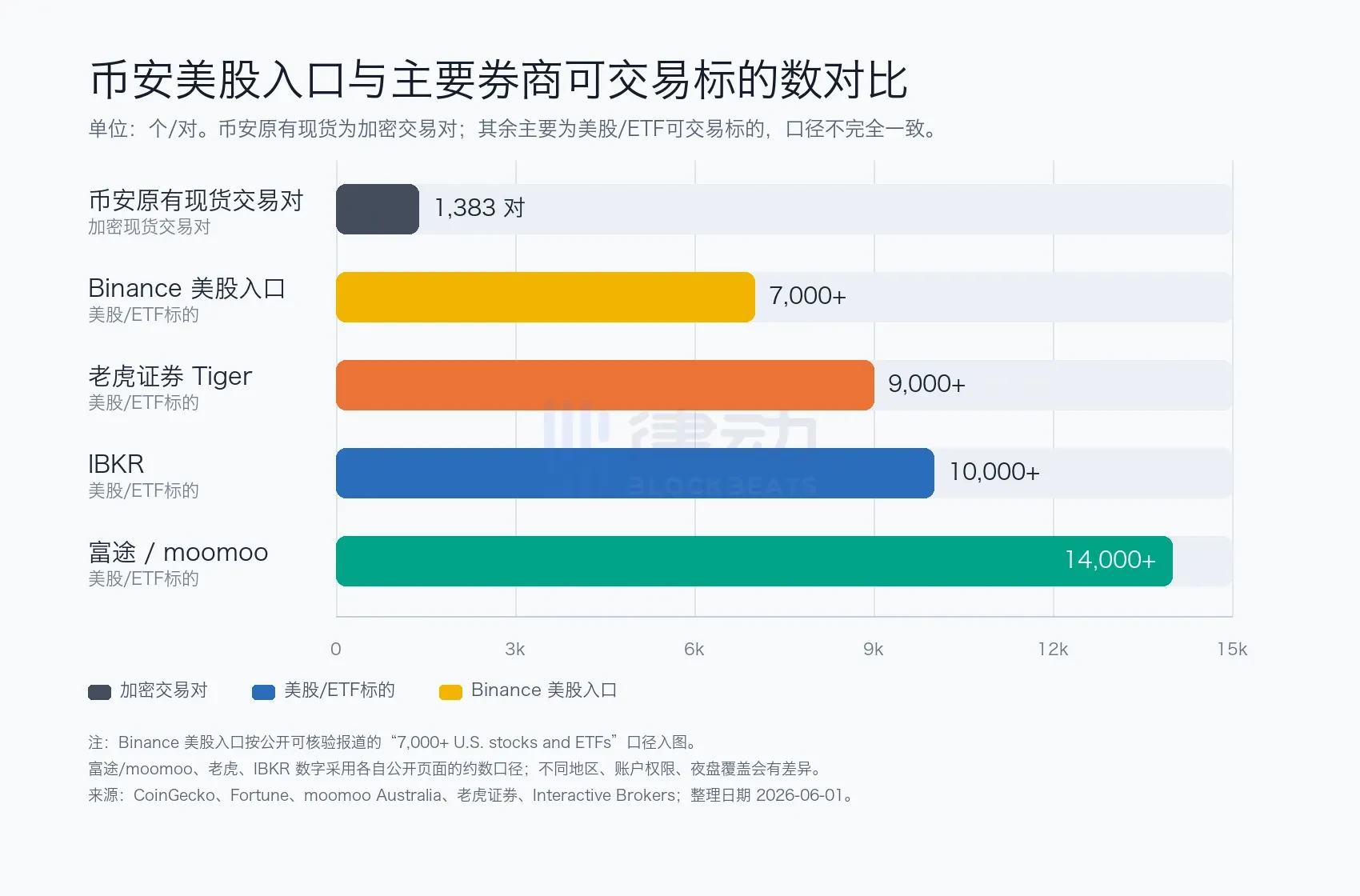
Binance isn't just testing the waters with a few tokenized blue-chip stocks this time. Instead, it has opened up access to over 7,000 US stocks and ETFs in one go, positioning itself as what co-CEO Richard Teng calls a "multi-asset financial super app." As he told Fortune, US stocks account for more than half of the global stock market, but overseas users face high costs and significant friction to buy them. What Binance aims to do is eliminate this barrier.
The BlockBeats editor conducted a complete test order with NVDA to experience this product from start to finish.
Product Hands-on: How is Binance's US Stock Experience?
Opening the "Settings" page of the Binance App, the first step is to confirm the version: v3.15.0, the latest version. The language has been switched to Traditional Chinese. This confirms what the community had previously reported as a prerequisite: Chinese users wanting to trade US stocks must switch their language from Simplified Chinese to Traditional Chinese or another language, with Simplified Chinese being specifically excluded.
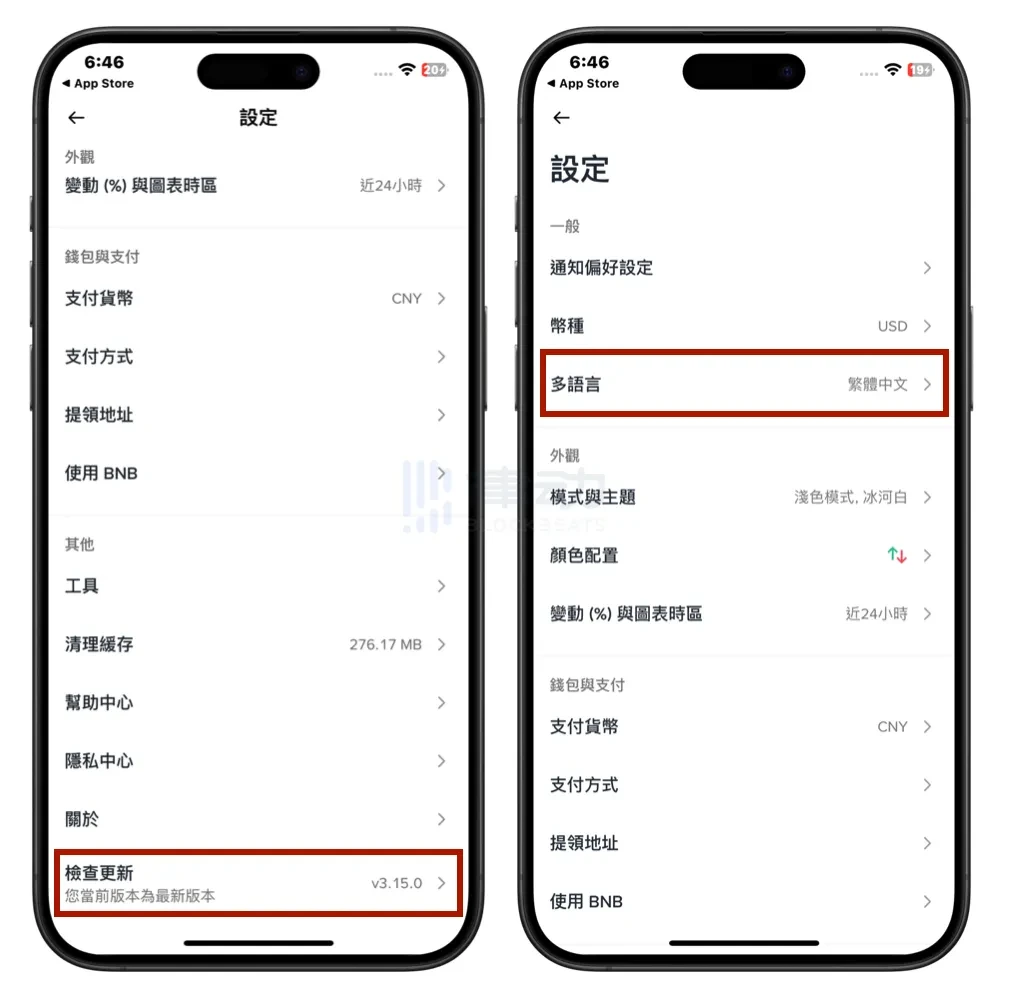
Switching to the "Markets" page, a "Traditional Finance" entry appears in the top tab, alongside "Cryptocurrency" and "Alpha." Below, it is divided into three sub-columns: Stocks, Spot, and USDT-M Perpetual. The Stocks column further breaks down into "US Stocks" and "ETF" filters.
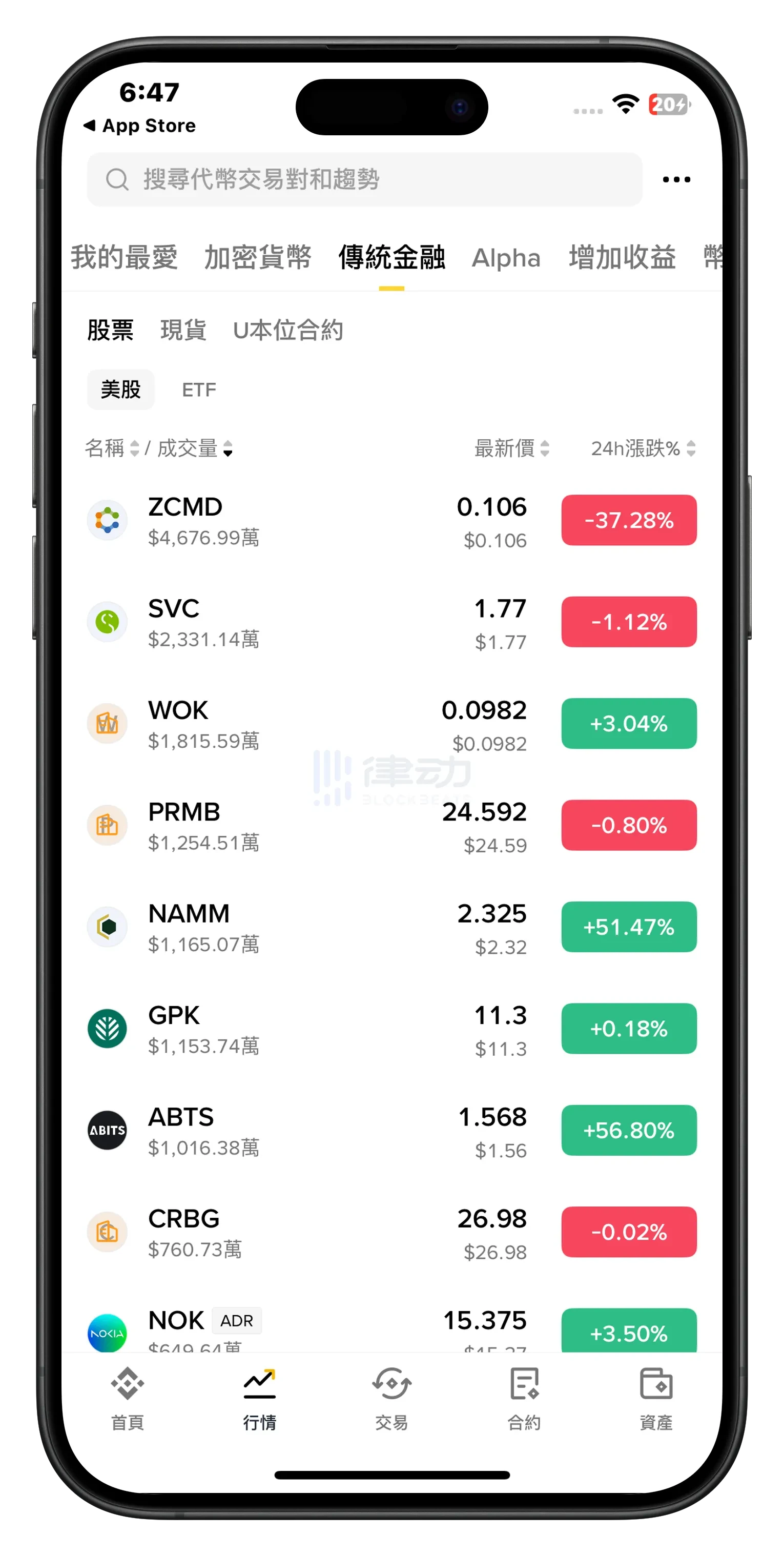
Scrolling down the list, the first things you see aren't Apple and Tesla, but obscure small-cap stocks like ZCMD (market cap ~$46.76 million), SVC (~$23.31 million), and WOK (~$18.15 million)—names that even seasoned US stock investors might not recognize. NOK also has an ADR tag next to it. This indicates that the coverage of 7,000 stocks isn't just for show with a few blue chips; it genuinely extends to small-cap and even ADR levels.
However, the experience might be better if there were sorting and filtering options to bring mainstream large-cap stocks like Nvidia and Intel to the front.
The ability to offer 7,000 US stock trading pairs stems from Binance not using an on-chain minting tokenization route, but rather a real broker-dealer channel. Therefore, the underlying assets are not limited by the issuer's minting progress. To compare scales: Kraken's xStocks covers over 60 blue chips, its underlying issuer Backed Finance currently has around 100, targeting over 500 by year-end; Robinhood's tokenized offerings in the EU cover about 200 companies. Others mint and list one by one; Binance directly connected to the entire US stock market shelf.
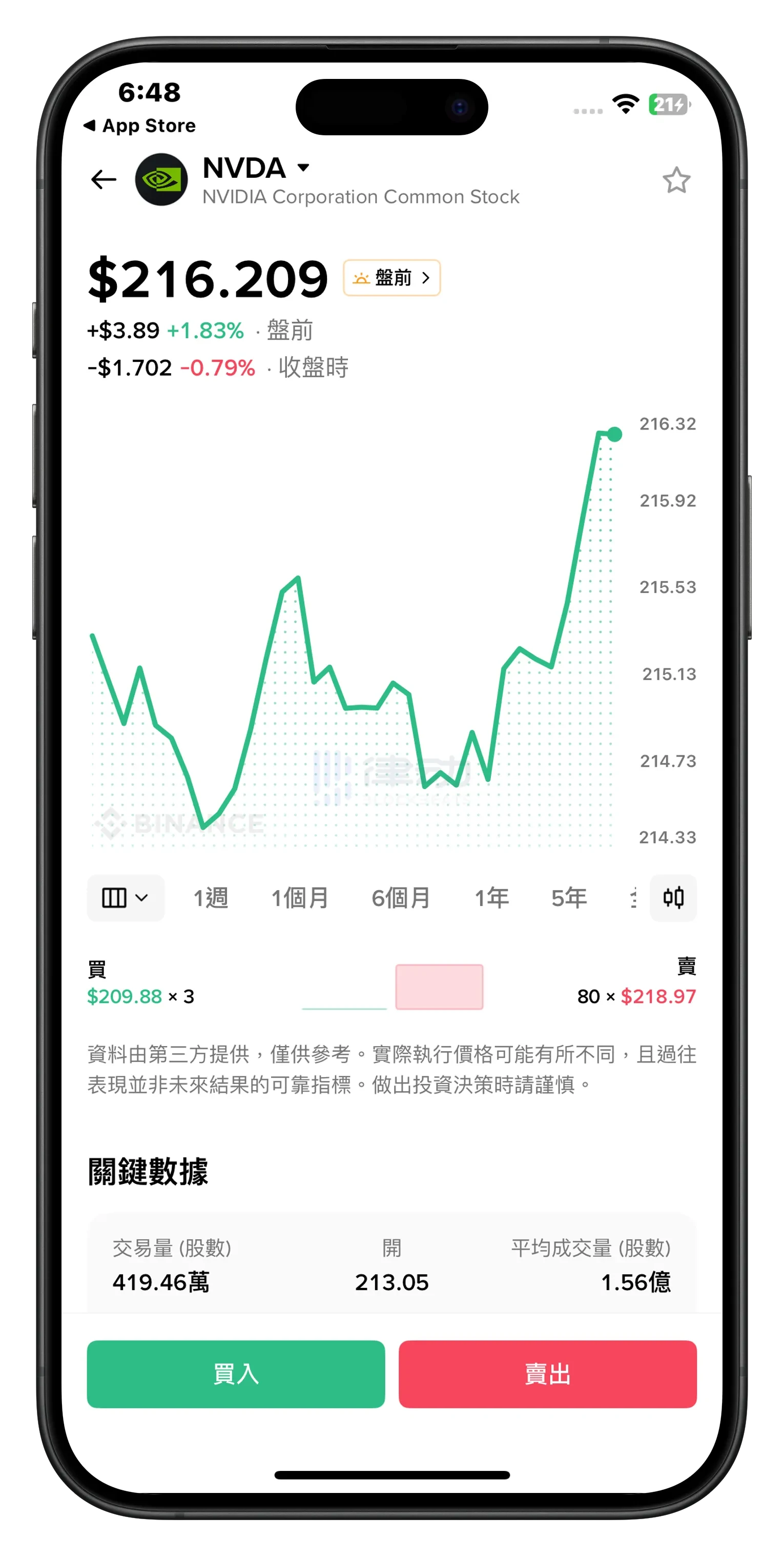
Entering the NVDA detail page. The quote is $216.209, marked "Pre-Market," up 1.83% pre-market, down 0.79% last close. The K-line supports time frames from 1 week to 5 years, similar to mainstream brokerage apps.
Scrolling down reveals a "Key Data" panel: Trading Volume 4.1946 million shares, Open 213.05, Avg Volume 156 million shares, 52W High 236.54, Low 135.40, Market Cap $5.11 trillion, P/E Ratio 32.04, EPS $6.59, Dividend Yield 0.02%, Free Cash Flow $119.076 billion. The data granularity reaches the level of Webull or Robinhood. Further down is a "Corporate Actions" section, indicating a cash dividend on June 4th.
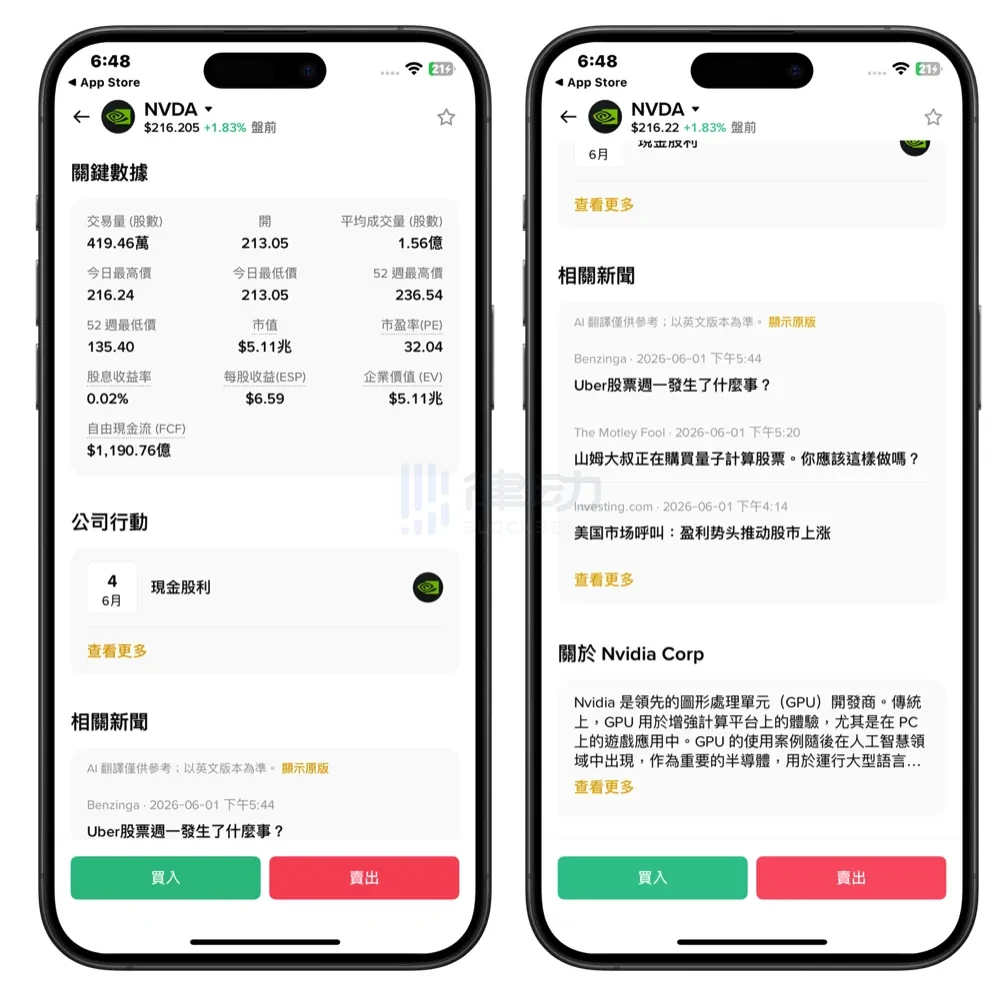
The "Related News" area aggregates sources from third parties like Benzinga, The Motley Fool, and Investing.com. At the very bottom is a company profile. The overall information architecture is sufficient for stock trading beginners, but it lacks deep data like financial statements, analyst ratings, and institutional holdings. It's a tier below Bloomberg or Tonghuashun. For Binance's target users, it might be enough. But for heavy stock traders, it might lack in information density and professionalism.
Next, we place an order.
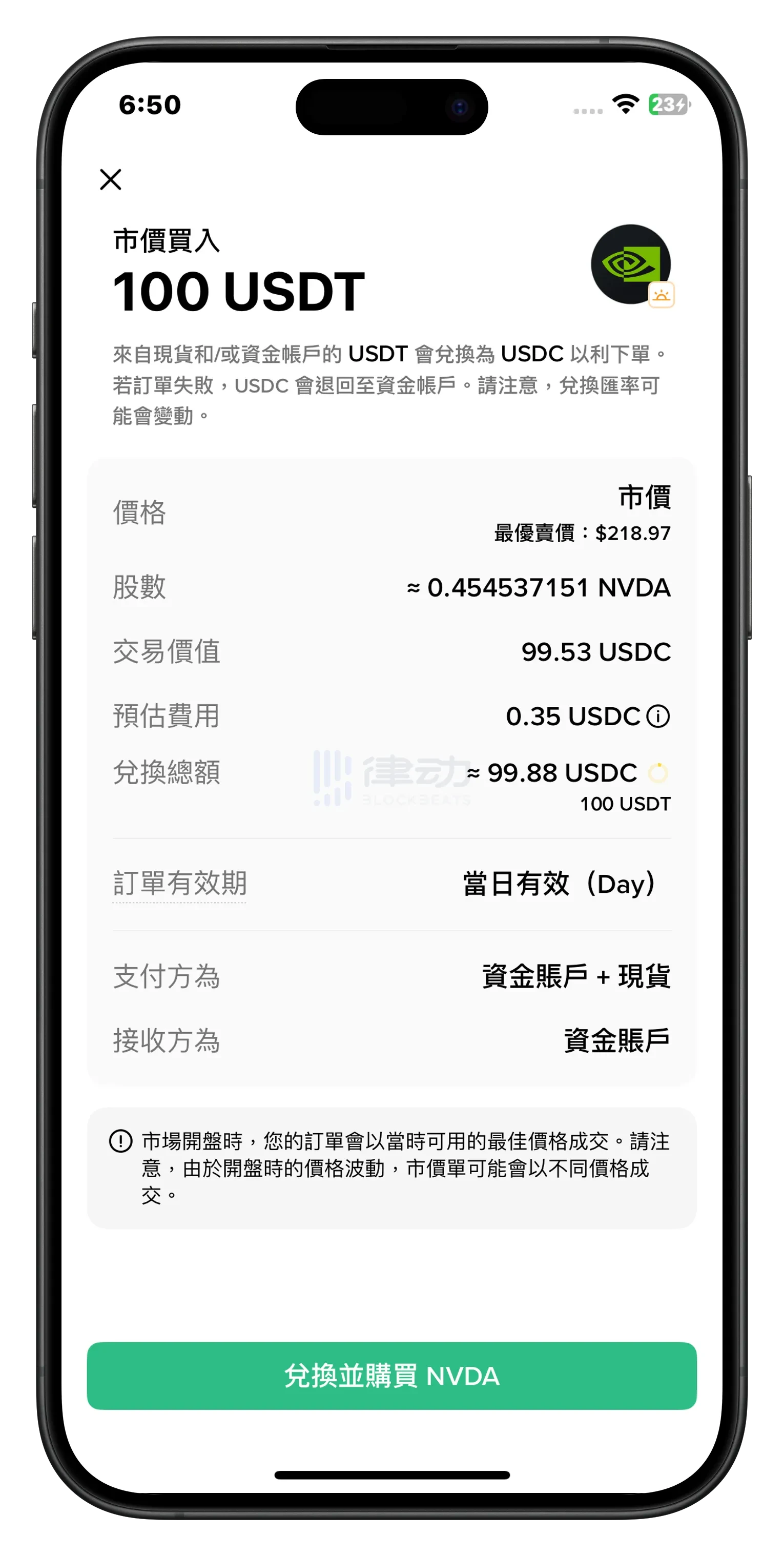
Clicking "Buy," enter 100 USDT. The system automatically converts: 100 USDT is first exchanged at a rate of 1 USDT ≈ 0.998859 USDC to get about 99.88 USDC, then used to buy approximately 0.4545 shares of NVDA at the market price (best ask $218.97), with a transaction value of 99.53 USDC and an estimated fee of 0.35 USDC.
There is an unavoidable intermediate step here: regardless of whether you pay with USDT or BNB, all funds are first converted to USDC, which is then used to settle the stock purchase. The exchange fee between USDC and USD is 0 (the spread is borne by Binance), but conversion from other coins like USDT or BNB to USDC is subject to "applicable market spreads." This means using USDC directly is the lowest cost path, while using USDT or BNB incurs an additional conversion loss.
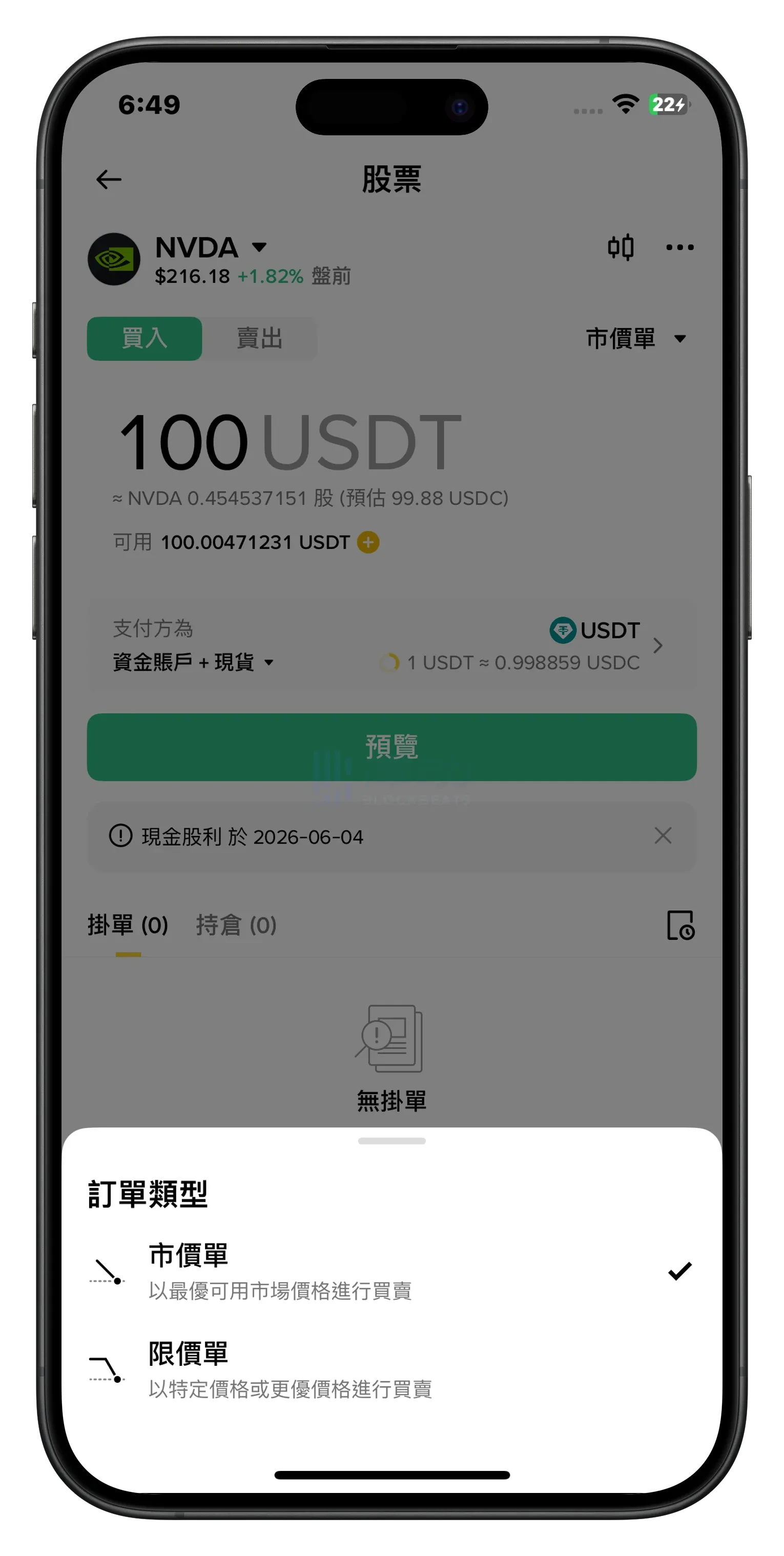
There are currently only two order types: Market Order and Limit Order. The order validity is "Day (Good for Day)." The payment source is "Funding Account + Spot," indicating the system automatically deducts from both wallets.
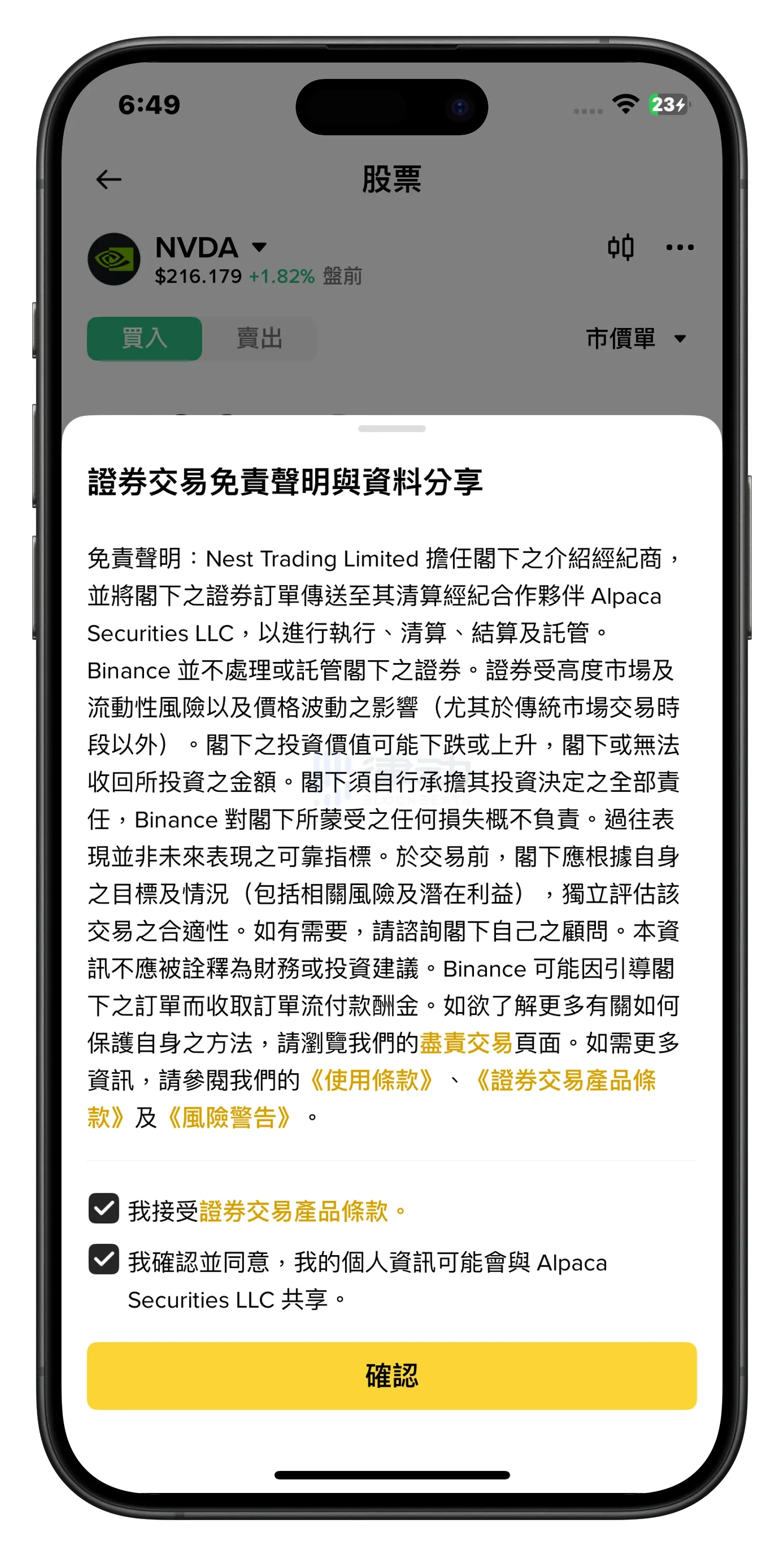
After clicking preview, a "Securities Trading Disclaimer and Information Sharing" notice pops up. The core terms, written in formal language, state one thing: Nest Trading Limited acts as the introducing broker, transmitting orders to Alpaca Securities LLC for execution, clearing, settlement, and custody. Binance does not handle or custody your securities. Two checkboxes must be ticked: Accept Securities Trading Product Terms, and Consent to sharing personal information with Alpaca Securities LLC.
The fee details popup clearly states: Commission 0 USDC, Platform Fee 0.35 USDC, Spread 0 USDC, Total 0.35 USDC. Three notes below are worth highlighting: First, Binance does not charge commissions, but orders are subject to platform fees or spreads; Second, BNB fee discounts are currently not supported; Third, regulatory fees (CAT, TAF, SEC fees) may be charged in the future.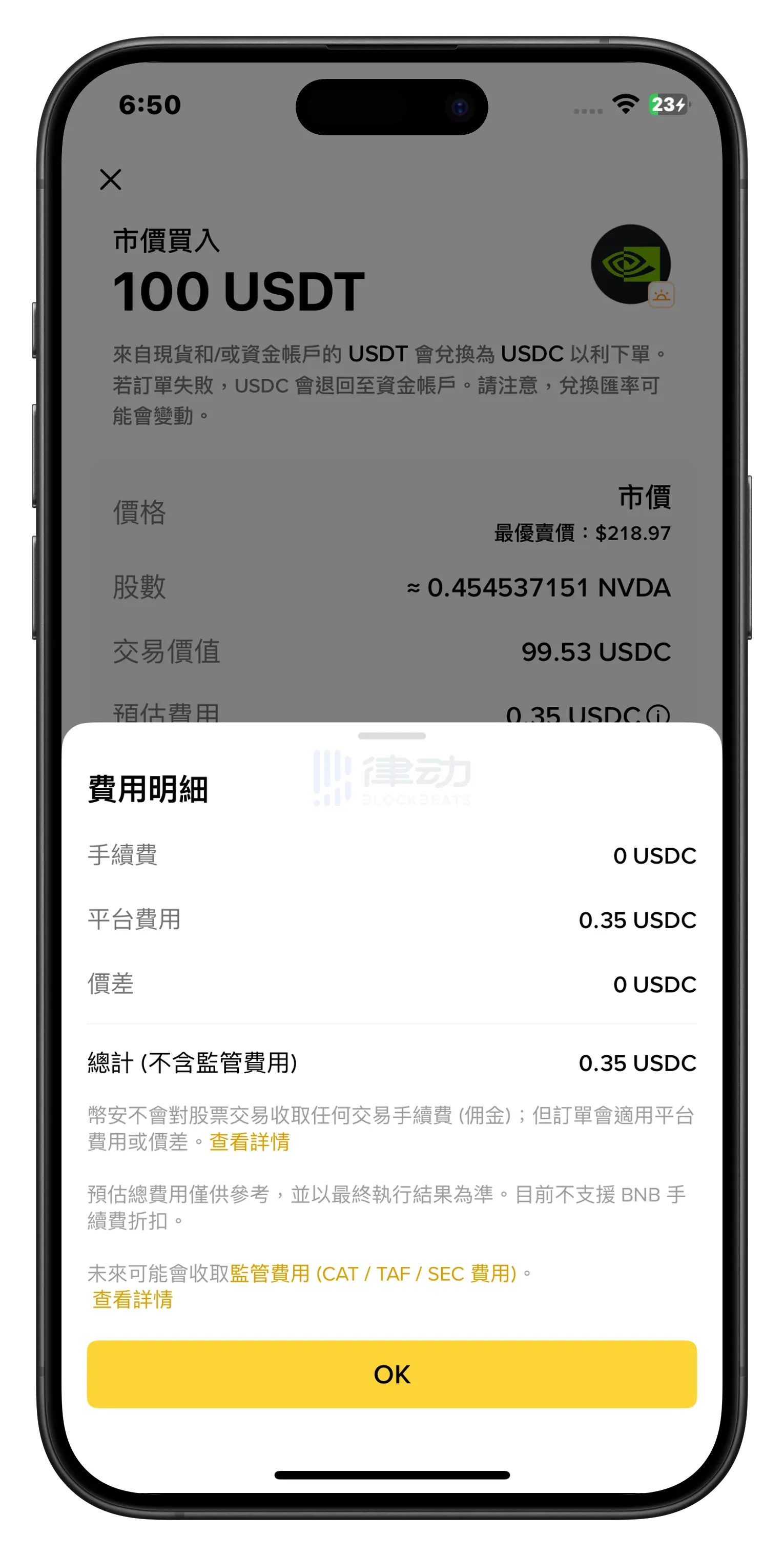
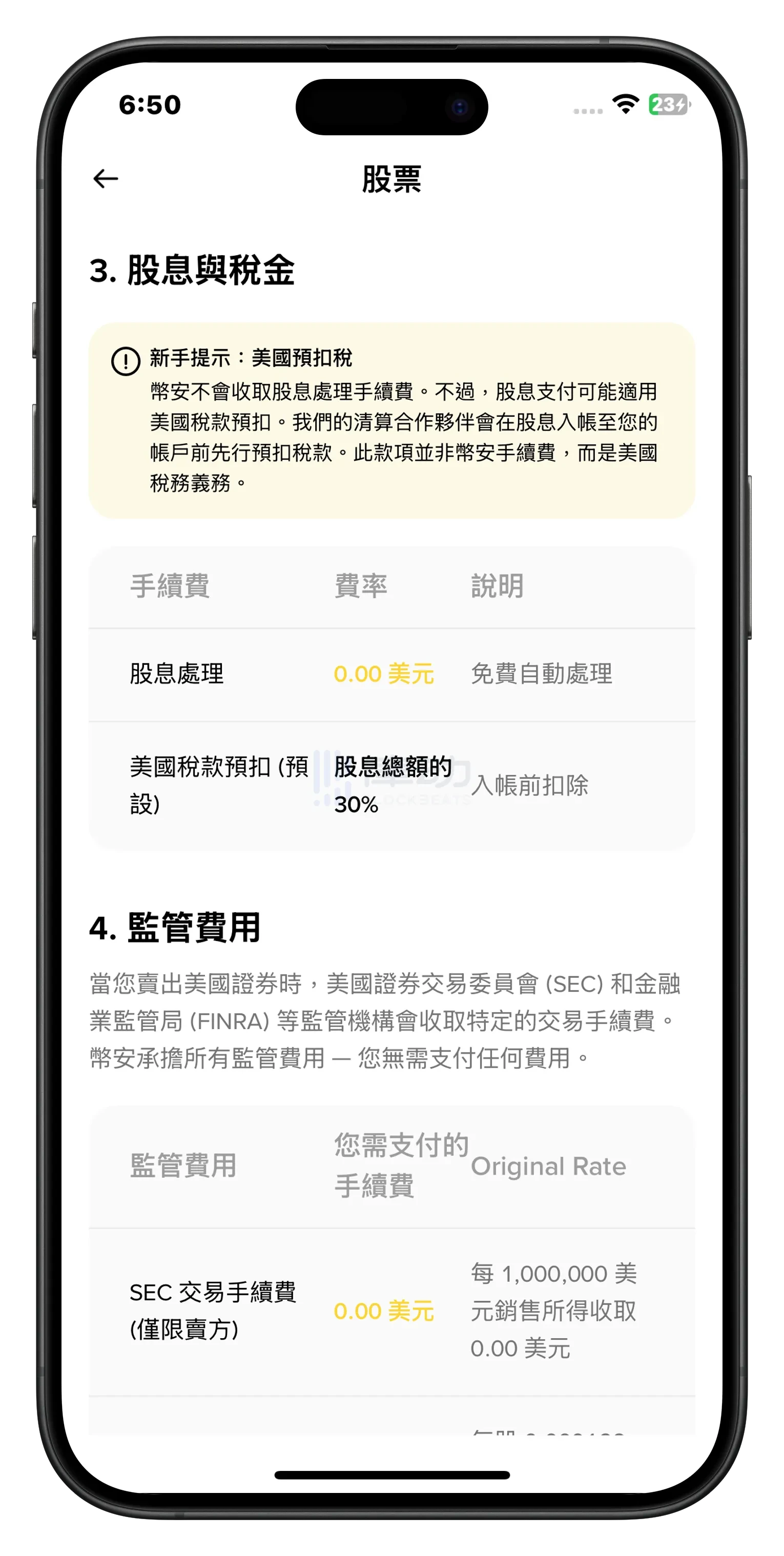
The fee page breaks the structure down further: Trading Spread 0.10%, minimum $0.35 per trade; fractional shares are subject to the same rate, minimum investment $1; account opening, maintenance, inactivity, and custody fees are all $0. For regulatory fees, the SEC transaction fee (seller side only) is borne by Binance, so the user pays $0.
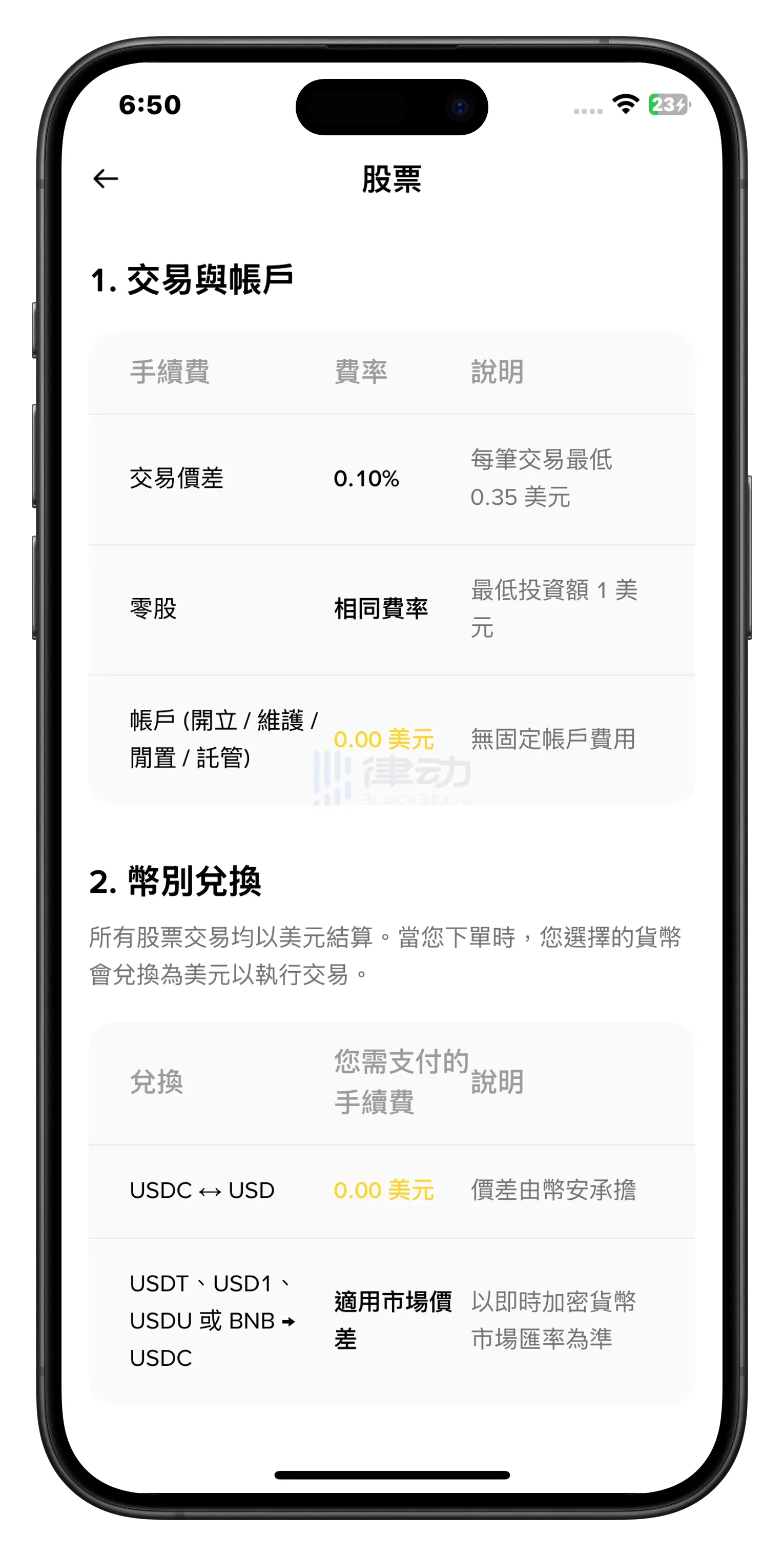
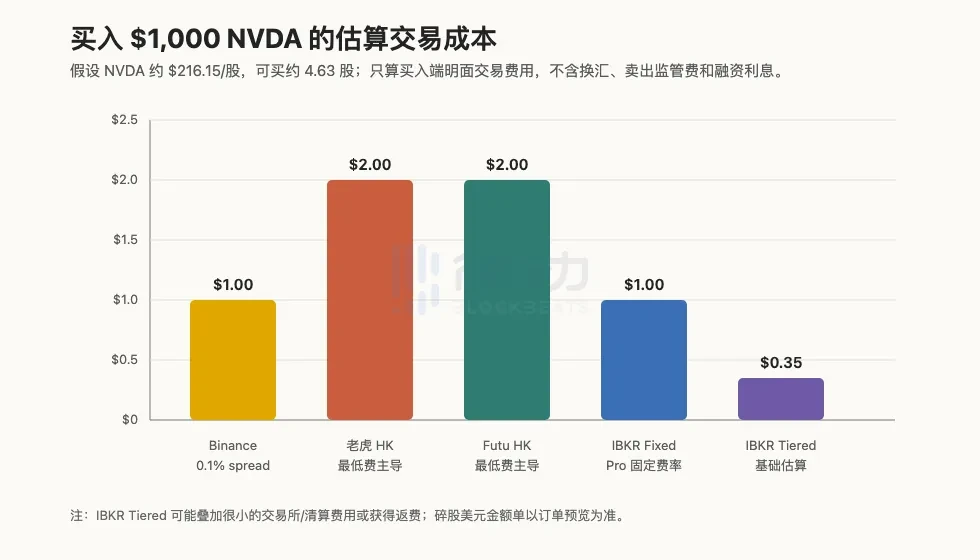
So, the term "zero commission" should be interpreted as follows: the commission is indeed zero, but the platform fee of 0.10% (minimum $0.35) is a hard cost, and the conversion spread for non-USDC coins is a soft cost. Using the example of buying NVDA with 100 USDT, the platform fee of 0.35 USDC on a transaction value of 99.53 USDC represents an actual fee rate of about 0.35%. This figure isn't low compared to traditional brokers (Robinhood and Webull are zero), but it isn't high compared to crypto trading platforms (the base spot trading fee is 0.10%). The temporary absence of the BNB discount creates a clear expectation gap in an ecosystem where BNB can be used for fees on almost all Binance products.
Another factor with a bigger impact for long-term holders: the dividend processing fee is $0, but US tax withholding defaults to 30% of the total dividend amount, deducted before crediting. This is the standard withholding tax rate for non-resident aliens in the US, not a Binance fee, but it means you only receive 70% of the stated dividend. For NVDA, with a dividend yield of only 0.02%, the impact is negligible. However, for high-dividend ETFs, this 30% cannot be ignored.
It's important to note that a pre-market market order will not be executed immediately. It will wait until the market opens to fill at the best available price at that time.
24-hour trading from Monday to Friday is enabled, but liquidity is extremely thin outside core hours. Market orders could face significant slippage. The disclaimer also makes this clear: "Securities are subject to high market and liquidity risks and price fluctuations, especially outside traditional market trading hours."
For crypto users, 24/7 trading is the norm. However, stock market liquidity isn't simply a matter of extending trading hours. The quotes from market makers, institutional participation, and order flow density are concentrated in the window between 9:30 AM and 4:00 PM ET. The significance of 24-hour access is more about being able "to place an order anytime" rather than being "able to get a fair price anytime."
Securities Lending: Binance's Other Big Weapon
Having completed the trading experience, the BlockBeats editor will now delve deeper into Binance's US stock product.
For a crypto trading platform to operate a US stock business, the buy button on the front end is just the thinnest layer. The real weight lies in the three pillars of matching, custody, and lending. In this approach, Binance strictly limits its role to the front-end gateway, delegating the backend tasks to two entities.
The first is Nest Trading Limited. The disclaimer calls it an "introducing broker," which sounds like an external partner. However, digging deeper reveals it's Binance's own company. In December 2025, the Financial Services Regulatory Authority of the Abu Dhabi Global Market (ADGM) approved licenses for three Binance entities: Nest Exchange Limited (for exchange platform business, spot and derivatives), Nest Clearing and Custody Limited (for clearing, settlement, and digital asset custody), and Nest Trading Limited (formerly BCI Limited), which holds a broker-dealer license for non-exchange platform businesses like OTC trading and exchange services. In other words, Nest Trading isn't a third-party Binance found; it's Binance's own licensed arm under the ADGM framework, specifically designed to handle business that doesn't go through the exchange's matching engine. Referring US stock orders is precisely an extension of this type of "OTC" business.
The second entity is Alpaca Securities LLC. This is a genuine, independent third party. Headquartered in New York, Alpaca is a self-clearing, licensed securities broker-dealer, registered with FINRA, protected by SIPC (up to $500,000 per customer account), and a clearing member of DTCC, FICC, and OCC. However, it is not a retail-facing brokerage but a B2B infrastructure provider for fintech companies. Its core product is a Broker API, enabling partners to embed stocks, options, fixed income, and crypto trading into their own apps. To date, Alpaca's API serves over 200 fintech clients in more than 40 countries, hosting over 10 million brokerage accounts. Early partners include Gotrade and Midas; Binance is the largest crypto platform it has onboarded.
Another noteworthy update is the launch of securities lending starting June 4th.
Fully Paid Securities Lending (FPSL) allows users to lend fully paid, eligible stocks to market participants (typically institutions needing to short, arbitrage, or make markets) and earn interest income.
FPSL is a highly mature business in traditional financial markets. Charles Schwab's securities lending program operates on a 50/50 profit split with a minimum asset threshold of $100,000; Fidelity requires a minimum account balance of $25,000; Interactive Brokers' Stock Yield Enhancement Program also has a 50% split and a $25,000 threshold; Robinhood launched its program in 2022 with the lowest barrier and daily interest accrual. The global securities lending market contributes nearly $10 billion in annual revenue.
Among crypto trading platforms, Kraken was a pioneer. It launched FPSL for its US stock business in 2025, allowing eligible users to lend out fully paid stocks for interest. This was also a key hook for Kraken to attract users to transfer stock positions from other brokers via ACATS. Alpaca itself launched FPSL for its Broker API partners in May 2025, so Binance's securities lending likely directly reuses Alpaca's underlying capabilities.
For Binance, the significance of FPSL goes beyond just another feature. It's a crucial step in moving users from "buy and hold" to "buy and earn yield," and it's a prelude to integrating stocks into DeFi lending protocols after future tokenization into bStocks. The path is coherent: first, operationalize lending within the traditional brokerage framework, then replicate the same logic on-chain.
Beyond Binance: A Race Among Exchanges
Zooming out, Binance's move is not isolated. In early 2026, the space is already crowded.
Coinbase, OKX, Kraken, and Bybit all announced or launched tokenized stock trading early this year. The market cap of tokenized stocks surged from $32 million to nearly $1 billion in under a year.
Coinbase is pursuing an "everything exchange" route. In early 2026, it launched traditional stock and ETF trading for US users, with zero commissions, 24/5 trading, fractional shares starting at $1, and a marketing partnership with Yahoo Finance, clearly targeting Robinhood. However, in the fine print of its announcement, it deliberately excluded tokenized equities from its licensed broker-dealer and main operating company entities, leaving a regulatory悬念.
Robinhood was the originator of this tokenization narrative. In June 2025, CEO Vlad Tenev presented a three-step plan at an event called "To Catch a Token." First, launch tokenized stocks in the EU, covering over 200 US companies, with the core idea being a seamless user experience. The underlying infrastructure is its own chain, an Ethereum L2 built on Arbitrum Orbit, dedicated to real-world asset tokenization, with a full launch planned for 2026.
Kraken focuses on DeFi integration and self-custody. Its xStocks allows investors to withdraw 1:1 backed equity tokens to their private wallets to use as collateral, settling on Solana and Ethereum, covering over 60 blue chips, and partnering with Nasdaq. On the capital front, Deutsche Boerse made a strategic investment of $200 million in April.
OKX also secured a significant advantage. In March 2026, ICE—the parent company of NYSE—announced a $25 billion strategic investment, centered around a "unified matching engine" placing tokenized equities associated with NYSE at its core. This is the first time a traditional exchange operator has invested in a top-tier crypto platform for this purpose, also securing a board seat.
The remaining players are also active.
Coinbase and Bybit are exploring collaboration on tokenization, custody, and distribution of US public and pre-IPO stocks. Bitget partnered with Ondo Finance to list over 100 tokenized US stocks, with spot volume surpassing $1 billion in January 2026. On the issuance engine side, Backed Finance's xStocks currently has about 100 underlying assets, targeting over 500 by the end of 2026, with cumulative trading volume surpassing $25 billion by March. On-chain, the daily trading volume of tokenized stock derivatives hit a record of $3.57 billion on May 18th, primarily driven by Binance and Hyperliquid.
It's worth noting that this isn't a one-way street of crypto moving towards stocks. Traditional institutions are also moving on-chain in the opposite direction. BlackRock has already created blockchain-wrapped versions of US Treasuries, and both NYSE and Nasdaq have announced plans to integrate tokenization technology into their own systems.
Two