






Grabbing Equity, Competing for Infrastructure: The Great Turmoil Among Korean Crypto Institutions


- Core Viewpoint: South Korean financial institutions are accelerating their entry into the crypto market through partnership agreements and acquisitions of exchange equity. However, most projects remain at the letter-of-intent stage, resulting in a low implementation rate. Institutional strategy has shifted from scrambling for retail investors to抢占稳定币、STO、托管等基础设施话语权,并借此影响未来监管框架制定。抢占稳定币、STO、托管等基础设施的话语权,并借此影响未来监管框架的制定。
- Key Elements:
- Low partnership implementation rate: According to Tiger Research statistics, most of the 196 collaborations among 150 institutions remain at the letter-of-intent stage, with very few actual commercial projects.
- Exchange equity scramble: Giants like Hana Bank, Hanwha Investment & Securities, and Samsung are aggressively acquiring shares in exchanges such as Upbit and Korbit, aiming to control the gateway to digital financial traffic.
- Uneven sector development: Asset custody has seen the most progress in implementation. RWA/STO and stablecoins are progressing slowly due to regulatory lag. Companies are either joining forces with local allies or turning overseas.
- Rise of local infrastructure: Companies like LG CNS, DSRV, and Altus are focusing on building financial infrastructure exclusive to South Korea, reducing reliance on overseas technology and becoming core pillars for institutions.
- Market focus shift: With retail trading volume declining by approximately 48% year-on-year, the market is transitioning from being retail-led to institution-led. Overseas public chains are also shifting their strategies towards partnerships with local financial giants.
Original Authors: Henry Kim, Ryan Yoon
Translation: Chopper, Foresight News
South Korean financial institutions are accelerating cooperation and equity acquisitions in the crypto space, yet the industry landscape remains intricate. While cooperation agreements are frequently announced, truly commercialized projects are few and far between. This article will analyze the reasons for the low implementation rate of these partnerships and why institutions continue to increase their investments.
TL;DR
- Institutional crypto businesses in Korea have moved from the letter-of-intent stage to actual operations and exchange equity acquisitions.
- Major institutions are competing for dominance over key financial infrastructure, including setting STO standards, stablecoin payment channels, and the asset custody market.
- Local infrastructure service providers are rising to become the core pillars of institutional business. Companies are developing proprietary systems based on the Bank of Korea's CBDC framework and local regulations, reducing reliance on foreign technology.
- The strategy of overseas Web3 public chain foundations in Korea has completely shifted. Traditional finance is gradually dominating the market; overseas institutions are no longer primarily focusing on retail community engagement but instead seeking cooperation with large corporations and financial institutions.
Multitude of Letters of Intent, Industry Enters a 'Signing Contest'
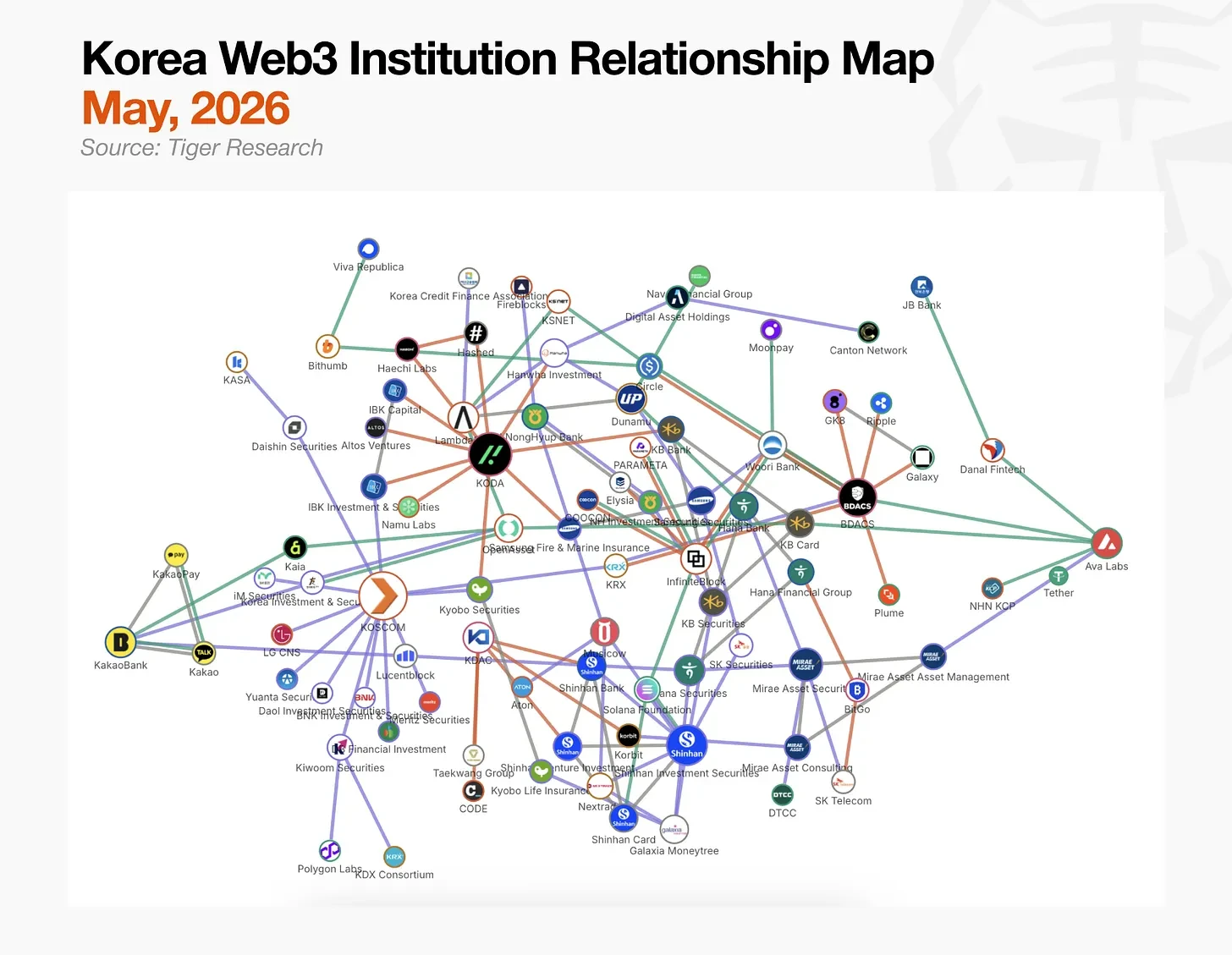
The above chart, compiled by Tiger Research, maps the partnership networks of various institutions in the Korean crypto market. The complex web makes it difficult for outsiders to distinguish between operational partnerships and mere letters of intent, blurring the line between core and peripheral industry players.
This complex landscape accurately reflects the current state of the institutional crypto market in Korea. Tiger Research analyzed 150 institutions and 196 cooperation cases, finding that no single entity holds a monopoly.
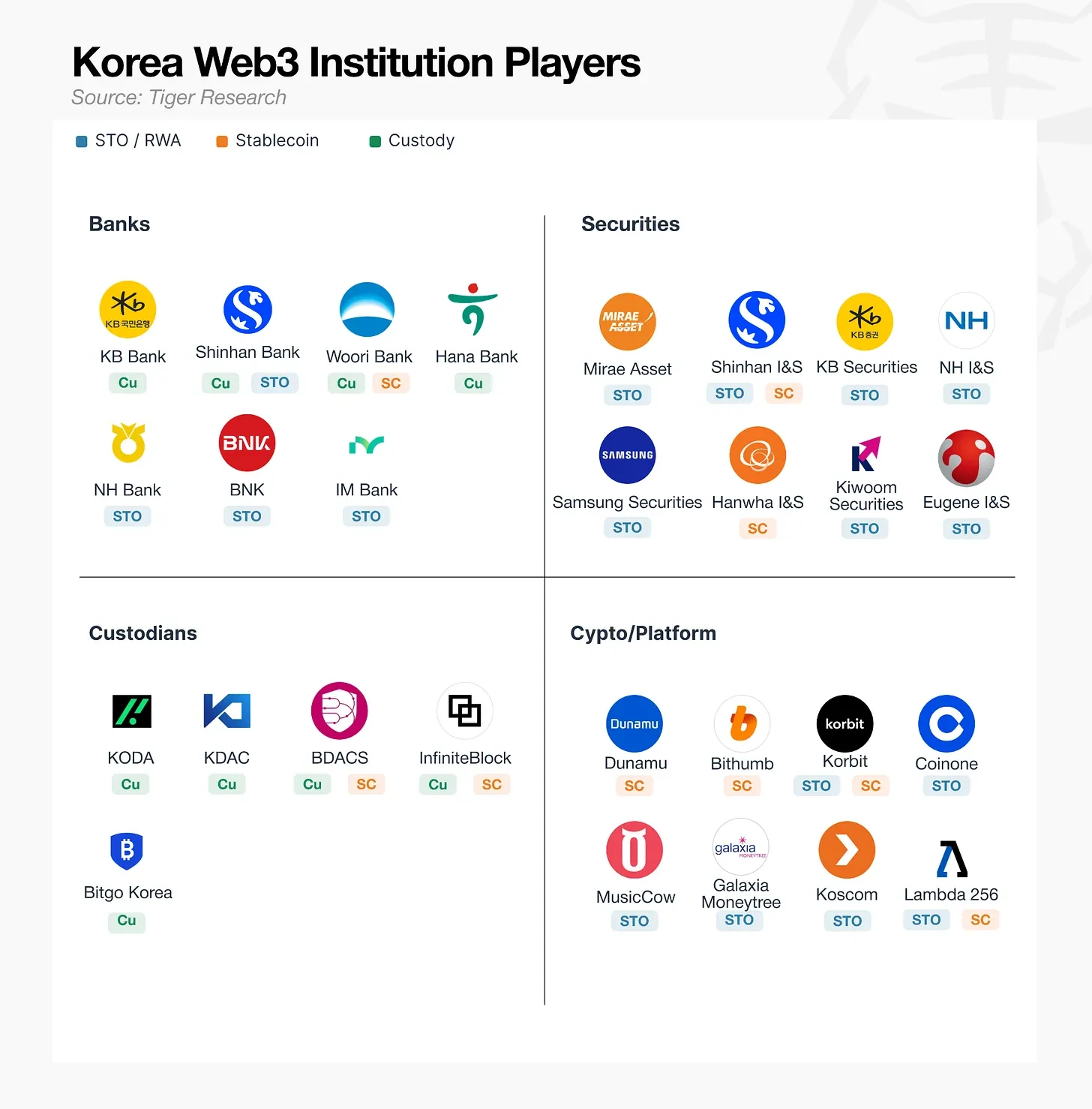
Before relevant regulatory frameworks are finalized, local Korean institutions are racing to secure their positions and occupy key verticals. Current competition is focused on three main areas: stablecoins, Security Token Offerings (STOs), and crypto asset custody.
Another significant trend is the intensive acquisition of crypto exchange equity by financial institutions. The industry views this as a move by institutions to secure market position ahead of regulatory clarity and a signal of their long-term bullish outlook.
The Battle for Exchange Equity Commences
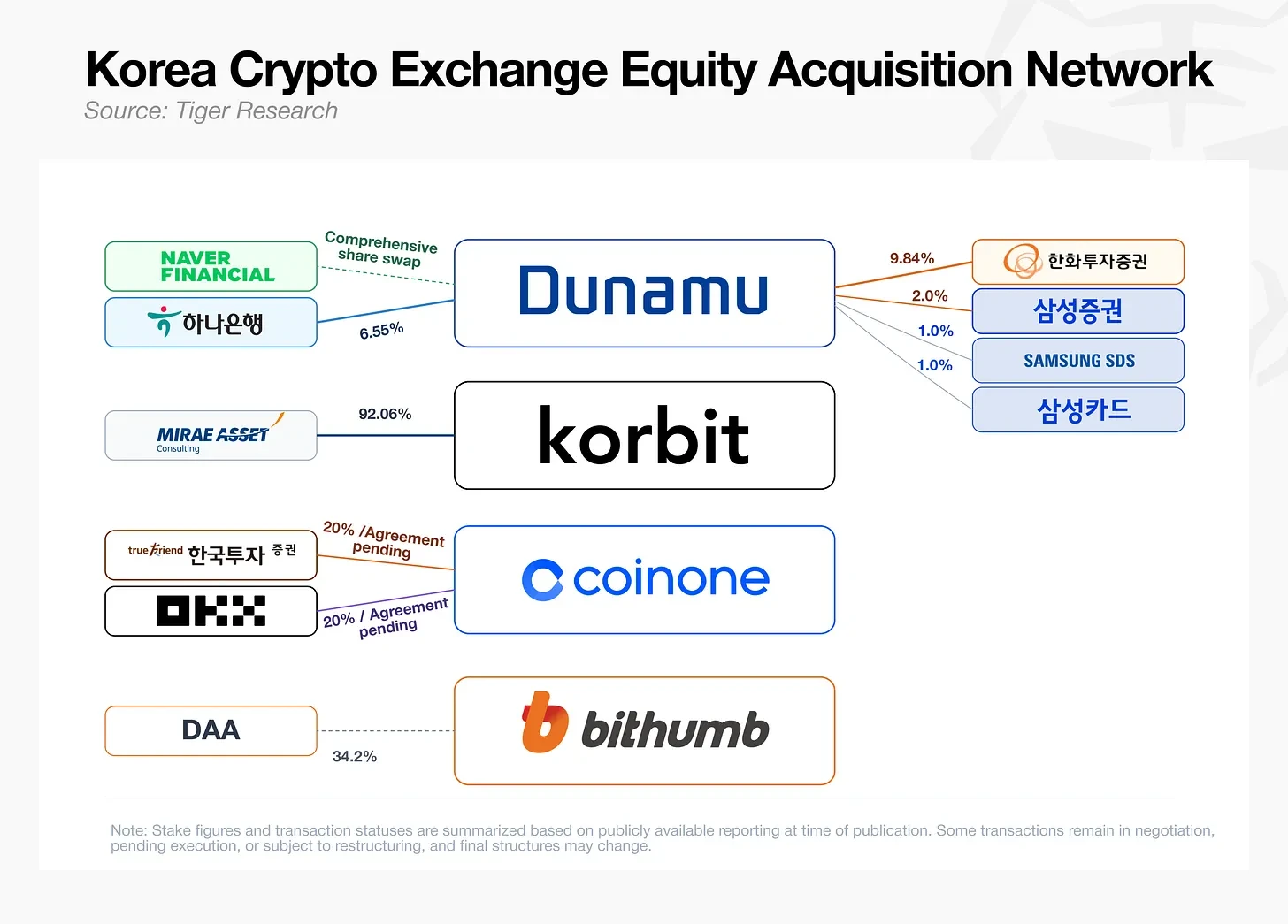
Hana Bank announced a ~1 trillion KRW (~$720M USD) investment to acquire a 6.55% stake in Dunamu, the operator of Upbit. Just ten days later, Hanwha Investment & Securities received approval to increase its stake by 3.90%. On the 28th of the same month, Samsung Securities, Samsung SDS, and Samsung Card jointly acquired a 4.0% stake in the platform.
Mirae Asset Consulting had already signed an agreement back in February to acquire 92.06% of Korbit. Additionally, Korea Investment & Securities is reportedly in talks with global exchange OKX to jointly acquire Coinone.
The valuation logic for crypto exchanges in capital markets has changed. They are no longer mere platforms for earning trading fees, but core traffic gateways for distributing stablecoins, custody services, STOs, and RWA products.
By holding exchange equity, banks and brokerages can indirectly acquire VASP-related qualifications while firmly controlling the platform's user base and liquidity. This equity battle is essentially a contest for control over digital financial front-end traffic and distribution channels.
Current State of Korean Crypto Sub-Sectors
The partnership network clearly shows uneven development progress across different crypto sectors. The asset custody sector has the most operational projects, with several players having overcome regulatory hurdles and launched services. RWA/STO projects mostly remain at the signing or letter-of-intent stage, awaiting supporting legislation. The stablecoin sector is also progressing slowly, with no clear leader setting industry standards yet.
The obstacles vary by sector, and institutions are adopting different strategies. Some are partnering with local allies and waiting for regulatory easing, while others are turning to more mature overseas markets. The following analyzes the bottlenecks and strategies for each sector.
RWA/STO: Legislation Enacted, Commercialization Infrastructure Remains the Weakest Link
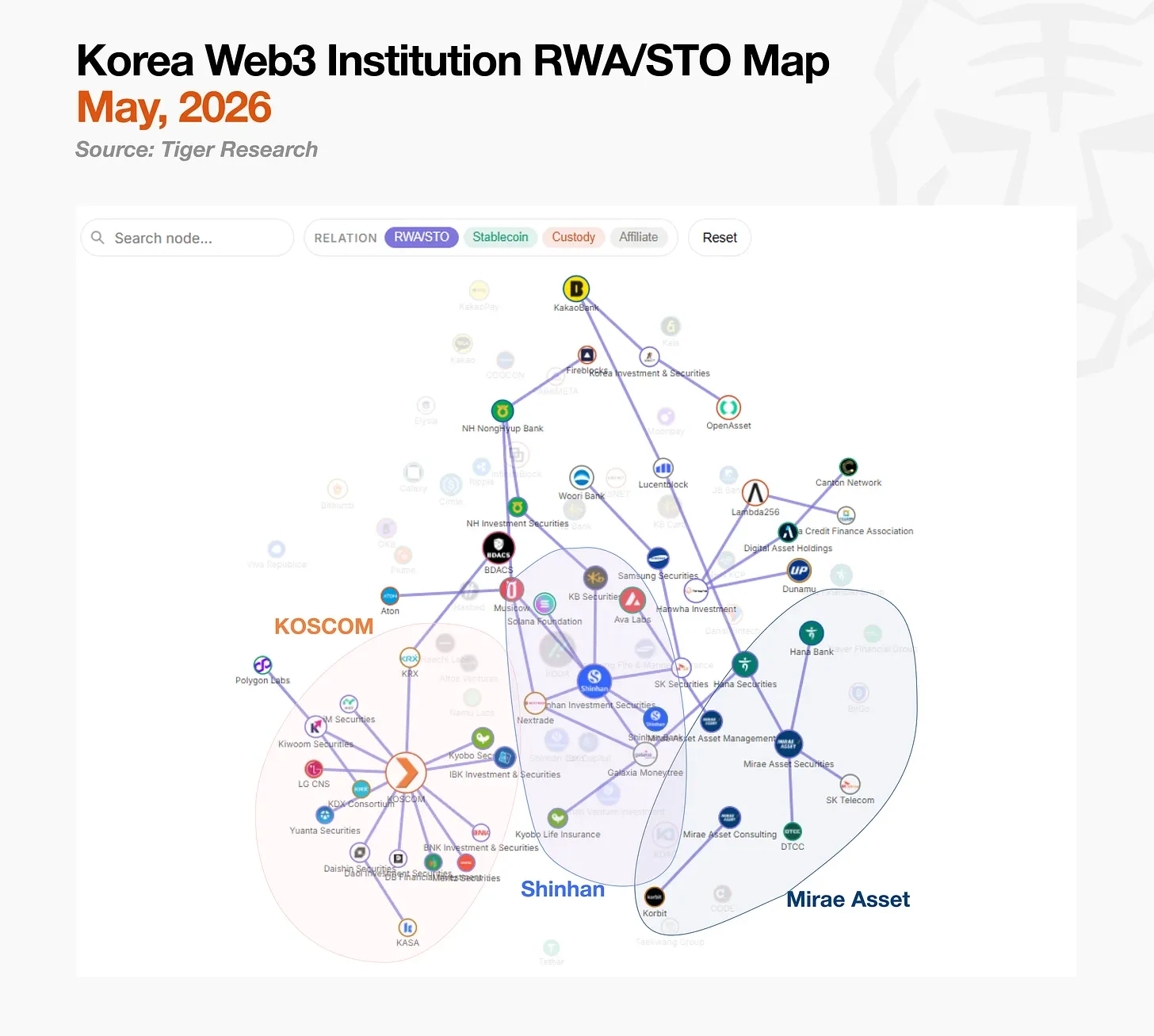
The domestic STO market is currently divided into two main camps: an alliance led by KOSCOM, and a fractional investment alliance led by Shinhan Investment Securities. Mirae Asset Securities has taken a different path, bypassing local infrastructure development altogether and directly expanding into overseas markets.
KOSCOM, 76.6% owned by the Korea Exchange, operates core financial networks in Korea. Its strategy is to build neutral shared infrastructure serving all brokerages. It hasn't signed exclusive deals with single issuers but has onboarded 11 brokerages to its platform, aiming to standardize STO issuance and circulation technology standards and connect to the centralized custody system of the Korea Securities Depository.
Shinhan Investment Securities has rapidly built its own STO ecosystem. It completed a proof-of-concept with Lambda 256 in 2022, launched the integrated platform PULSE in 2024, and introduced multi-platform account aggregation services in 2025. Just in 2025, it participated in 10 investment contract-type security token offerings as an account manager and acquired a controlling stake in OTC exchange NXT, establishing a channel from token issuance to circulation.
Mirae Asset Securities has completely bypassed local infrastructure, focusing entirely on overseas expansion. It issued digital bonds in Hong Kong, obtained a virtual asset retail license from the Hong Kong SFC, and plans to launch a smart trading system for local retail investors in June. In the US, it is the only Korean brokerage to join the DTCC Tokenization Working Group, participating in global standard-setting alongside JPMorgan, Goldman Sachs, and BlackRock. This strategy positions it favorably for compliance and negotiation when the domestic STO system eventually aligns with global standards.
Stablecoins: Technology Mature, Regulation is the Key Barrier
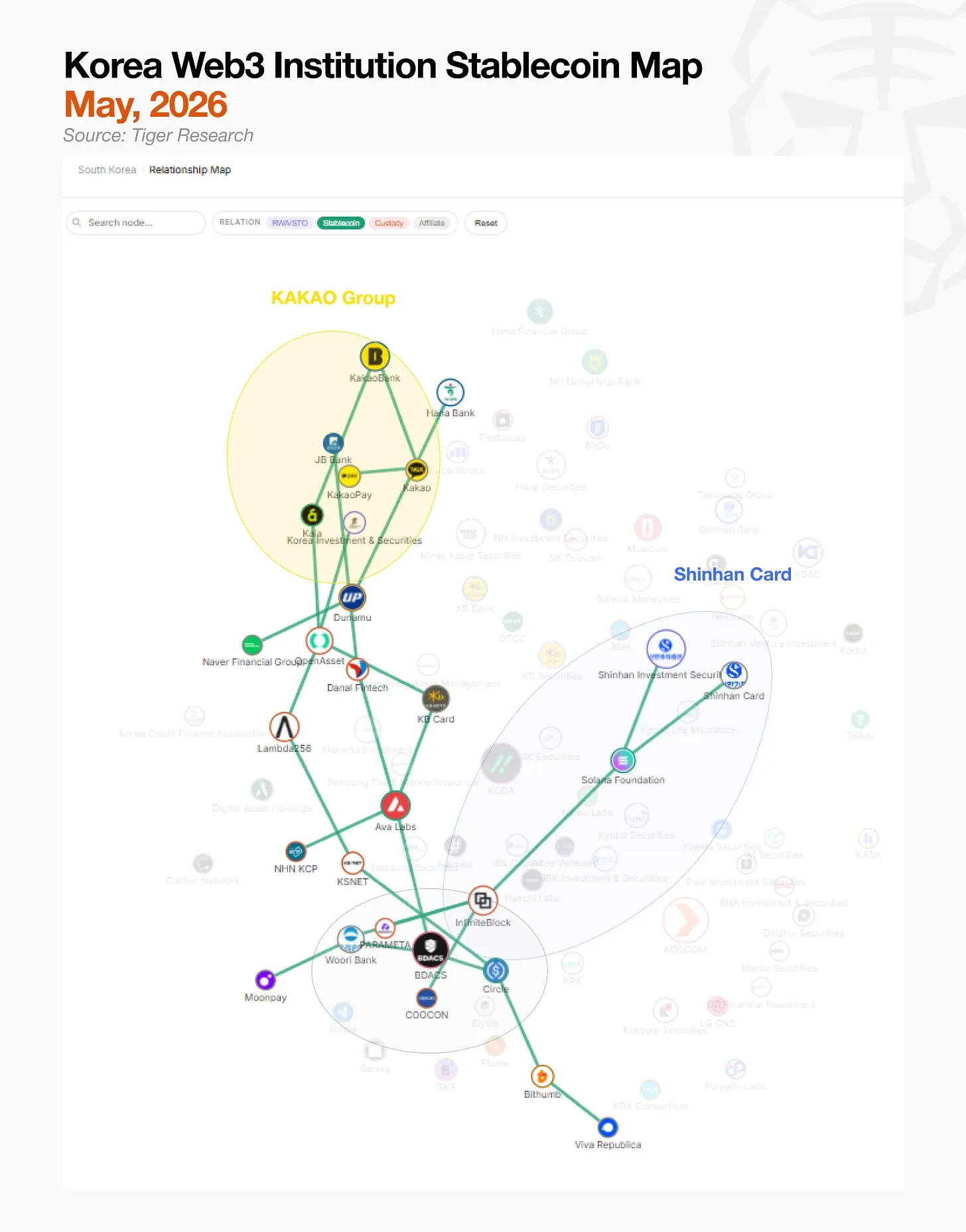
The stablecoin sector features the most diverse set of participants, including credit card companies, exchanges, fintech firms, and infrastructure providers, each leveraging their strengths to enter the market.
The Kakao group represents the largest camp. Kakao, KakaoBank, and Kakao Pay have formed a joint task force to develop a 'super wallet' encompassing stablecoins, cryptocurrencies, and local currencies. The team's core advantage comes from the infrastructure capabilities built over years of operating the Kaia public chain, which already has USDT live and is conducting real-world payment tests.
Shinhan Card is migrating its existing payment network to a blockchain platform. It signed an MOU with Solana in April this year, but related technology R&D was already underway: it previously completed a proof-of-concept with Solana, Visa, Mastercard, and Fireblocks, and is now conducting deep testing across six modules including wallets and smart contracts.
Hindered by regulatory delays for the Korean won stablecoin, the exchange camp is prioritizing the USD stablecoin market. Dunamu is partnering with Naver Financial to develop a Korean won stablecoin business on its proprietary GIWA chain. Bithumb has paused its Korean won stablecoin efforts, first building a USD stablecoin distribution network with Circle and WLF, while also discussing a joint Korean won stablecoin issuance with payment platform Toss. Overall progress remains slow.
Despite the flurry of activity, all camps are constrained by the same regulatory hurdle. The Bank of Korea has proposed a 51% ownership rule, requiring stablecoin issuers to be consortia majority-owned by banks. Fintech companies have raised objections, leading to a stalemate in finalizing issuance rules. Once formal regulations are established, the camp with the most extensive front-end traffic channels is likely to dominate the market.
Asset Custody: Business Launched, Awaiting Institutional Capital Inflow
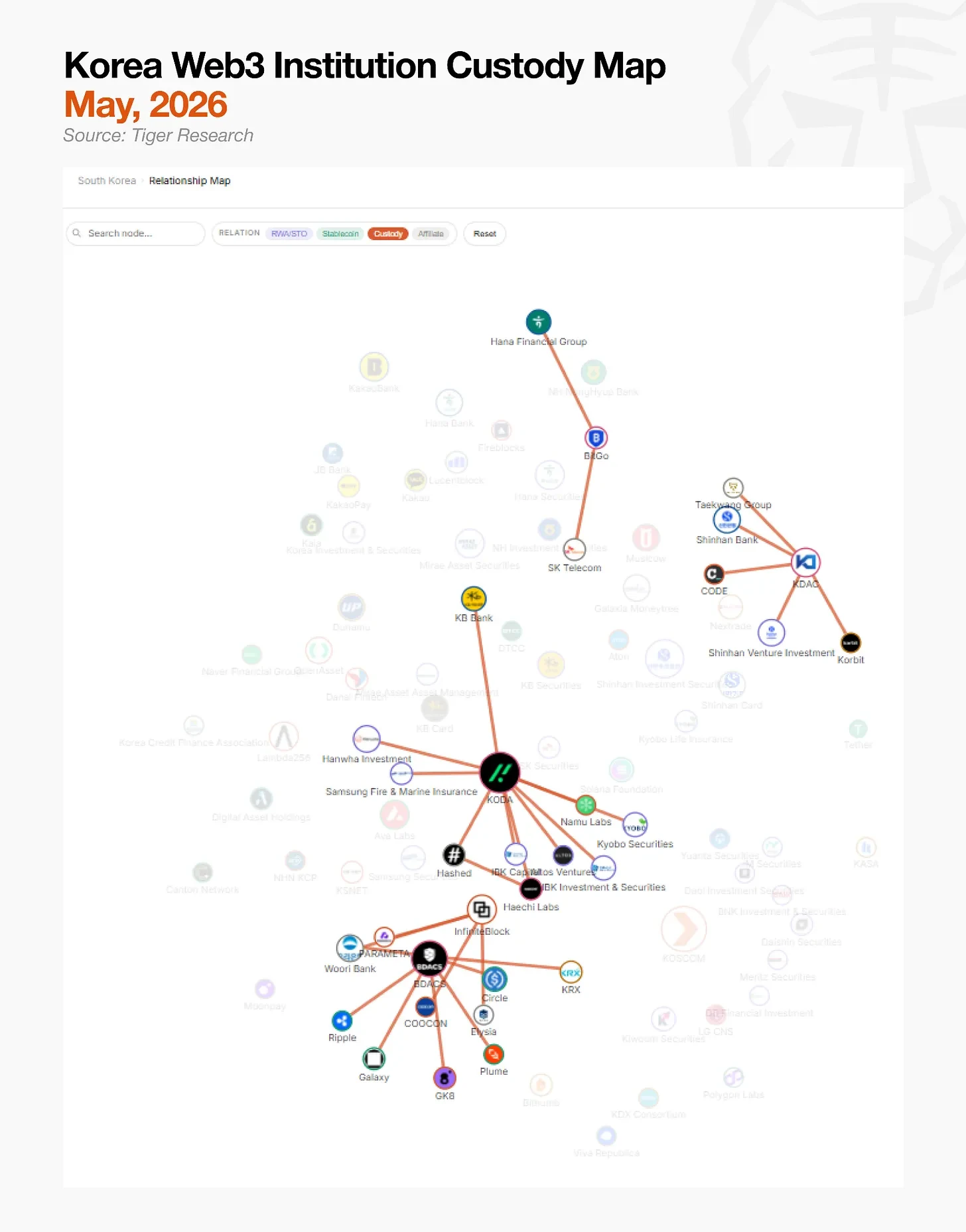
Compared to other sectors, the custody market structure is clearer. Four major custodians have solidified their positions by partnering with domestic and international financial and technology partners.
KODA was founded by KB Kookmin Bank, crypto VC Hashed, and Haechi Labs. It later received investments from Hanwha Investment & Securities, IBK Capital, and Kyobo Securities, and signed an exclusive custody insurance agreement with Samsung Fire & Marine Insurance, establishing a robust risk control system.
KDAC is a traditional finance-led custodian, with Shinhan Bank and Nonghyup Bank as its two major shareholders. Nonghyup Bank originally invested in another custodian, Kardo; the two entities merged and formally integrated into KDAC, placing two of Korea's top five banks amongst its shareholders.
BDACS focuses on technology and ecosystem partnerships, collaborating with Woori Bank, Galaxy, GK8, and others to expand custody and payment infrastructure. It partnered with Circle to issue the KRW1 Korean won stablecoin on the Arc network, currently undergoing proof-of-concept testing. BDACS is also the designated VASP and core custody partner for the KDX alliance led by the Korea Exchange (KRX), simultaneously developing both custody and payment businesses.
BitGo Korea entered the market leveraging its parent company's global technology. Its headquarters custodies assets worth over $70 billion, handling ~20% of global Bitcoin on-chain transactions. Hana Financial Group and SK Telecom are shareholders, providing both financial and telecommunications capital backgrounds.
Many financial institutions conduct business through these custodians. However, reports suggest that all four major custodians were loss-making last year. This indicates that the industry infrastructure was built ahead of demand, but hasn't yet seen the large-scale institutional capital inflow needed to sustain operations.
Analyzing the STO, stablecoin, and custody sectors reveals a common issue: while local Korean institutions have built a complete business framework, the underlying technology remains highly dependent on overseas solutions.
The Rise of Local Infrastructure Service Providers
Long-term reliance on foreign technology creates structural vulnerabilities. As the industry scales, significant revenue would flow overseas in the form of technology licensing fees. Furthermore, changes in policies or fee increases by overseas partners could pose risks to local businesses.
A deeper conflict lies in the fact that scenarios like Korean won stablecoin issuance, STO circulation rules, and local corporate account integration need to deeply conform to Korean regulatory requirements, which global standard solutions cannot directly fulfill. Therefore, once relevant legislation is enacted and capital flows in, local tech companies capable of independently designing and controlling the underlying technology stack will become essential.
Several local companies have already identified this technology gap and are specializing in Korea-specific financial infrastructure. Key players include:
LG CNS
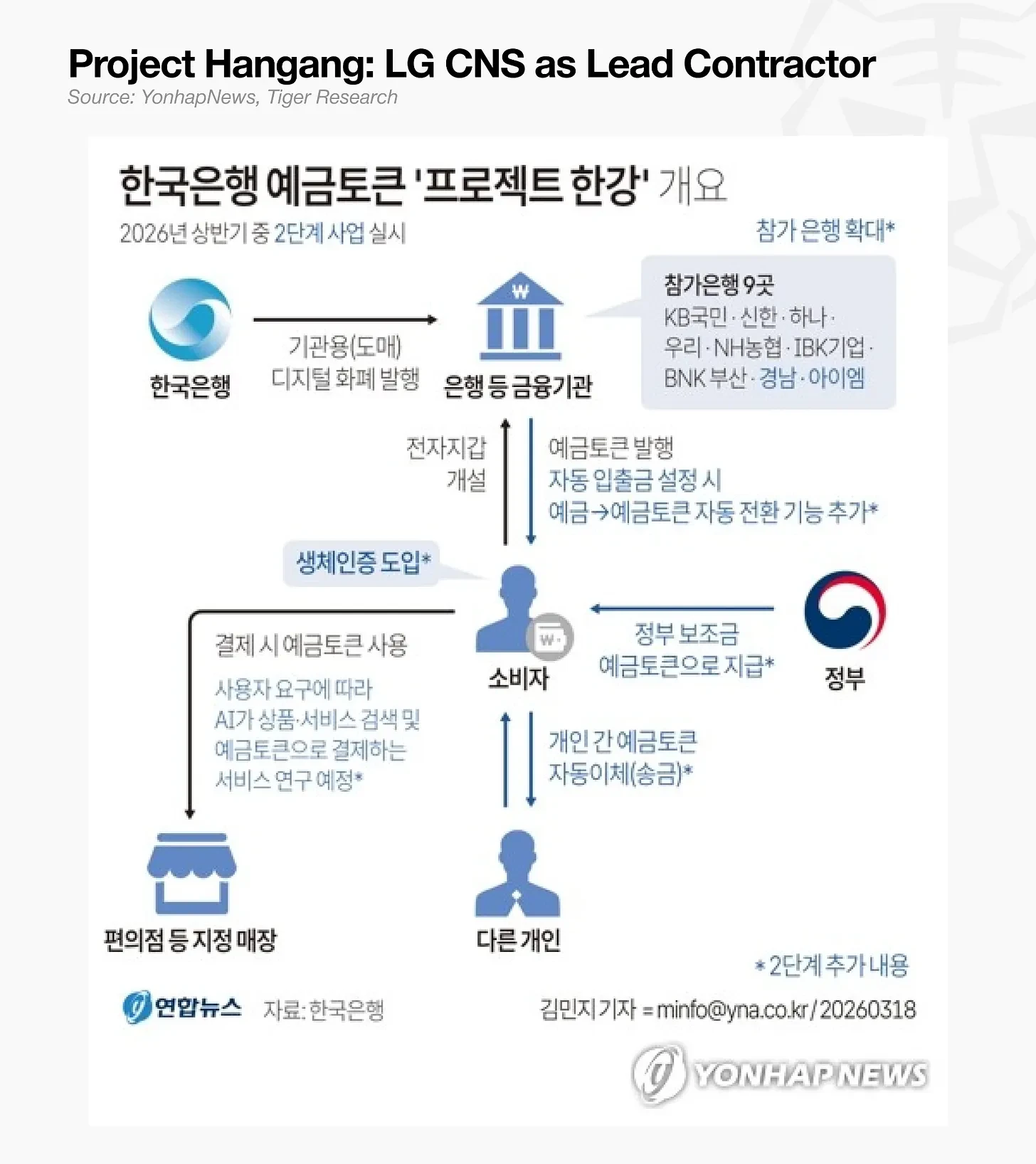
Among traditional IT service providers, LG CNS has the most prominent blockchain strategy. The company launched its proprietary blockchain platform Monachain in 2018. Leveraging the Korea Minting and Security Printing Corporation's local currency services, it provides on-chain services to over 220 local governments, accumulating extensive operational experience.
Building on this expertise, LG CNS secured key projects, including the Bank of Korea's CBDC project (Hangang) and STO-related initiatives. As the prime contractor for the CBDC project, it is responsible for building a government subsidy distribution system based on deposit tokens, enabling institutional CBDC and private digital assets to operate on the same network, migrating traditional financial security standards and processes onto the blockchain.
Additionally, LG CNS has won contracts to develop STO platforms for KOSCOM and Mirae Asset Securities. Its business strategy focuses on three areas: building token issuance and circulation platforms for banks, providing software services for credit card companies and payment processors, and creating digital asset payment platforms for securities firms. After regulation takes effect, LG CNS is well-positioned to become a major winner in the local infrastructure market.
DSRV
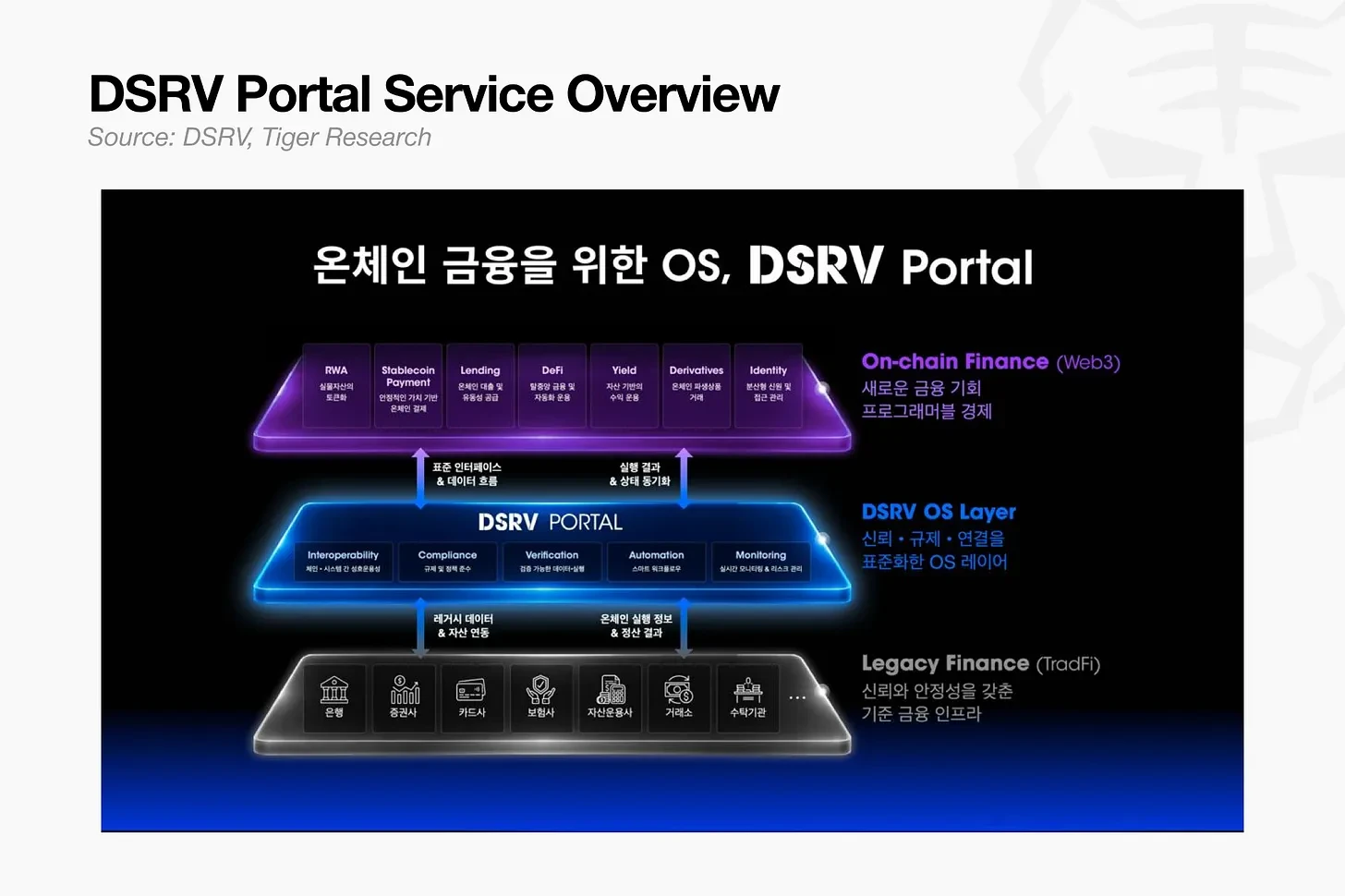
DSRV is a leading blockchain infrastructure service provider, covering over 70 public chains and managing assets under custody worth over 4 trillion KRW (~$2.9B). Its Ethereum staking volume ranks first in Korea and within the global top ten.
The company has evolved from simple node operation into a one-stop institutional on-chain infrastructure provider. Its DSRV Portal allows financial institutions to use APIs and data dashboards to access a suite of services including wallets, payments, asset tokenization, custody, and staking. Financial institutions can quickly launch personal wallets, institutional wallets, automated payments, token operations (issuance/burning/transfer/locking), asset custody, and staking without building their own nodes and security systems.
DSRV has obtained VASP, ISMS, and SOC 1 Type 1 certifications, directly addressing financial institutions' core requirements for compliance, security, and risk management. It takes on responsibilities that financial institutions prefer to avoid, such as wallet security, internal control, and operational risk.
Its partnerships focus on cross-border and on-chain payment rails: collaborating with SBI Ripple Asia on compliant cross-border remittance infrastructure between Korea and Japan; partnering with Circle to build an institutional-grade USDC issuance, redemption, and settlement system independent of exchanges; and working with BC Card to bridge traditional credit card networks with stablecoin payment channels. The company recently completed a 30 billion KRW (~$21.7M) Series B funding round to accelerate technology development.
Altus (formerly B-Harvest)
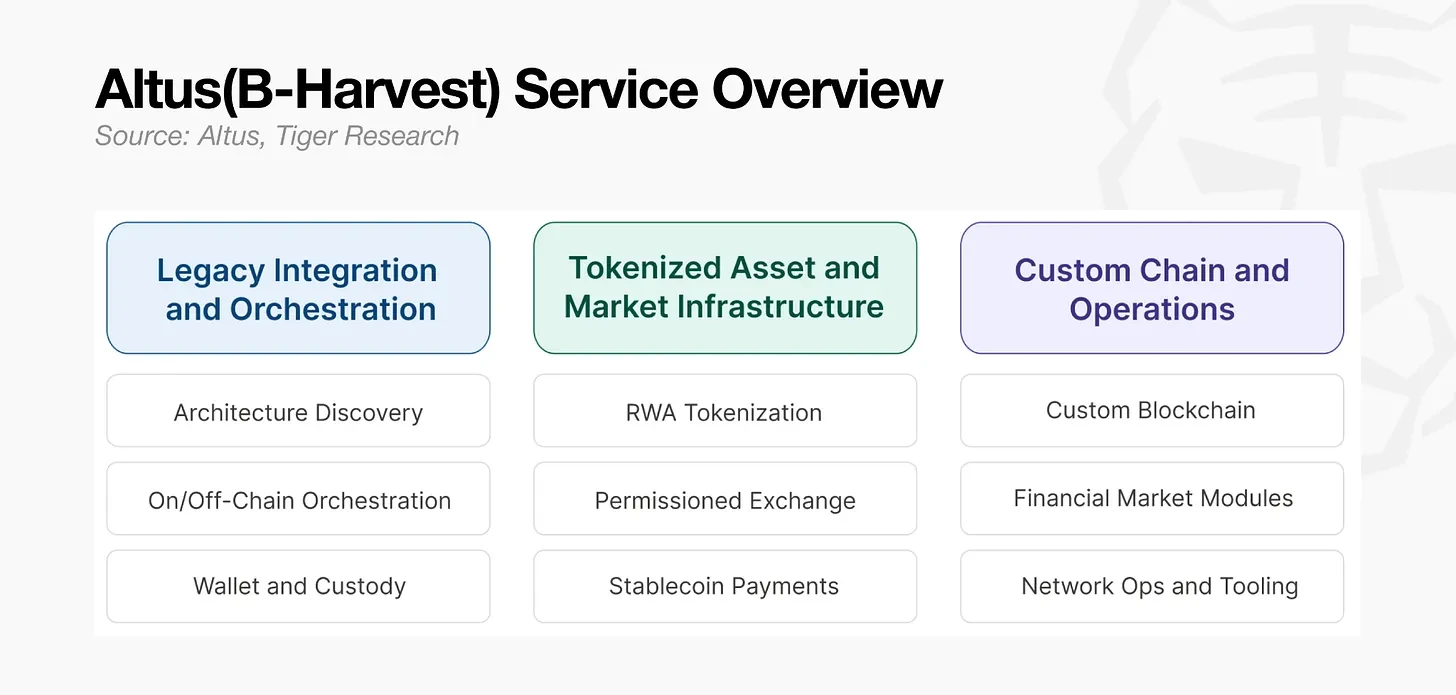
Altus specializes in connecting legacy traditional financial systems with blockchain technology. Founded in 2018, the team of over 40 engineers and researchers has deeply participated in developing EVM public chains based on Cosmos SDK, leading the construction of several commercial chains like Canto, Crescent, Stable, and Ault.
The company provides protocol development and underlying architecture design for Ault, an institutional-grade public chain focused on real-world assets, trading, and payments. It also performed EVM adaptation, performance optimization, and security audits for the Bitcoin staking chain Babylon, ensuring its successful launch.
For financial institutions, Altus builds solutions tailored for the financial industry from scratch, including cross-chain orchestration layers linking legacy systems and blockchains, real-world asset tokenization frameworks, permissioned exchanges, stablecoin payment and settlement systems, and institutional wallet/custody infrastructure.
The company currently has two major R&D projects underway: the Canton network architecture supporting selective data disclosure between institutions, and the Commonware Stack, a modular blockchain framework targeting a throughput of 1 million transactions per second.
Each of the three companies has distinct strengths: LG CNS leverages its reputation in traditional financial IT, DSRV relies on its node and staking infrastructure, and Altus excels in custom protocol development. However, they share a common goal: securing a dominant position in the core underlying system before large-scale institutional capital enters the market. The ultimate winner will depend on the commercial implementation experience each accumulates before the market fully opens.
Retail Fades, Institutions Dominate the Market
The recent flurry of cooperation agreements goes beyond simple business development. It represents a strategic positioning by institutions ahead of regulatory implementation, an attempt to influence the final shape of the regulatory framework itself. The current cooperation race is less about capturing market share and more about shaping the regulatory landscape.
Within just six months, the landscape of the Korean crypto market has been completely reshaped: custody camps have formed, STO alliances have emerged, and major financial holding companies have acquired exchange equity. Simultaneously, retail trading enthusiasm has cooled significantly, with total trading volume across Korea's five major exchanges dropping by approximately 48% year-on-year. The market's center of gravity is rapidly shifting from retail to institutional.
This market transformation has also rewritten the localization strategies of overseas Web3 public chain foundations. Cases like Shinhan Card choosing Solana and Mirae Asset Securities partnering with Avalanche are becoming more common. Overseas institutions are no longer relying on offline community events to attract retail investors. Instead, they focus on connecting with local financial giants and large enterprises. The traditional community management model is becoming obsolete.
Korea Blockchain Week (KBW 2026) in Seoul this September may reveal the cumulative results of this industry transformation. Judging from the announced lineup of speakers, traditional finance figures now dominate. While last year saw overseas public chains keen on hosting token-incentivized community events, this year's focus will entirely shift toward substantive commercial partnership discussions.


