Who is selling, who is holding, and who is continuing to buy? The divergence in US institutional crypto ETF holdings


- Core Thesis: In Q1 2026, different institutions adopted differentiated strategies amid the crypto ETF pullback: University endowments like Harvard actively reduced positions, pivoting toward AI; investment banks like Goldman Sachs scaled back crypto ETF exposure, shifting to select stocks; while sovereign wealth funds like Abu Dhabi’s and JPMorgan Chase bucked the trend and increased holdings, indicating that institutions are conducting a more precise risk ranking of crypto assets.
- Key Elements:
- Harvard University endowment cut its IBIT holdings by 43% and completely exited Ethereum ETFs, while simultaneously increasing holdings in AI and computing-related stocks, reflecting a structural rebalancing strategy of "reducing crypto, adding AI."
- Goldman Sachs significantly reduced its Bitcoin and Ethereum ETF holdings in Q1 2026, liquidated all XRP and Solana-related ETFs, while increasing positions in Circle (+249%) and Coinbase (+65%), indicating an internal rotation from ETF risk exposure to selected individual stocks.
- Abu Dhabi sovereign wealth fund Mubadala increased its IBIT holdings by approximately 15.9%, despite the market value decreasing from $631 million to $566 million due to price declines, demonstrating sovereign capital's long-term allocation patience.
- JPMorgan Chase increased its IBIT holdings by 174% to approximately 8.3 million shares, while also increasing Ethereum ETF exposure, reflecting the strategy of a major bank expanding its product shelf and meeting client allocation needs.
- US university endowments (Brown, Dartmouth) chose to hold steady or make modest adjustments. For instance, Dartmouth College retained its Bitcoin core position and switched its Ethereum product to an ETF with staking attributes, illustrating long-term allocation discipline.
原文作者:KarenZ,Foresight News
The most noteworthy aspect of the first quarter is not how much prices have fallen, but how institutions navigated through this downturn.
Looking solely at market performance, crypto ETFs faced headwinds in Q1 2026. Bitcoin and Ethereum both came under pressure during the quarter, causing the book value of spot ETF holdings to generally decline. Even for positions that weren't sold, the quarter-end picture wasn't pretty. However, the truly interesting part of any downturn is never the NAV curve itself, but the different actions various types of institutions took on the same drawdown chart.
With the latest batch of 13F filings disclosed by mid-May 2026, the market can now see the quarter-end holdings of institutions as of March 31, 2026. University endowments, major investment banks, sovereign wealth funds, market makers, and wealth management firms have provided several distinctly different answers.
Some Reduced Positions: Prioritizing Risk Contraction First
Let's first look at those who reduced their holdings.
Harvard Management, which manages the Harvard University endowment and related financial assets, is one of the most typical examples in this round. According to its 13F filing, its IBIT (iShares Bitcoin Trust ETF) holdings decreased from 5,353,612 shares at the end of Q4 2025 to 3,044,612 shares at the end of Q1 2026, a reduction of about 43%. The corresponding book value also fell from approximately $266 million to roughly $117 million. Concurrently, its position in ETHA (iShares Ethereum Trust), which it still held in the previous quarter, was completely liquidated this quarter. This indicates that Harvard wasn't merely reacting to price pullbacks but actively compressing its public exposure to spot Bitcoin and Ethereum ETFs.
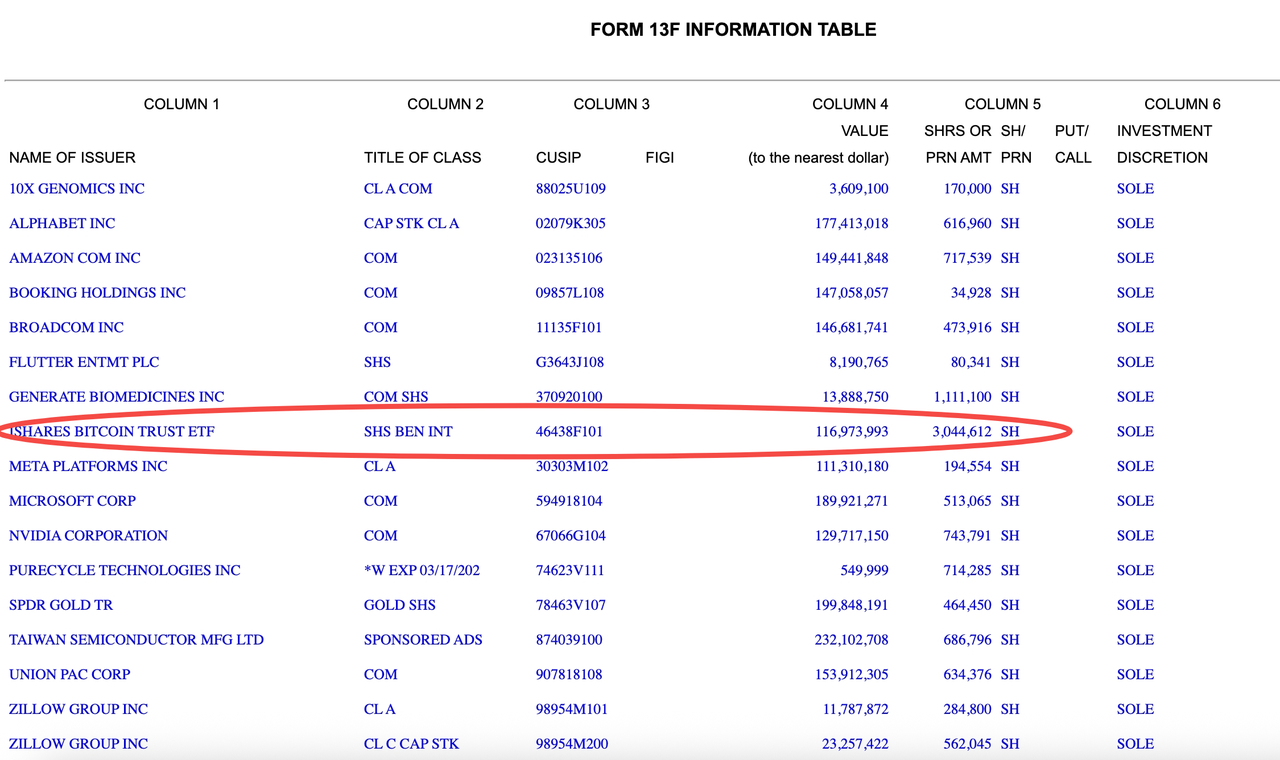
This change in holdings has another implication. Harvard didn't shift entirely into defense; instead, it reallocated part of its capital to assets related to the AI and computing power chain, increasing holdings in stocks like NVIDIA, Broadcom, and TSMC. Looking at these actions collectively, it appears more like a structural rebalancing of "reducing crypto, adding AI" rather than an overall risk contraction.
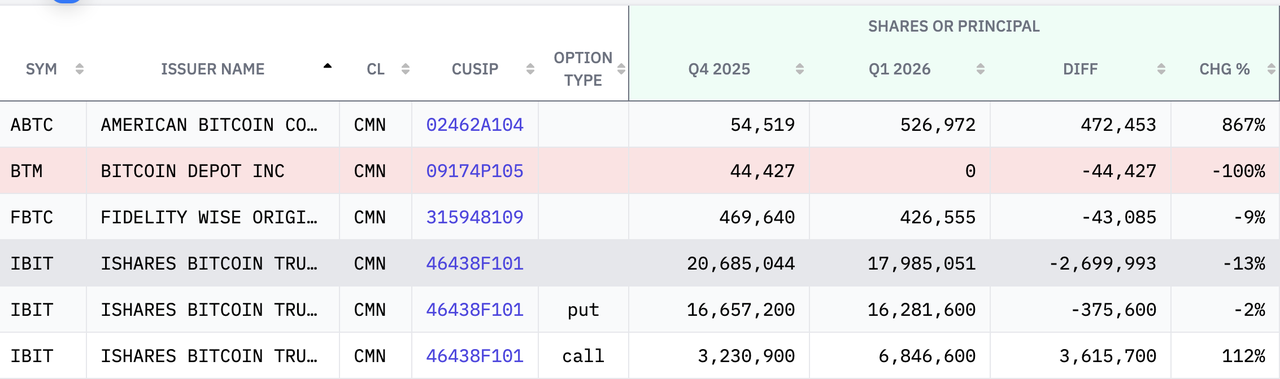
Goldman Sachs' strategy is largely similar, albeit more complex. Comparing the last two 13F filings, Goldman Sachs still held approximately $690 million in IBIT and about $25.18 million in FBTC (Fidelity Wise Origin Bitcoin Fund) at the end of Q1 2026, both lower than the previous quarter. More noteworthy than the simple reduction is the structure of its positions: Goldman Sachs held spot, call options, and put options on IBIT simultaneously, indicating this wasn't just a directional bet but also carried clear trading and hedging attributes.
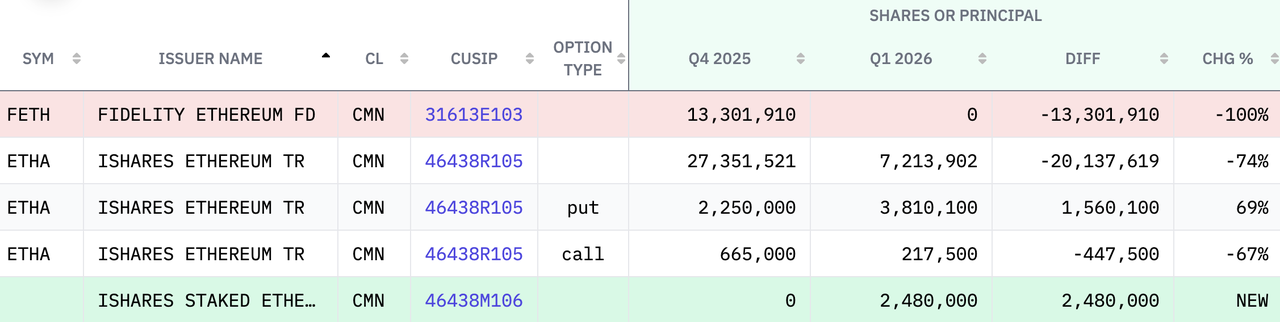
Goldman Sachs was more aggressive with Ethereum. It not only liquidated its holdings in the Fidelity Ethereum Fund (worth $394 million at the end of Q4 2025) but also significantly reduced its spot position in the iShares Ethereum Trust (ETHA) by about 74%, leaving a remaining position of around $114 million. Additionally, it newly holds $66.885 million in the iShares Staked Ethereum Trust ETF.
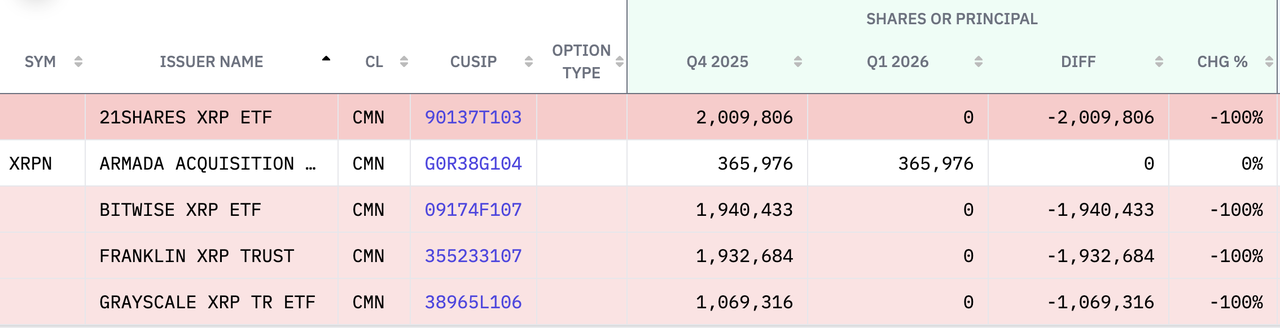
Meanwhile, Goldman Sachs liquidated all its positions in XRP and Solana-related ETFs. As of the end of Q4 2025, it held XRP ETFs from Bitwise, Franklin Templeton, Grayscale, and 21shares totaling approximately $152 million, and also liquidated all its Solana ETFs/trusts from Grayscale, Bitwise, and Fidelity (worth $109 million at the end of Q4 2025).
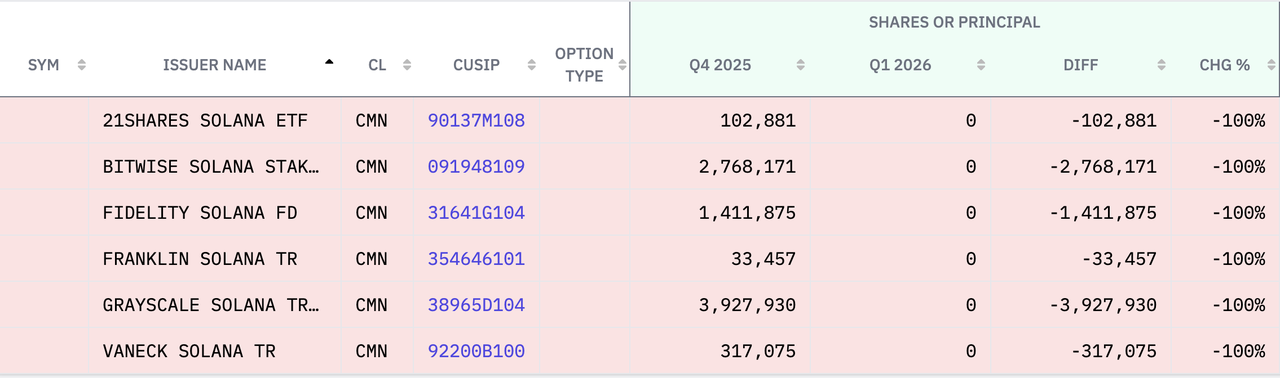
Regarding crypto equities, Goldman Sachs increased its position in Circle by 249% to around $140 million, and its position in Galaxy Digital also grew by 205% (reaching $41.48 million). Holdings in Coinbase (+65%), Robinhood (+35%), and PayPal also increased. During the same period, it reduced holdings in Strategy and Riot Platforms. Overall, this looks more like an internal rotation of "compressing ETF risk and rotating into selected stocks."
Among hedge funds, Millennium Management also signaled similarly. Public summaries show its IBIT holdings dropped from 34.334 million shares to 19.287 million shares, a decrease of about 43.8%; ETHA holdings also declined concurrently (down about 34.3%), indicating a clear reduction in its spot Bitcoin and Ethereum ETF positions.
Capula Management Ltd, a hedge fund management firm headquartered in London, UK, went even further. As of December 30, 2025, it held $470 million in IBIT, $160 million in FBTC, $207 million in ETHA, and $61.43 million in FETH. However, its latest 13F report shows these ETFs were completely liquidated. Additionally, Capula Management Ltd fully exited its Coinbase position (retaining a small options position).
Inaction Itself is a Statement
The second category comprises those who held their ground.
Brown University's IBIT holdings remained at 212,500 shares, with no additions or reductions. Based on the reported market value, this position decreased from approximately $10.551 million at the end of 2025 to about $8.164 million at the end of Q1 2026. This type of endowment fund didn't translate a single quarter's price volatility directly into trading instructions, but rather emphasized portfolio discipline and long-term allocation pacing.
Dartmouth College's handling of crypto assets in Q1 2026 looks more like a moderate expansion than an aggressive reallocation. Comparing its latest and previous 13F filings, the college maintained its existing Bitcoin ETF core holdings, with IBIT share count essentially unchanged. However, due to price pullbacks in Q1, the book value dropped from over $10 million to roughly $7.7 million. For Ethereum exposure, it swapped products, replacing its previous Grayscale Ethereum Mini Trust with the staking-enabled Grayscale Ethereum Staking ETF, holding approximately 178,100 shares. It also established a new position in the Bitwise Solana Staking ETF, holding about 304,803 shares with a book value of roughly $3.3 million.
Another Strategy: Buying More as Prices Fall
The third category comprises contrarian buyers who increased holdings.
Abu Dhabi's sovereign wealth fund, Mubadala, is one of the most prominent names. Its IBIT holdings increased from 12,702,323 shares to 14,721,917 shares, an increase of about 15.9%. However, despite the higher share count, the quarter-end market value of the position still fell from approximately $631 million to around $566 million. This set of numbers is very telling. The act of adding positions itself doesn't automatically lead to profits, especially when the market remains in a downtrend. Increasing allocation first brings greater exposure, and only secondarily, the potential for higher future upside.
JPMorgan Chase's actions can also be understood within this logic. The latest 13F data shows JPMorgan increased its IBIT holdings from roughly 3.028 million shares to about 8.3 million shares, a 174% increase, while also adding exposure to some FBTC, BITB, and Ethereum ETFs. Based purely on the change in share count, it was clearly more aggressive. However, this doesn't mean it has locked in excess returns amidst this volatility. For major banks, increasing ETF positions often serves multiple purposes: expanding product offerings, meeting client allocation needs, and balancing liquidity and book risk, rather than being purely a bullish directional bet.
Wells Fargo's position changes also merit individual attention. Comparing the before and after, the bank retained its core IBIT position while increasing allocations to products like BITB and the Grayscale Bitcoin Mini Trust. More notably, it significantly boosted its Ethereum ETF exposure, raising its ETHA holdings from roughly 672,600 shares to about 1.1 million shares, and also increasing its ETHW holdings concurrently. This means Wells Fargo adopted a strategy of "retaining the Bitcoin base and increasing the Ethereum weight."
Market maker Jane Street demonstrated another typical style. Comparing its two 13F filings, it significantly reduced its spot Bitcoin ETF exposure in Q1, with IBIT holdings falling from roughly 20.3 million shares to about 5.9 million, and FBTC also seeing a clear decline. Simultaneously, it added roughly $82 million in Ethereum ETF exposure. On the crypto equity side, Jane Street increased positions in Galaxy Digital (+8746%), Circle (+1162%), Coinbase (+14%), and BitMine (+47%). This combination looks more like a classic trading-driven rebalancing: reducing Bitcoin ETFs, adding Ethereum ETFs, while seeking higher beta in individual stocks.
Bitcoin, Ethereum, and Solana: Institutions are Making Finer Risk Distinctions
This round of 13F filings also reveals another signal worth exploring separately: institutional attitudes towards BTC ETFs, ETH ETFs, and even Solana ETFs are no longer uniform. The more pertinent question now is which crypto asset institutions intend to keep as a core holding, which one goes into a flexible/beta position, and which one is simply removed for now.
Take Harvard Management as an example. It reduced IBIT while completely exiting ETHA. This looks very much like a risk ranking. The Bitcoin ETF retains a relatively core position, while the Ethereum ETF was prioritized for cutting during the portfolio rebalancing.
Goldman Sachs' approach also shows that large financial institutions are pushing this ranking further. It maintained a relatively large Bitcoin ETF exposure in Q1 but contracted its Ethereum-related products much faster, while essentially liquidating XRP and Solana-related ETFs. Collectively, Goldman Sachs is re-concentrating its positions into the layer of assets it deems most liquid, easiest to hedge, and most easily integrated into institutional risk models. Bitcoin here acts more like a "base position," Ethereum belongs to a compressible position, and products like Solana and XRP are closer to peripheral experimental holdings. Once market volatility amplifies, these are often the first to be cut.
On the other hand, Wells Fargo and Dartmouth College presented completely different answers. Wells Fargo actively increased the weight of its Ethereum ETF, suggesting that within its internal framework, Ethereum is seen more as a secondary position worth increasing allocation to during drawdowns to seek upside. Dartmouth College's strategy is perhaps more representative: it didn't touch its Bitcoin ETF base, but instead extended new flexibility into Solana-related ETFs, particularly those with staking features.
13F Filings Offer a Snapshot of the Market, but Leave Blanks as Well
This is also where the most restraint is needed when analyzing institutional holdings.
13F filings allow the public to see, under a unified reporting standard, how mainstream institutions are allocating to crypto ETFs. However, they come with very clear limitations. First, there is a time lag. What investors see in May is merely a snapshot of institutional holdings as of March 31st. If significant portfolio adjustments occurred in Q2, the form won't show them in advance. Second, 13F filings only display holdings, not the actual purchase cost. A decline in an institution's position value over a quarter doesn't necessarily mean it's overall at a loss, as it could have bought at an earlier, lower price, or could have reduced and re-added positions within the quarter.
Furthermore, for institutions like Goldman Sachs, spot ETF positions are often layered with options, hedges, and market-making positions. Looking at the form in isolation can easily lead to misinterpreting trading activity as a long-term directional stance.
Yet, precisely because it is incomplete, the 13F acts more like a window into institutional sentiment rather than a conclusive scorecard. Seeing Abu Dhabi's sovereign wealth fund Mubadala increase holdings while its book value falls shows the patience of sovereign capital. Seeing Brown University hold steady while absorbing drawdowns demonstrates long-term allocation discipline. Seeing Harvard University reduce Bitcoin and exit Ethereum ETFs reveals the real sensitivity of endowment funds to volatility. And seeing JPMorgan, Wells Fargo, and Jane Street continue adjusting exposure in certain products shows that Wall Street still views crypto ETFs as a product category that needs to remain on the shelf and be continuously re-priced.