离开OpenAI,他們的身價漲了多少倍?


- 核心觀點:從OpenAI出走的精英正形成強大的「校友網絡」,他們利用在AI核心崗位積累的「情境意識」進行跨行業認知套利,透過投資而非親自創業來押注AI的下一個時代,其否決清單比投資清單更具價值。
- 關鍵要素:
- OpenAI離職員工創辦的企業(如Anthropic、Perplexity)總估值逼近10000億美元,其核心輸出被認為是這批擁有行業內部認知的「出走者」。
- Leopold Aschenbrenner利用在OpenAI積累的AI能源消耗第一手認知,重倉核電(Vistra)和燃料電池(Bloom Energy)實現「跨行業認知套利」,成為經典案例。
- Zero Shot基金(前OpenAI員工創立)刻意將規模控制在1億美元,其核心優勢在於基於內部資訊生成的「否決清單」,能精準避開如「氛圍編程」等技術路線陷阱。
- 前OpenAI高層投資前同事的創業項目(如Mira Murati投資Worktrace),基於長期共事積累的零資訊成本判斷,形成了高效的「校友網絡」融資體系。
- 與PayPal黑手黨不同,OpenAI校友網絡的凝聚力源於對「AGI會來且窗口期有限」的共同信仰,其世界觀分歧直接決定了投資準入門檻。
There’s only one real use for an information advantage: betting before anyone else can price it in.
For the past two years, everyone has been anxious, trying to find the answer to the same question: what’s the next sector in AI to rally?
Storage, optical modules, AI computing stocks, energy stocks – the narrative shifts every few months. Someone always misses the boat, and someone always says “next time for sure.”
Few people ask a different question: what are the people who truly understand AI betting on?
Those who left OpenAI now have a combined net worth approaching one trillion dollars. Their startups and investments mark the beginning of the next era for AI.
Dario Amodei founded Anthropic, with a potential valuation of $900 billion. Ilya Sutskever’s SSI has no product, yet is valued at $32 billion. Aravind Srinivas built Perplexity, valued at $21.2 billion. Mira Murati’s Thinking Machines Lab is worth $12 billion.
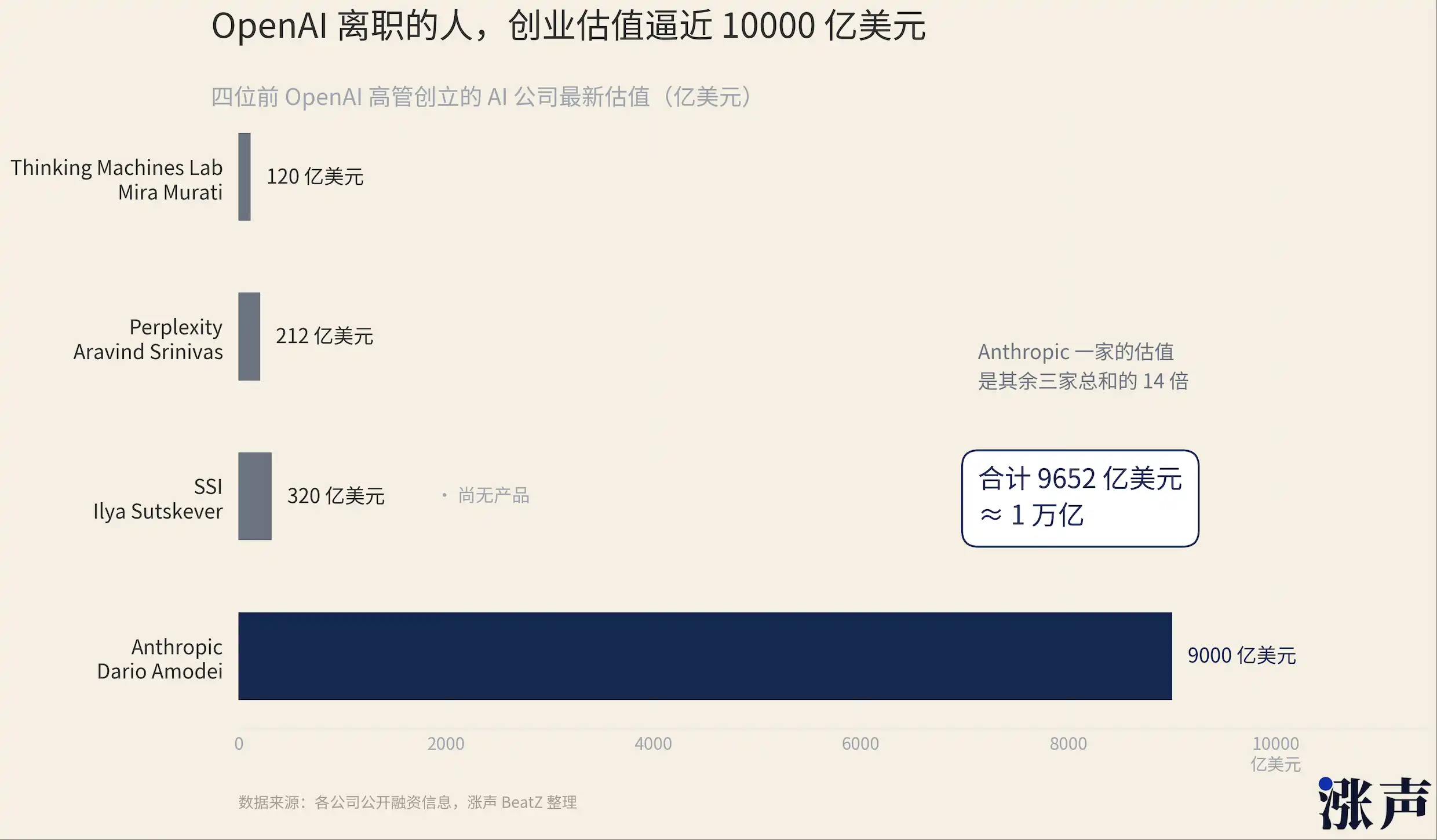
So, OpenAI’s most important output in recent years might not be GPT-4, but rather these former employees it has released into the world.
Among them, Leopold Aschenbrenner – the youngest to be fired from OpenAI – has become one of the most frequently cited names in the capital markets over the past two years.
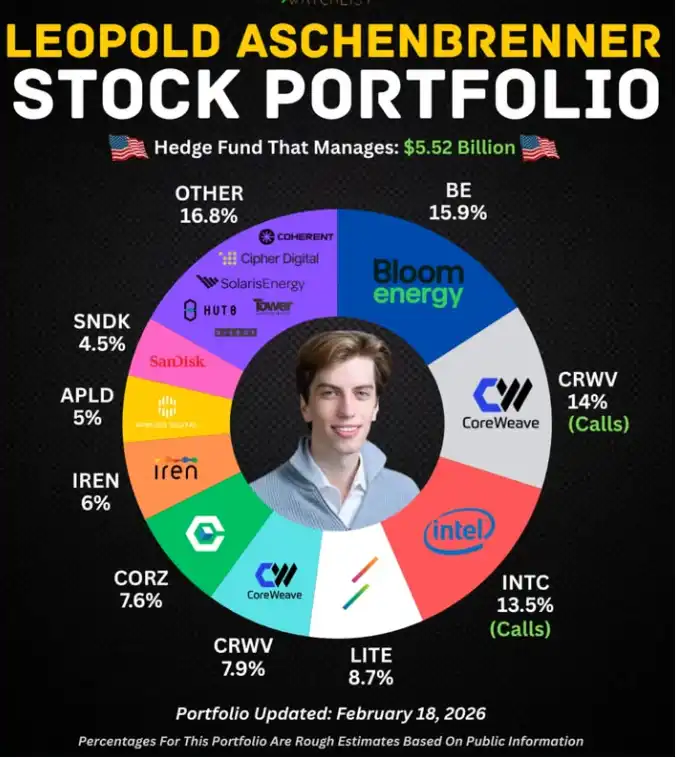
His legendary track record has been chewed over repeatedly by the media: fired from OpenAI at 23, wrote a 165-page report titled “Situational Awareness,” and within a year grew a hedge fund from $225 million to $5.5 billion by heavily betting on nuclear power and fuel cells – all correct.
The story is too perfect, the contrast too stark, the result too successful. Now, whenever the investment logic of the AI era is discussed, he’s almost inescapable.
But Leopold is just the first among this group to be noticed.
Those who left OpenAI have gradually forged two paths.
One is the path of Ilya, Mira, and Aravind: start a company, raise massive funds, pursue the next disruptive product – a classic Silicon Valley genius departure story.
The other path is much quieter: a group chose to place bets, letting others execute while they focus solely on making judgments.
Leopold represents the extreme form of this second path.
He went to public markets. Using an operator’s perspective from the AI industry, he found mispriced assets in traditional energy stocks and bought heavily. He doesn’t understand energy, but he knows how much electricity AI needs to burn – and that’s enough. This kind of insight can’t be replicated by reading reports or attending industry conferences. It can only be accumulated by being in that position.
Beyond this path, there’s another group doing things with the same logic but different forms: smaller funds closing due diligence in hours that takes others months, where the list of rejected investments is more valuable than the investment list itself. They form the most easily overlooked yet most worthy layer of this great exodus.
Most people leaving a company take away a resume. Those leaving OpenAI take away answers that others don’t yet know they need.
1. There Is No Second Leopold
Leopold’s big bets were on nuclear power company Vistra and fuel cell company Bloom Energy.
After both paid off, he adjusted his positions in phases by end of 2025, clearing Vistra and concentrating funds further on Bloom Energy and data center infrastructure.
Traditional energy analysts looking at these two stocks would pull up grid expansion plans, compare carbon tax policies, and build demand growth models. Leopold’s approach was entirely different.
At OpenAI, he saw the scale of server rooms, the electricity bills for training a flagship model, and engineers discussing why the next generation of data centers must be located next to nuclear power plants. These details aren’t in any financial report or analyst report, but they form a conclusion about energy demand that’s more real than any model.
In the investment world, this approach is called “cross-industry cognitive arbitrage”: translating internal information from one industry into underappreciated assets in another.
In the past, this was the domain of top macro hedge funds, relying on a global macroeconomic perspective.
Leopold did something more precise: using an AI operator’s perspective, he found pricing lag loopholes in the traditional energy public market.
This path is hard to replicate.
2. Zero Shot: The Most Valuable Thing Is the Rejection List
Evan Morikawa, founder of Zero Shot fund, is also an OpenAI alumnus with solid technical chops. He went into VC.
Same alumni network, completely different path.
Leopold’s judgment comes from specific frontline experience in AI’s core roles – firsthand perception of model training costs, data center planning, and energy needs. It can only be accumulated from that seat, with no fast-forward button. Among OpenAI’s core positions, very few are truly qualified to make this bet.
In April this year, a new $100 million fund quietly surfaced, named Zero Shot.
It’s a term from AI training, referring to a model answering directly without seeing any samples.
The three co-founders are from OpenAI: Evan Morikawa, former head of application engineering for DALL-E and ChatGPT; Andrew Mayne, OpenAI’s first prompt engineer; and Shawn Jain, former researcher and engineer.
They’ve already invested in three companies: AI enterprise workflow company Worktrace, AI-enhanced factory robotics company Foundry Robotics, and another project still in stealth mode.
$100 million is a small number in today’s multi-billion dollar AI funds.
But looking at which sectors they refuse to invest in is more revealing.
Mayne has publicly stated he’s bearish on most “vibe coding” tools – products that help you write code using natural language.
The reasoning is straightforward: he knows what OpenAI has internally accumulated in the coding direction, and how quickly the moat of these tools could be dissolved directly by foundational models. Morikawa keeps his distance from the many “human-centric video data companies” in the robotics space – those collecting human action data to train robots – believing this technical route will hit a dead end.
These are judgments typical VCs cannot make.
They haven’t been at the source of information, haven’t seen those internal discussions, so they can’t judge which path is a dead end.
Zero Shot’s strength lies in its rejection list. In a market where everyone is shouting about AI startups, knowing where the traps are is more valuable than knowing who to bet on. For those who have already mined, a minefield map is more useful than a treasure map.
They deliberately kept the fund size at $100 million for a very specific reason.
They know exactly at which stage their advantage is most valuable: the early stage, before technical routes converge. At that stage, insiders can instantly tell which path leads somewhere.
Once a project reaches Series C or D, financial data and public information overshadow informational advantages, and this card is fully played.
The larger the scale, the more you must chase “certain large tracks,” fighting with others’ tactics.
$100 million is their honest assessment of their own advantage boundary.
3. Angel Investing Is a Different Business
Mira Murati and Zero Shot fund both invested in Worktrace, founded by former OpenAI colleague Angela Jiang, a company using AI to optimize enterprise workflows.
But the investment logic is far deeper than “good relationships.”
Mira saw Angela’s decision-making under OpenAI’s high pressure, her judgment of AI product boundaries, and her execution ability under real constraints. These things cannot be faked in a two-hour founder pitch, nor fully uncovered by the most thorough due diligence.
Angela doesn’t need to convince Mira to believe in her, because Mira already formed her judgment. The information cost of angel investing approaches zero, but the information quality far exceeds market averages.
A bigger flywheel exists with Sam Altman.
According to reports, Altman decides whether to co-invest within hours of hearing about an ex-employee’s startup, layering on funding from the OpenAI Startup Fund and significant API credits.
He holds no equity in OpenAI, but every successful alumnus expands OpenAI’s data access, distribution channels, and policy influence. He’s using capital to sustain an ecosystem that doesn’t belong to him yet continuously rewards him. It’s an invisible equity, but one that genuinely compounds.
This ecosystem leads many to mistakenly believe it’s just old colleagues banding together for warmth.
Comparing it to the PayPal Mafia makes the difference clear.
The PayPal Mafia’s cohesion came from shared hardship: fighting the payments war together, going through the eBay acquisition together, forming a trench bond during the near-death survival period. This trust is real, but their judgments about the future were divergent. Thiel did venture capital, Musk built rockets, Hoffman built a social network – paths scattered in all directions.
What unites OpenAI alumni is a shared bet on the future: AGI is coming, the window is limited, and now is a once-in-a-lifetime moment to position. The driving force of faith is more enduring than camaraderie, because it directly aligns with interests. Once each person’s bet direction is right, the entire network benefits.
This also makes the entry threshold for this circle quite subtle.
If the product is good enough, raising money from this group is no problem. But if you are skeptical about AI’s future, or your entrepreneurial logic is based on the premise that “AGI is far away,” even with an excellent product, it’s hard to get a check from this group.
Worldview differences end the conversation before the handshake.
4. From Builders to Investors
The destinations of OpenAI alumni can be grouped into three categories.
Ilya, Aravind, and Mira all chose entrepreneurship.
But even within entrepreneurship, they are doing completely different things. Aravind is in a highly competitive consumer business, Mira is building a tool platform, and Ilya’s SSI has no product yet, valued at $32 billion on the bet of “safety” itself.
Leopold and Zero Shot chose investing.
Leopold went to public markets, Zero Shot does early-stage VC. Both externalize judgment into capital rather than personal execution. This is a minority among OpenAI alumni, but this minority is worth a closer look: someone choosing to bet rather than build usually means their judgment on the outcome is so clear that action isn’t needed to explore.
People often think the highest form of genius is creation. But this group offers another answer: when judgment is clear enough, distributing cognition across multiple directions and letting those with execution ability build is a more efficient choice.
Leopold’s report is titled “Situational Awareness” – a military term describing a pilot’s real-time perception of the entire battlefield.
A pilot’s situational awareness determines their actions two seconds later; losing it means death. What this group brought out of OpenAI is precisely this situational awareness of the AI battlefield. They know the direction of the war, know where the high ground is, and know which trench leads to a dead end.
What they are doing now is deploying accordingly.
When the smartest people of an era start going ALL IN, it means the answer is clear enough to them, so clear that it no longer needs validation through action.