YZiLabs EASY S3 結業:25 個項目拼出 AI-Native 金融系統版圖


- 核心觀點:YZiLabs EASY Residency Season 3 畢業項目揭示出行業核心趨勢:AI 正從「聊天機器人+發幣」階段,進化為擁有身份、錢包和決策能力的原生金融參與者;同時,鏈上金融市場正透過引入波動率、固定利率等傳統金融基礎設施,為機構級資金和 AI 策略的大規模入場鋪路。
- 關鍵要素:
- AI Agent 基礎設施成熟:本季項目如 Bank of AI 和 Functor,專注於為 AI Agent 構建鏈上帳戶、支付授權及安全邊界,使其能自主執行鏈上操作並參與 DeFi,標誌 AI 開始作為獨立金融實體運作。
- 鏈上金融核心元件完善:LayerV 和 TermMax 等項目正將波動率市場、固定利率等傳統金融萬億級原語原生帶到鏈上,補齊了 DeFi 基礎設施短板,這是吸引機構資金的關鍵前提。
- 交易執行向 AI 與專業策略演進:NewsLiquid 等 AI 交易終端將資訊優勢轉化為毫秒級執行優勢,L7 等平台將交易能力資產化,交易執行正演變為資訊獲取、槓桿博弈與風險對沖的綜合競爭。
- 合規與隱私共存成為趨勢:SilentSwap 和 0xBow 等項目探索「可問責隱私」架構,在保護交易隱私的同時,允許合規自證,這成為大額資本制度化入場的前提條件。
- 社交與金融深度綁定:Dapital 等平台將社交訊號直接轉化為鏈上執行,Flap 提供可程式化代幣發射平台,使社交互動與代幣經濟在金融屬性層面實現融合。
Original Author: Biteye
At around 8 AM Beijing time today, @YZiLabs officially unveiled the full roster of graduates from EASY Residency Season 3. This edition of the incubator officially concluded with its Demo Day at the Computer History Museum in Mountain View, California. The direction of this season was also clearer than any previous one: restructure the on-chain financial market structure, making AI a native participant in the financial system.
In the past few years, Crypto AI has largely remained in the phase of "chatbots + token launch narratives."
But in this season, EASY S3, a very obvious change has occurred: AI is beginning to genuinely possess identities, wallets, and assets, existing as a native participant within the financial system.
In a sense, this season is not about incubating "tools." It is about building the on-chain financial infrastructure for the age of Agents.
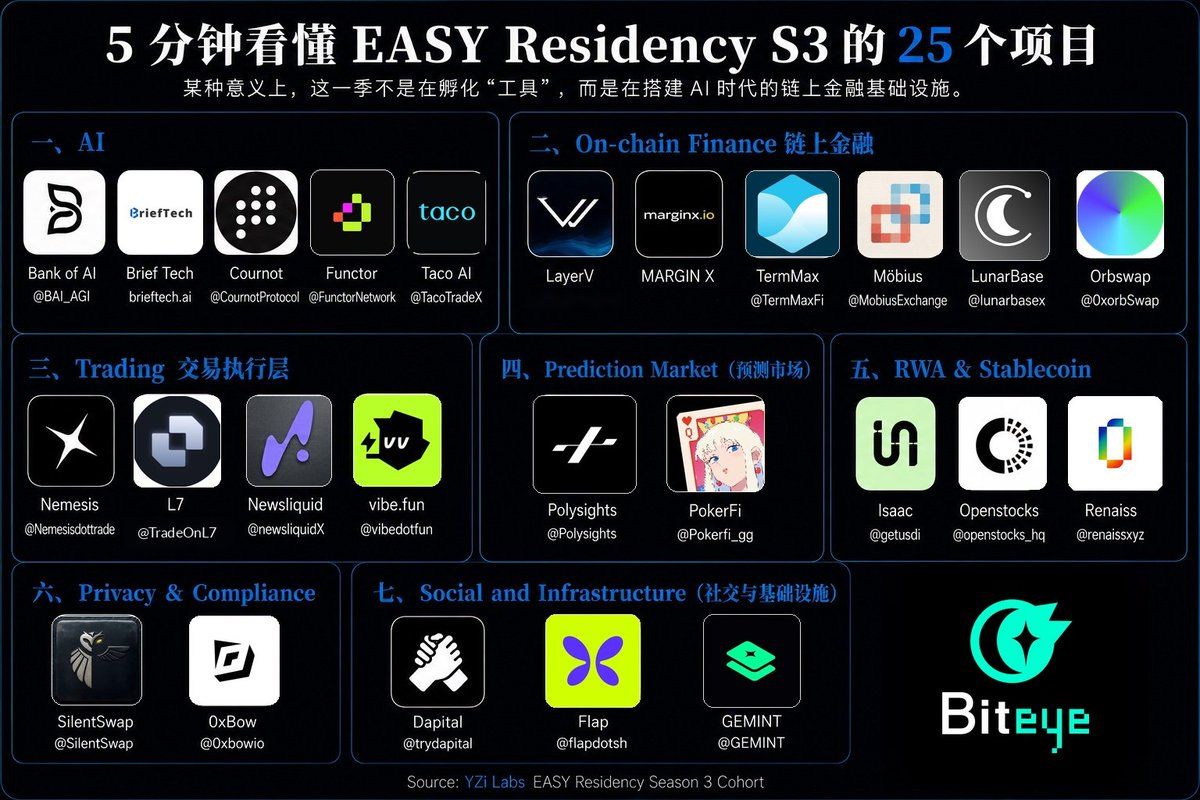
1. AI and Agent Infrastructure
This season's AI projects are no longer just dialog boxes, but Agent infrastructure with identities, wallets, and decision-making capabilities.
Bank of AI @BAI_AGI Official Twitter XHunt Rank: 14384
[Core]: On-chain account and payment infrastructure for AI Agents.
Bank of AI is building on-chain account and payment infrastructure for AI Agents. It's not just a simple AI relay station; it's building infrastructure around on-chain payments, identity, and DeFi interactions for AI Agents, covering modules like x402 Payments, On-chain AI Identity, and Autonomous DeFi. This allows AI Agents to have verifiable identities, initiate on-chain payments, and participate in DeFi operations.
Brief Tech (brieftech.ai)
[Core]: AI infrastructure for the vertical domain of high-value legal workflows.
BriefTech is a LegalTech AI project primarily serving lawyers, dispute resolution teams, and legal professionals. It can be used for automated bundling, AI-powered indexing, and legal document organization. The project's highlight lies in its vertical AI application, directly embedding into high-ticket, high-barrier legal workflows to solve high-frequency, time-consuming, and repetitive document processing issues in the traditional legal industry.
Cournot @CournotProtocol
[Core]: Transforming probabilistic AI outputs into verifiable reasoning through "truth discovery."
Cournot addresses a fundamental flaw in AI: model outputs are probabilistic, cannot self-verify the reasoning process, and more importantly, cannot bear the trust and capital required for high-stakes decisions. Cournot's solution is to coordinate multiple agents for "truth discovery," converting AI conclusions into auditable, structured statements, thereby enabling verifiable reasoning. Areas like prediction markets, on-chain governance, and scientific discovery need an arbitration layer that can replace "committee guessing" with verifiable reasoning. As AI begins to participate in prediction markets, governance, and on-chain decisions, the "AI says so" itself also needs to be verified.
Functor @FunctorNetwork Official Twitter XHunt Rank: 195698
[Core]: Establishing a programmable security boundary authorization layer for Agent on-chain actions.
What happens after an Agent gets authorization? The real issue is, once an Agent can operate a wallet, who limits how much it can spend, which contracts it can call, and how to stop losses if something goes wrong? Functor builds the self-custodial authorization layer for Agents: every signature must pass predefined on-chain authorization rules. It's not a wallet, but a programmable security boundary standing between Agent actions and fund safety. Agent workflows from asset management and prediction markets to DeFi automation are already integrated.
Taco AI @TacoTradeX Official Twitter XHunt Rank: 165910
[Core]: An AI trading execution portal with a decoupled architecture featuring a brain, memory, and vault.
Taco AI positions itself as an AI-driven crypto trading execution layer, with the slogan "Run Crypto with AI, the Easy Way." It allows users to bypass complex self-custody and cloud infrastructure, directly using AI Agents for trading, prediction, and automated operations. Taco's architecture decouples the brain, sandbox, vault, and memory, solving security issues during Agent execution and preventing "amnesia" with each interaction. If Bank of AI is the account layer and Functor is the authorization layer, then Taco AI is more like the user-facing Agent execution portal.
2. On-Chain Finance
This track is nativizing mature TradFi building blocks (prime brokerage, fixed interest rates, unified margin). Once primitives like volatility, fixed rates, and prime brokerage are in place, institutional-grade capital and automated AI strategies can truly enter on a large scale.
LayerV
[Core]: Bringing the trillion-dollar "volatility market" from TradFi on-chain.
In the past few years, most DeFi users have only traded one thing: direction—up or down. But in TradFi, the truly massive market is "volatility" itself. LayerV aims to bring this long-missing volatility market on-chain. LayerV's goal is to make the vast TradFi volatility market accessible to retail and professional users in a simpler, more liquid, and on-chain tradable way. This is one of the highest-barriered and least developed corners of current DeFi.
MARGIN X
[Core]: Building a decentralized prime brokerage liquidity market.
MARGIN X is not just another perpetual DEX; it is an on-chain prime brokerage layer for the BNB Chain ecosystem. In recent years, on-chain market making has had a rarely discussed problem: a large amount of market-making inventory relies on off-chain, non-transparent token lending. MARGIN X aims to nativize this "prime brokerage" model on-chain, replacing the OTC model with transparent, composable on-chain prime brokerage. Projects deposit tokens to earn yields, market makers and traders borrow inventory as needed, and the hedging paths for both sides are integrated into a single transparent desktop interface.
TermMax @TermMaxFi Official Twitter XHunt Rank: 22952
[Core]: Providing fixed-rate infrastructure for institutional digital assets.
TermMax is a fixed-rate DeFi lending protocol for users looking to lock in borrowing costs or yields. Its significance lies in bringing the very basic TradFi primitive of fixed interest rates into the on-chain lending scene, laying the groundwork for more sophisticated institutional participation.
Möbius @MobiusExchange
[Core]: Creating a unified margin layer for on-chain finance.
Möbius's mission can be summed up as: nativizing the unified margin architecture that created the trillion-dollar prime brokerage industry in TradFi onto the chain. Through a single self-custodial credit account, users can simultaneously engage in lending, perpetual contract trading, and DeFi strategy deployment. It aims to solve the problem of collateral being scattered across different platforms, where overall risk is controllable but assets get forcibly liquidated locally.
LunarBase @lunarbasex
[Core]: Introducing professional market-making strategies (Prop AMM) to improve liquidity pricing efficiency and order fulfillment capacity on EVM chains.
LunarBase addresses a direct problem: the quality of liquidity on EVM chains is far inferior to CEXs, leading to high slippage for large trades and low market-making efficiency. Its solution is to bring Prop AMM, a more professional market-maker-oriented liquidity mechanism, onto the EVM to enhance pricing efficiency and order-filling capability.
Orbswap @0xorbSwap
[Core]: Improving capital efficiency of fragmented stablecoins through an N-dimensional AMM structure.
Stablecoin fragmentation is deepening across issuers, chains, and jurisdictions. The real problem is that more stablecoins mean more fragmented liquidity. Orbswap uses an N-dimensional AMM to pool various stablecoins together, enabling lower-friction swaps. This structure significantly improves capital efficiency for traders, wallets, and protocols frequently switching between different stablecoins.
3. Trading Execution
Trading execution is no longer just about "buying and selling"; it has evolved into a millisecond-level comprehensive competition of "information acquisition, leverage gaming, and risk hedging." The addition of AI allows ordinary users to access professional-grade, structured profit models.
Nemesis @Nemesisdottrade Official Twitter XHunt Rank: 51669
[Core]: A permissionless on-chain leveraged trading protocol supporting 20x leverage on any asset.
Nemesis focuses on a permissionless on-chain leveraged trading protocol. Its innovative Omni-directional Market Maker (OMM) allows for simultaneous swaps, leveraged longs/shorts, and liquidity provision within a single liquidity pool, thereby enabling 20x leveraged trading on any on-chain token. This is more than just enabling leverage on small-cap coins; more importantly, the OMM creates a novel, organic on-chain yield source for LPs that is several times higher than peers.
L7 @TradeOnL7
[Core]: A mobile-first, Agent-oriented, all-market trading terminal and capital acquisition platform.
L7 is a mobile-first, Agent-oriented capital acquisition platform. It's not a simple perpetual exchange, but an all-market trading terminal spanning perpetual contracts, prediction markets, tokenized stocks, yield products, and RWAs. It's more like turning "trading ability" itself into a capital-deployable asset. Traders here monetize their skills into funded accounts, while capital providers earn returns through evaluation fees and profit sharing.
Newsliquid @newsliquidX Official Twitter XHunt Rank: 9427
[Core]: Event-driven AI trading that turns market events directly into executable orders.
While most traders still rely on manually scrolling through Twitter and reading news, AI is already compressing "information advantage" into millisecond-level execution advantages. It tries to compress the "news understanding → market impact assessment → trade execution" loop into a single automated pipeline. Its AI model delves into each news event, identifies target assets, reads charts, understands order books, and then provides executable trading decisions.
Vibe.fun @vibedotfun
[Core]: A mobile application transforming complex structured derivatives into a minimalist trading experience.
Vibe.fun aims to make the less mature structured derivative expressions in DeFi more intuitive. Centered around TradFi structured primitives like barrier options, range accruals, and path-dependent yields, it attempts to simplify complex products into a more accessible trading experience using a mobile-first, no-liquidation, ultra-short-cycle approach.
4. Prediction Markets
Prediction markets are expanding from "election betting" into a broader experimental ground for information financialization. Markets no longer just trade outcomes, but "who obtains real information earlier."
Polysights @Polysights
[Core]: An infrastructure layer providing automated intelligence and trading tools for prediction markets.
Prediction markets are evolving from niche tools into a meaningful new asset class. Polysights is the infrastructure layer providing automation, intelligence, and tools for this market. It aggregates and analyzes data from Polymarket, generating probability calculations and trading signals, helping users turn prediction markets from pure gambling into more data-driven decision arenas. This is classic "selling shovels during a gold rush": as prediction market volume expands, the value of infrastructure providers compounds.
PokerFi @Pokerfi_gg
[Core]: An on-chain skill-based gaming marketplace turning game outcomes into tradable options.
PokerFi brings poker on-chain with a novel primitive: every card in every hand is a tradable equity token, and the entire game is settled cryptographically using ZK and Merkle trees. It's not just a game project, but a skill-based gaming options market turning game results into hedgeable, tradable financial products.
5. RWA and Stablecoins
RWA is advancing into deeper waters. Whether it's compliant stablecoins in the Middle East market, or Pre-IPO stocks and collectibles, the core lies in "releasing liquidity under compliance."
Isaac @getusdi
[Core]: Building a neobank track serving the global Muslim market with a dollar-based rail. Isaac's goal is a dollar neobank track serving the global Muslim market, and its key differentiating weapon is its proprietary zero-interest stablecoin, USD-i. It's not just an interface on top of an existing stablecoin; Isaac controls the issuance of the underlying monetary instrument itself, constructing a full-stack compliant financial system from stablecoins, savings, to payments.
Openstocks @openstocks_hq
[Core]: Creating a platform for stablecoins, trading, and yield generation based on Pre-IPO stocks. Openstocks turns illiquid Pre-IPO stocks into yield-bearing tokenized assets. Compliance is handled via a Cayman Islands offshore structure, with assets backed 1:1 by real Pre-IPO collateral, monitored by a dedicated risk engine for liquidation and collateral ratios.
Renaiss @renaissxyz Official Twitter XHunt Rank: 9464 [Core]: Providing transparent valuation and global circulation rails for the global physical collectibles market. Renaiss targets a more consumption-oriented, deeper-seated RWA track. The $500 billion physical collectibles market has long suffered from poor liquidity, opaque valuation, and difficulties in authentication and custody. Renaiss attempts to enable true circulation of non-standard assets like collectible toys, trading cards, and art through on-chain settlement, authenticity verification, provenance tracking, and global market access.
6. Privacy and Compliance
Privacy is no longer the enemy of compliance, but the prerequisite for institutional entry. Accountable Privacy is the standard for future high-value on-chain transactions.
SilentSwap @SilentSwap Official Twitter XHunt Rank: 92229
[Core]: Balancing privacy, compliance requirements, and non-custodial cross-chain Swaps.
SilentSwap is a non-custodial, compliance-oriented cross-chain privacy swap, finding a more usable balance between the often mutually exclusive conditions of privacy, compliance, and non-custody. It is similar in direction to 0xBow but emphasizes non-custodial privacy and cross-chain swap experience during the transaction process.
0xBow @0xbowio Official Twitter XHunt Rank: 9488
[Core]: Implementing Privacy Pools that enable coexistence of private transactions and self-certification of fund compliance.
In the crypto world, privacy and compliance have long been seen as opposites. 0xBow's Privacy Pools architecture is designed to prove they can coexist. It allows users to conduct private transactions while retaining