From AI Assistant to On-Chain Agent: What Is the Next Evolution of Web3 Wallets?


- Core Thesis: By 2026, the integration of AI and Crypto has shifted from conceptual narratives to product implementation. Industry giants are building on-chain execution infrastructure like wallets and payment protocols for AI Agents. The core of future competition will shift from model capabilities to reusable work methods (Skills) and community co-creation. Wallets will become workstations where users accumulate experience and co-create.
- Key Elements:
- Binance, TON, and OKX launched Agentic Wallets or payment protocols within a week, signaling that the giants' competition is starting with custodial infrastructure that "lets AI take over on-chain execution." (Core drivers: permissions, reusability, and co-creation).
- The development of AI+Crypto occurs in two phases: Phase 1 sees AI as a "research assistant" aiding information understanding (e.g., Binance Social Hype); Phase 2 sees AI becoming the "on-chain executor," directly completing transaction operations through Agentic Wallets and Skills.
- Industry giants (Cobo, Coinbase, Gemini, etc.) are highly converging on four pillars: the identity layer, permissions layer (e.g., ERC-7715), payment layer (e.g., x402), and execution layer, building financial account infrastructure that AI can directly invoke.
- The concept of "Skills" is emerging, encapsulating complex on-chain operations (e.g., Swaps, DeFi participation) into standardized, reusable capability units. This shifts the competition in the Agent ecosystem from model parameters to the competition of work methods and community knowledge.
- The core problem wallets need to solve in the next decade is: When AI agents execute tasks, users need a secure Verifiable UI to confirm the interface's authenticity and be able to distill operational experience into shareable Skills or templates. Wallets will evolve from "address books + signers" into "portals for identity, authorization, knowledge, and co-creation."
Over the past year, AI+Crypto has been one of the most crowded narratives in the crypto industry.
Initially, the market focused more on AI tokens, decentralized compute power, data networks, and various AI Agent concept coins. But entering 2026, projects are no longer just discussing "how AI will change Crypto," but are beginning to integrate AI into wallets, exchanges, payment protocols, and on-chain execution processes.
Within just one week, three landmark events occurred in succession:
- On April 24, Binance Wallet launched Agentic Wallet, a standalone, non-custodial wallet specifically designed for AI Agents. It features independent balances, configurable permissions, and real-time monitoring functions, and comes with built-in Agentic Wallet Skills by default, allowing Agents to perform automated operations within preset boundaries;
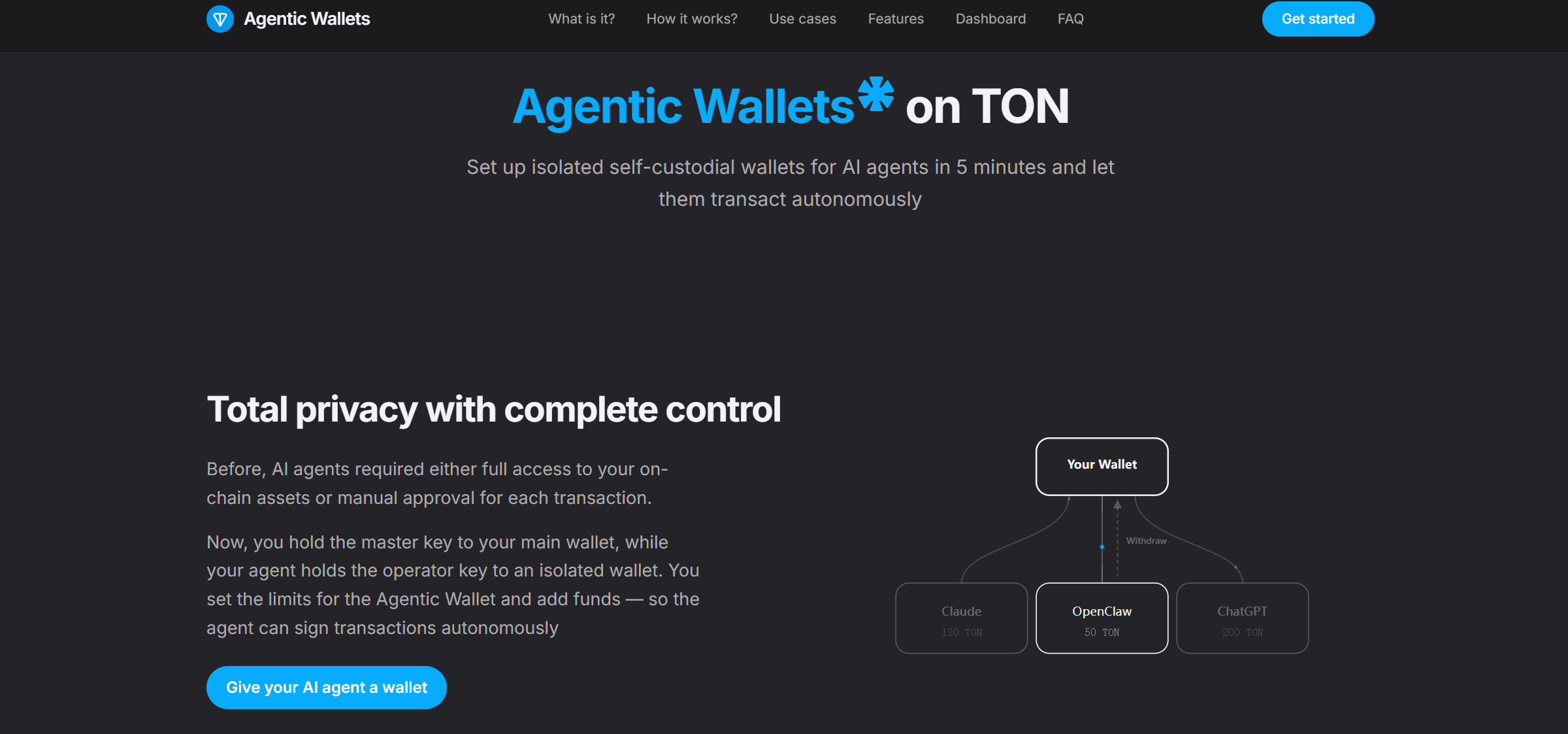
- On April 28, TON launched Agentic Wallet, a self-custodial wallet contract for AI Agents. Users can set up an independent wallet for an AI Agent within minutes, enabling the Agent to autonomously perform on-chain operations like transfers, Swaps, and staking without touching the user's private keys;
- On April 29, OKX released the Agent Payments Protocol, an open payment standard designed for AI Agent business activities. It covers the complete business workflow including quoting, negotiation, escrow, metering, settlement, and dispute resolution, attempting to provide a practical payment and settlement framework for the future Agent economy;
On the surface, this looks like a competition among giants centered on "letting AI take over on-chain execution." But if you zoom out, you'll see the real underlying thread of this competition is about permissions, reuse, and co-creation.
This may very well be the most significant change for Web3 wallets in the next decade.
1. The Evolution of AI+Crypto
Let's first outline the evolution of AI+Crypto over the past few years.
As we know, for most average users, the biggest problem in the on-chain world has never been a lack of information, but rather too much chaotic information. For example, a single token might appear simultaneously on 𝕏, Telegram, DEX Screener, block explorers, project documents, and various KOL discussions, making it difficult for the vast majority of users to identify its potential gains and risks within a limited time.
Therefore, the first AI features implemented by many wallets and trading platforms revolved around "information comprehension."
The AI features launched by Binance Wallet in January of this year are typical examples: Social Hype attempts to rank token popularity using social attention and engagement data; Topic Rush generates theme cards for emerging narratives and categorizes them by capital inflow phases; AI Assistant provides summaries of narratives, sentiment, and event timelines on token pages.
In fact, the value of these features isn't about making decisions for users, but in lowering the barrier to understanding. After all, for a newcomer to the on-chain world, a sufficiently clear AI summary can be more helpful than dozens of fragmented tweets. Even for experienced users, AI can act as an information filter, helping them quickly locate clues worthy of further research.
But this is just the first step. In the world of Crypto, after "understanding," users often need to consider how to operate – authorization, cross-chain, slippage settings, risk control, revoking permissions, identifying phishing pages, etc. In other words, if AI remains at the level of only "helping users summarize information," it still cannot truly enter the core workflow of on-chain interaction.
So, if the first phase of AI was more like a research assistant, the second phase of AI is moving closer to being an executor (Extended reading: "New Tickets for the AI Agent Era: Pushing ERC-8004, What is Ethereum Betting On?").
Gemini's launch of Agentic Trading is a very representative signal. According to Gemini, users can connect AI Agents to their trading accounts via MCP, allowing the Agent to call trading-related APIs to perform actions like reading market data, placing orders, monitoring the market, and managing risk. Gemini also designed some trading capabilities as Trading Skills, such as getting real-time quotes, checking bid-ask spreads, and reading candlestick data, allowing the Agent to call these modules like tools.
This shows that exchanges are rethinking how users will interact with trading systems in the future. It may no longer be about clicking buttons, entering prices, and confirming orders, but about users setting goals in natural language, with AI assisting in breaking down the path, calling tools, and completing execution.
Similar changes are happening at the wallet layer.
Cobo's Agentic Wallet proposed the Pact protocol to define what an Agent can and cannot do, and under what conditions it should stop. It also uses a Recipe-driven skill layer to provide Agents with preset execution paths, such as lending, Swaps, DCA, grid strategies, and micropayments. Coinbase is also developing Agentic Wallets and Agent Skills for AI Agents, combining them with machine payment protocols like x402, allowing Agents to send, trade, earn yields, and even automatically pay for resources like APIs, compute power, data, and storage within set limits.
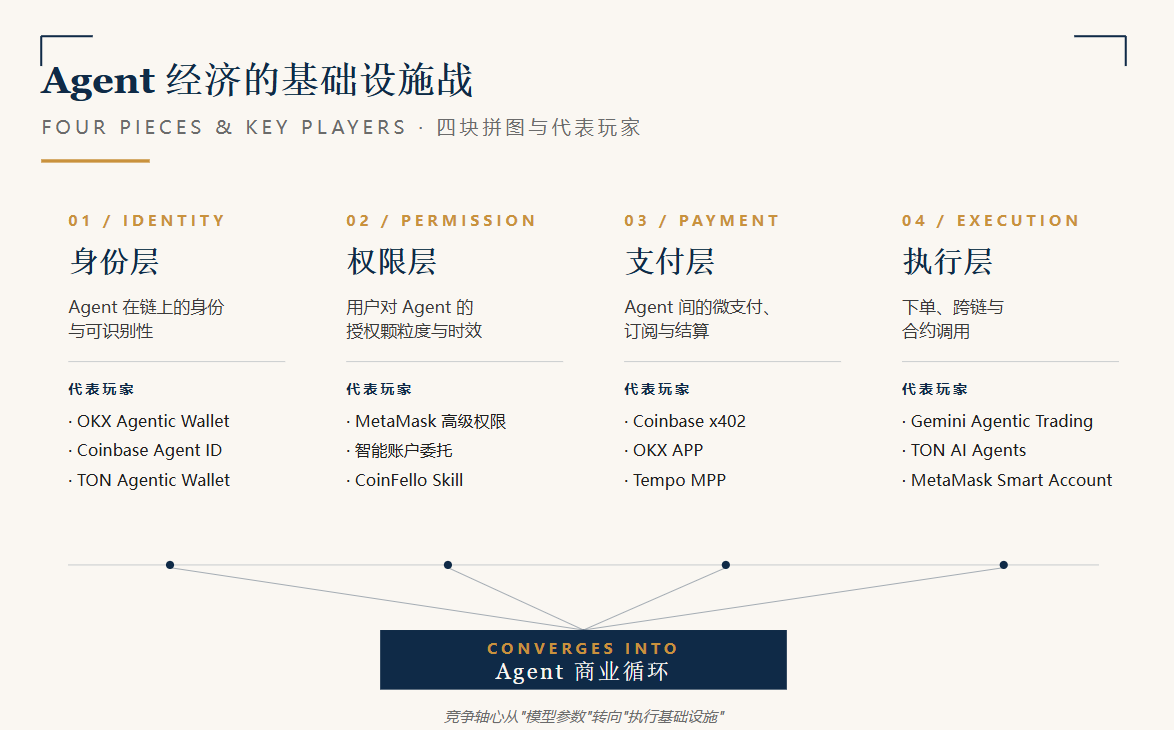
The core change behind all this is that Crypto is providing AI with a set of directly callable financial and account infrastructure. Looking at all these actions in one picture reveals a high degree of structural convergence – everyone is assembling the same four pieces of the puzzle:
- Identity Layer: On-chain identity and recognizability of the Agent (OKX Agentic Wallet, Coinbase Agent identity);
- Permission Layer: Granularity and timeliness of user authorization for the Agent (MetaMask ERC-7715 advanced permissions, Coinbase safety guards);
- Payment Layer: Agent micropayments, subscriptions, settlements (x402, APP, MPP);
- Execution Layer: Agents placing orders on exchanges/public chains, cross-chain operations, calling contracts (Gemini Agentic Trading, TON Agentic Wallet);
After all, in the traditional internet, AI Agents can help you search, summarize, write emails, and generate code. But once it comes to payments, authorization, and asset operations, they encounter identity, trust, account, and settlement issues. Blockchain naturally provides accounts, signatures, assets, payments, contracts, and traceable records, giving AI Agents the opportunity to evolve from "digital assistants" to "on-chain executors."
However, execution capability is just the first step.
If this infrastructure is about "creating hands" for Agents, then another important and easily overlooked question is: where do the "working methods" for Agents come from?
2. AI Agents Need More Than Just Wallets; They Need Reusable Skills
This is why the concept of Skills is worth paying attention to.
How do you understand Skill? Essentially, it's a capability unit that encapsulates a specific working method. For instance, each Skill is a folder containing a SKILL.md file that tells the AI what this Skill does, when to use it, and how to execute it.
So, when large models like Claude are running, they can load the corresponding Skill on demand based on user intent, transforming from a general-purpose model into an Agent specialized in a specific task.
This design seems simple, even somewhat "anti-high-tech," but the truly important aspect behind it is that the emergence of Skills means the competition in the Agent ecosystem is no longer just about model parameters, reasoning capabilities, and calling speed, but also about working methods, community knowledge, and reusable capabilities.
The moat of an Agent platform might no longer just be "my model is bigger, faster, smarter," but rather "on my platform, can experts, enterprises, developers, and ordinary users package their experience into reusable assets that others and other Agents can repeatedly utilize?"
Applying this judgment to the wallet industry leads to a more interesting proposition: as wallets enter the Agent era, the competition in the second half won't just be about doing "execution" well, but about becoming a workbench where users can deposit methods and co-create.
Indeed, whether it's Gemini's Trading Skills, Coinbase's Agent Skills, or Cobo's Recipe-driven skill layer, they are all fundamentally doing the same thing: breaking down complex operations into standardized, modular, and callable capability units.
This is especially important for ordinary users because on-chain operations are never a simple instruction. A seemingly normal Swap might involve token identification, contract address verification, allowance management, slippage settings, gas estimation, phishing risk identification, and transaction confirmation. A cross-chain transfer might involve bridge selection, arrival time, fees, target chain asset display, and failure handling. Participating in DeFi might involve understanding yield sources, smart contract risks, liquidation risks, and exit strategies.
If this experience exists only in an individual's mind, it's hard to pass on. If it's written as a simple tutorial, it's hard to be automatically called upon in actual operations. But if these experiences can be solidified into Skills, templates, checklists, or interactive works, they can become knowledge assets that every user can reuse in the AI era.
This is the new value of wallets in the AI era.
Overall, the truly noteworthy aspect of the future wallet track isn't just "can AI help me complete an operation," but whether the experience behind these operations can be solidified, reused, and collectively improved.
This is also the direction that imToken can further explore when introducing UI 3.0.
3. The Next Decade: The Vision for Wallets in the AI Era
Objectively speaking, over the past decade, the wallet industry has undergone multiple rounds of iteration: from seed phrases to multi-chain asset management, from DeFi to NFTs, from L2 to account abstraction, and now to AI Agents.
But no matter how the industry narrative shifts, wallets have always faced the same fundamental question: how to help users manage their on-chain lives more securely, independently, and clearly. In the AI era, this question becomes more complex and more important.
Because when users start involving AI in on-chain operations, the wallet needs to answer not just "can this transaction be signed," but also what does this transaction mean? Does it align with the user's true intent? Is the authorization scope reasonable? Are the risks fully explained? Especially if the Agent makes an error, does the user still retain ultimate control? If this operation has value, can the user solidify the experience and share it with others?
This is also the new direction UI 3.0 can convey. The future wallet interface isn't just about being more beautiful and smoother, but about understanding users better, explaining risks better, carrying knowledge better, and being more suitable for user co-creation.
From this perspective, imToken's reflections on Verifiable UI over the past year form the first line of defense for wallets in the AI era (Extended reading: "From the Kelp DAO Incident to Verifiable UI: Why is a 'Verifiable Interface' the New Decentralized Security Baseline?").
This is a crucial and somewhat counter-intuitive judgment. In most industry discussions, AI often implies more natural input, smarter parsing, and smoother human-computer dialogue. But from the wallet's perspective, the smarter the AI, the more the interface needs to be verifiable.
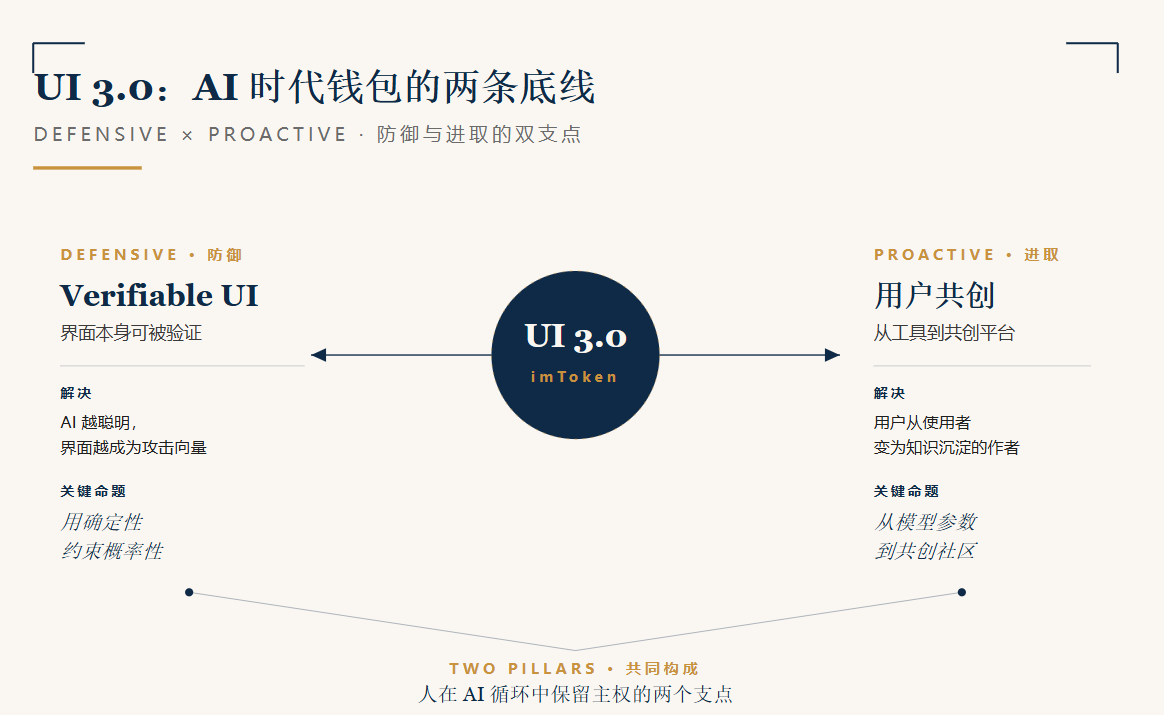
What Verifiable UI aims to solve is precisely the user's need to verify the authenticity of the interface itself. Even if a centralized service goes down, or if the Agent's interpretation is biased, the user should still retain ultimate control over their assets and interaction processes. This principle is homologous to imToken's long-standing commitment to non-custodial solutions.
Non-custodial addresses the question of "who owns the private key," while Verifiable UI further addresses: "Is what I see exactly what I am about to sign?"
It is precisely under this principle that imToken believes "using deterministic constraints on probabilistic models" is more suitable for wallet judgment in the AI era. After all, no matter how smart the AI or how powerful the model, whether a final transaction can be executed must still be governed by the deterministic code, rules, and permission boundaries within the wallet itself. The wallet is not an auxiliary entry point for AI, but the final checkpoint for user asset security in the AI era.
But beyond defense, UI 3.0 has another more progressive main theme: shifting from a tool to a co-creation platform. When execution is gradually taken over by Agents, and when the interface becomes verifiable, the next question wallets must answer becomes: what can users create here? The logic behind this is isomorphic with the logic of Skills.
As more and more wallets integrate Agents, design permissions, and provide execution capabilities, long-term differentiation may not come from "who integrated AI first," but from whether users can solidify their own creations within that wallet. For example, an on-chain strategy, a security rule template, a wallet app for a specific scenario, a shareable operations checklist, or a Skill that can be called upon by other users and Agents in the future.
Overall, the evolution of wallets over the past decade has been from "address book + signer" to "DApp browser" and then to "multi-chain entry point." The next decade's question might be: when Agents execute on my behalf, and when the interface is verified by me, what can I co-create here?
Because when users start involving AI in on-chain operations, the wallet needs to answer not just "can this transaction be signed," but also what does this transaction mean? Does it align with the user's true intent? Is the authorization scope reasonable? Are the risks fully explained? Can the user solidify this operation's experience and share it with others?
This is also the new direction UI 3.0 can convey: the future wallet interface isn't just about being more beautiful and smoother, but about understanding users better, explaining risks better, carrying knowledge better, and being more suitable for user co-creation.
This means users are not only here to share stories but also to co-create works together. For example, a Skill on "how to add a token safely," an interactive guide for "using Layer2 for the first time," a risk checklist for "identifying phishing authorizations," a process template for "hardware wallet cold storage," or even a wallet learning path suitable for beginners.
These works don't have to be complex initially. They can be an image, a tutorial, an operations checklist, a security alert template, or a Skill prototype that can be called by AI Agents in the future.
The important thing is that users transform from "people being educated" to "people co-creating."
This might be the most exciting change in user education in the AI era: knowledge is no longer unilaterally output by projects, but is continuously supplemented, refined, validated, and reused by real users in real scenarios.
Final Thoughts
In retrospect, the combination of AI+Crypto is rapidly moving from concept to product.
Exchanges are starting to let AI connect to accounts and trading capabilities. Wallets are designing asset permissions and execution boundaries for Agents. Payment protocols are exploring automated settlement between machines. Skills and Recipes are beginning to turn complex operations into reusable modules.
These changes ultimately point not to a world where "everything is done by AI," but to a world where user capabilities are amplified again. In this world, the wallet remains the entry point, but it is no longer just an entry point for assets, but an entry point for identity, authorization, knowledge, operations, and co-creation.
For imToken, its tenth anniversary is not just about looking back at the on-chain journey spent with users over the past decade, but also about issuing an invitation for the future – inviting every user to solidify their experiences, questions, methods, and works, and to participate together in building the wallet knowledge network of the AI era.
After all, in a truly vibrant Agent ecosystem, the competition isn't just about models, but about the community that co-creates.
And the wallet might just be the most natural starting point for this community, and the path everyone will walk together for the next decade.