CLARITY還沒過,華爾街已經先開張了


- 核心觀點:2026年5月,在《Clarity Act》加密市場結構法案尚待參議院通過之際,華爾街主流券商(如E*Trade、Charles Schwab)已開始以大幅低於原生交易所的費率,向散戶提供加密現貨交易,而法案中限制總統家族加密收益的「道德條款」成為關鍵政治博弈點。
- 關鍵要素:
- E*Trade於5月6日以0.50%費率,向860萬散戶開放BTC、ETH、SOL現貨交易,創下華爾街券商低費率紀錄,較Coinbase散戶費率(1.5%-3.5%)低約三分之二。
- 華爾街集中進場(2026年4-5月)的合規信心,源自《GENIUS Act》穩定幣法律框架已落地,且《Clarity Act》通過機率較高,監管不確定性降低。
- 《Clarity Act》將數位資產分為三大池:CFTC監管的「數位商品」、SEC監管的「投資合約資產」及銀行監管的「支付穩定幣」,並增設DeFi活動豁免與中介雙重註冊要求。
- 民主黨要求的「道德條款」旨在禁止官員從加密資產獲利,直接針對川普家族約430億美元的加密資產(含已實現14.7億和未實現28億),成為法案在參議院推進的核心障礙。
- 法案已通過眾議院(294:134),但參議院審議因道德條款僵持,若錯過8月休會期或11月期中選舉,2026年內通過機率將顯著降低(歷史成功率:6年僅1部加密法案簽署生效)。
On May 4, the White House expressed its hope that Congress would send the Clarity Act to the President's desk before July 4. This crypto market structure bill passed the House of Representatives by a vote of 294 to 134 in July 2025 but has been stalled in the Senate for nearly a year.
The Senate Banking Committee, chaired by Tim Scott, has scheduled the markup to be completed within May, aiming to push the bill to a full Senate vote in June or July. The obstacle in the middle is the "ethics provision" that Democratic lawmakers insist on adding, which prohibits senior government officials from personally profiting from crypto assets while in office. The target of this provision is the President himself.
Two days later, on May 6, Morgan Stanley's E*Trade opened spot trading for Bitcoin, Ethereum, and Solana to its 8.6 million retail clients at a 0.50% fee rate, which is currently the lowest retail crypto fee among major Wall Street brokerages. Although the bill hasn't passed yet, traditional big banks have already started their business.
While Congress debates whether to wait for the bill, Wall Street has already given its answer.
Wall Street Has Already Opened for Business
Even before the bill's passage, traditional brokerages have been entering the market en masse from April to May 2026, pushing retail fees down to a new floor.
Here's the timeline. On February 22, 2018, Robinhood was the first to integrate crypto trading into its retail internet brokerage, offering it commission-free from launch (including spread). In the same year, Coinbase launched its retail app with fees ranging from 0.99% to 2.99% plus a 0.5% spread. In 2022, Coinbase launched Advanced Trade, reducing retail fees to 0.40% to 0.60%. In 2023, Fidelity Crypto launched with a 1% fee rate. Then came a two-year gap.
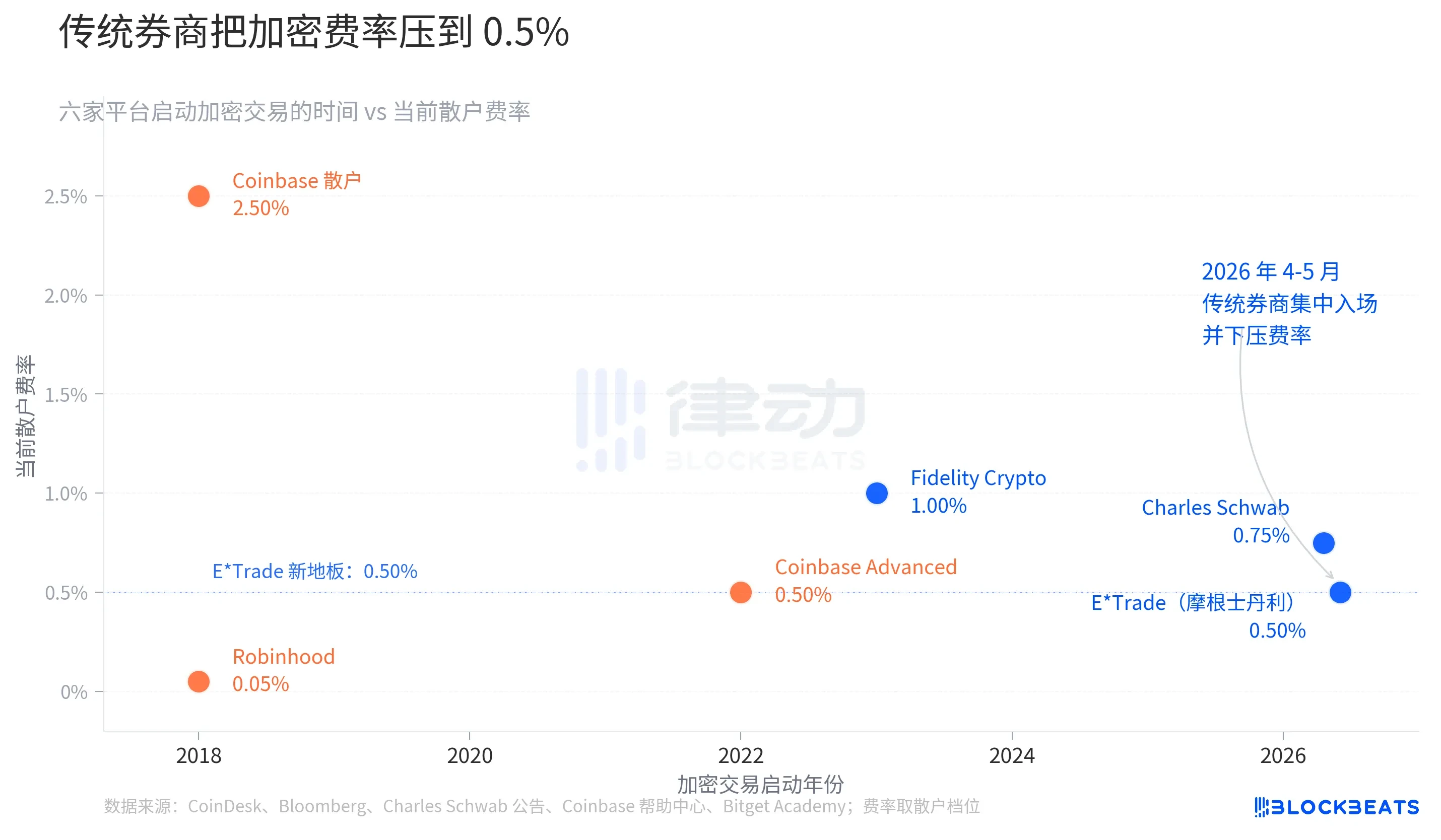
In early April 2026, Charles Schwab launched Schwab Crypto, gradually opening spot Bitcoin and Ethereum trading to retail clients at a 0.75% fee rate. A month later, on May 6, Morgan Stanley's E*Trade followed suit at 0.50%, covering Bitcoin, Ethereum, and Solana. According to BeInCrypto, this is currently the lowest retail crypto trading fee among traditional major banks.
A comparison of fee structures reveals the pressure. Coinbase's standard app charges retail users 0.99%-2.99% plus a 0.5% spread, effectively costing 1.5%-3.5%. E*Trade's 0.5% cuts that to about one-third. Fidelity's 1% now looks like the most expensive among peers. Coinbase Advanced Trade remains competitive, but that's a professional interface for high-frequency and high-net-worth users, not the primary retail choice for average investors.
Why did they collectively open for business in April-May 2026? There are two key anchors. One is the GENIUS Act, the stablecoin legal framework, which was signed into law in July 2025, providing a compliant path for traditional financial institutions to custody and settle stablecoins. The other is that the Clarity Act is about to enter the Senate markup. Regardless of the final outcome, the contours of the mainstream market structure are now clear, and major traditional banks no longer fear being pursued by regulators after entering the market. Wall Street is making decisions based on the probability distribution that "the Clarity Act will likely pass," rather than waiting for the bill to be signed.
The "Ethics Provision" Targets the President
The ethics provision demanded by Democratic lawmakers has been repeatedly submitted to the White House since 2025 and repeatedly rejected. The reason is not abstract. According to a Bloomberg report from January 2026, roughly one-fifth of the Trump family's $6.8 billion wealth comes directly from crypto projects.
Breaking down these projects provides more detail. Realized cash flow is about $1.47 billion, primarily from four products. World Liberty Financial (WLFI) token sales constitute the bulk; as of December 2025, the Trump family profited approximately $1 billion from this DeFi project, including $550 million raised from the public offering.
The $TRUMP memecoin, launched 3 days before the inauguration in January 2025, brought the family $362 million in fees and trading profits. Melania's $MELANIA memecoin followed, contributing about $65 million. Interest on the USD1 stablecoin reserves amounted to $42 million.
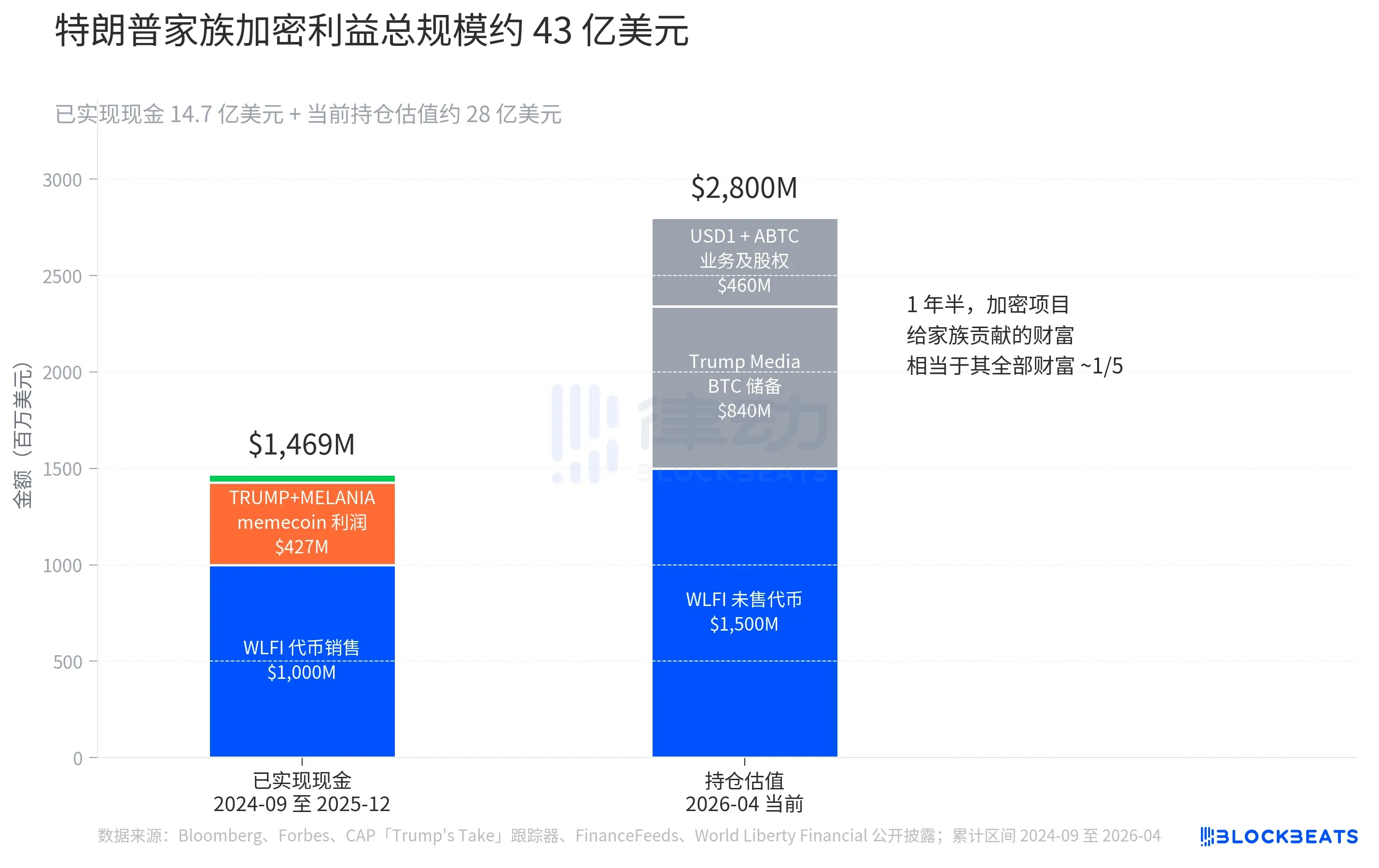
The unrealized holdings are valued at approximately $2.8 billion. WLFI still has $1.5 billion in unsold tokens on its books, but this is highly susceptible to WLFI price fluctuations. According to FinanceFeeds estimates, Trump Media's Bitcoin reserves range between 9,500 and 11,500 BTC, worth about $840 million at the current Bitcoin price. The combined value of the USD1 business valuation and equity in American Bitcoin mining is around $460 million.
Adding realized and unrealized amounts together gives a total of about $4.3 billion. This is the real number behind the ethics provision. The version pushed by Senator Elizabeth Warren and others explicitly states, "prohibits senior officials from personally profiting from crypto assets while in office." A compromise version entered the White House only to be rejected again. Whether the bill advances to a full Senate vote with this provision essentially asks every senator: Are you willing to vote publicly on this, openly cutting into the $4.3 billion pie of the President's family?
Will the CLARITY Act Pass This Year?
The Clarity Act forces all digital assets into three distinct buckets. The first bucket is "digital commodities," regulated by the CFTC, corresponding to tokens operating on "mature blockchain systems." The Act defines "maturity" with two hard standards: first, the network's functions are complete and it can achieve consensus; second, it is sufficiently decentralized, with no single entity able to unilaterally modify the protocol or governance.
The second bucket is "investment contract assets," under SEC jurisdiction, corresponding to tokens representing equity, debt, or similar rights, such as tokenized stocks, traditional securities distributed on-chain, and RWAs (real estate, notes, accounts receivable). The third bucket is payment stablecoins, overseen by banking regulators, requiring compliance with standards for capital, custody, and anti-manipulation.
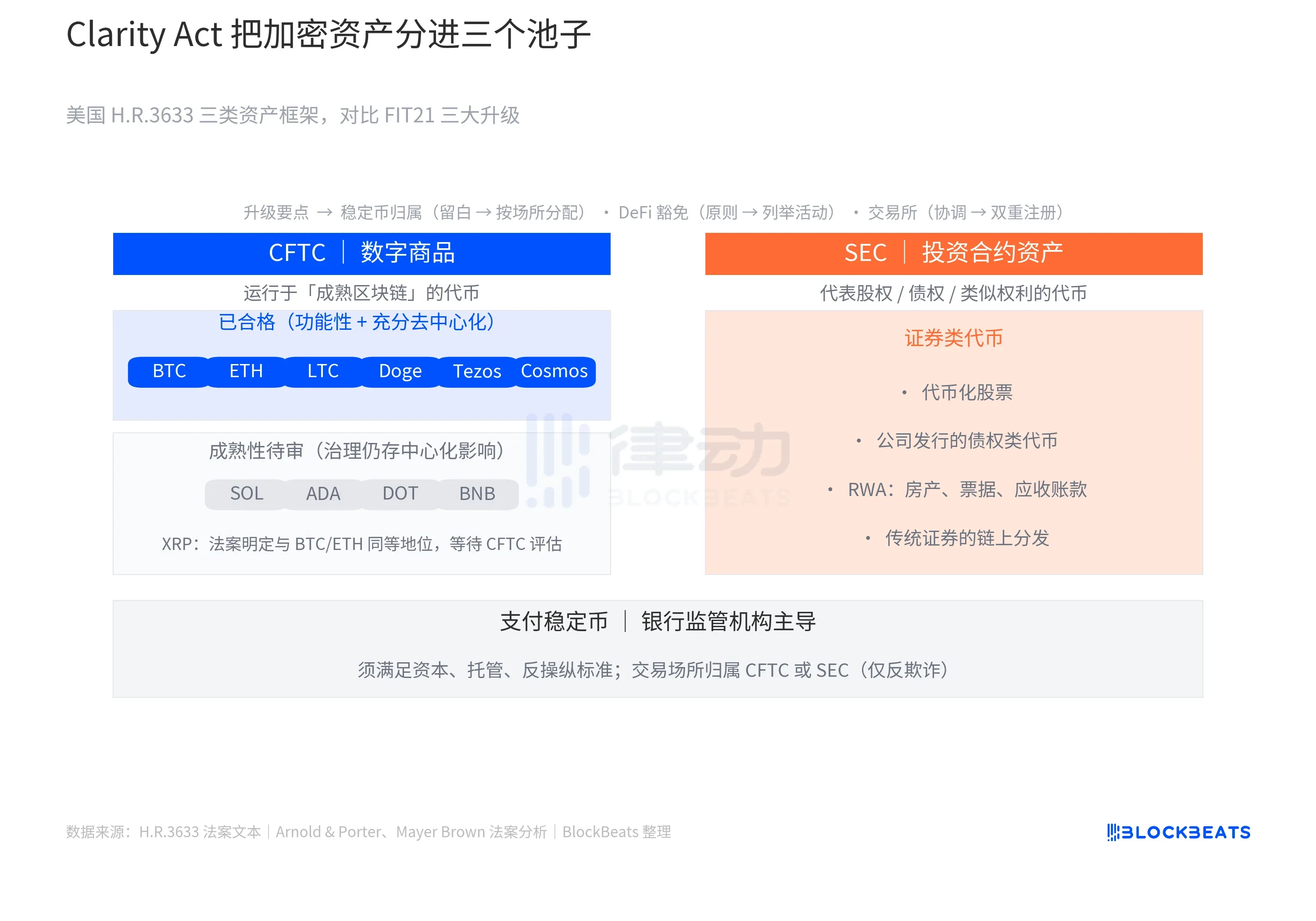
Compared to FIT21, which died in the Senate in 2024, the Clarity Act has three upgrades. Stablecoin attribution changed from "left unspecified" to "allocated based on trading venue": stablecoin trades on CFTC platforms fall under CFTC jurisdiction, those on SEC platforms fall under SEC, but the SEC only retains anti-fraud authority.
DeFi exemptions shifted from a principled safe harbor to a list of specific activity exemptions: operating a custody front-end, running a node, and publishing code do not trigger registration obligations. Exchange registration changed from "inter-agency coordination" to mandating dual registration for intermediaries handling digital commodities, even if that intermediary is already an SEC-licensed broker-dealer.
The logic of the bill is clear: to codify into law the biggest uncertainty in the crypto industry over the past few years – "who the hell is in charge of this stuff."
The Clarity Act's current position doesn't have many precedents.
According to a public statement from Representative French Hill's office, over 40 crypto and blockchain-related bills were introduced in the 116th Congress (2019-2020) alone. None of them passed. The 118th Congress (2023-2024) saw FIT21, which passed the House in May 2024. It was the first crypto market structure bill to pass a full House vote, but it also died in the Senate.
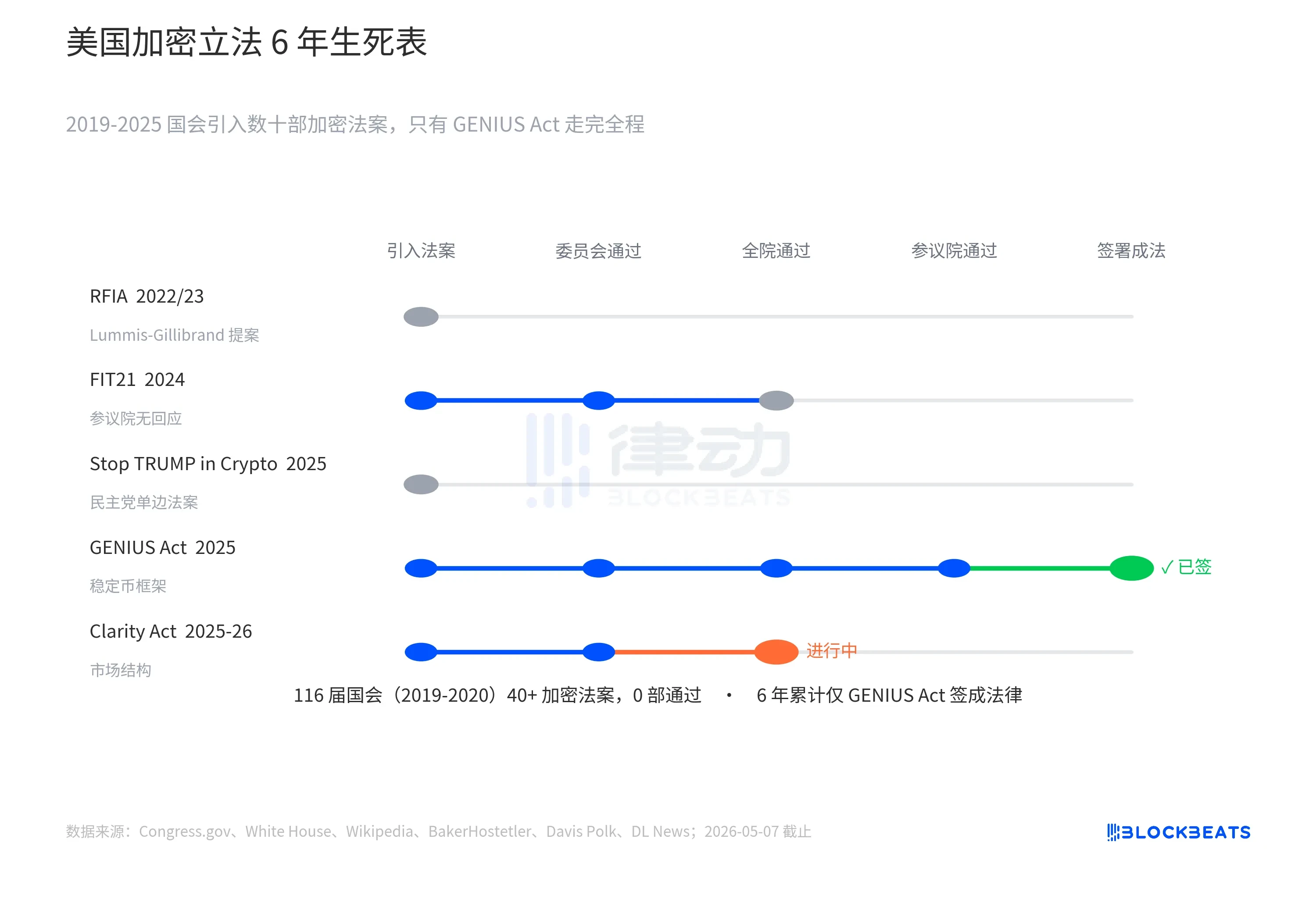
On July 18, 2025, President Trump signed the GENIUS Act into law, regulating payment stablecoins. It is the first, and so far the only, crypto-related federal bill signed into law in six years. On July 17 of the same year, the House passed the Clarity Act with 294 votes to 134. Theoretically, the Clarity Act has reached the same position FIT21 did: passed by the House, awaiting a Senate vote.
The difference lies in the political environment. During the FIT21 era, the Democratic Party controlled the White House, and there was no top-level impetus for crypto legislation. Now, the Trump administration is openly pushing for it. However, the compromise version of the ethics provision was rejected by the White House, and core Democratic senators remain unconvinced. If it misses the first week of August, the Senate will be in recess until September 14. Considering the midterm elections on November 3, whether the bill can be signed in 2026 is no longer entirely within the White House's control.
Historically, out of 50+ bills over 6 years, only one has been signed into law. Whether the Clarity Act will be the second will be decided in the next couple of months.