OpenAI Launches an Advertising Platform, a Wealthy Person's Business Sold to the Poor


- Core Thesis: To offset massive losses, OpenAI is rapidly introducing advertising to ChatGPT. However, its ad model, targeting 94% free users, creates fundamental contradictions of audience mismatch and low conversion rates. Meanwhile, "ad-free" is being weaponized by competitors like Anthropic as a premium positioning strategy.
- Key Factors:
- OpenAI launched a self-serve ad platform, Ads Manager, in May 2026, targeting $100 billion in ad revenue by 2030; its annual losses could reach tens of billions, with massive infrastructure spending.
- Ads are shown only to non-paying users (94% of the base), but high-ticket advertisers typically target paying users, creating an audience mismatch.
- ChatGPT's core use cases are often productivity-oriented (writing, coding) rather than consumer decision-making, meaning its ad intent value is far lower than search ads, raising questions about conversion effectiveness.
- Anthropic declared Claude will never show ads, using this to build user trust and a premium image. Its annualized recurring revenue has skyrocketed to $19 billion, with free user numbers growing rapidly.
- Advertising shifts the focus of GEO (Generative Engine Optimization). Brand competition moves from "how to be cited by AI" to "how does AI evaluate my product," making product reputation more critical than mere exposure.
Original Author: Kaori
Original Editor: Sleepy
Sam Altman once referred to advertising as ChatGPT's "last resort."
For a long time, this statement represented restraint. OpenAI still packaged itself as a research company, an infrastructure company, and a company trying to make AI capabilities accessible to everyone. Advertising, the most familiar monetization method of the old internet, was treated as a backup plan.
But the advertising plan quickly became the main event.
On May 5th, OpenAI launched its self-service advertising platform, Ads Manager, allowing advertisers to place ads on ChatGPT directly or through agencies like Dentsu, Omnicom, Publicis, and WPP. This came less than three months after the initial ad pilot program launched on February 9th.
The platform is still in its testing phase, but the direction is clear. ChatGPT is no longer just a conversational product; it is also becoming ad inventory. OpenAI aims to generate $2.5 billion in advertising revenue by 2026 and push that figure to $100 billion by 2030.
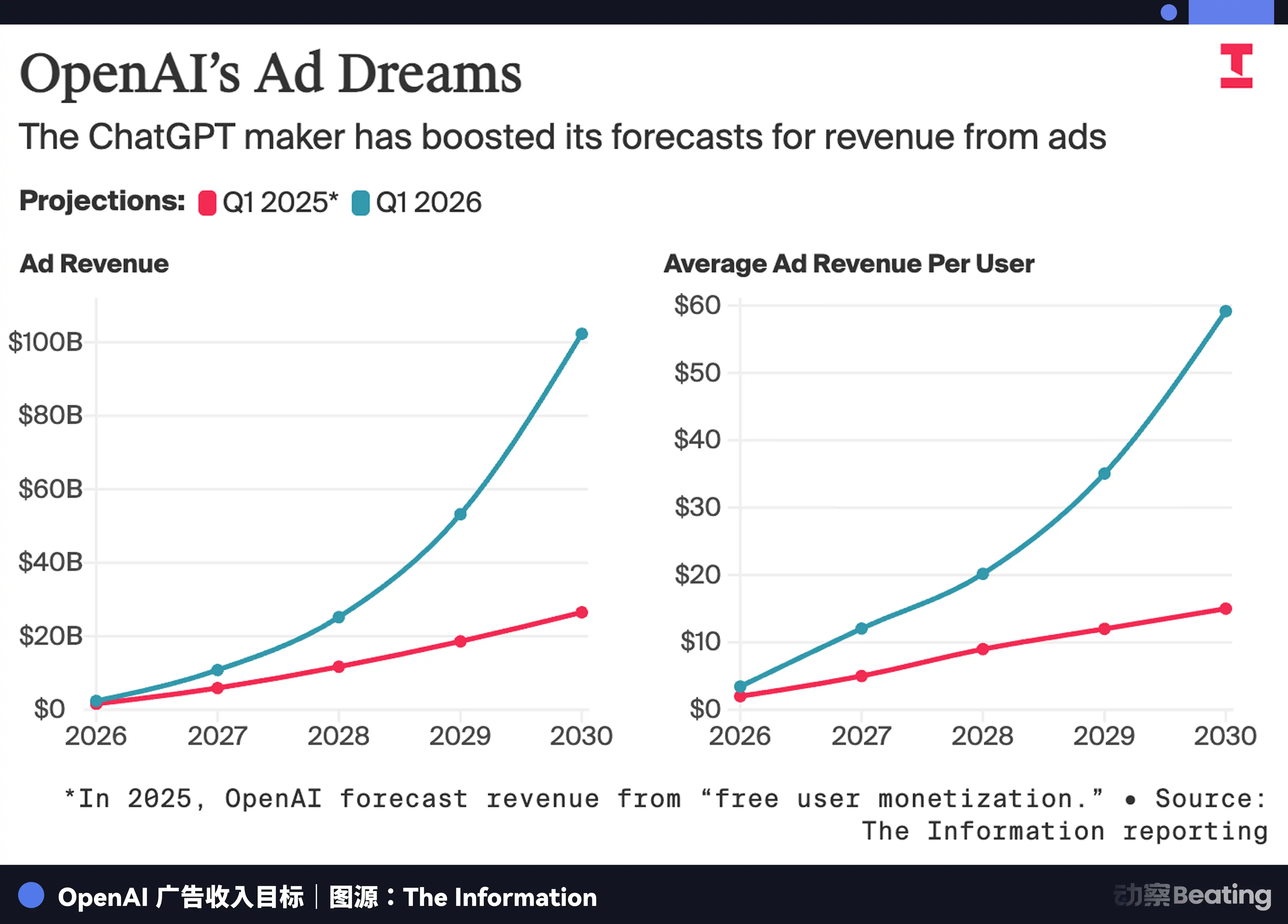
With a user base of 900 million, ChatGPT is finding the free route increasingly difficult.
Burning Billions Annually, Advertising to the Rescue
OpenAI is growing so rapidly that it's hard for traditional internet companies to find a benchmark.
But it's also burning cash quickly.
Analysts at HSBC estimated in late 2025 that OpenAI could still face a funding gap of $207 billion by 2030. Its cloud and AI infrastructure spending could reach $792 billion between the second half of 2025 and 2030, with long-term computing commitments potentially nearing $1.4 trillion by 2033.
These figures explain why they decided to venture into the advertising business.
Subscription revenue can prove users are willing to pay, but it struggles to cover the inference costs for all free users. Enterprise API contributions can generate cash flow, but face price wars and model convergence. Capital financing can sustain operations but dilutes equity and pushes higher valuation pressure back onto the company.
Advertising is the fastest non-dilutive revenue source. It doesn't require free users to pay, doesn't need to re-educate the market, and is easier to pitch to investors.
According to Reuters, OpenAI's advertising pilot generated over $100 million in annualized revenue within six weeks. Ads are only shown to free and Go plan users, don't affect ChatGPT's generated responses, and don't share user data with marketers.
Leaving user privacy aside for now, there's a more fundamental problem behind this strategy.
Ads are sold to free users, but advertisers want paying users.
ChatGPT has 900 million weekly active users, with paid subscriptions at around 50 million, meaning a free-to-paid conversion rate of less than 6%. Since ads are only shown to free users, OpenAI's entire ad inventory comes from the 94% unwilling to pay.
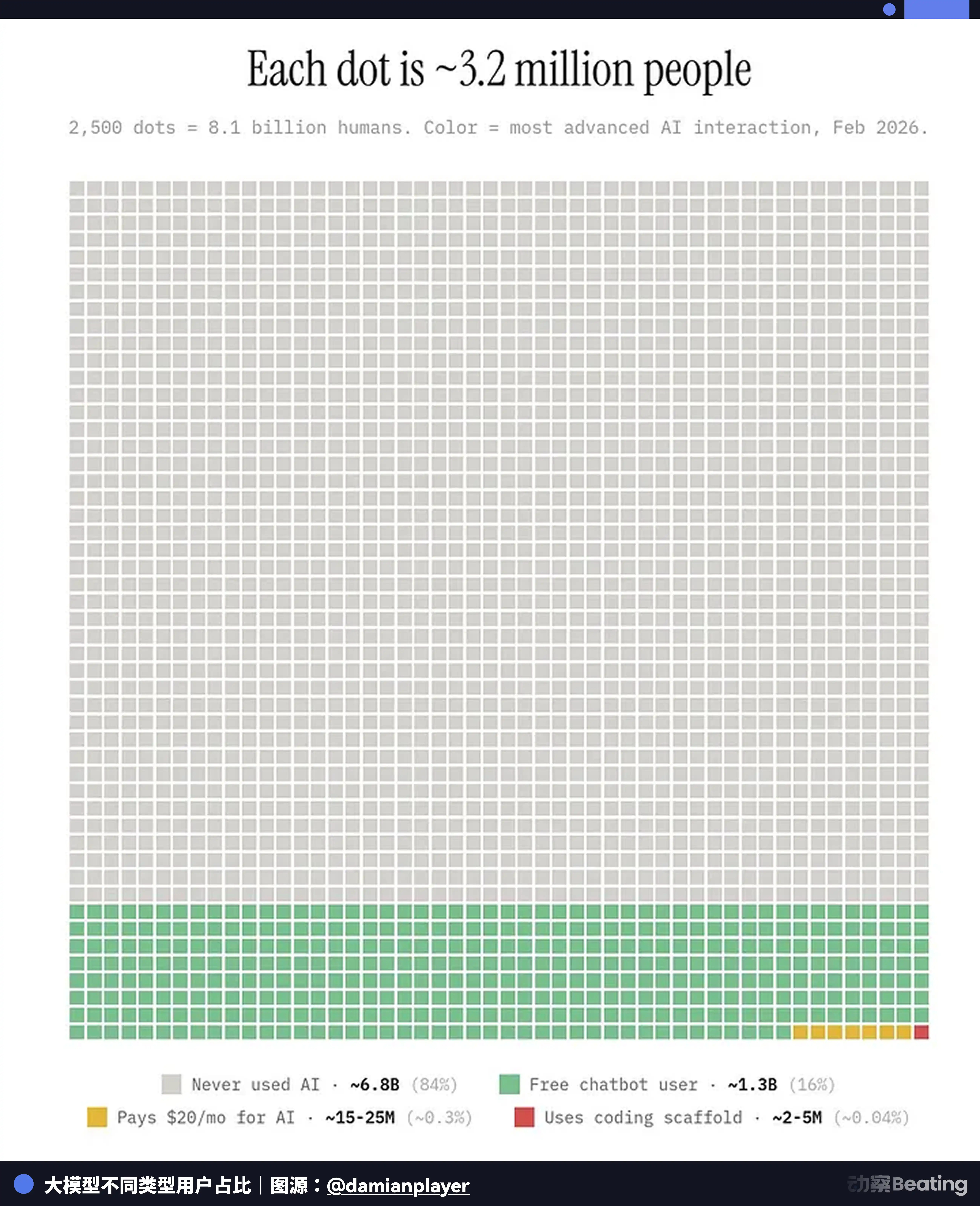
The problem is that advertisers willing to spend a minimum of $50,000 are often not selling to individual consumers. Decision-makers for high-ticket items like enterprise software, SaaS tools, and B2B services are most likely paying ChatGPT users themselves. They spend $20 to $200 monthly for better models and larger context windows, and ads never appear on their screens.
Beyond the audience mismatch, there's a deeper issue: even if ads successfully reach free users, can the usage scenarios themselves support high ad value?
High Intent Doesn't Equal High Conversion
OpenAI's advertising narrative is built on a core assumption: ChatGPT users enter the dialog with genuine intent, making ad placement in this high-intent context worth a premium.
This assumption is only half right.
For the past two decades, brands have most wanted to capture the search box because it represents intent. A user searching for hotels likely wants to book a room; searching for enterprise tax software likely indicates a procurement need; searching for the best noise-canceling headphones means the user is already at the decision-making doorstep.
Google built its advertising empire on this. With the advent of ChatGPT, users directly entrust the decision-making process to AI. This is both more enticing and more frightening for advertisers. Enticing because ChatGPT sees the entire demand context; it doesn't just know what the user wants to buy, but why. Frightening because if AI provides the answer directly, users might not even look at the search results page.
But "help me buy a pair of running shoes" and "help me write an email" are two entirely different intents. The former is a consumption scenario, the latter a productivity scenario. In ChatGPT's daily usage, the latter far outweighs the former. Users come here to write, translate, edit code, make plans, and sort out emotions – high frequency, but not naturally corresponding to purchasing goods.
This directly suppresses advertising performance metrics. Advertisers are willing to pay a premium for high-certainty purchase intent. Google search ads are expensive because users often enter the search box with clear intentions to buy, compare, book, or order. Meta ads are cheaper, but they possess social profiles and massive conversion data, allowing algorithms to repeatedly filter low-intent users into potential consumers.
ChatGPT sits in the middle. It looks more like a demand entry point than social media, but it's harder to gauge commercial intent than search. It's more private than search, but harder to attribute conversions. It can solve user problems, but not necessarily generate ad clicks.
This is also why OpenAI's move from CPM (cost per impression) to CPC (cost per click) isn't just a product upgrade; advertisers were unwilling to pay a premium based on the vision of ChatGPT as the "next-generation search entry point." They ultimately ask: who brought this click? Where does the conversion happen? How much budget should be shifted from Google, Meta, TikTok to ChatGPT?
Category compatibility is also a problem. Low-risk categories like home, travel, education, and software tools can be tested first. High-profit categories are often heavily regulated, such as finance, healthcare, insurance, and recruitment. If ChatGPT runs ads in these areas, the platform faces risks not just related to ad effectiveness, but also misinformation, discrimination, and compliance.
Google's approach serves as a mirror. In Q1 2026, Google's search advertising revenue was $77.25 billion. Yet even so, Google is very cautious about ad placements within AI Mode and AI Overviews; its standalone Gemini app has yet to formally feature ads.
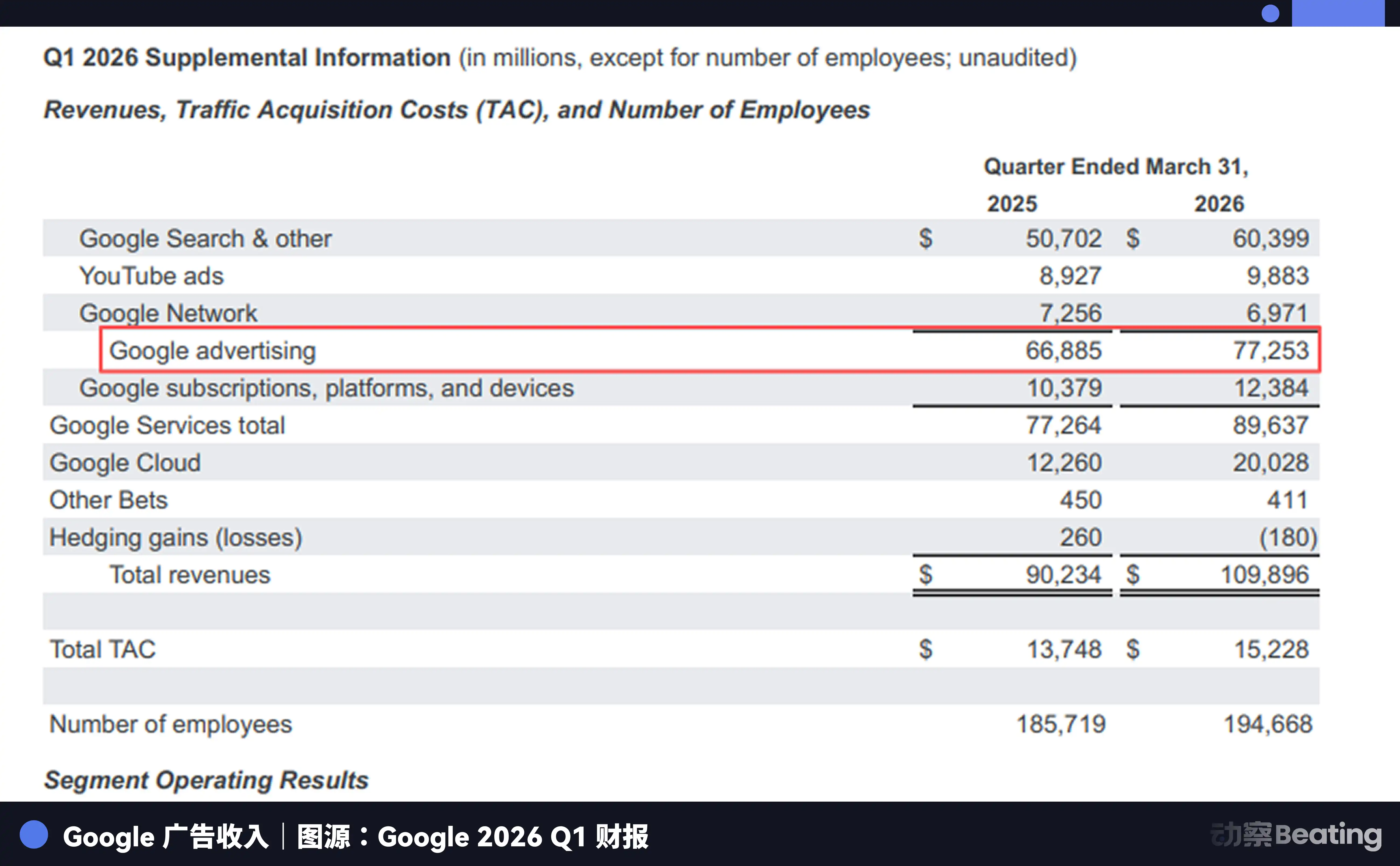
OpenAI's expansion into advertising is exploring a broader business model for the entire large model track.
OpenAI must make users feel AI is intimate enough while convincing advertisers there is sufficient commercial intent. If this balance is lost, ChatGPT could lose both sides simultaneously: users find it impure, advertisers find it incomvertible.
But the changes brought by advertising go further; it is reshaping how brands compete.
The Focus of GEO is Shifting
Over the past year, brands have been anxious about disappearing from AI answers. The market packaged this as GEO, but it's essentially not a new concept—just the old search marketing anxiety rebranded for the AI era.
OpenAI launching Ads Manager precisely taps into this anxiety, but it also shifts its direction.
In the ad-free era, the core GEO question was "how to get into the AI's context." Brands competed to be cited by models through product documentation, media reports, third-party reviews, and community discussions, relying on information quality and data structure.
With the ad platform online, targeted traffic can be directly purchased; brands no longer rely solely on organic citations. However, the competitive focus hasn't returned to the traditional "buy more impressions." Instead, it has shifted from "how to get into the AI's response" to "what does the AI say about my product."
The reason is simple: after seeing an ad, the most natural next step for a user is to ask the AI, "is this product any good?" The AI's response then becomes the true conversion gateway. Advertisers can buy impressions, but they cannot buy positive AI reviews. If the AI gives a negative evaluation based on public data, every dollar spent on ads accelerates user churn rather than driving conversion.
This means brands need to build a positive reputation within the AI's evaluation system. The quality of the product itself, the density of user reviews, and the coverage of third-party evaluations – signals the AI can read – will determine conversion effectiveness more than the ad placement itself.
GEO is moving from "entering the context" to "winning the evaluation," a trend worth watching after OpenAI launched its new advertising platform.
Not Running Ads is the Most Expensive Advertisement in 2026
Having discussed OpenAI, we must mention its arch-rival, Anthropic, which is pursuing a completely different "advertising model."
On February 4, 2026, two days before the Super Bowl, Anthropic published a blog stating that Claude will never feature ads. No sponsored links, no third-party integrations.
That statement itself was an expensive advertisement.
Super Bowl ads are not cheap. Anthropic spent heavily to tell users it doesn't sell ads, essentially using advertising to buy ad-free brand perception.
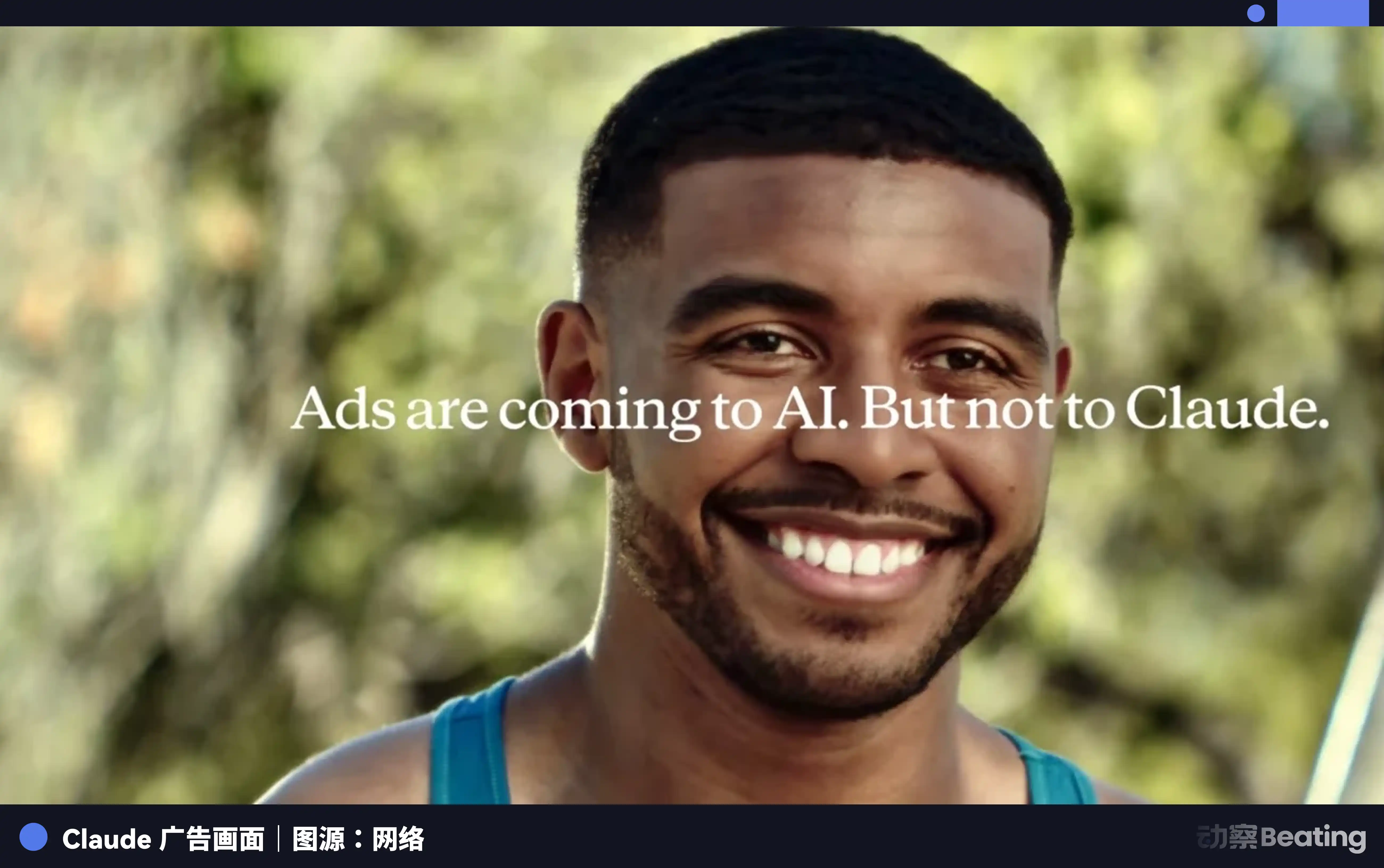
Being ad-free is never just a moral stance; it's also a business positioning. It tells enterprise clients, professional users, and users in high-sensitivity scenarios: Claude's answers won't be influenced by advertisers, Claude's product direction won't optimize around ad inventory, and Claude's revenue comes from what you pay.
The effect was immediate. Claude's ranking in the US App Store climbed from 42nd place at the beginning of the year. On February 28, following OpenAI's Pentagon contract controversy and the 'QuitGPT' movement, Claude topped the US App Store free apps chart for the first time, surpassing ChatGPT. Free active users grew by 60%, daily registrations quadrupled, and paid users doubled within a week.
Anthropic's revenue structure is completely different from OpenAI's: over 80% comes from enterprise clients, with annual recurring revenue surging from approximately $9 billion to $19 billion. Enterprise tools like Claude Code and Cowork have already contributed at least $1 billion in revenue. Anthropic doesn't need the ad value of free users; it needs the trust premium from enterprise clients that their data won't be used for advertising.
In this context, not running ads is a precise business decision – reinforcing the trust barrier for enterprise clients by forgoing ad revenue, thereby supporting higher subscription pricing.
However, "not running ads" is not a permanent virtue.
Stanford AI Index data shows that the cost to achieve performance equivalent to GPT-3.5 dropped 280 times in two years, from $20 per million tokens in November 2022 to $0.07 in October 2024. If model capabilities continue to converge and API price wars escalate, the enterprise subscription premium Anthropic enjoys today may be gradually eroded. When model costs drop to the point where all competitors offer similar performance, why would enterprise clients continue to pay more for Claude?
This question currently has no answer, but time will tell.
There's No Such Thing as a Free Lunch
OpenAI chooses advertising; Anthropic chooses to turn not running ads into a premium. They seem like opposite paths, but both answer the same question: when the inference cost of an AI product cannot be sustained by the free model in the long run, who pays?
OpenAI's Ads Manager is not just an advertising product; it's also a signal that the AI industry is moving from free expansion to cost recovery.
But OpenAI's chosen method of stemming losses actually exposes the most fragile part of this business. It needs to use the user group with the least consumption intent to support an ad pricing model three times more expensive than Meta's.
This isn't a problem solvable by user scale alone. 900 million weekly active users is an impressive number, but if those 900 million come to ChatGPT to write emails rather than buy things, advertisers will eventually vote with their feet.
Advertising can be a revenue source for AI products, but it shouldn't be treated as the only answer. Because when a product's business model requires users to stay as long as possible and expose as much intent as possible, that product is no longer the user's assistant – it's the advertiser's assistant.