






解讀Polymarket昨夜重大更新:收費擴圍、自我監管、新增激勵


- 核心觀點:預測市場平台Polymarket近期進行了一系列重大更新,核心在於透過強化合規監管、調整收費結構及推出激勵計劃,推動平台從「高風險博弈場」向強調透明度與資訊定價的基礎設施轉型,以爭取監管信任並為長遠發展鋪路。
- 關鍵要素:
- 平台更新市場完整性規則,明確禁止利用未公開資訊交易、基於非法資訊建倉及具備影響事件結果能力的主體參與交易,並配套監控與舉報機制。
- 宣布自2026年3月30日起調整手續費,新增金融、政治等多個市場類別收費,費率採用動態計算,在價格接近50%時達到峰值。
- 全面開放推薦計劃,交易額超1萬美元的用戶可獲直接推薦30%、二級推薦10%的手續費返傭,獎勵無上限且每日發放。
- 上線做市返利計劃,將部分taker手續費按日重新分配給提供流動性的做市方,返利比例因市場而異(如金融類高達50%)。
- 此次更新未涉及代幣空投,但社群回饋整體積極,用戶將推薦計劃視作長期收益渠道,做市參與意願提升,而套利交易空間則可能被壓縮。
Original | Odaily (@OdailyChina)
Author | Asher (@Asher_ 0210)
Last Saturday, Mustafa, a member of the Polymarket official team, posted on the X platform, indicating that major news would be announced on Monday.
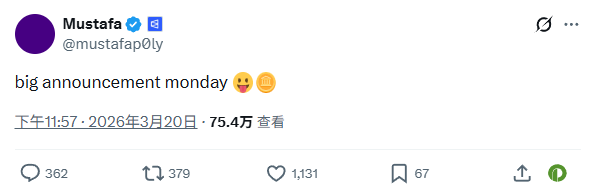
Activity from a Polymarket official team member last weekend
As expected, the official Polymarket account has released multiple significant updates since last night. Next, Odaily will break them down for you one by one.
Updating Market Integrity Rules to Combat Insider Trading and Manipulation
Last night, Polymarket announced updates to its market integrity rules for both its DeFi platform and its CFTC-regulated US exchange, further clarifying regulatory requirements regarding insider trading and market manipulation. Neal Kumar, Chief Legal Officer at Polymarket, stated: "Market prosperity relies on transparency. The refinement of these rules makes our expectations for all participants on both platforms clear and highlights our established compliance infrastructure. As Polymarket continues to grow, we will keep building on this foundation, ensuring our markets fulfill their primary purpose—revealing the truth—through clear communication with our users."
The new rules detail three categories of prohibited behavior, specifically including:
- Trading on Material Non-Public Information: Participants may not trade any contract if they possess confidential information about the outcome or potential outcome of the underlying event, and using that information would breach a pre-existing duty of trust or confidence owed to another person or entity.
- Establishing Positions Based on Illegally Sourced Information: Participants may not trade using confidential information provided to them by another person if that information was provided by someone who owed a pre-existing duty of trust or confidence to another, and the participant knows or has reason to know that the person providing the information would themselves be prohibited from trading on it.
- Trading by Entities with the Ability to Influence Event Outcomes: Participants may not trade any contract if they possess sufficient authority or influence to affect the outcome of the underlying event.
Simultaneously, the platform explicitly prohibits behaviors such as wash trading, matched orders, and price manipulation, and has launched a dedicated page to explain the rules and provide channels for reporting suspicious activity. Furthermore, Polymarket stated that its DeFi platform identifies risks through on-chain transparency mechanisms and multi-layered monitoring systems, while its US platform combines technical monitoring with collaboration with industry regulators to investigate and penalize violations.
This round of rule updates essentially redefines Polymarket's market boundaries: what information can be traded, and what behaviors are explicitly excluded. Focusing on insider information, information sources, and the ability to influence outcomes, the platform has turned previously ambiguous gray areas into clear "no-go" red lines, while also introducing supporting monitoring and reporting mechanisms to bring trading behavior into a more traceable framework.
More importantly, this points to a shift in the platform's positioning. Polymarket is moving from an external perception as a "high-risk gambling arena" towards emphasizing its role as market infrastructure for information pricing and transparency. By proactively strengthening compliance and rule articulation, it aims to gain trust from regulators and the public, laying the groundwork for broader future expansion.
The Era of "Big Fees" Arrives: Fees Applied to All Except Geopolitical Events
According to the latest official Polymarket documentation, the platform will adjust its fee mechanism starting March 30, 2026. In addition to the existing Crypto and Sports categories, several new market categories including Finance, Politics, Economics, Culture, and Weather will be brought under the taker fee structure.
The new fee rates are calculated using a dynamic formula directly related to price intervals. Overall, the new fee structure shows a "high in the middle, low at the ends" distribution: the effective fee rate peaks when prices are near a 50% probability, while it drops significantly in extreme ranges close to 0% or 100%, potentially even rounding down to 0 for very small trades.
Under the current fee system, the peak effective rate for Crypto markets is about 1.56%, and for Sports about 0.44%. In the new structure set to take effect, the differences between categories widen further. For example, Crypto peaks around 1.80%, Finance and Politics around 1.00%, and Economics can reach 1.50%. Concurrently, corresponding maker rebate percentages are set for each category, such as up to 50% for Finance, with most other categories around 25%.
The fee calculation is based on a unified formula, dynamically computed by integrating trade size, price, and different market parameters. Fees are denominated in USDC but are collected in "share form" for buy orders and deducted in USDC for sell orders.
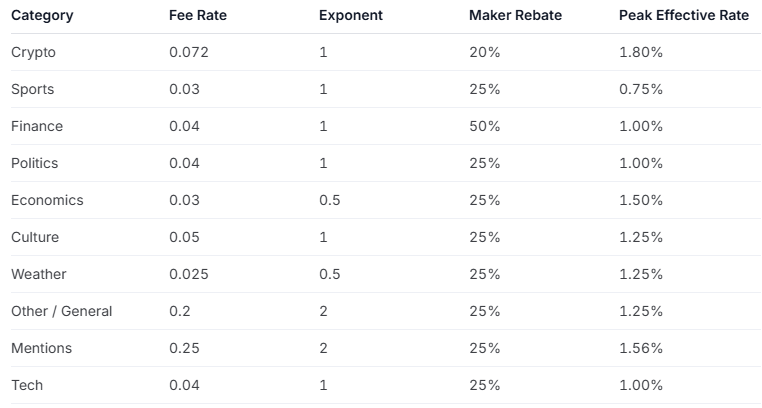
New fee standards for various markets
Not News About Funding or Token Airdrops, But Opening the Referral Program
This morning, Polymarket announced on the X platform that its referral program has expanded from internal testing to all traders with over $10,000 in trading volume. Eligible users can receive rewards proportional to the trading volume of new users they refer. The specific invitation details are as follows:
- 30% fee rebate from direct referrals, 10% fee rebate from secondary referrals (rewards will be valid for the first 180 days after a user registers with Polymarket; this period is subject to change without notice);
- Fee rebate rewards are distributed once daily (UTC);
- Rewards are uncapped; the more the referred users trade on the platform, the more earnings the referrer receives.
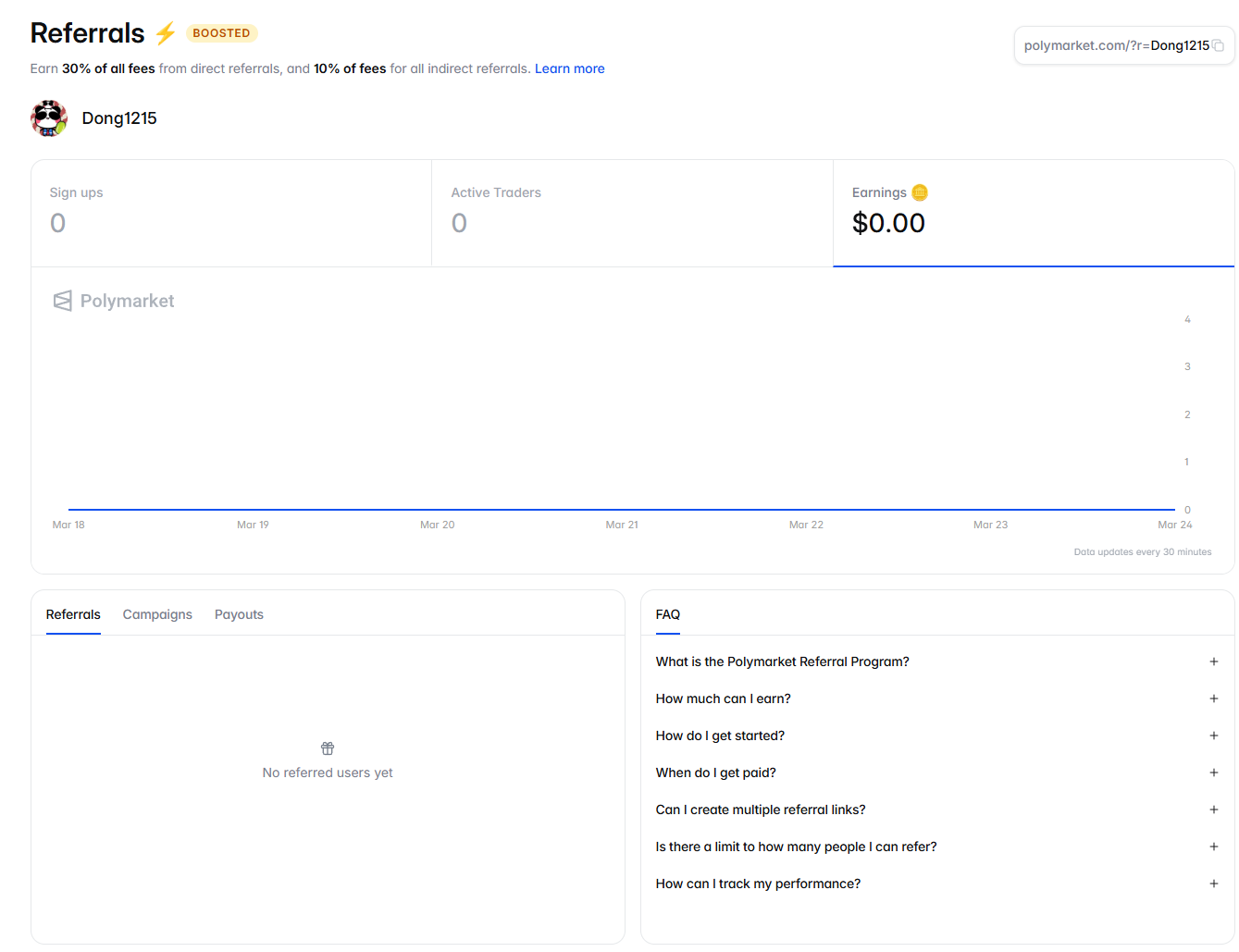
Polymarket invitation interface
Launch of Maker Rebate Program
In addition to opening the referral program, to incentivize consistent and competitive quoting and thereby provide a better trading experience for all traders, Polymarket has launched a maker rebate program. Specifically, this mechanism redistributes a portion of taker fees back to liquidity-providing makers, effectively redistributing trading costs among market participants.
Rebates are settled and distributed daily in USDC. Only successfully placed orders that are executed participate in the distribution. The overall earnings are not a fixed value but are calculated based on the proportional contribution of liquidity in actual executed trades. More executions and higher contributions lead to correspondingly higher rebates.
Regarding the distribution logic, the system calculates a "fee equivalent value" for each executed trade, aggregating trade size, price, and fee parameters for different markets. Final rebates are allocated according to each maker's contribution share. This means competition exists not only in whether a quote gets filled but also in the price range of the quote and the fee contribution it generates. Overall, these rebates come from fees paid by takers, with varying rebate percentages across markets, such as 20% for Crypto, up to 50% for Finance, and around 25% for most other categories.
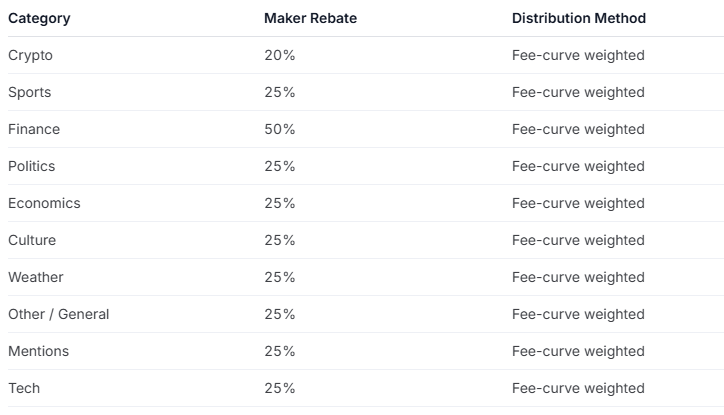
Rebate percentages for various markets
No Token Airdrop-Related Information, But Overall Community Sentiment Remains Optimistic
Although the community previously anticipated that the "major news" might point to a token or airdrop, what ultimately materialized was a combination of fee, rebate, and referral system updates. From the outcome, this set of mechanisms leans more towards long-term incentive design rather than a one-time release of expectations. However, sentiment hasn't cooled as a result; instead, with clear, actionable paths now available, the overall feedback from the trading community has been positive.
Many users have already started treating the referral program as a "de facto airdrop entry point," especially KOLs with existing traffic or community resources, who have noticeably increased their sharing efforts, with some even treating it as a long-term income stream. Following the launch of the maker rebate program, feedback from the LP side has been direct, with more people reassessing their market-making strategies and showing significantly increased willingness to participate.
In contrast, arbitrage traders and those looking for closing price opportunities have reacted more cautiously. With the arrival of the new fee rules, some previously viable arbitrage opportunities will be compressed, requiring strategies to be recalculated. Trading rhythms are consequently becoming more conservative, relying more on precise execution and cost control.
However, with both Polymarket and Kalshi now under regulatory scrutiny, their valuations in the coming period will likely be weighed down by policy uncertainties. (Related news: US lawmakers to introduce bipartisan bill to ban sports predictions on prediction markets like Polymarket)


