






Golden Age or Crisis Era? South Korea's Central Bank Set to Hike Rates, Brokerages Propose 5x Increase in Margin Requirements


- Core Viewpoint: The Bank of Korea is expected to raise interest rates for the first time since January 2023, while brokerages plan to sharply increase the investment threshold for leveraged ETFs. The government is taking a multi-pronged approach to curb the stock market overheating. The South Korean stock market, after a surge in semiconductor stocks followed by a sharp decline, is triggering a comprehensive regulatory tightening, posing a risk of liquidity squeeze.
- Key Elements:
- The Bank of Korea is expected to raise rates by 25 basis points to 2.75% this Thursday, potentially starting a tightening cycle, with year-end rates possibly reaching 3.00%.
- South Korean brokerages plan to raise the minimum margin requirement for single-stock leveraged ETFs from 10 million won to 50 million won to curb excessive leverage by retail investors.
- South Korean President Lee Jae-myung acknowledged that the stock market, after a short-term surge, needs time to stabilize and urged regulators to address the controversy surrounding leveraged ETFs.
- Foreign investors have net sold over 110 billion USD worth of South Korean assets year-to-date, while retail investors' margin debt has reached a record high of 28 trillion won.
- The Financial Supervisory Service will impose a monthly cap on stock loans for online investment finance companies to limit retail investors' leverage levels.
- Samsung Electronics and SK Hynix together account for approximately 43%-50% of the KOSPI weight, indicating the market's rally is heavily dependent on a single sector, creating structural imbalance.
Original|Odaily Planet Daily (@OdailyChina)
Author|Wenser (@wenser 2010 )
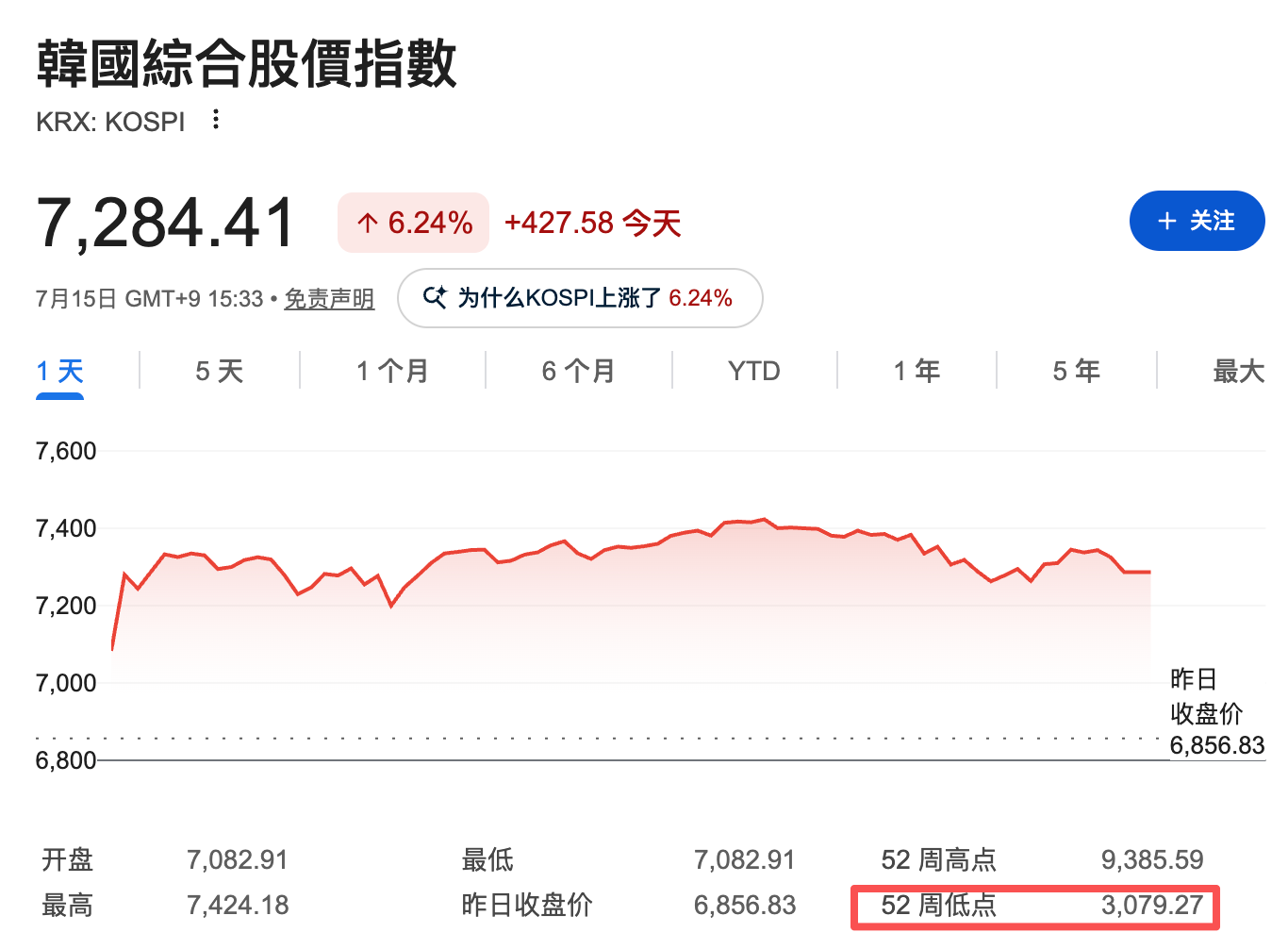
Unexpectedly, what may arrive before the KOSPI index hits a new high could be a rate hike by the Bank of Korea!
According to foreign media reports, sources have revealed that the market widely expects the Bank of Korea to raise interest rates by 25 basis points at its meeting tomorrow, lifting the benchmark rate to 2.75%; if true, this would be South Korea's first rate hike since January 2023, after a gap of about three and a half years. Some bond market experts even predict further rate hikes within the year, with the benchmark rate reaching 3.00% by year-end and climbing to 3.25% in the first half of next year.
At once, despite the KOSPI index's violent rebound today, it has still triggered a certain degree of market panic. Additionally, due to the drastic fluctuations in ETFs tracking stocks like SK Hynix and Samsung Electronics, South Korean brokerages are planning to raise the minimum margin requirement for single-stock leveraged ETF investments by 5 times.
Exactly one month ago, South Korean girls were cheering the stock market surge, declaring "the golden age of humanity has arrived"; a month later, is the South Korean market now entering an era of crisis due to liquidity tightening and increased entry barriers?
South Korea's Stock Market Faces All-Around Attention: From the President to Brokerages, from the Central Bank to Financial Regulators
The consecutive sharp rises and falls in the stock market have driven the South Korean people, often called a "nation that lives on leverage," into complete frenzy. On July 13, an incident even occurred in Busan where an "investment KOL was stabbed by an emotionally driven fan who had lost money."
Such frenzied and extreme speculative fervor has sparked widespread attention and discussion across South Korean society, from President Lee Jae-myung to Financial Investment Association Chairman Hwang Sung-yeop and CEOs of South Korea's 10 largest asset management firms; from the central bank to central financial regulators, everyone is revolving around "stocks," "securities," and "financial markets."
President Lee Jae-myung: The Stock Market Needs Time to Stabilize After a Sharp Surge
During a policy meeting with senior government officials in Seoul today, President Lee Jae-myung stated: "South Korea's domestic stock market is currently quite unstable. Given that the market has experienced an unprecedented sharp rise in a very short period, it needs time and a certain degree of volatility to stabilize."
Regarding the controversy surrounding leveraged ETFs, Lee acknowledged its existence and urged the heads of the Financial Supervisory Service and the Korea Exchange to promptly address related issues and formulate follow-up measures.
Market insiders expect regulators to intervene to curb the impact of such high-risk products on market stability, potentially including raising the minimum margin requirements for leveraged ETF investments. South Korea's main opposition party, the People Power Party, criticized the Lee administration on Tuesday for, on one hand, proposing ambitious stock market targets while, on the other hand, neglecting the accumulating leverage risks, thereby encouraging excessive risk-taking.
Previously, driven by the global AI industry chain and semiconductor boom, the South Korean government had proposed an "800 trillion won chip factory investment plan" and plans to invest at least 30 trillion won in the chip sector over the next 15 years. Just half a month later, circuit breakers were triggered on the KOSPI index, involving stocks like SK Hynix and Samsung, dimming the "semiconductor glory" that the South Korean government and the nation had once been so proud of.
However, following market logic, a sharp rise is inevitably followed by a sharp fall. The government's push for domestic industrial development and long-term construction is justified, but during this process, who bears the cost and who reaps the rewards will depend on whose performance is better.
South Korean Brokerages: Planning to Raise Minimum Margin for Single-Stock Leveraged ETFs
According to reports from The Korea Herald, South Korean brokerage industry has agreed to tighten investor protection regulations for single-stock leveraged ETFs.
On Tuesday (July 14), the Korea Financial Investment Association convened an emergency meeting with CEOs of major brokerages to assess the market situation of leveraged ETFs tracking Samsung Electronics and SK Hynix and discuss countermeasures. Participants agreed in principle to raise minimum margin requirements to curb excessive leverage use by retail investors. One proposal under discussion is to increase the minimum margin threshold from 10 million won (Note from Odaily Planet Daily: approximately $6,714) to 50 million won (Note from Odaily Planet Daily: approximately $33,570).
The institutions also agreed to provide more targeted risk warnings based on investor age and portfolio composition, and to strengthen investor education to help them better understand the structure and risks of such products. Additionally, the industry agreed to more evenly distribute rebalancing and hedging transactions across the entire trading session to reduce market impact from concentrated buying and selling near the close.
Bank of Korea: Potential 25 Basis Point Rate Hike This Thursday, Tightening Cycle Approaching
According to reports from BigGo Finance, sources from financial circles revealed that the market widely expects the Bank of Korea to raise rates by 25 basis points at its meeting this Thursday, lifting the benchmark rate from 2.50% to 2.75%. This would be the first rate hike since January 2023, after a gap of about three and a half years, and likely marks the start of a tightening cycle.
Bond market experts predict further rate hikes within the year, with the benchmark rate reaching 3.00% by year-end and rising to 3.25% in the first half of next year, meaning borrowers should prepare for at least a year of rising rates.
A central bank rate hike itself is a signal to control on-market liquidity. Because this means —
- Margin loan rates increase, making the cost of borrowing for investment rise sharply;
- The carry cost of existing leveraged funds and investments surges, potentially forcing the sale of some previously leveraged stock holdings to free up liquidity;
- Higher capital costs further transmit to the leveraged trading side, leading to a further contraction in new leveraged funds;
During the previous South Korean rate hiking cycle from August 2021 to January 2023, the KOSPI index first surged to nearly 3,000 points before falling below 2,300 points, a decline of nearly 25%. Now, over the past year, the KOSPI index's low point was around 3,080 points, but its high has surged to 9,385 points, a cumulative increase of over 204%. JPMorgan data shows the KOSPI index has outperformed global benchmarks with a 109% gain year-to-date (compared to the S&P 500's mere 11% gain over the same period).
But as mentioned earlier, the major components of single-stock leveraged ETFs—Samsung Electronics and SK Hynix—together account for approximately 43% to 50% of the KOSPI's weight. This "crazy bull run" was never a true broad-based rally, but a malnourished, false prosperity.
On the other side, retail investors are also facing mounting pressure from the central bank and leveraged assets.
Retail Investors Under Pressure: Foreign Investors Sold Over $110 Billion in Assets This Year, Retail Investors Bear the Brunt
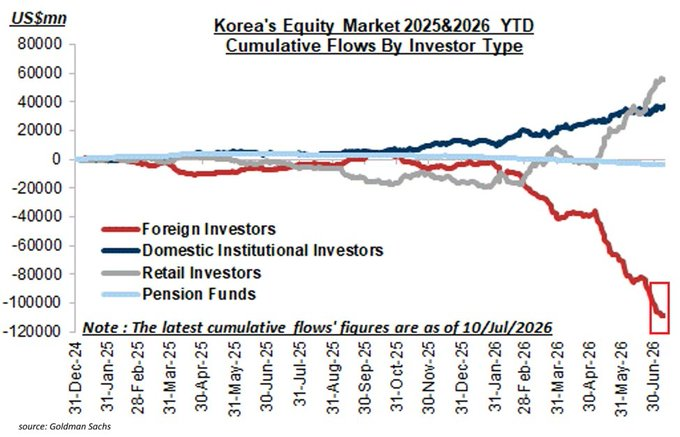
According to Goldman Sachs data, foreign investors have net sold $110 billion in assets in South Korea's financial market this year, more than five times the previous 7-year high ($22 billion in 2021); they sold $31 billion in June alone, a monthly record high.
On the other side, South Korean retail investors are accelerating their buying: after net buying 42.4 trillion won in June, they have net bought 13.2 trillion won worth of KOSPI stocks this month as of July 14. As of July 14, the balance of margin loans used by retail investors for KOSPI stocks stood at 28 trillion won, having hit a record high of 29.8 trillion won on June 24.
These retail investors, heavily reliant on margin trading and leveraged funds, are also facing risks related to capital constraints.
Data released by the Financial Services Commission and the Financial Supervisory Service shows that as of the end of June, the balance of stock loans in the online investment-related financial industry was 898.3 billion won, an increase of 374.5 billion won from the first half of the year. Compared to 351.3 billion won at the end of last year, this represents a surge of 71.5% in six months.
In response, the Financial Supervisory Service will issue management targets to online investment finance companies, requiring that the monthly new stock loan volume not exceed 30% of the previous month's new related loan volume. This new management measure will take effect immediately on August 16. Additionally, to prevent risk accumulation from an excessive concentration of stock loan business by online investment finance companies, regulators have stipulated that the stock loan limit for a single borrower should not exceed 1 billion won in principle. However, if a company can keep its end-of-month stock loan balance from July onwards within the level seen at the end of June, it may be exempted.
In summary, regulators are controlling retail investors' leverage levels from the source of funds, aiming to prevent further fueling of the stock market bubble.
In conclusion, South Korean government agencies are implementing four measures—"shutting the gate, restricting loans, raising thresholds, and cooling sentiment"—to address risks associated with the domestic stock market's sharp fluctuations, structural imbalances, and accelerating bubble.
As for whether the rate hike will sound the first whistle for a downward trend in the stock market this year, we still need to observe the market's reaction tomorrow.


