






Cách quản lý các quỹ ETF đòn bẩy đơn cổ phiếu? Hôm thứ Năm, toàn bộ thị trường đều đổ dồn sự chú ý vào cuộc họp này của chính phủ Hàn Quốc


- Quan điểm cốt lõi: Các quỹ ETF đòn bẩy đơn cổ phiếu ra mắt tại Hàn Quốc, chỉ trong vòng một tháng rưỡi, đã bị cho là làm gia tăng biến động thị trường và kích hoạt số lần cắt mạch nhiều nhất trong lịch sử, buộc tầng lớp ra quyết định kinh tế cao nhất của Hàn Quốc (F4) phải can thiệp khẩn cấp để tìm kiếm giải pháp.
- Các yếu tố chính:
- Chỉ số KOSPI của Hàn Quốc gần đây giảm mạnh, giảm hơn 8% trong một ngày, kích hoạt lần cắt mạch thứ bảy trong năm. Thị trường thường đổ lỗi cho các quỹ ETF đòn bẩy đơn cổ phiếu ra mắt vào tháng Năm.
- Sản phẩm này cho phép nhà đầu tư đặt cược gấp đôi vào các cổ phiếu đơn lẻ như Samsung Electronics. Hiệu ứng khuếch đại "tăng thì đẩy tăng, giảm thì đẩy giảm" của nó đã làm trầm trọng thêm sự lệch giá trong các đợt biến động thị trường.
- Cơ quan quản lý có ngôn từ hiếm khi nghiêm khắc. Chủ tịch Cơ quan Giám sát Tài chính (FSS) thẳng thắn bày tỏ sự "hối tiếc" vì đã không ngăn cản được việc ra mắt sản phẩm, đồng thời thừa nhận tình thế khó khăn mang tính cấu trúc khi đối mặt với việc các nhà đầu tư cá nhân mua ròng gần 10 nghìn tỷ Won và thanh lý bắt buộc khó khăn.
- Dữ liệu xác nhận tác động: Sau khi sản phẩm ra mắt, tỷ lệ số ngày KOSPI biến động hơn 3% đã tăng vọt từ 27% lên 52%; Năm nay đã kích hoạt 35 lần cơ chế "sidecar", vượt xa kỷ lục trước đó.
- Cuộc họp cấp cao "F4" sắp diễn ra để thảo luận về ba biện pháp khắc phục tiềm năng: tăng ký quỹ, giới hạn biên độ giá và điều chỉnh tỷ lệ đòn bẩy. Tuy nhiên, các quan chức thẳng thắn thừa nhận rằng các biện pháp này có thể chỉ là "vá víu tạm thời".
Original author: Long Yue
Original source: Wall Street News
A financial product that has been online for only one and a half months has already put South Korea's highest economic decision-making bodies on emergency standby.
South Korea's "F4" high-level coordination mechanism will hold a meeting this Thursday to discuss response plans regarding the impact of single-stock leveraged ETFs on the stock market. This is the first time this issue has been formally brought to the highest-level economic coordination platform involving the Ministry of Economy and Finance, the Financial Services Commission (FSC), the Bank of Korea, and the Financial Supervisory Service (FSS).
The trigger for the event is clear: KOSPI plunged over 8% in a single day this Monday, triggering its seventh circuit breaker of the year. Market blame has been directed squarely at single-stock leveraged ETFs. These products amplify the daily price movement of a single stock, causing price deviations to accelerate during periods of sharp volatility, creating an amplifying effect that "boosts gains when rising and deepens losses when falling." Single-stock leveraged products were officially launched on May 27, allowing investors to place 2x bets on the price movements of Samsung Electronics and SK Hynix. The returns of these products are linked to a multiple of the daily price change of the underlying asset. To achieve this return matching, the underlying asset must be bought or sold daily, further exacerbating market volatility.
Prior to Thursday's meeting, South Korean securities companies and asset management firms have planned to hold an industry meeting on Tuesday to discuss issues related to leveraged ETFs and overall market conditions, gathering intelligence ahead of the government meeting.
Escalating Regulatory Language: The Rare Utterance of 'Regret'
The tone of regulatory authorities has shifted from 'concern' to 'self-criticism', and they have even directly spoken of facing a structural dilemma.
On July 13, FSS Governor Lee Bok-hyun presided over a closed-door meeting at the Yeouido Financial Investment Association attended by representatives from 20 asset management companies. During the meeting, he admitted: "There are structural issues, so it is unlikely to provide a clear answer." He further stated, "Under the current circumstances, this problem cannot be solved all at once. It requires continuous monitoring, revision, and improvement." This reflects the deep-seated dilemma financial authorities face when proposing specific solutions.
Regarding the so-called 'structural issues', Lee Bok-hyun did not elaborate. External interpretations generally point to two main factors: First, individual investors have net purchased nearly 10 trillion Korean Won of the aforementioned products, making forced liquidation almost impossible. Second, these products were only launched after joint revisions of enforcement decrees by the Presidential Office (Cheong Wa Dae), the FSC, and the Korea Exchange. Forced delisting would damage the legal credibility of the relevant regulations.
He also stated: "This does not seem to be an area where one individual can make the final decision. The authorities (the FSC) may also need extensive deliberation. We (the FSS) will do our best, but currently, we are in a position to accept criticism. Asset management companies should honestly share their actual demands and suggestions at the institutional level, which will serve as important references for policy decisions."
At a regular press conference on the 22nd of last month, FSS Governor Lee Bok-hyun stated bluntly: "Regarding the launch of single-stock leveraged ETFs, I regret not having fought with all my might to prevent it." This phrasing is extremely rare within the context of South Korean financial regulation. However, the very next day after his statement, KOSPI plunged by 10%. From the 22nd of last month to the 13th of this month, KOSPI's cumulative decline exceeded 25%.
Earlier this month, he further stated that regulators were "seriously reviewing the unintended consequences that have emerged since the launch of these products."
Deputy Prime Minister and Minister of Economy and Finance, Koo Yun-cheol, also stated at a National Assembly meeting last week, "Given that various parties have raised numerous issues, we are currently in discussions regarding plans to remedy and minimize related problems."
Presidential Chief of Staff for Policy, Kim Yong-beom, clearly stated at a press conference that the F4 meeting is in-depth studying the issue of single-stock leveraged ETFs exacerbating market volatility. "If remedial measures are deemed necessary, a decision will be made at the F4 market situation review meeting."
Three Paths Pushed Forward Simultaneously: Raising Margin Requirements, Limiting Price Fluctuation Bands, Adjusting Leverage Ratio Caps
Ahead of Thursday's meeting, regulatory authorities have been concurrently advancing countermeasure research through multiple paths.
According to sources in South Korea's financial investment industry, financial authorities have formally requested asset management companies to submit specific improvement suggestions regarding the potential market volatility caused by single-stock leveraged ETFs. Authorities will gather industry opinions before initiating formal plan formulation.
Possible measures currently under market discussion include three categories: raising margin requirements, limiting daily price fluctuation ranges, and adjusting leverage ratio caps.
The FSC will convene experts from major securities companies and asset management firms on the 14th to discuss supplementary measures for single-stock leveraged products. Specific proposals include raising the minimum margin requirement (the threshold of funds investors must pre-deposit in their accounts) and strengthening pre-investment education.
However, regulatory officials also admitted that the above plans "may only be temporary patches, not a solution to the structural root causes of market volatility." This implies that even if a decision is reached at Thursday's meeting, subsequent policies may still face further adjustments.
Data Confirms the Impact: Circuit Breakers Reach a Historical Record
In terms of data, the comparison of market volatility before and after the launch of single-stock leveraged ETFs is stark. According to statistics from NH Investment & Securities, in the 96 trading days before the product launch, KOSPI's single-day change exceeding 3% occurred on 27% of days (26 days). In the 33 trading days post-launch up to the 13th, this ratio surged to 52% (17 days). In comparison, the US S&P 500 index has not seen a single-day change of 3% so far this year.
Data from the Korea Exchange shows that as of the 13th, the stock market had triggered the 'sidecar' (temporary trading halt mechanism, including 17 buy-side triggers and 18 sell-side triggers) 35 times this year. This is significantly higher than the total of only 3 times last year. Furthermore, even before the end of July, this number has already surpassed the historical record of 26 times set during the 2008 global financial crisis. The circuit breaker mechanism, which completely halts market trading, has been triggered 7 times this year, exceeding half of the total 13 triggers since its introduction in 2000.
The Wall Street Journal also noted: "Volatility in the South Korean stock market has been further amplified by leveraged products linked to Samsung Electronics and SK Hynix."
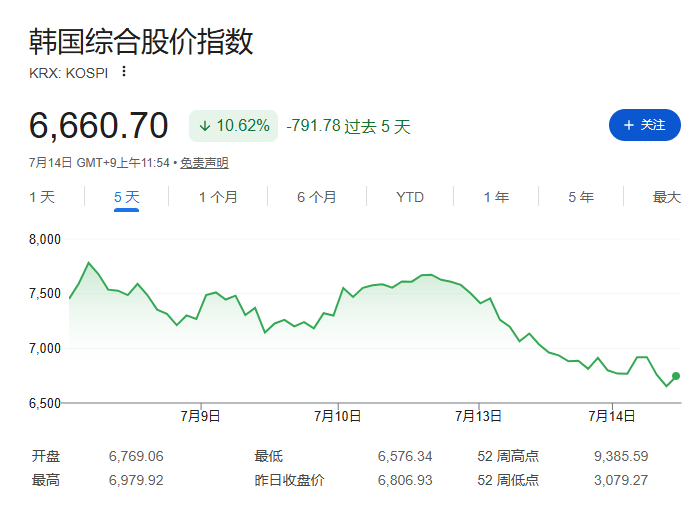
Product Launched for One and a Half Months, Already Triggering Top-Level Decision-Maker Intervention
Single-stock leveraged ETFs have been listed in South Korea for about a month and a half. Regulatory pressure has rapidly escalated from the level of the Financial Supervisory Service to the highest economic decision-making bodies.
Kim Yong-beom pointed out at the press conference, "The relevant products have been in operation for about one and a half months. The F4 will carefully assess their actual impact on the market."
Currently, market expectations for stricter limitations on this type of product are heating up—tightening leverage ratios, raising investor entry barriers, or other structural constraints are all under discussion. As the market continues to experience violent fluctuations, criticism over the rushed launch of these products in less than five months is also growing louder.
The direction of subsequent policies will depend on the evaluation conclusions of Thursday's South Korean F4 meeting.


