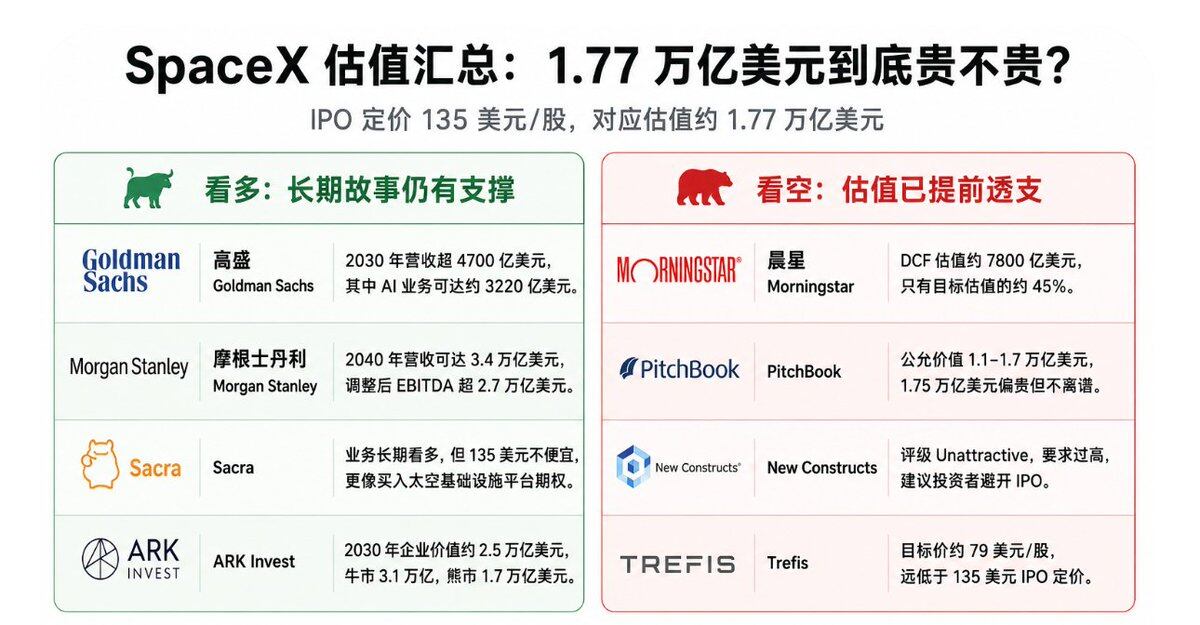
The biggest IPO in history sparks a fierce bull-bear debate: Is SpaceX worth $1.77 trillion?


- Core Viewpoint: SpaceX's IPO initial pricing is $135 per share, corresponding to a valuation of approximately $1.77 trillion. However, the market is significantly divided on this valuation. Bulls emphasize its future potential in space infrastructure and AI business, while bears believe the valuation has already been over-extrapolated.
- Key Elements:
- Bulls (such as Goldman Sachs, Morgan Stanley) project SpaceX's revenue could reach $470 billion by 2030, with the AI business contributing approximately $322 billion, supporting the valuation with a long-term narrative.
- Bears (such as Morningstar) use a DCF model to estimate SpaceX's fair value at around $780 billion, only 45% of the IPO valuation, arguing the price is clearly too high.
- Independent research firm New Constructs points out that to justify a $1.75 trillion valuation, SpaceX would need to grow revenue by an average of 50% annually over the next decade to reach $1.1 trillion by 2035, a feat with no historical precedent.
- Trefis gives SpaceX a target stock price of around $79 per share, significantly lower than the $135 IPO price, arguing that investors should not ignore price risk.
- Despite the massive controversy, the IPO subscription multiple for $SPCX has already reached 4x, indicating that market capital's enthusiasm for SpaceX remains high.
Original Author: Biteye
Currently, SpaceX's IPO price has been preliminarily set at $135 per share, with a planned fundraising scale of approximately $75 billion, corresponding to a fully diluted valuation of about $1.77 trillion. This has basically secured its position as the largest IPO in the history of capital markets.
If this scale is ultimately realized, Musk's net worth will also skyrocket by over $220 billion, propelling him towards becoming the world's first trillionaire.
However, great power comes with great responsibility. The reason SpaceX's IPO attracts so much attention is not just that it could be the largest IPO ever, but also because the capital market is already fiercely debating its valuation.
Is SpaceX really worth $1.77 trillion? Looking at the extra $220 billion in his wallet, can Musk sleep soundly?
🌟Bullish: Underwriters Use Starlink + Rocket Launch + AI to Tell a Long-Term Story
The bullish camp believes that betting on SpaceX isn't just about betting on a rocket company, but about getting ahead in securing a foothold in the future space infrastructure landscape.
A $1.77 trillion valuation may seem high, but if Starlink, low-cost launches, and AI businesses continue to deliver, $135 can be supported by a compelling long-term narrative.
Goldman Sachs @GoldmanSachs
X Followers: 1.132 million | XHunt Rank: 12015 | Global top-tier investment bank, one of the core underwriters for the SpaceX IPO.
Core View: SpaceX's valuation should not be understood simply by comparing it to traditional aerospace companies. Instead, Starlink and future AI businesses must be incorporated into a long-term growth model.
Goldman Sachs projects SpaceX's revenue to be around $160 billion in 2028, exceeding $470 billion by 2030.
Among these projections, the AI division is considered the most aggressive part. Goldman Sachs estimates that SpaceX's AI-related businesses could generate approximately $322 billion in revenue by 2030.
Morgan Stanley @MorganStanley
X Followers: 742,000 | XHunt Rank: 32049 | Global top-tier investment bank, one of the core underwriters for the SpaceX IPO.
Core View: SpaceX's long-term value comes from the compound growth of "Space + AI", with a future revenue ceiling far higher than that of traditional aerospace companies.
Morgan Stanley also projects SpaceX's revenue to be around $160 billion in 2028.
More aggressive is the long-term forecast: By 2040, Morgan Stanley expects SpaceX's revenue could reach $3.4 trillion, with an adjusted EBITDA exceeding $2.7 trillion.
If you are buying into the gateway to future space infrastructure over the next decade or more, $135 is undervalued, but it will take a long time to materialize.
Sacra
An independent research firm focused on private technology companies, mainly conducting in-depth company analysis and valuation breakdowns.
Core View: Bullish on the business long-term, but $135 is not a low price. It's more like buying an option on SpaceX's transformation from an aerospace company into a space infrastructure platform.
Sacra estimates SpaceX's 2025 revenue at around $18.7 billion, with Starlink contributing $11.4 billion, making it the company's most important profit center.
It believes SpaceX's core advantage lies in vertical integration: building its own rockets, launching them, deploying its own satellites, and controlling its own terminals and ground networks. This creates a cost advantage that is difficult for competitors to replicate.
If you only look at the current Starlink and rocket launch businesses, $135 is not cheap. If you believe SpaceX can further expand from an aerospace company into a comprehensive platform covering satellite internet, low-cost launches, and more space infrastructure, this price becomes more palatable.
ARK Invest @ARKInvest
X Followers: 816,000 | XHunt Rank: 1637 | Cathie Wood's innovation-focused tech investment firm, with a long-term focus on disruptive technology assets.
Core View: While SpaceX's $1.77 trillion valuation is very high, it is not entirely unsupported when looking at the long-term potential towards 2030.
ARK Invest's open-source SpaceX valuation model suggests an expected enterprise value for SpaceX of around $2.5 trillion by 2030. According to its model, the bull case scenario is about $3.1 trillion, and the bear case scenario is about $1.7 trillion.
ARK's core logic is that SpaceX's value comes not just from rocket launches, but from Starlink's global satellite internet network, low-cost launch capabilities, and future space infrastructure businesses.
Based on ARK's predictions, the IPO price of $135 still has some upside potential.
🌟Bearish: Independent Institutions Believe the IPO Valuation is Already Too Stretched
The bearish camp does not deny that SpaceX is the world's most scarce commercial aerospace asset, nor does it deny Starlink's long-term value.
However, they believe that the $1.77 trillion IPO valuation has already priced in too much future growth, especially considering the significant uncertainty surrounding the AI business.
Morningstar @MorningstarInc
X Followers: 238,000 | XHunt Rank: 98209 | Globally renowned independent investment research firm, often using fundamental and DCF models to assess company value.
Core View: SpaceX is a good company, but the IPO valuation is clearly too high.
Using a DCF model, Morningstar estimates SpaceX's fair value to be approximately $780 billion, only about 45% of the IPO target valuation of $1.77 trillion.
In Morningstar's sum-of-the-parts valuation, SpaceX's core launch business plus Starlink is valued at about $611 billion, and the probability-weighted value of xAI/AI-related businesses is about $170 billion.
Morningstar also highlights two risks: Musk is a key person for SpaceX, and there is a noticeable 'Musk premium' in the company's valuation. After the IPO, as lock-up periods expire, early shareholders and employees could create selling pressure.
Morningstar believes the $135 price is clearly expensive and not suitable for chasing immediately. There might be better entry points after the IPO.
PitchBook @PitchBook
X Followers: 48,000 | XHunt Rank: 49174 | Global data platform for private equity, venture capital, and private companies, covering extensive valuation and funding information for private firms.
Core View: A valuation around $1.5 trillion is acceptable. $1.75 trillion is expensive, but not entirely irrational.
Using a Sum-of-the-Parts model, PitchBook estimates SpaceX's fair value range to be between approximately $1.1 trillion and $1.7 trillion, focusing mainly on the launch business and Starlink, without fully relying on the xAI narrative.
The $135 price is near or slightly above the upper end of PitchBook's valuation range, so it's not cheap. However, if Starship and Starlink deliver on their long-term promises, it cannot be considered completely unreasonable.
New Constructs @NewConstructs
X Followers: 5,675 | XHunt Rank: - | Independent stock research firm focusing on financial quality, valuation risks, and reverse DCF analysis.
Core View: SpaceX is not worth participating in at a $1.75 trillion valuation. It advises investors to avoid the IPO.
New Constructs gives SpaceX an Unattractive rating. They believe the growth and profit expectations implied by the $1.75 trillion valuation are too high. SpaceX would have to become one of the highest revenue and profit companies in the US stock market simultaneously to justify this price.
Concerns include: Inadequate internal accounting controls at SpaceX, little to no voting rights for public investors, potential use of IPO proceeds for debt repayment, potentially misleading non-GAAP metrics, and related-party transaction risks.
To support a $1.75 trillion valuation, SpaceX's revenue might need to reach $1.1 trillion by 2035, implying an average annual growth rate of roughly 50% over the next decade. Fortune considers this growth rate historically unprecedented.
New Constructs' judgment is the most direct: the risk-reward at this price is unattractive, and they do not recommend participating in the IPO.
Trefis @Trefis
X Followers: 2,661 | XHunt Rank: - | Independent US stock valuation platform, deriving target prices through disaggregated business models.
Core View: SpaceX is a very unique company, but the $135 offer price is clearly too expensive.
Trefis acknowledges SpaceX's long-term advantages in commercial aerospace, Starlink satellite internet, and low-cost launches, but believes these advantages don't mean investors should ignore the price.
Trefis gives SpaceX a target price of approximately $79 per share, significantly lower than the $135 IPO price.
🌟Final Thoughts
Whether bullish or bearish, most parties basically acknowledge that SpaceX is one of the world's most unique commercial aerospace companies.
The real debate revolves around the $135 price: does it offer a sufficient margin of safety?
📈 The bullish camp believes that buying SpaceX means buying into the long-term story of Starlink, low-cost launches, AI, and future space infrastructure.
📉 The bearish camp believes that $135 has already priced in expectations fully.
Currently, the subscription multiple for the $SPCX IPO has reached 4x, indicating that despite the valuation controversy, capital enthusiasm for SpaceX remains very high.
🙋 So, the question is, will you participate in the $SPCX IPO subscription? Do you think Musk will take that $220 billion gain in stride, or will it keep him up at night?