






黄仁勋、Marvell CEO同台对谈:未来AI拼的不是算力是「连接」


- Quan điểm cốt lõi: Khi AI bước vào kỷ nguyên tác nhân, các nút thắt về sức mạnh tính toán và bộ nhớ trong trung tâm dữ liệu đã được phá vỡ. Chiến trường quyết định tiếp theo chuyển sang nhu cầu "kết nối", điều này đang thúc đẩy sự bùng nổ của cơ sở hạ tầng truyền thông quang học, và Marvell cùng các nhà cung cấp cốt lõi khác sẽ được hưởng lợi từ đó.
- Các yếu tố chính:
- CEO Jensen Huang của Nvidia dự đoán Marvell sẽ trở thành "công ty nghìn tỷ đô la tiếp theo" và đã đầu tư chiến lược 2 tỷ đô la vào họ, nhấn mạnh vị thế chiến lược của họ trong việc kết nối trung tâm dữ liệu AI.
- Tỷ trọng doanh thu mảng trung tâm dữ liệu của Marvell đã tăng từ dưới 10% một thập kỷ trước lên hơn 75%, và đang tăng tốc với tốc độ tăng trưởng 40% mỗi năm. Thị trường dự đoán doanh thu năm tới của họ có thể đạt 16,4 tỷ đô la.
- Sự đồng thuận cốt lõi là: Các nút thắt trong cơ sở hạ tầng AI đã lần lượt chuyển từ sức mạnh tính toán sang bộ nhớ và giờ là kết nối, khiến các nhà cung cấp dịch vụ đám mây hàng đầu phải lên kế hoạch lại kiến trúc mạng.
- Jensen Huang đề xuất chiến lược "dùng đồng khi có thể, dùng quang khi cần" và dự đoán trong 5-10 năm tới, cáp đồng và linh kiện quang sẽ cùng tồn tại, trong khi Marvell cung cấp giải pháp hoàn chỉnh cho cả hai lĩnh vực.
- Giới hạn vật lý thúc đẩy nhu cầu truyền thông quang học: Khi tốc độ một kênh tăng lên 400Gbps, cáp đồng sẽ không thể kết nối toàn bộ một kệ thiết bị, khiến nhu cầu truyền thông quang học tăng lên theo cấp số nhân.
- Marvell đang đặt cược lớn vào công nghệ CPO (Quang học đóng gói chung), đã ra mắt switch 51.2T dựa trên CPO, nhằm loại bỏ các đường dây đồng và phá vỡ ranh giới vật lý của trung tâm dữ liệu.
- Nvidia và Marvell hợp tác ra mắt NV Link Fusion, nhằm tích hợp nền tảng công nghệ của Nvidia với các giải pháp của Marvell, xây dựng các trung tâm dữ liệu AI tùy chỉnh, phân tách và không đồng nhất.
Original author: Dong Jing, Wall Street News
As AI models move towards the era of massive "Agents," the computing bottleneck in data centers is shifting towards "connectivity," triggering a comprehensive revolution in the underlying infrastructure from copper cables to fiber optics.
On the second day of the Computex conference in Taipei, Matt Murphy, Chairman and CEO of Marvell, a leader in AI custom chips, optical communications, and data center interconnectivity, delivered a keynote speech.
NVIDIA CEO Jensen Huang made a surprise appearance as a special guest. The two leaders, at the pinnacle of AI computing power and network connectivity, shared the stage, highlighting the deep strategic binding between the two companies. This joint appearance quickly became the most notable moment of the entire event so far.
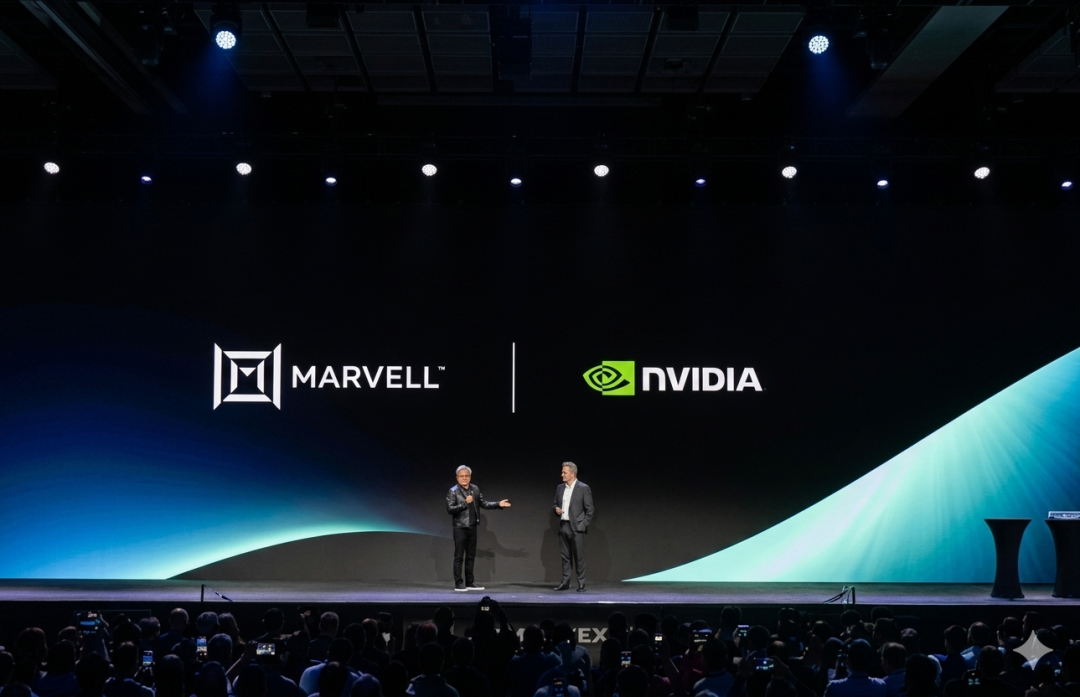
(Marvell CEO Matt Murphy and Jensen Huang in a joint discussion at Computex)
Jensen Huang set the tone with one sentence: "Ladies and gentlemen, the next trillion-dollar company" — referring to Marvell.
The audience erupted in applause. According to a Wall Street News article, this was the latest testament to the deep bond formed by NVIDIA's strategic investment of $2 billion in Marvell, announced several months prior, and their ongoing collaboration in the AI data center infrastructure sector.
Following the release of the previous quarter's earnings, the market is highly focused on how Marvell benefits from the AI supercomputing cycle.
In response, Murphy presented impressive results: a decade ago, Marvell's data center revenue accounted for less than 10% of its total. Last quarter, this figure exceeded 75% and is accelerating at roughly 40% annually.
Based on the latest earnings guidance, Wall Street generally expects its revenue to reach a staggering $16.4 billion next year.
Behind this rapid growth, Jensen Huang and Murphy's discussion revealed the core investment theme in AI infrastructure: after breakthroughs in computing and memory, "connectivity" will define the system's ultimate performance. The central consensus of the two CEOs is:
The next decisive battleground for AI infrastructure is not computing or memory, but connectivity. Marvell is at the heart of this revolution.
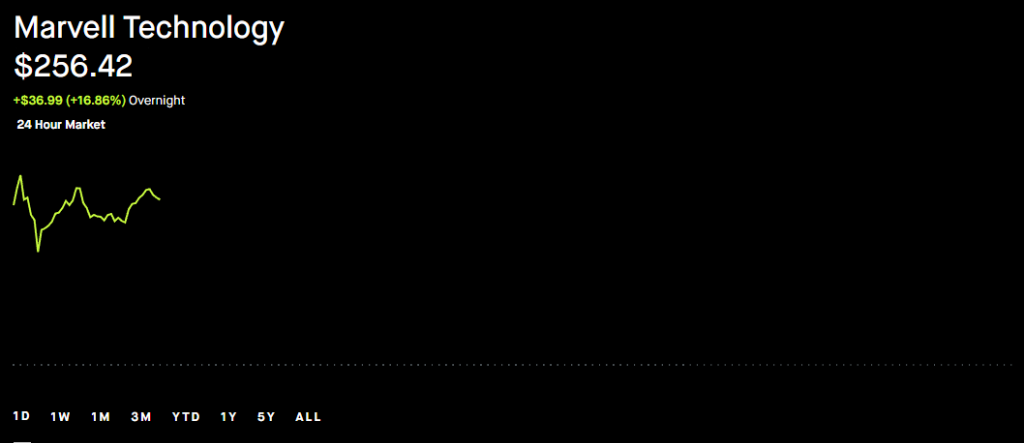
Notably, Marvell's stock surged over 16% in after-hours trading.
The End of Computing is Connectivity: AI Enters the 'Useful Phase', Triggering Infrastructure Interconnect Demand
Why has connectivity become so crucial today?
In his speech, Murphy explained why "connectivity" is currently the most critical constraint using a clear logical chain:
The bottlenecks in AI infrastructure appear sequentially and are broken through one by one — Computing (led by NVIDIA, the first company to reach a $5 trillion market cap) → Memory (recently seeing three new trillion-dollar companies emerge) → Connectivity (currently unfolding).
"The world's top hyperscalers are fundamentally rethinking their entire network architectures, recognizing that scaling AI infrastructure has become the primary connectivity challenge," Murphy said. "This isn't just my opinion; it's feedback we get from our largest customers."
Jensen Huang offered the most straightforward business logic during their talk:
"Useful AI is here. It can generate profits now, and tokens can be profitable.
When token production is profitable, everyone wants to produce more tokens. That's why there's such strong demand for Marvell, and why there's such strong demand for us."
Huang noted that AI is moving towards an "Agent" model, a new computing paradigm that requires breaking down tasks and distributing them across massive computing clusters. "When you decompose a computing problem into multiple parts and distribute them across an entire data center, connectivity becomes absolutely indispensable."
Huang was generous with his praise for the partner, even stating on stage: "Ladies and gentlemen, (Marvell) this is the next trillion-dollar company."
Murphy stated that a single processor can no longer handle AI workloads; the future requires millions of processors working in concert.
"Scaling computing is fundamentally a connectivity challenge. The industry has largely solved the computing bottleneck, is working on the memory bottleneck, and the next bottleneck limiting infrastructure limits is connectivity."
'Use Copper Where You Can, Optics Where You Must'
The most market-relevant part of the dialogue between Murphy and Huang was their assessment of the timeline for the transition from copper cables to fiber optics.
Huang's strategic framework was direct: "Use copper wherever you can, use optics wherever you must."
He explained that copper has physical limits in bandwidth and transmission distance. Within these limits, copper is a simple, low-cost, and practical choice. Once the critical point is crossed, fiber optics take over to handle inter-rack, inter-data center, and cross-data center scaling needs.
His core conclusion was:
"Over the next 5 to 10 years, we will still use a lot of copper, but we will also use massive amounts of optical components. These data centers are already part of the infrastructure."
This assessment of "coexistence of copper and optics, each with its own limits" means Marvell is in a position to benefit continuously regardless of whether the market leans towards copper or fiber — and Marvell is one of the few companies capable of providing complete solutions in both domains.
The timeline for the copper-to-optics shift is driven by unavoidable physical laws. Murphy explained: The transmission distance of copper is inversely proportional to bandwidth; doubling the bandwidth halves the transmission distance.
Current fastest mass-produced systems operate at single-channel speeds of 200 Gbps, supporting copper lengths of approximately 2.5 meters. A server rack is about 2 meters tall, and considering internal cabling, 2.5 meters is already near the limit.
"When we upgrade to 400 Gbps, copper will be unable to fully connect an entire rack. The 'Copper Wall' is moving, and it has already begun." Each time the copper wall shifts rightwards, the number of connections increases by at least an order of magnitude, directly triggering demand for optical communications.
To address this physical limit, Marvell is heavily investing in CPO (Co-Packaged Optics) technology, integrating optics directly into the package adjacent to the compute chips to solve density and power consumption challenges.
On the day of the event, Marvell officially launched a new 100T Ethernet switch designed for AI data centers, touted as having the industry's lowest power consumption, and demonstrated a 51.2T switch based on CPO, eliminating copper traces entirely at the board level.
"This isn't some futuristic concept; it's being deployed right now," Murphy stated. Once optical interconnects completely remove the limitations of distance, future data centers will no longer have rigid physical boundaries for compute and memory, allowing infrastructure to be dynamically combined on a large scale according to AI model requirements.
NVLink Fusion Builds a Heterogeneous Ecosystem: Marvell to be the 'Switzerland' of the AI Era
To address the extremely complex network architecture demands, NVIDIA previously made a strategic $2 billion investment in Marvell. Their collaboration is expanding into multiple dimensions, including optical communications, silicon photonics, and NVLink Fusion.
NVLink Fusion emerged to solve the customization pain points for Cloud Service Providers (CSPs). Jensen Huang explained that while cloud providers design their own custom ASICs, they still desire access to NVIDIA's system architecture.
"You don't have to buy everything from us; you can just buy a part. By fusing NVIDIA's technology platform with Marvell's solutions, we can essentially build a decoupled, distributed, and heterogeneous data center."
In this ecosystem, Marvell finds its irreplaceable niche.
Murphy emphasized Marvell's neutral and critical position:
"We work deeply with computing companies, and we also work deeply with storage companies. In many ways, we act as the 'Switzerland' of the industry, collaborating with all players."


