






Solana và Hyperliquid, những người bảo vệ trung thành nhất của mỗi bên, bắt đầu mắng chửi nhau


- Quan điểm cốt lõi: Cuộc tranh luận giữa Kyle Samani và các thành viên cộng đồng như Arthur Hayes xoay quanh chủ đề "HYPE vs SOL" đã bùng nổ. Tranh cãi cốt lõi nằm ở việc các dự án tiền mã hóa nên ưu tiên theo đuổi phi tập trung hóa hay tăng trưởng sản phẩm. Sự trỗi dậy của Hyperliquid đang thách thức vị thế của Solana trong câu chuyện "thị trường vốn Internet".
- Các yếu tố chính:
- Samani chỉ trích Hyperliquid có tính tập trung hóa cao, tiềm ẩn rủi ro pháp lý, gọi bản chất của nó là "Binance 2.0" không có đội ngũ tiếp thị, và cáo buộc nó có thể phải đối mặt với các cáo buộc tương tự như Bộ Tư pháp Mỹ.
- Các thành viên cộng đồng như Hayes đã phản ứng mạnh mẽ. Hayes trực tiếp đánh cược rằng HYPE sẽ vượt trội hơn 10 loại tiền mã hóa hàng đầu khác trong bảy tháng còn lại, và đề xuất tổ chức một cuộc thi sáng tạo nhắm vào Samani với giải thưởng 100 HYPE.
- Logic cốt lõi của Solana là xây dựng cơ sở hạ tầng tài chính hiệu quả trên chuỗi để thu hút thanh khoản tự nhiên hội tụ; trong khi Hyperliquid tiếp cận trực tiếp từ nhu cầu cốt lõi, tạo ra một vòng xoáy tích cực thông qua hợp đồng vĩnh viễn (nhiều nhà giao dịch hơn → nhiều phí hơn → mua lại HYPE → giá tăng → nhiều vốn hơn).
- Khả năng tạo dòng tiền của Hyperliquid đã vượt qua các hệ sinh thái blockchain bao gồm cả Solana. Nó đang dần mở rộng từ hợp đồng vĩnh viễn sang giao ngay, thị trường dự đoán, v.v., phù hợp hơn với câu chuyện "thị trường vốn Internet" và chiếm lĩnh không gian câu chuyện thị trường của Solana.
- Cách tấn công của Samani (đặt câu hỏi về phi tập trung hóa, rủi ro pháp lý) rất giống với cách phe Ethereum từng chỉ trích Solana trong quá khứ, cho thấy sự "hai mặt" trong lập trường: Khi Solana trỗi dậy, ông ta nhấn mạnh hiệu quả là ưu tiên, nhưng nay lại dùng phi tập trung hóa để đặt câu hỏi về Hyperliquid.
Original | Odaily Planet Daily (@OdailyChina)
Author | Azuma (@azuma_eth)

As HYPE continues to hit new highs, a heated debate has erupted on X around the topic of "HYPE vs SOL."
At the center of this war of words is Kyle Samani, former co-founder and managing partner of Multicoin Capital and a flagship figure in the Solana community (see "The Man Who Called SOL's Rise Best Exits the Crypto World"). Surrounding him in the attack are devoted "disciples" of Hyperliquid, led by BitMEX co-founder Arthur Hayes.
The War of Words Between S Guards and H Guards
Over the past weekend, Samani posted extensively on X, launching a high-intensity offensive against Hyperliquid, criticizing the project for being highly centralized in nature and having serious regulatory issues.
At 6:30 on May 30, Samani wrote: "Hyperliquid is essentially just a Binance 2.0 without a marketing team (poor Binance catching strays...). It has made thousands of technical decisions in its architecture that only work in a centralized environment but are completely unsuitable for a permissionless, decentralized one. Now, they are far behind on this path. Moreover, no real US company will collaborate with them in the future."
At 10:53 on May 31, Samani further stated: "Hyperliquid is just as suspect as Binance (again catching strays...). All the allegations the US Department of Justice made against Binance apply to Hyperliquid, and the evidence for every crime is documented. Claims of 'communicating with regulators' are pure nonsense; Binance has also been talking to regulators for years..."
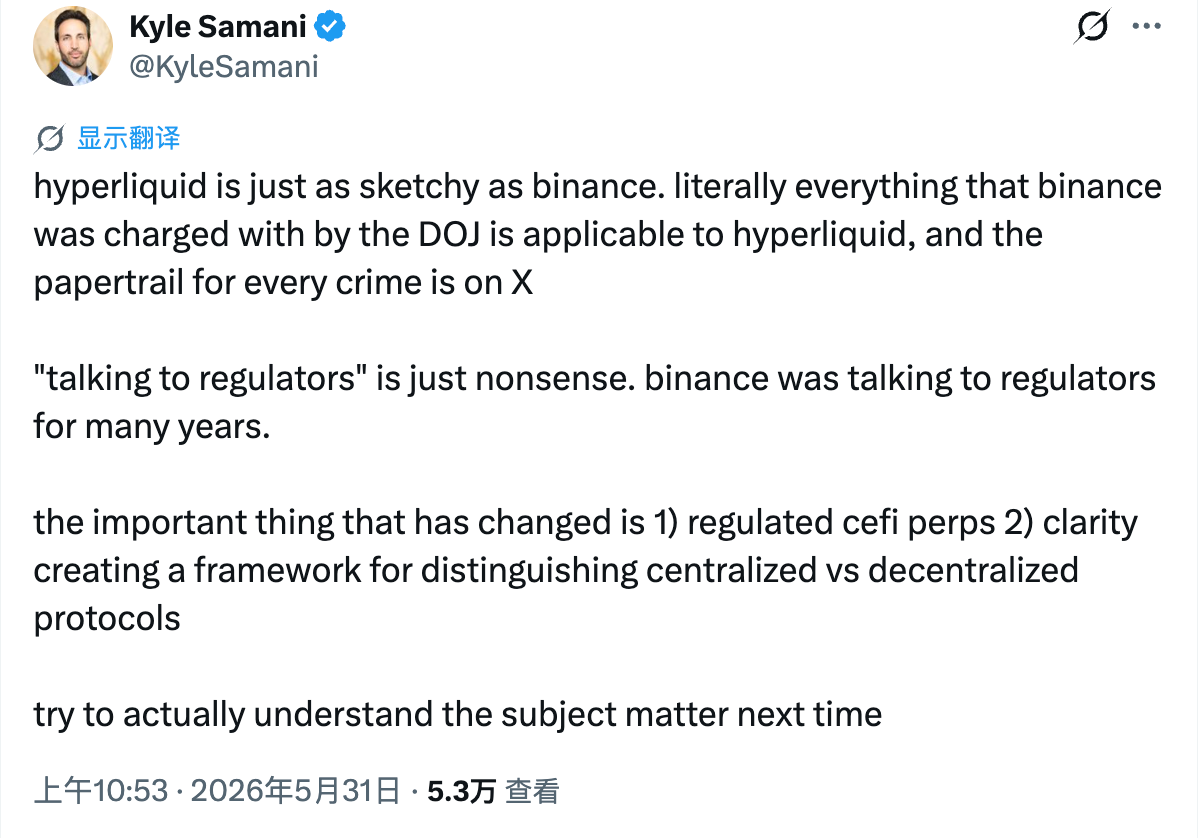
While attacking Hyperliquid, Samani did not forget to kick his old rival ETH, calling it "reputationally neutral but technically flawed," in other words, "completely useless"...
Finally, when asked by renowned Bitcoin developer Udi Wertheimer about "which token in your mind counts as a success story," Samani gave the unsurprising answer — Solana.
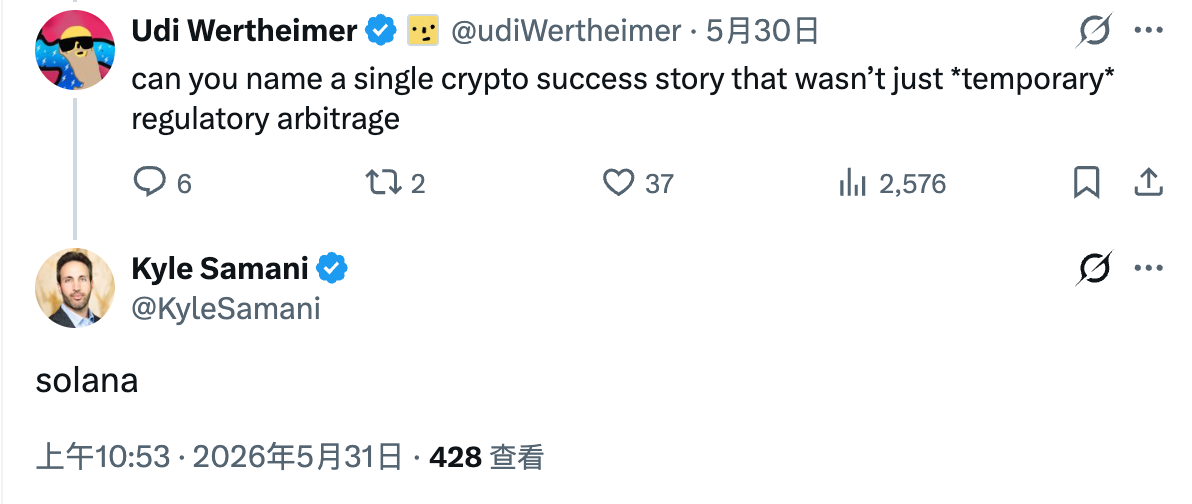
Unsurprisingly, Samani's remarks drew fierce backlash from the community, especially amid HYPE's strong performance. Investors like Hayes, developers like Wertheimer, and traders like Ansem all responded to Samani's views with varying degrees of force.
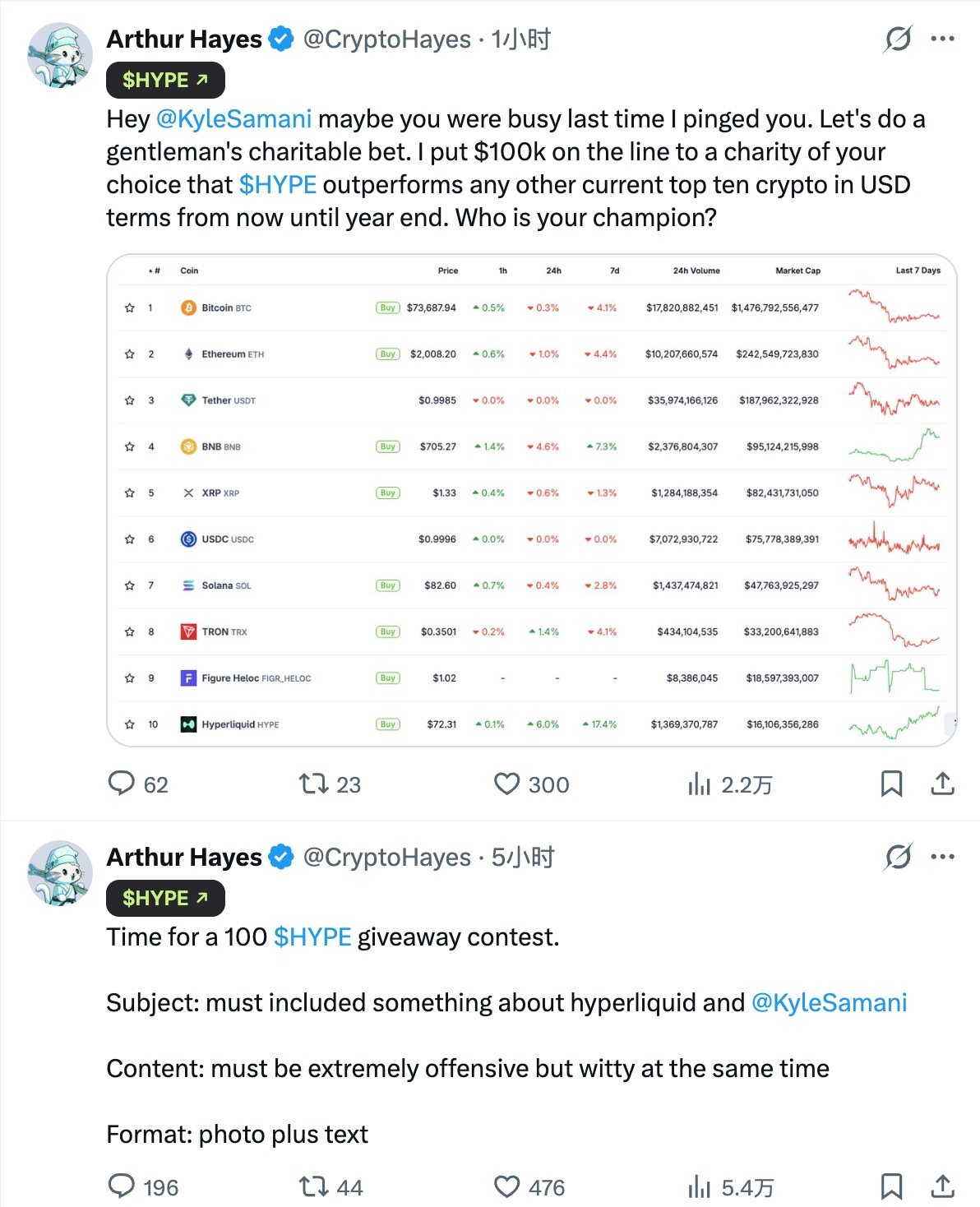
Among them, Hayes' response was the most direct. On May 31, Hayes posted a sarcastic comment targeting Samani, saying: "Before this cycle ends, HYPE should at least surpass SOL."
Earlier today, Hayes posted again, proposing a content competition with a prize pool of 100 HYPE, requiring participants to respond humorously and offensively to Samani... At the same time, Hayes directly called out Samani, offering a $100,000 bet that HYPE would outperform the other tokens in the top 10 of the cryptocurrency rankings over the remaining seven months of this year.
The Narrative Clash Between Solana and Hyperliquid
Over the past few years, Solana's greatest success has been building a high-speed, low-cost on-chain financial infrastructure. From Meme and DeFi to AI Agents, various assets and applications have chosen to issue and trade on Solana, with the core logic being that liquidity gravitates toward the most efficient markets.
However, Hyperliquid has taken this logic a step further.
Unlike Solana, which provides infrastructure and waits for applications and liquidity to grow organically, Hyperliquid taps directly into the core demand of the crypto industry—trading. It accumulates users, fee revenue, and liquidity through the perpetual contract market, then gradually expands to spot trading, stock tokens, prediction markets, and more financial products.
As a result, Hyperliquid has formed an extremely rare positive flywheel: more traders bring more fee revenue; more revenue feeds back into HYPE buybacks and ecosystem incentives; rising HYPE prices attract more capital; and more capital further enhances platform liquidity and trading depth. The cash flow generated by this flywheel has even surpassed that of public chain ecosystems like Solana.
In recent years, Solana's core narrative slogan has been 'Internet of Capital Markets.' However, as users, assets, liquidity, and pricing power continue to shift toward Hyperliquid, the latter now seems far more aligned with this narrative than Solana. In other words, Hyperliquid appears to have become what Solana aspired to be.
As Solana's most loyal standard-bearer, Samani is naturally unwilling to accept this situation.
Samani's Tactic: Using the Same Arguments That Were Used Against Solana to Attack Hyperliquid
Looking closely at Samani's recent offensive against Hyperliquid reveals a rather dramatic phenomenon.
In the past, during the debates between Ethereum and Solana, the most common attack from the Ethereum camp was questioning Solana's decentralization. High barriers for validator nodes, excessive hardware requirements, frequent network outages, and over-reliance on a few core institutions... In the eyes of many Ethereum supporters, while Solana was fast, it essentially sacrificed decentralization for performance.
Solana's response to this was simple—users don't care. For the vast majority of users, what they need is faster confirmation times, lower fees, and better product experiences, not a research report on node distribution.
In a sense, Solana's rise itself was a major victory for the 'efficiency-first' approach. But now, as Hyperliquid starts to capture market attention, Samani has raised the flag that the Ethereum camp loved to wave.
Centralization, regulatory risks, censorship resistance... These accusations sound somewhat familiar, except the former 'defendant' was Solana, and now it's Hyperliquid.
This might feel a bit 'double-standard,' but perhaps in Samani's eyes, Solana represents the perfect balance point—Ethereum is sufficiently decentralized but overly cumbersome, Hyperliquid is extremely smooth but essentially resembles a CEX, while Solana, on the other hand, seems so 'upright and straightforward'...
In a sense, the essence of this debate is not about the competition between HYPE and SOL, but rather the age-old question that has persisted in the crypto industry for over a decade—should we prioritize decentralization, or prioritize products and growth?
Years ago, Ethereum and Solana argued endlessly over this question. Today, Solana and Hyperliquid find themselves in the same position.
Only this time, facing a more aggressive opponent, Solana's followers have become the ones waving the banner of 'decentralization.'


