






宏观大师Raoul Pal访谈:经济奇点正在逼近,未来四年不要轻易下车


- Core Thesis: The current AI race is the largest capital event in human history, driving the economy toward a singularity. The crypto market, especially Layer 1 tokens, emerges as the core asset class with the optimal risk-reward ratio, fueled by the AI agent economy, fiat currency debasement, and the on-chain migration of the financial system. Long-term holders will significantly outperform swing traders.
- Key Elements:
- The AI race, driven by great power competition, has entered a "too big to fail" state that will persist until the economic singularity (when the system can no longer handle the pace of technological development). AI technology follows Reed's Law, exhibiting exponential growth of exponential growth.
- The infinite Total Addressable Market (TAM) for cryptocurrencies (especially Layer 1s) is being transformed by the AI agent economy: agents will possess wallets and operate on-chain, shifting the market valuation logic from one based on human users to one with unlimited agent users.
- The logarithmic growth compounding model of a long-term hold strategy significantly outperforms swing trading: 99% of traders cannot perfectly time the market, and the most profitable accounts for brokers are "forgotten accounts."
- Blockchain Layer 1s will ultimately converge to 3-5 core chains (e.g., ETH, Solana, Sui). Their value is predicated on being the cheapest, fastest, and most programmable, and they cannot be valued using traditional DCF models.
- DeFi is better suited for AI agents than for humans. Agents can execute cross-chain transactions in milliseconds without needing a front-end interface, making them the largest user base for DeFi.
- The economic singularity is expected to arrive in approximately four years. In the meantime, one should accumulate as many crypto assets as possible (viewed as "humanity's collective pension") to navigate future uncertainties.
- The current bullish mix includes bank entry into the space, regulatory clarity, increasing global liquidity, and crypto assets being at historically undervalued levels relative to the Nasdaq.
Original source: "When Shift Happens"
Compiled by: Felix, PANews
Macro investor and Real Vision co-founder Raoul Pal returns to the "When Shift Happens" podcast for an in-depth analysis of why the AI race is the largest capital event in human history, and why cryptocurrency holders are in a favorable position. Raoul Pal explains the economic singularity, why traders always lose to long-term holders, and why he keeps buying during corrections.
PANews has compiled the highlights of the interview.
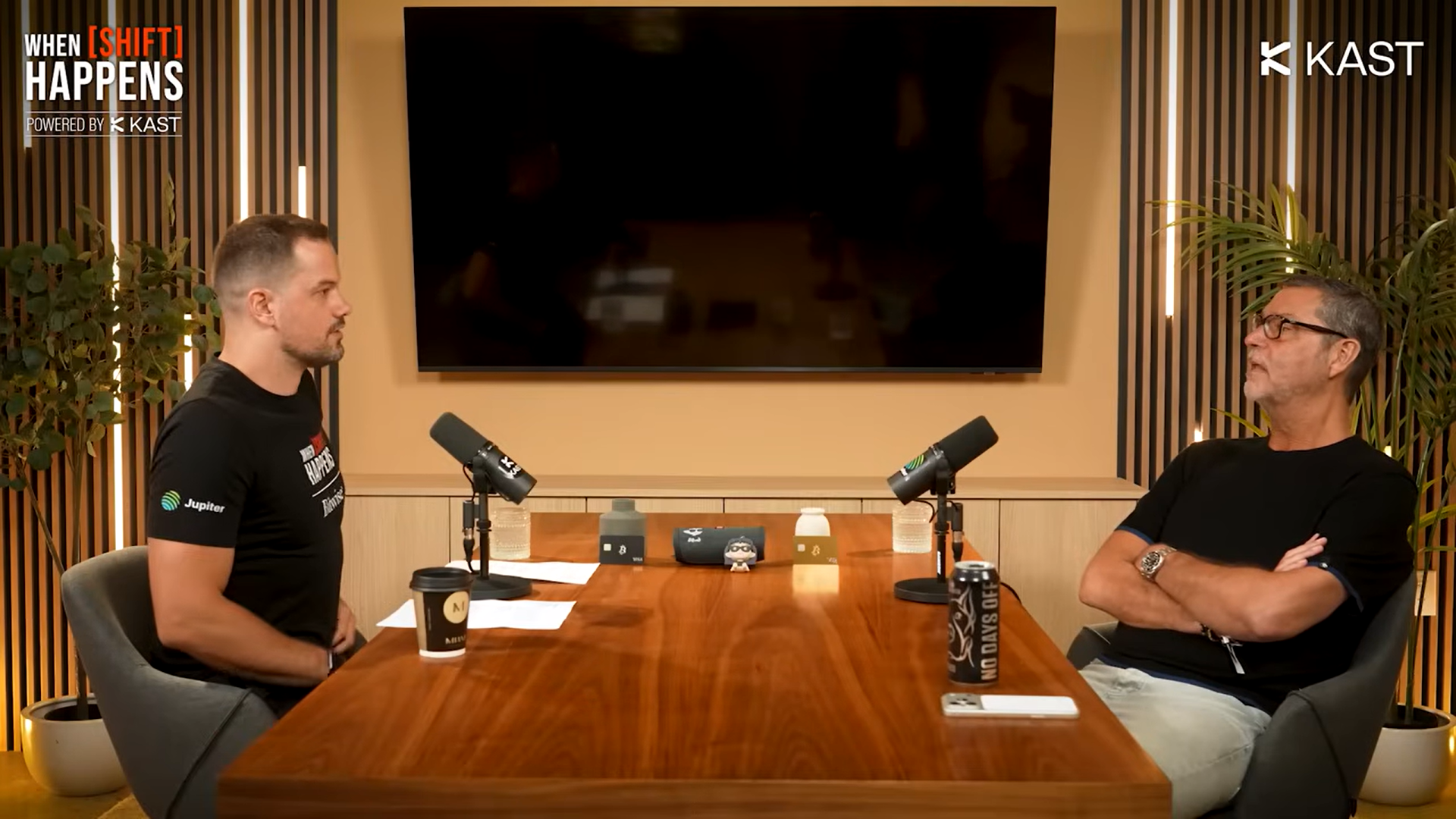
Host: You shared and commented on an interesting video a few weeks ago. It sarcastically said that the U.S. stock market keeps going up, you can make money just by "buying the dip," and if you don't have money, you borrow to buy. It's not a pyramid scheme, it's a "buy-the-dip" plan. What's really going on with the stock market?
Raoul Pal: There are two main reasons. The first is obviously liquidity; we are witnessing an expansion of liquidity. The other thing is that we are experiencing the most extraordinary period in human history, and nothing else matters. All capital is flowing into the AI sector; it's the biggest race ever. It's a race between nations, a race between corporations. Therefore, it will naturally suck up every last bit of capital because you can't slow it down.
Host: Tell me about this race.
Raoul Pal: In this world, no one will allow a single superpower to monopolize AGI (Artificial General Intelligence). So there must be two, and only the US and China in the world can afford this race. Game theory shows that no country will stop now because stopping means the other side will gain an advantage. Even in a scenario like OpenAI going bankrupt and running out of money, the US government would immediately auction its assets to companies like Microsoft and Google, never allowing a single company to hold an advantage. The scale of this game is too huge; no one will stop. It's a game of "converting units of energy into units of intelligence."
Host: Too big to fail. So, should we just "buy the dip" forever? Will it ever end?
Raoul Pal: In my "Global Macro Investor," I wrote that it won't end until we reach the economic singularity. The economic singularity is when the system can no longer cope with the speed of technological development. You know the magical formula: population growth + productivity growth + debt growth. When you count AI and robots as population, our current maximum human population is 9 billion, but we could reach 18 billion, 100 billion, or even 1 trillion intelligent agents. With 10 billion or 50 billion agents, the economic system simply cannot function as it did; it runs too fast.Almost all past technology adoptions followed Metcalfe's Law (PANews note: the value of a network is proportional to the square of the number of connected users), showing logarithmic growth. But AI is the first observable case of "Reed's Law" in human history (PANews note: the value of a network scale increases not only with user growth but, due to the role of group formation, the total value grows exponentially), which is exponential growth on top of exponential growth. It is estimated that by 2028, AI will produce more text annually than all the text produced in human history from Gutenberg's printing press to today.
Host: An interview with Anthropic today also said that they initially expected 10x growth in the first quarter, but ended up with 80x growth. That's incredible.
Raoul Pal: Yes, the economic singularity is what happens when you have economic intelligent agents capable of instant capital formation. That's the significance of Meme coins: instant capital formation and destruction. They can build a digital business instantly, capture the market quickly, and then exit when the opportunity is gone. In this economy, what is the role of large traditional enterprises? Who are the workers? The system can no longer function properly. Because carbon-based lifeforms (human neurons) operate at 1 millisecond, but now we are passing electricity through sand (silicon, the second most common element on Earth) to create intelligence, which is six orders of magnitude (one million times) faster than human neurons. That's insane.
Host: Since AI is exploding exponentially, a lot of people in crypto are thinking of switching to AI. They feel the crypto industry is boring now, or even afraid of being trapped. How do you view the investment choice between AI and crypto?
Raoul Pal: Despite the extreme heat in the AI industry, I still believe that over the long term, cryptocurrency remains one of the best risk-reward investments. However, it's indeed hard to compete with chip companies like Nvidia because they are the core part of converting energy into intelligence. That said, cryptocurrencies have an "infinite TAM (Total Addressable Market)." Around October last year, we witnessed the birth of the agent economy (AI Agents). When these agents start scaling massively, they will have their own wallets and conduct business on-chain. Previously, we estimated the crypto market could reach $100 trillion based on human users, but now with unlimited AI agents, this completely changes the game. Furthermore, the Fed will run the economy like in the Greenspan era, relying on the productivity miracle to reduce the debt-to-GDP ratio. Fiat currency depreciation won't stop, and the entire financial system is migrating to blockchain infrastructure, so you just need to front-run the institutions. The worst is over because global liquidity is accelerating.
Host: So for you, Bitcoin dropping from its recent peak back to $60k is not a bear market?
Raoul Pal: It's just a painful correction within a bull market. I've been in crypto since 2013. A 50% correction for Bitcoin is very normal, and other altcoins fall even harder. For example, Solana in the last cycle dropped 80% before its massive surge. The difference is that the correction in 2021 was very fast; it plummeted and then recovered quickly. This time, the correction is more choppy, taking several months, so people find it very painful. But looking at it differently, the longer the consolidation period, the longer and bigger the subsequent bull market might be.Host: The problem is that in 2021, the drop was fast, and the recovery was fast. But this time, the market is volatile and time-consuming. Also, some companies performing very well (like stablecoins, RWA) don't have tokens, so retail investors can't invest in them. People feel the promise of early wealth creation has been broken.
Raoul Pal: I don't think that's true. Product-market fit is king. Just because your altcoin hasn't gone up doesn't mean the promise is broken. The market doesn't owe you anything. People got used to the easy days of making money blindly in previous years, but liquidity in 2024 was actually still suppressed. We haven't entered the real "Banana Zone" (period of crazy upward movement). Even if ordinary people can't buy equity in stablecoin companies, that's not a problem at all. You just need to hold the underlying Layer 1 tokens. This is our "Universal Basic Equity." If a large part of the future economy is dominated by AI and agents using crypto networks, we just need to hold Layer 1 tokens to share in their success. We didn't have this opportunity in the internet age; there's no excuse to miss it now.
Host: What did you add to your portfolio during the recent drop?
Raoul Pal: I bought some Sui and a little bit of Zcash. I didn't chase Zcash when it soared last year; I started buying during the correction. In the store-of-value space, privacy has value. This is a very simple "left curve" trade (intuitive trade): it's Bitcoin with privacy features. The "right curve" trade (deliberate trade) considers its quantum-resistant properties. Although this might invite government crackdowns, it offers a very important protective feature in the future.Host: Can you explain in detail why smart contract Layer 1s will capture the majority of crypto value over time?
Raoul Pal: Layer 1 is the investment-grade infrastructure layer. Just like the operating system market eventually had only three or four major players, Layer 1s will eventually converge to 3 to 5 core chains. And how to understand the value of Layer 1s? If you pull the plug on Ethereum today, the economic value you destroy is enormous: all Layer 2s, DeFi, NFTs, RWAs would go to zero. ETH's current valuation might even be undervalued. Bitcoin has a single function; its goal is to capture a share of global savings. But the scalability of smart contract infrastructure is infinite.
Host: So which Layer 1s will win?
Raoul Pal: ETH has the highest density of economic value and developer intelligence resources (security, Lindy effect, etc.). It's like Microsoft; buying it won't be a big mistake. Solana has proven itself successful; it's more efficient, faster, and cheaper. Sui is very early, but when the market dropped 80%, ETH, Solana, and Sui were the only three tokens that maintained economic density. Sui's programmability within a single block, its ability to process thousands of transactions, and its finality speed are on a completely different magnitude. You can't evaluate blockchains using traditional "Discounted Cash Flow (DCF)" models because the network's purpose is to provide the cheapest and fastest service. Valuing it based on how many fees it generates is nonsense. The cheapest, fastest, and most programmable chain will ultimately outperform the market.
Host: Some people say DeFi is "dead" after a large number of hacks in the past few months. How can traditional financial institutions put money on DeFi that is easily hacked?
Raoul Pal: But this will only force people to develop better products. Just like we install antivirus software on our computers, hacks are everywhere. Every big bank internally has teams dealing with hacks and a percentage of stolen funds; they just don't publicize it. I predicted back in 2014 that the infrastructure of the entire financial system would move to the blockchain. Why? Because it's the most efficient way to output energy. The financial system will always migrate to the most profitable and efficient track. Moreover, DeFi is actually more suitable for machines (AI agents) than humans. Machines don't even need a front-end website; they can perform extremely low-friction asset rebalancing and instant trading across multiple chains using multiple stablecoins in milliseconds. They will be the largest user group of DeFi, and we might not even notice these transactions.
Host: Do you think NFTs will gain huge value due to the aforementioned wealth effect? The Crypto Punks and XCOPY I bought have had stagnant prices lately; I don't even want to look at them.
Raoul Pal: That's because NFT activity is a function of the overall crypto economy's prosperity. You have to wait until the overall crypto market reaches a scale of hundreds of trillions of dollars. When ETH goes from its current price to $5000, or breaks out upwards, you will see a massive resurgence in NFT activity. Think about it, we are experiencing the biggest turning point in human history: we will no longer be the top intelligence on Earth, and art is the vessel documenting the culture of our time. When people make big money in this vast machine economy, they will naturally look to buy "trophy assets" (PANews note: referring to top-tier assets that are extremely scarce, in prime locations, or possess significant historical/cultural value, showcasing the buyer's social status and providing immense psychological satisfaction, often 'hard to find'), just like tech tycoons, real estate moguls, and hedge fund managers buy art after getting rich.
Host: So how do you plan to allocate an NFT portfolio? Should you only buy the top-tier "Holy Grails"?
Raoul Pal: I'm actually in the process of launching an NFT fund. Many high-net-worth individuals, family offices, and even OGs who have made money in crypto but never bought digital art don't know how to get in. Our fund will have two parts: one part invests in "Holy Grail" assets (like Alien Punks, XCOPY, Beeple, valued from hundreds of thousands to tens of millions of dollars). These already have proven social consensus. The other part invests in mid-tier artists with high convexity. For example, "Die with the most likes," who records the decline of the American middle class in a humorous, sometimes vulgar way; or German artist Kim Asendorf, who is at the forefront of AI art. If the works of these artists go from 20 ETH to 200 ETH (a 5x to 10x increase), and ETH itself could also go up 10x in the future, you'll get a stunning 100x double return.Don't worry about the common NFTs because the whole industry is still small, and everything will be repriced. Even buying an ordinary Punk from the same collection is a good trade. Furthermore, our fund will also engage in NFT collateralized lending, earning yields of over 15%, and reinvesting to support the liquidity of the entire art ecosystem.
Host: Is Bitcoin a proxy for investing in AI?
Raoul Pal: You could say that, because AI will promote economic growth, and the fiat currency devaluation caused by massive debt will benefit Bitcoin as a digital store of value. However, Layer 1 smart contract platforms are a better and more direct bet.
Host: You say everyone focuses too much on cycles, but the big picture is so obvious: unless you absolutely need to, you should never sell.
Raoul Pal: Exactly. In this era of agents, fiat currency devaluation, and everything moving on-chain, why would you sell? If we know the long-term direction of market cap, why sell? This is humanity's pension plan. The economic singularity is about 4 years away. You now have 4 years to accumulate as much of these assets as possible. They can carry you through the greatest uncertainty of the future.
Host: Can you prove with data that "buy and hold" outperforms those trying to trade the swings?
Raoul Pal: Absolutely. I've run the models. If you buy when it's oversold at 1 to 2 standard deviations below the logarithmic trend channel, and then do nothing, the compounding is astonishing. If you try to sell at the top and buy back at the bottom, 99% of people can't do it; it's too hard. People tend to chase highs on the way up. I've been in this industry for 35 years, and I don't know anyone who has consistently made a fortune through short-term trading. The traders who make big money actually make it from asset management fees.
It turns out that the people who make the most money in crypto are those who "do nothing." Why are the most profitable accounts at major brokerages often the "dead accounts" (forgotten accounts)? Retail traders try to buy low and sell high, not only failing to do so but also consuming immense emotional and psychological energy, getting angry or ecstatic every day over price fluctuations. This is absolutely the least efficient use of one's energy. If you have spare productive energy, study AI, and then just hold your Bitcoin tightly. If the price gets overbought to two standard deviations, you can sell a little to enjoy life; otherwise, shut up, buy the dip, and hold patiently.
Host: How can people maintain conviction when their portfolio is down 60-80% and it lasts for months?
Raoul Pal: I simply don't care. I live on my salary. If I have spare cash and the market is severely oversold, I just keep buying. Because my core thesis hasn't changed: Tomorrow will be more digital than today.
Host: AI stocks are skyrocketing now, with many charts pointing straight up. Could this tempt people away from boring crypto to buy AI?
Raoul Pal: It's your job to be a mercenary for your own capital; go where the returns are. But I believe the compound returns are higher in crypto. Compared to the Nasdaq, Bitcoin is currently in a severely oversold position relative to its long-term trend. This means, relative to Nasdaq, you should be allocating more capital to crypto right now.
Host: Finally, give us some optimistic hope for 2026 to 2027 to help boost morale.
Raoul Pal: There is a lot of good news. First, banks are entering the space, and stablecoins will see explosive growth over the next two years. The "Clarity Act" on the regulatory front will be signed, allowing almost everyone to start building on the blockchain. On the macro front, the US government has trillions of dollars in interest to roll over and pay; they have to keep printing money. Global liquidity will inevitably increase. The business cycle remains strong, and more income will be recycled into speculative assets. Most importantly, current crypto assets, relative to assets like Nasdaq, are at their cheapest point in the long-term log uptrend. We have also experienced the longest and lowest "extreme fear" period in history (Fear & Greed Index below 10), and there's a strong possibility the Middle East conflict will be permanently resolved. This is a perfect storm of bullish factors. I think the probability of this positive bullish outcome is 70%. The remaining 30% downside risk mainly lies in the


