






30 ngày, hai kỳ tăng hơn 40%, Pre-IPO của Bitget từ hoài nghi đã chứng minh được giá trị thực


- Quan điểm chính: Thông qua các sản phẩm IPO Prime (như preSPCX, preOPAI), Bitget đã chuyển đổi kỳ vọng Pre-IPO của các gã khổng lồ chưa niêm yết như SpaceX, OpenAI thành token có thể giao dịch cho người dùng phổ thông, tạo ra hiệu ứng tài sản rõ rệt và thúc đẩy CEX mở rộng từ tài sản thuần Crypto sang hướng giao dịch đa tài sản toàn cầu.
- Yếu tố then chốt:
- IPO tiềm năng của SpaceX có định giá lên tới 1,75 nghìn tỷ USD, có thể trở thành một trong những đợt IPO lớn nhất lịch sử. Thị trường đã đặt cược trước vào biến động định giá của nó thông qua các hợp đồng vĩnh viễn Pre-IPO do các nền tảng như Bitget cung cấp.
- Sản phẩm IPO Prime preSPCX (giá đăng ký 650 USD) của Bitget tăng tối đa 45,8%, preOPAI (giá đăng ký 725 USD) tăng tối đa 48,8%, tạo ra lợi nhuận sổ sách rõ ràng.
- Nguồn lợi nhuận bao gồm ba lớp giá trị: chênh lệch giữa giá đăng ký và giá thị trường thứ cấp, hạ thấp rào cản tham gia (Pre-IPO truyền thống chỉ dành cho tổ chức), và airdrop VIP (hai vòng tổng cộng 950 preSPCX, trị giá hơn 610.000 USD).
- Bitget kết nối trực tiếp thanh khoản thị trường chứng khoán Mỹ thông qua giao thức RWA Reality và hỗ trợ chia cổ tức, mở rộng thêm các tài sản toàn cầu vào kịch bản giao dịch, thể hiện chiến lược UEX (Sàn giao dịch đa tài sản toàn cầu) của mình.
- Sự phân hóa lộ trình của ba sàn giao dịch lớn: Binance thiên về hợp đồng, OKX mở rộng các danh mục vĩnh viễn, trong khi Bitget tập trung vào tài sản thực hỗ trợ và hệ sinh thái quyền lợi người dùng (đăng ký + spot + hợp đồng + airdrop).
Author: White Runner

SpaceX's IPO prospectus flooded the internet overnight.
The super-unicorn has finally laid its books bare to the public market: Starship, Starlink, Musk, the Mars mission, and a potential valuation target of up to $1.75 trillion. According to Reuters, this IPO could be one of the largest in history, potentially rewriting the pricing models for late-stage tech company financing and exits.
As one of the world's most well-known private companies, everyone is watching SpaceX, but only a select few insiders, institutions, and primary market investors have ever had early access to its equity.
The market can't wait any longer.
The preSPCX (formerly preSPAX) product related to SpaceX on Bitget has already surged over 40%. While SpaceX's IPO is still on the horizon, trading based on its expectations has already begun.
The wealth effect is shifting from "crypto narratives" to "cross-asset opportunities"
Historically, the most attractive opportunities for CEX users came from within the crypto ecosystem: new token launches, Launchpads, Memes, perpetual contracts, and exchange tokens. Users cared about who could snag the next hot project and get tokens before the market opened.
But in a weaker cycle, this logic is becoming increasingly unsustainable. The narrative density of purely native crypto assets is declining; new tokens peak upon launch, Meme trends rotate rapidly, and platforms find it hard to sustain a wealth effect solely by listing new coins.
Simultaneously, external financial markets are providing fresh material. While access to traditional overseas stocks has become more sensitive, assets like US equities, AI, commercial aerospace, and Pre-IPOs continue to attract global capital. User interest in high-quality overseas assets hasn't vanished; it's just that the direct participation channels are narrowing.
This creates a new misalignment: traders don't necessarily just want to trade cryptocurrencies; they want to trade any asset that offers potential returns. Stocks, gold, forex, AI, SpaceX, OpenAI, or even the pre-listing expectations of these assets, could all become new trading targets.
SpaceX is the most typical example. It hasn't officially IPO'd yet, but platforms like Binance, Bitget, and Trade.xyz have already launched related perpetual contracts based on its listing expectations, allowing users to trade on SpaceX's anticipated valuation. The FT also noted that these products don't offer stock ownership; they essentially let users bet on valuation changes around SpaceX's listing.
Against this backdrop, the significance of Bitget's Pre-IPO offering goes beyond just listing new products. It signifies that the boundary of CEX asset supply is shifting: from "who can list the next hot coin" to "who can turn the expectations of globally hot assets into tradeable products faster."
When new coins are no longer exciting, unlisted giants become the new story for exchanges.
Bitget IPO Prime: From Skepticism to Reputation Turnaround
When Bitget IPO Prime first launched, the market's initial reaction was mostly curiosity and skepticism.
This is normal. Neither SpaceX nor OpenAI is publicly listed yet. A regular user suddenly seeing they can subscribe to Pre-IPO products for these companies on an exchange often reacts not with "opportunity has arrived," but with "isn't this trading on nothing?", "does this represent actual equity?", or "isn't the valuation too high?"
Subsequently, Bitget's Head of Greater China, Xie Jiayin, consistently addressed user questions and sentiments positively on Twitter, explaining the product logic of IPO Prime, the source of underlying assets, Republic's issuing role, and the boundaries between preSPAX/preOPAI and real equity or economic rights.
On one hand, he acknowledged the shortcomings of the early rules, stating that "all rule iterations were forged by criticism." On the other hand, he repeatedly emphasized that Bitget's core goal with IPO Prime was to lower the barriers and bring primary market opportunities——previously exclusive to institutions and high-net-worth individuals——to a broader base of regular users.
He also highlighted several times in his tweets that preOPAI is the "only token globally backed by real equity." Several KOLs also wrote analyses supporting this conclusion, making this "real equity backing" a key footnote in the shift of public opinion.
Eventually, the market was convinced by actual returns. As price performance materialized, rules improved, and users deepened their understanding of the product structure, the initial skepticism was gradually replaced by discussions about "can it double?", "looking forward to the next offering", and "how to upgrade VIP level."

In a way, preSPCX bore the educational costs and public opinion pressure for IPO Prime, while preOPAI completed a reputation turnaround with a more mature product narrative and clearer market expectations. Thus, Bitget's IPO Prime transformed from a initially questioned new concept into a Pre-IPO asset gateway that users are willing to continuously follow and participate in.
According to Bitget's announcement, preSPCX, as the first project on IPO Prime, had a total supply of 94,000 tokens, a total subscription value of $61.1 million, and a subscription price of $650. preOPAI is the second project, with a total subscription amount of 29,082 tokens, a total subscription value of approximately $21.08445 million, and a subscription price of $725. Additionally, there are SPCXUSDT and OPAIUSDT perpetual contract products.
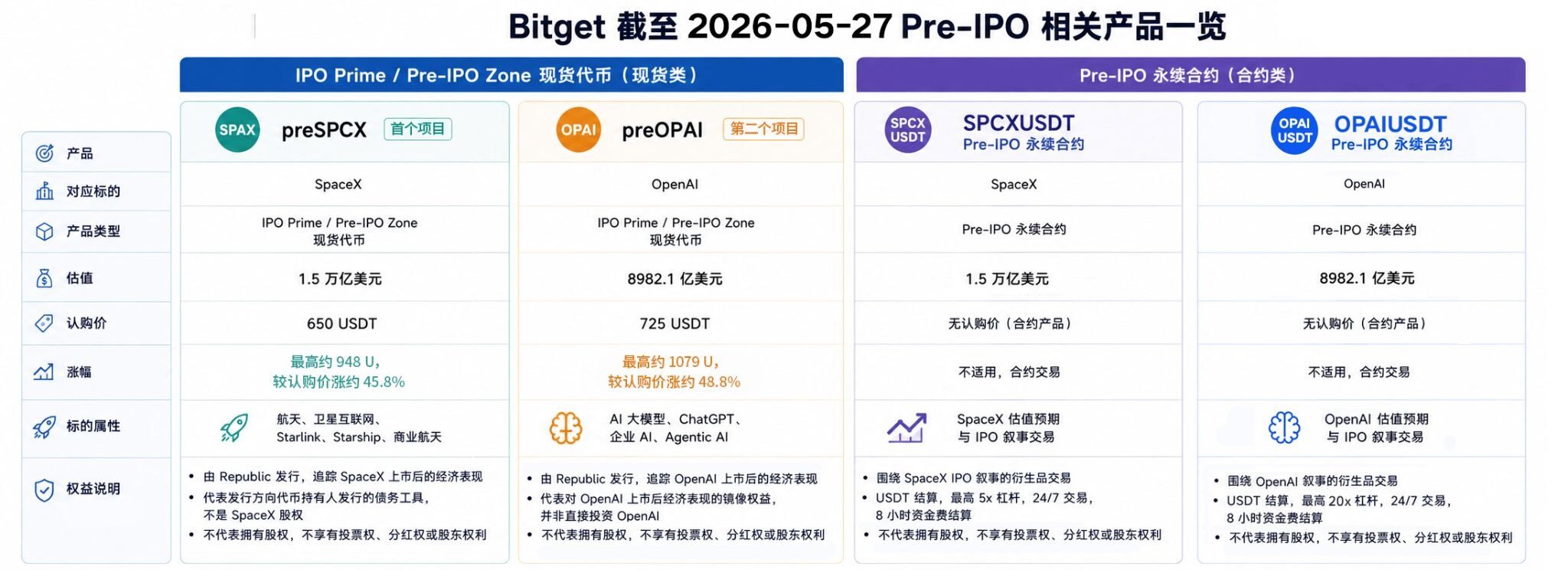
Looking at peak gains, preSPCX rose from 650U to 948U, a gain of 45.8%, and preOPAI rose from 725U to 1079U, a gain of 48.8%, clearly constituting substantial paper profits. From my perspective, these gains come from three layers.
The first layer is the spread between the subscription price and the secondary market valuation. When users subscribe via IPO Prime and the token lists for spot trading, the market re-prices it around SpaceX/OpenAI's pre-listing expectations. For this previously low-liquidity Pre-IPO exposure, spot trading also provides a clearer path for exits, portfolio adjustments, and short-term trades.
The second layer is the lower barrier to entry. Traditional Pre-IPO access is typically reserved for institutions, high-net-worth individuals, and accredited investors; regular users rarely get near targets like SpaceX or OpenAI. Bitget IPO Prime turns these quasi-primary market opportunities into subscription and trading products accessible to regular exchange users. The wealth effect here comes not just from price appreciation, but also from the fact that "you couldn't participate before, but now there's an entry point."
The third layer is the additional benefits from VIP airdrops. Bitget set up two rounds of VIP airdrops around preSPCX: the first round targeting existing VIP users with a pool of 760 preSPCX tokens; the second round for users who upgraded their VIP level during the event, with a pool of 190 preSPCX tokens. Together, this totals 950 tokens. At the $650 subscription price, this corresponds to a nominal value of approximately $617,500 (which has grown to $860,500 at current prices). This integrates IPO Prime not just as a subscription product but also into the platform's user benefit system.

(The generous VIP 5 airdrop was enviable, and Xie Jiayin's "listening to feedback" also boosted reputation)
These three layers of value are what make Bitget IPO Prime noteworthy: subscriptions provide early-stage tokens, spot trading offers liquidity, VIP airdrops incorporate Pre-IPO exposure into the user rewards system, and SPCXUSDT/OPAIUSDT extend SpaceX's pre-listing expectations into the derivatives market.
Therefore, the market's attitude towards Bitget IPO Prime is constantly evolving. Early skepticism focused on structure, valuation, and liquidity, while the current focus is on the gains achieved by the first two products, the extra benefits from VIP airdrops, and whether they can continue securing top-tier targets like SpaceX and OpenAI.
Currently, Bitget IPO Prime has essentially proven its logic: transforming the expectations of leading private companies into new wealth gateways that regular users can participate in, platforms can distribute, and markets can trade.
From US Stock Products to Pre-IPO: Bitget's All-Asset Strategy
From the perspective of a long-term observer of Bitget, its foray into Pre-IPO is not an isolated move. Within the broader exchange competition, it seems more like a part of CEXs expanding from crypto-native assets to global asset expectations, and an extension of its UEX (Universal Exchange) strategy.
Previously, the competition among exchanges was about listing speed, contract depth, Launchpad allocations, and exchange token ecosystems. Now, the competition is expanding horizontally. Users don't just want to trade BTC, ETH, or Memes; they also want to trade US stocks, gold, forex, AI, SpaceX, OpenAI, and the pre-trading expectations of these assets.
Looking at US stock and Pre-IPO products, it's clear that Binance, OKX, and Bitget have taken different paths.
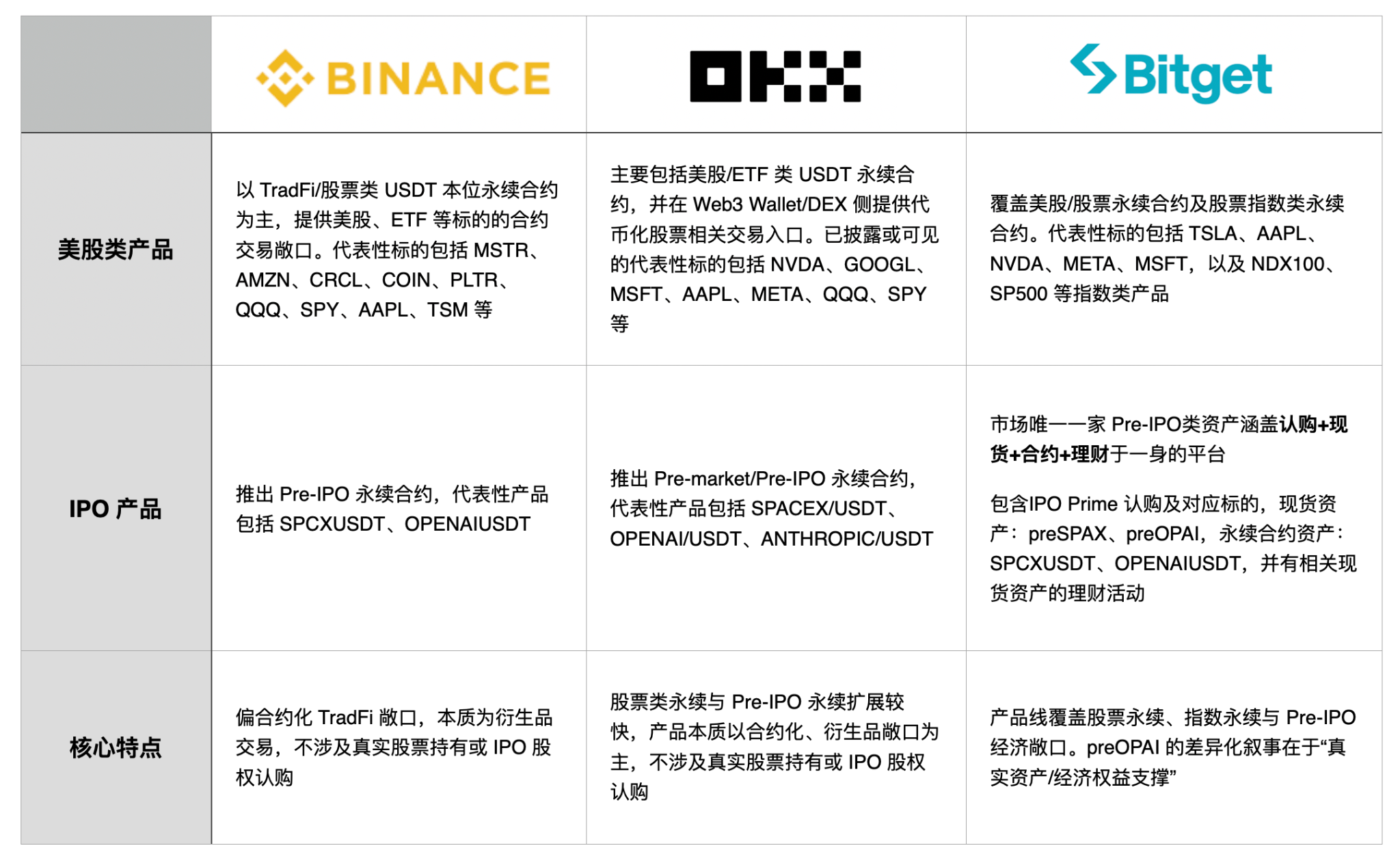
Overall, the differences among the three can be summarized as: Binance leans more towards contract-based TradFi exposure; OKX focuses more on rapidly expanding stock and Pre-IPO perpetual categories; Bitget offers more comprehensive product coverage, emphasizes real asset backing, and builds a richer user reward ecosystem through mechanisms like subscriptions, spot trading, perpetual contracts, and VIP airdrops.
Observing exchange trends, US stock products are clearly the next frontier for CEX expansion. Pre-IPOs, tokenized stocks, stock contracts, and RWA indices may look different in form, but they fundamentally answer the same question: How can exchanges expand users from "trading only crypto" to "trading globally important assets"?
For exchanges, this means new asset supply, new trading scenarios, and new ways to retain users. For users, it means the objects of their trading are changing. In the past, people looked on CEXs for the next new coin; now, they might start looking for the next yet-to-be-listed SpaceX or OpenAI, or the next global asset that can be tokenized, contracted, or indexed.
Therefore, the wealth effect of Bitget's Pre-IPO should not be judged solely by a single project's price increase. It's more like an entry point in the CEX cross-asset competition: whoever can identify high-awareness assets faster and package them into tradeable products will gain an advantage in the next round of asset supply competition.
Sustaining the wealth effect depends on who can turn global narratives into user opportunities
SpaceX's significance goes beyond taking a rocket company public. What it truly brings to the public market is the combined imagination of commercial aerospace, the Starlink network, orbital infrastructure, AI, and the future space economy. The value of its IPO is not just for shareholders to exit, but for this super-narrative——previously confined to the private market——to receive its first public pricing from global capital.
Bitget's UEX strategy points to similar logic. It's not simply about listing a few more US stock or Pre-IPO products, but about packaging high-quality global assets——US stocks, gold, forex, etc.——into a 24/7 crypto trading gateway accessible to its users.
We have also seen that Bitget's SpaceX and OpenAI-related products surged over 40% in less than a month, distributing a total of $617,500 worth of airdrops (based on subscription price) to VIP users. The subscription spread, secondary market liquidity, VIP benefits, and contract trading collectively form a significant wealth effect. In the current bearish market environment filled with fear, such clear positive feedback is rare.
As this article was being written, Bitget announced another new initiative: launching the RWA protocol "Reality," directly connecting US stock liquidity and supporting dividend payouts. Bitget is steadily bringing more real-world assets into a unified trading scenario. Memes might cool down, but the market's demand for high-quality assets, liquidity, and trading efficiency will not disappear.
SpaceX's Starship continues to launch, and its IPO is channeling the potential of commercial aerospace into the capital markets. For exchanges, the real competition has just begun: whoever can capture the expectations of these global-level assets sooner may define the next-generation trading gateway.
Starship flies towards the cosmos, igniting trillion-dollar imaginations about commercial aerospace. And as capital begins to price this imagination, what Bitget aims to do is turn this distant primary market narrative into an entry ticket for ordinary users.


