






Tổng quan về chiến lược mới nhất của "Thần cổ phiếu AI" 24 tuổi: 60% danh mục phòng hộ sự suy giảm của ngành bán dẫn


- Quan điểm cốt lõi: Danh mục đầu tư quý I của quỹ do "Thần cổ phiếu AI" mới nổi Leopold Aschenbrenner quản lý đã được công bố, tổng giá trị thị trường tăng lên 137 tỷ USD. Quỹ áp dụng chiến lược mua quyền chọn bán quy mô lớn để phòng hộ bong bóng định giá ngắn hạn của cổ phiếu bán dẫn AI, đồng thời tiếp tục tập trung đầu tư mạnh vào cơ sở hạ tầng năng lượng và sức mạnh tính toán, phản ánh nhận định cốt lõi của ông về chuỗi công nghiệp AI: "Ngắn hạn bi quan với mảng chip, dài hạn lạc quan với cơ sở hạ tầng".
- Các yếu tố chính:
- Tổng giá trị danh mục tăng 148% lên 137 tỷ USD, trong đó 32,51% đến từ dòng vốn mới ròng, cho thấy dòng tiền bên ngoài mua vào ồ ạt.
- Trong các vị thế mới, hơn 60% giá trị danh nghĩa được đầu tư vào quyền chọn bán cổ phiếu bán dẫn AI, 5 vị thế lớn nhất là PUT của SMH, NVDA, ORCL, AVGO, AMD.
- Đối với Micron (MU) và TSMC (TSM), quỹ đồng thời nắm giữ cả quyền chọn mua và quyền chọn bán, sử dụng chiến lược đặt cược hai chiều để đón đầu biến động lớn do báo cáo tài chính hoặc địa chính trị gây ra.
- Động thái tăng tỷ trọng tập trung vào cổ phiếu phổ thông, đặc biệt là tăng mạnh vị thế tại SanDisk (SNDK) và CoreWeave (CRWV), tiếp nối logic "Điện là dầu mỏ mới", đẩy mạnh đầu tư vào các công ty cơ sở hạ tầng sức mạnh tính toán và điện lực.
- Thanh lý hoàn toàn quyền chọn mua Intel (INTC CALL), các công ty chip quang thông tin và mô-đun quang như LITE, COHR, cho thấy động thái tháo bỏ đòn bẩy cao và rút lui khỏi mảng phần cứng mạng AI.
- Trong số các vị thế giảm tỷ trọng, Bloom Energy từ vị thế lớn nhất giảm xuống còn 6,42%, quyền chọn mua CoreWeave giảm đòn bẩy mạnh, đều là các động thái chốt lời hoặc giảm thiểu rủi ro.
Original: Odaily Planet Daily (@OdailyChina)
Author: Azuma (@azuma_eth)
No confidentiality filing! No complete liquidation either! The newly minted "AI Stock God" Leopold Aschenbrenner's fund, Situational Awareness LP, officially released its 13F filing this evening.
- Odaily Note: For details on Leopold Aschenbrenner's personal story, see SBF's protege turned $225 million into $5.5 billion in one year.
This confirms that our first assumption in this morning's article, The answer could be revealed today; the entire market is watching the 24-year-old "AI Stock God's" next move, was correct. Situational Awareness LP submitted the filing late on the May 15 deadline, causing the SEC to miss posting it on its website that day. The market had to endure another weekend until the SEC returned on Monday to reveal the fund's holdings.
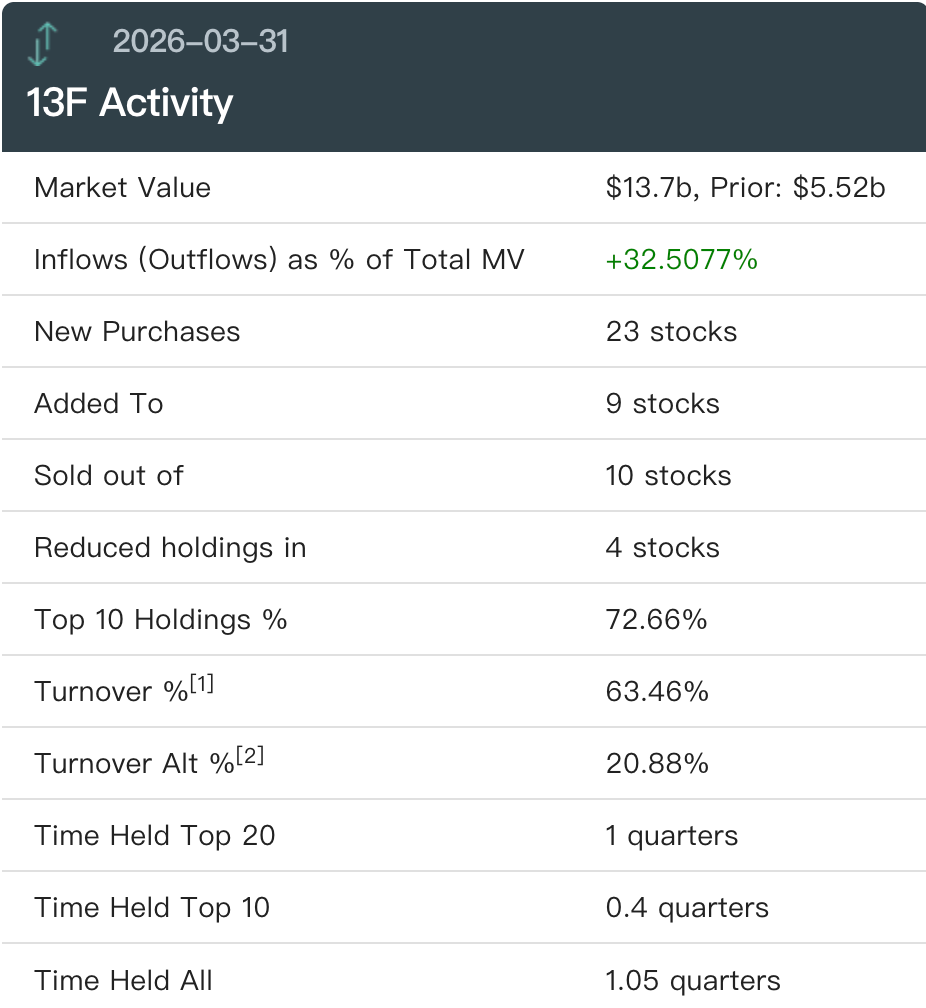
According to this latest 13F filing, as of March 31, 2026, Situational Awareness LP's total nominal portfolio value had surged to $13.7 billion, more than doubling (148%) from $5.52 billion on December 31 last year.
- Odaily Note: It's important to note that in the calculation of US stock 13F filings, the market value of options assets usually represents the "Notional Value" of the underlying stocks, not the actual premium cost paid by the fund. This means that while the fund built a semiconductor hedging wall worth tens of billions in notional assets, its actual cash cost (maximum loss) is much smaller, representing a typical high-leverage macro hedge.
Furthermore, net capital inflows this quarter accounted for 32.51% of the fund's total portfolio value, indicating that the fund's explosive growth was not only due to portfolio appreciation but also significant new external capital subscriptions.
Aggressive Portfolio Rebalancing
The filing also shows that Situational Awareness LP executed substantial portfolio adjustments in the first quarter of this year.
- New Purchases: 23 stocks (including options);
- Added To: 9 stocks;
- Sold Out: 10 stocks (including options);
- Reduced Holdings: 4 stocks (including options).
New Purchases: Hedging Against Semiconductor Downturn with 60% of Portfolio
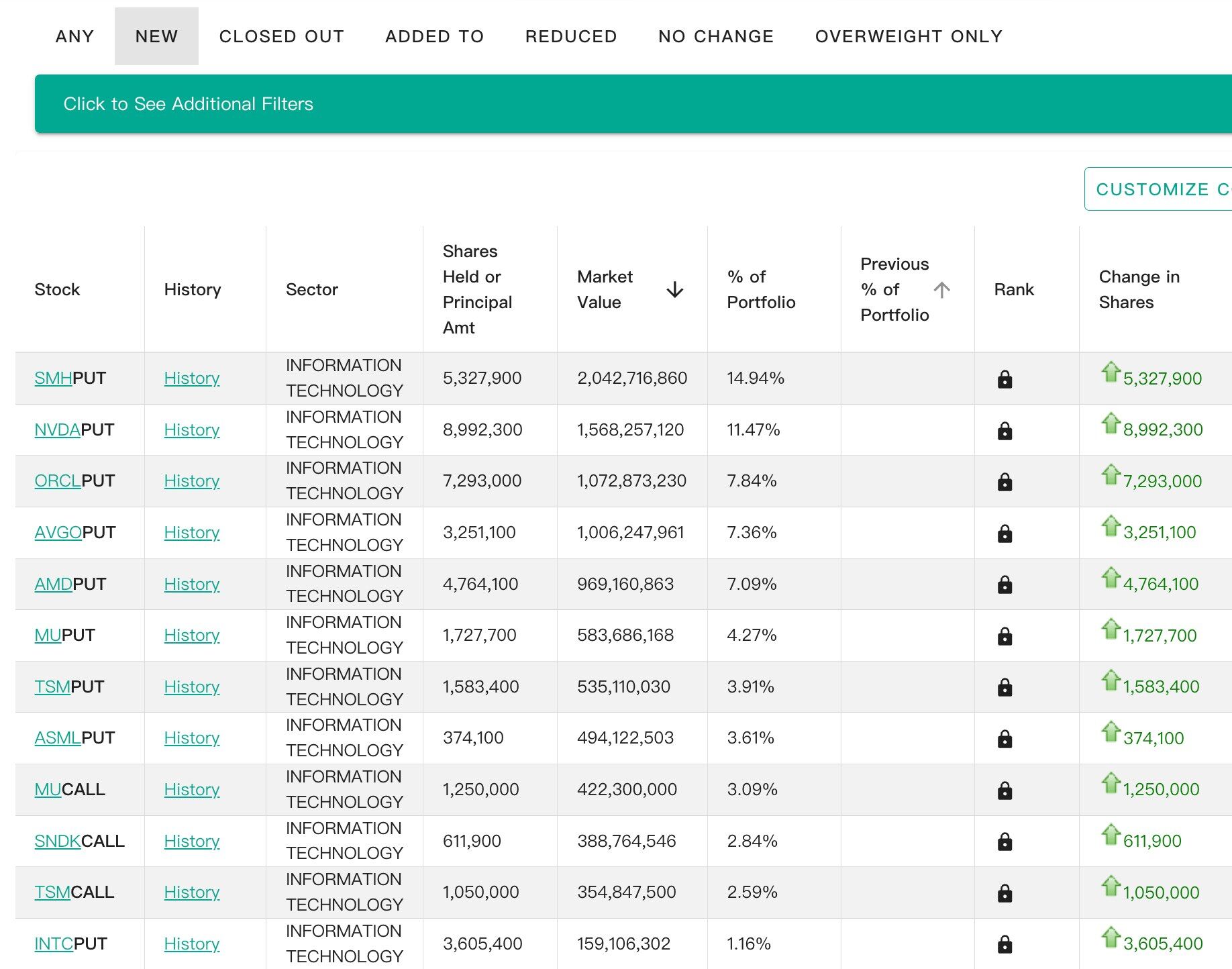
- Odaily Note: The chart above only covers new positions valued over $100 million. All 23 new stocks can be viewed via this link.
Looking first at the new purchases, which contain the most shocking information in Situational Awareness LP's entire 13F report: In the first quarter, the fund used a massive Put option position to systematically hedge risk in the AI semiconductor and computing hardware sectors.
Let's look at the data directly:
- SMH PUT (VanEck Semiconductor Core ETF Put Options): 14.94% ($2.04 billion market value) – Largest new position;
- NVDA PUT (NVIDIA Put Options): 11.47% ($1.56 billion market value) – Second largest new position;
- ORCL PUT (Oracle Put Options): 7.84%;
- AVGO PUT (Broadcom Put Options): 7.36%;
- AMD PUT (AMD Put Options): 7.09%;
These top five put option positions alone accounted for 48.7% of Situational Awareness LP's $13.7 billion total nominal portfolio value. Including put options on Micron (MU), TSMC (TSM), ASML (ASML), and Intel (INTC), over 60% of the fund's nominal positions are betting on or hedging against a decline or sharp volatility in core AI hardware stocks.
Additionally, it's noteworthy that Situational Awareness LP simultaneously bought both call and put options on the same stocks, such as buying Micron put options (MU PUT, 4.27%) while also buying MU CALL (3.09%), and buying TSMC put options (TSM PUT, 3.91%) while also buying TSM CALL (2.59%).
This is a common two-way betting strategy used by hedge funds, suggesting the fund believes that Micron (memory chips) and TSMC (foundry) could experience stock price volatility significantly exceeding market expectations in upcoming earnings reports or industry cycles in 2026, due to geopolitical factors or extreme supply-demand imbalances. If the one-way swing is large enough, it can be profitable on both sides.
Additions: Still Favoring Sandisk and CRWV in Common Stocks
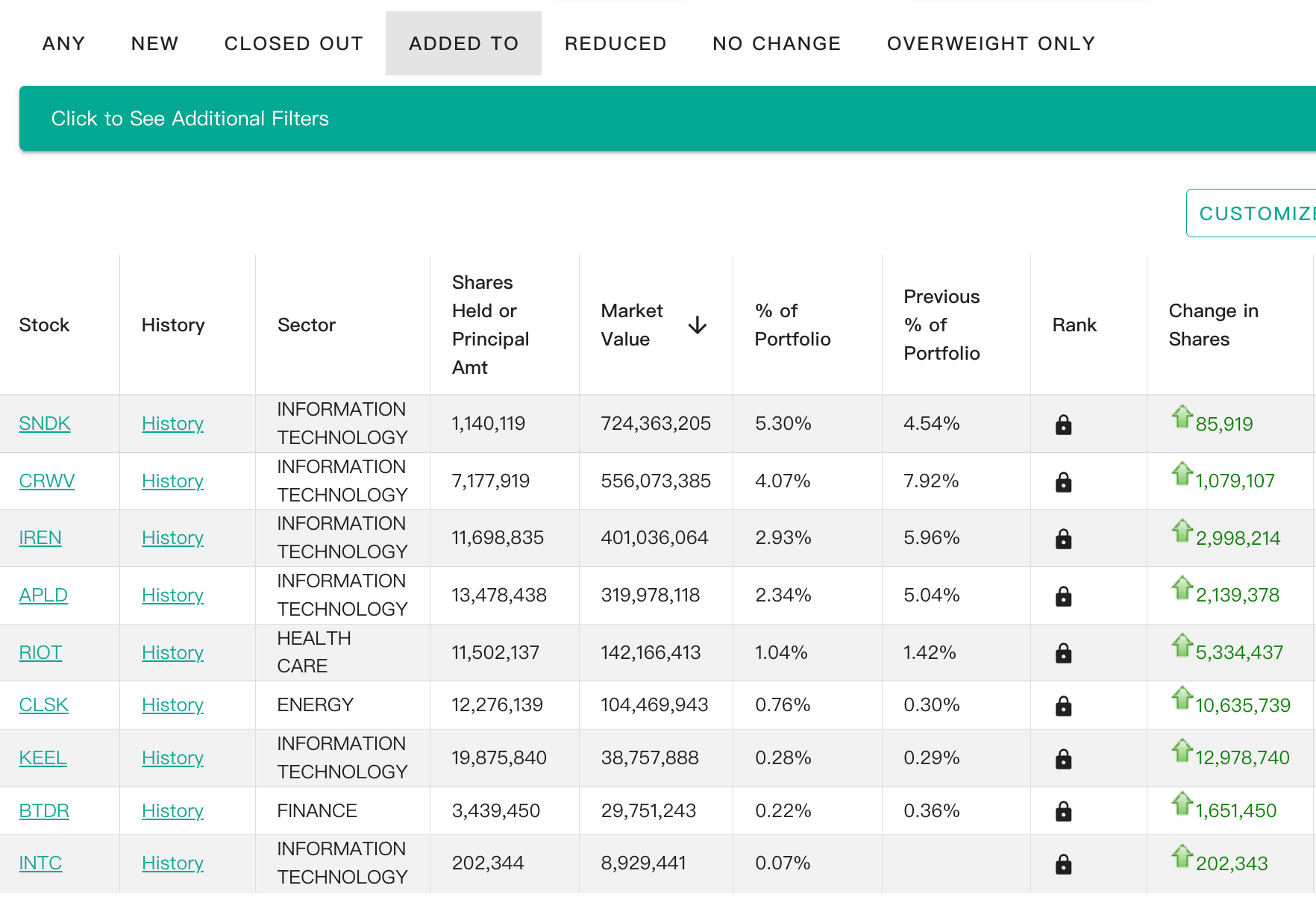
Regarding additions, Situational Awareness LP did not use options but instead increased holdings in 9 stocks through common stock purchases.
In the first quarter, Situational Awareness LP slightly increased its holdings of Sandisk (SNDK) by 85,000 shares, bringing total holdings to 1.14 million shares, with a market value of $724 million, accounting for 5.30% of the entire portfolio. This is one of the very few super-heavyweight positions in Situational Awareness LP's portfolio held entirely in common stock.
Another notable action is that Situational Awareness LP significantly increased its holdings of CoreWeave (CRWV) by over 1.07 million shares in Q1, pushing the position value to $556 million, or 4.07% of the portfolio. CoreWeave is one of the most closely watched infrastructure companies in the AI GPU cloud services sector and a key partner in the NVIDIA ecosystem. After its IPO, Situational Awareness LP quickly integrated it into its core portfolio and aggressively added to the position. This indicates that while the fund is shorting NVIDIA's short-term valuation (via PUTs), it remains extremely bullish on the cloud giants that directly convert GPUs into computing power for leading AI models.
Furthermore, Situational Awareness LP also added positions in computing or power infrastructure companies like KEEL, IREN, APLD, RIOT, CLSK, and BTDR, continuing the logic advocated by Leopold Aschenbrenner that "Electricity is the new oil."
Sell-Offs: Exiting Intel Call Leverage, Withdrawing from Optical Communications
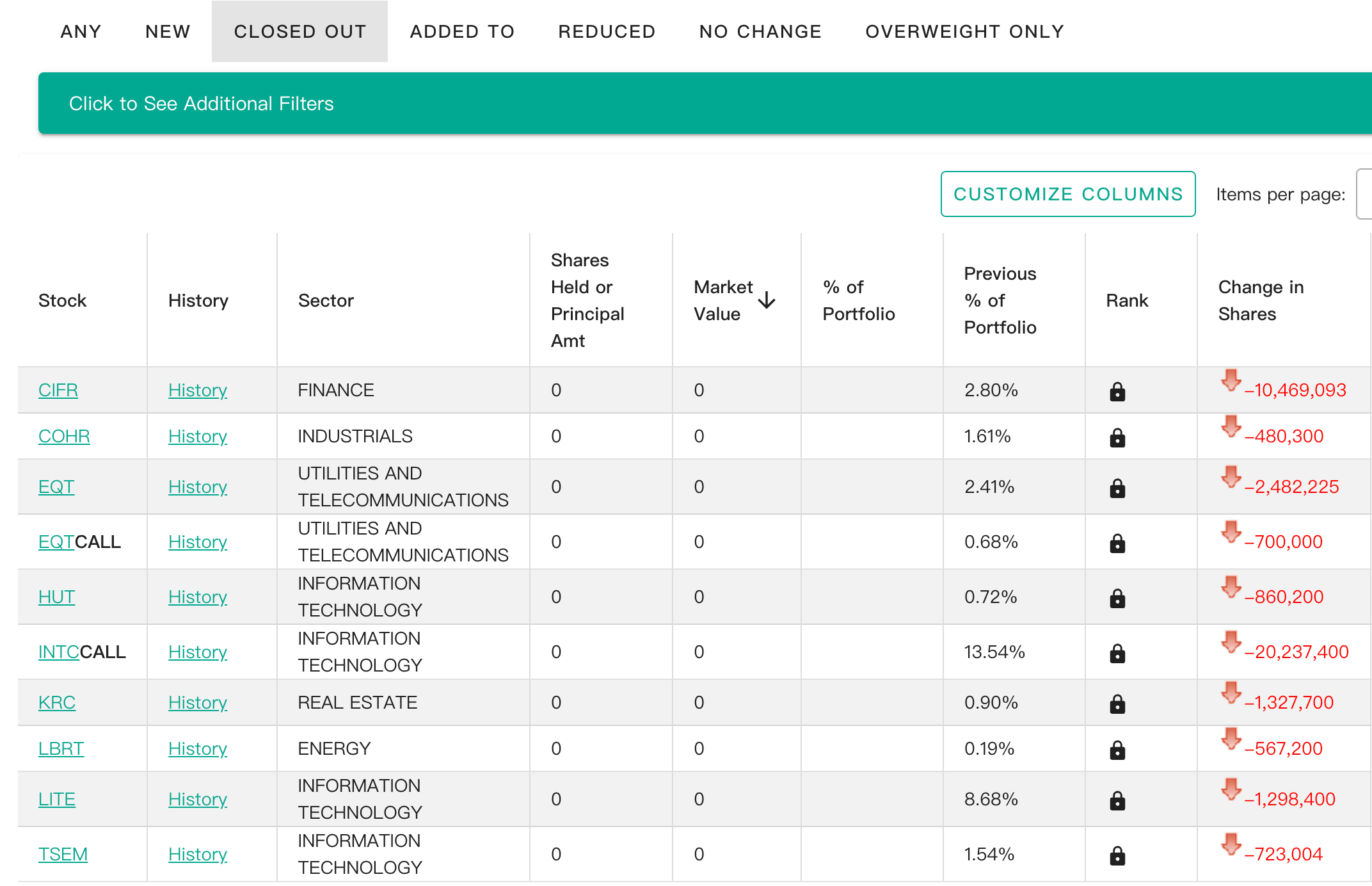
Regarding sell-offs, Situational Awareness LP's biggest move was completely unwinding its leverage on Intel call options (INTC CALL). In the previous reporting period, Situational Awareness LP had bet over 13% of its portfolio on Intel call options (as high as 20.23 million option contracts), a highly leveraged directional bet. It completely exited this position in Q1, switching to a minor common stock holding (0.07%).
Additionally, Situational Awareness LP completely sold out of LITE (8.68% weight in previous period) and COHR (1.61% weight in previous period). LITE and COHR are both global giants in optical communication chips and optical transceivers. This sell-off suggests Situational Awareness LP is withdrawing from the AI optical module/network hardware sector.
Situational Awareness LP also sold out of CIFR (2.80% weight in previous period) and HUT (0.72% weight in previous period) in Q1, both of which are cryptocurrency mining companies (including CORZ reduced in the next section). Considering the additions to similar companies like RIOT, CLSK, and BTDR, this may simply be a routine portfolio adjustment.
Reductions: Taking Profits on BE
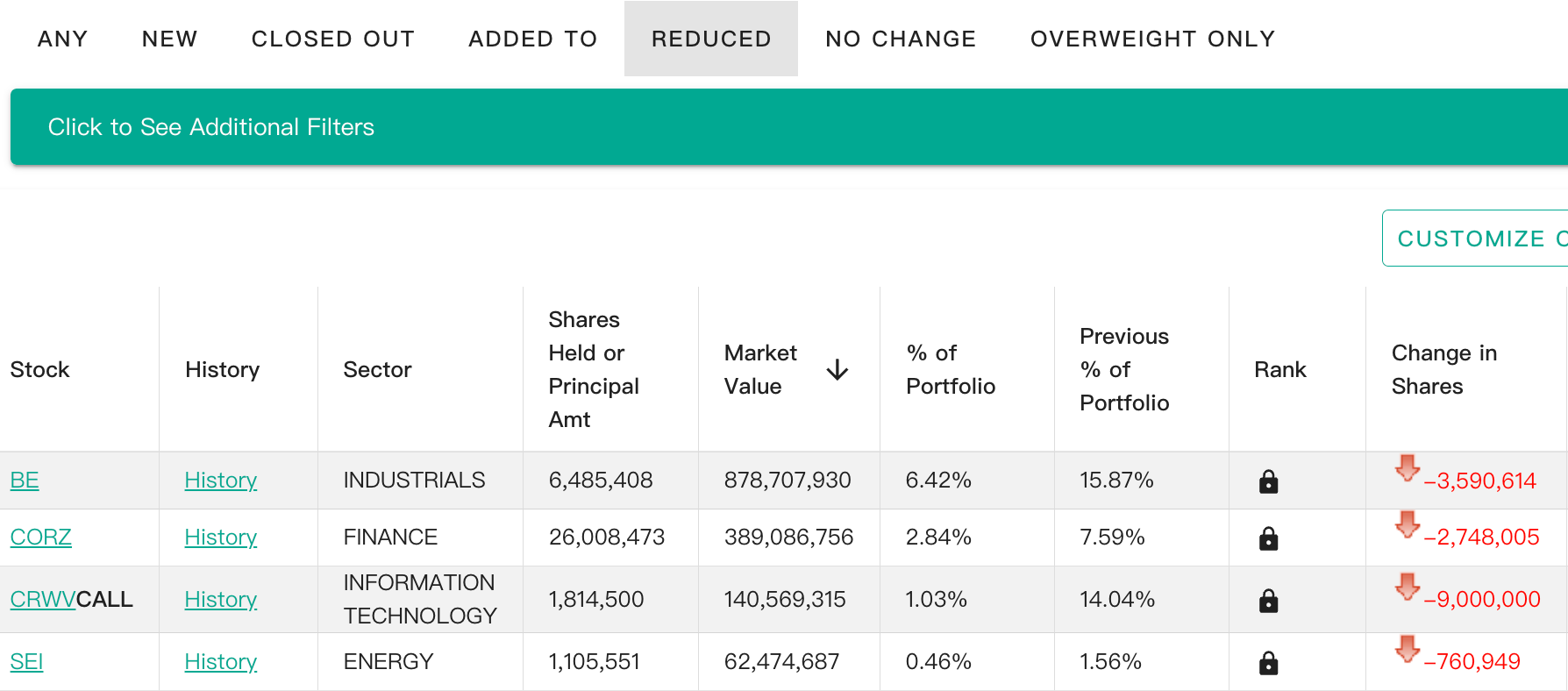
Looking at the reductions, Bloom Energy (BE) was Situational Awareness LP's largest disclosed holding in the previous 13F filing. In Q1, the fund reduced its stake by 3.59 million shares, causing the position weight to drop sharply from 15.87% to 6.42%.
Bloom Energy specializes in solid oxide fuel cell technology and is a core target for data center "on-site independent power generation," bypassing the traditional grid. Given the still large remaining position, the reduction doesn't imply Situational Awareness LP has turned bearish on the company but is more likely a routine profit-taking move.
CoreWeave call options (CRWV CALL) were Situational Awareness LP's second-largest reduction (position weight plummeting from 14.04% to 1.03%). As mentioned earlier, the fund shifted to holding CRWV in common stock, so this is more about deleveraging.
Situational Awareness LP also reduced its stake in Core Scientific (CORZ) by 2.74 million shares, bringing the position from 7.59% down to 2.84%. CORZ is a leading Bitcoin miner transitioning to AI computing hosting. However, considering Situational Awareness LP added other mining companies in transition with more attractive valuations this quarter, reducing CORZ appears to be another partial profit-taking move.
What is the "AI Stock God" Really Thinking?
If one only looks at the surface data of this 13F filing, many might draw a simple, crude conclusion – Leopold Aschenbrenner, who once loudly predicted "AGI by 2027," is turning completely bearish on AI.
But the reality is clearly not that simple. Within Situational Awareness LP's portfolio structure, there exist two seemingly contradictory yet highly unified main themes.
- On one hand, extreme caution regarding short-term valuation bubbles in the "chip sector." Situational Awareness LP used a staggering notional value of PUT positions, essentially buying "crash insurance" for the entire AI semiconductor supply chain, including NVIDIA and Broadcom.
- On the other hand, an almost obsessive optimism about long-term AI infrastructure demand. Whether it's CoreWeave, Bloom Energy, or a series of power, transformer, and data center companies, all point to the same deterministic logic – the AI computing war has entered deep water.
This is likely Situational Awareness LP's core judgment at present. What will truly be scarce in the future may not be the GPU chips themselves, but the energy, power systems, and data center infrastructure needed to keep these GPUs running continuously. GPU production can be expanded, and advanced manufacturing processes will eventually ramp up, but megawatt-level power supply capabilities, transformers, transmission systems, and large-scale data center construction cycles are difficult to replicate simultaneously in a short period. Compared to the "selling shovels" logic already fully priced in by the market, Leopold Aschenbrenner seems more focused on where the real bottlenecks might appear in the next phase of the AI industry.
This also explains why Situational Awareness LP would simultaneously buy large-scale semiconductor put options to hedge against sharp volatility in the AI hardware sector while continuing to heavily invest in GPU cloud services, power, and computing infrastructure assets.
In a sense, this 13F filing reads less like a simple disclosure of holdings and more like Leopold Aschenbrenner's roadmap for the next evolutionary phase of the AI supply chain.
When a genius investor who rose to fame by going all-in on AI begins allocating billions of dollars in notional value to buy insurance for the AI sector, it at least indicates one thing – even the most steadfast AI bull of this era has begun to take volatility seriously.


