






Báo cáo Đạo luật CLARITY mang đến biến số lớn nào cho cuộc bầu cử giữa nhiệm kỳ năm 2026?


- Quan điểm cốt lõi: Khảo sát của HarrisX cho thấy cử tri Mỹ ủng hộ xuyên đảng thông qua Đạo luật CLARITY nhằm đảm bảo vị thế dẫn đầu của Mỹ trong lĩnh vực tiền mã hóa. Vấn đề này đã trở thành một biến số chính trị quan trọng ảnh hưởng đến cuộc bầu cử giữa nhiệm kỳ năm 2026, mang lại lợi thế bầu cử đáng kể cho những người ủng hộ.
- Các yếu tố then chốt:
- Tỷ lệ ủng hộ cao và lợi ích bầu cử: 52% cử tri ủng hộ Đạo luật CLARITY, chỉ 11% phản đối. Ủng hộ đạo luật này có thể mang lại cho các thượng nghị sĩ mức lợi ích bầu cử ròng là 20 điểm phần trăm, 37% cử tri có xu hướng bỏ phiếu cho ứng cử viên ủng hộ đạo luật.
- Sức hấp dẫn xuyên đảng: 47% cử tri sẽ cân nhắc bỏ phiếu xuyên đảng nếu ứng cử viên ủng hộ đạo luật này, tỷ lệ này ở những người nắm giữ tiền mã hóa lên tới 72%, cho thấy vấn đề này có khả năng phá vỡ rào cản đảng phái và thu hút cử tri dao động.
- Động lực từ câu chuyện an ninh quốc gia: 56% cử tri cho rằng nếu các hệ thống thanh toán kỹ thuật số được xây dựng ở nước ngoài sẽ làm suy yếu an ninh quốc gia Mỹ. Lý do này được 23% cử tri cảnh giác coi là lý do hàng đầu để ủng hộ đạo luật, đưa vấn đề quản lý trở thành vấn đề cạnh tranh quốc gia.
- Sự bất mãn với hiện trạng và yêu cầu hành động: 70% cử tri cho rằng Mỹ lẽ ra đã thông qua luật về tiền mã hóa từ lâu, 60% sẵn sàng chấp nhận quy định liên bang không hoàn hảo hơn là tiếp tục phụ thuộc vào mô hình "xử lý từng vụ" của SEC, phản ánh tính cấp bách lập pháp mạnh mẽ.
- Khoảng cách nhận thức và sở thích chính sách: Chỉ 33% cử tri biết rằng 8 trong số 10 sàn giao dịch lớn nhất toàn cầu có trụ sở ở nước ngoài, nhưng sau khi được thông báo, 46% cho rằng đó là một vấn đề. Tỷ lệ ưa chuộng các quy tắc rõ ràng hơn là giám sát thực thi vẫn ở mức gần 50%, cho thấy thông tin bổ sung có thể củng cố sự ủng hộ.
Original Title: National survey of voters shows bipartisan support for American leadership in cryptocurrencies and passing the CLARITY Act.
Original Author: HarrisX
Original Translation: Peggy, BlockBeats
Editor's Note: Crypto regulation is emerging as a new variable in the 2026 U.S. midterm elections.
A HarrisX survey shows that national voters not only support, across party lines, U.S. leadership in digital finance and cryptocurrencies, but also broadly support the passage of the CLARITY Act.
Note: HarrisX conducted an online poll of 2,008 registered voters from May 1 to 4, 2026.
This bill was originally a regulatory framework legislation, centering on clarifying the regulatory boundaries of the SEC and CFTC over digital assets, establishing registration rules for exchanges and custodians, and enhancing consumer protection. However, based on the HarrisX survey results, its political significance extends beyond the crypto industry itself: 37% of voters said they would be more likely to support a Senator who voted for the bill; overall, supporting the CLARITY Act could yield a net electoral gain of 20 percentage points.
More noteworthy is the cross-party flow. The survey shows that 47% of voters said they would consider voting for a candidate outside their preferred party if that candidate supported the CLARITY Act, but their preferred party did not. This percentage is even higher among cryptocurrency holders, voters familiar with digital assets, and those aware of the bill.
This means the CLARITY Act is not just a legislative attempt by the crypto industry to seek regulatory clarity, but could also become a tool for candidates to attract young voters, crypto holders, and swing voters. For the U.S. political class, the core question regarding crypto regulation is shifting from "whether to regulate" to "who can use it to mobilize votes."
Below is the original text:
Introduction
Digital assets and their federal regulatory framework are at a critical turning point.
The Digital Asset Market Clarity Act of 2025 (CLARITY Act, H.R.3633), currently under consideration in Congress, will clarify three things: which types of digital assets are regulated by the SEC or the CFTC, registration rules for cryptocurrency trading platforms and custodians, and industry-wide consumer protection standards. This is one of the most important pieces of digital asset legislation Congress has ever considered.
Building on its long-standing experience in public opinion polling, HarrisX conducted a national survey of 2,008 registered voters to measure four things: voters' awareness and ownership of digital assets, their attitudes towards U.S. leadership in digital finance, support for the CLARITY Act, and whether a candidate's stance on crypto regulation could influence the 2026 midterm elections.
Eight of the world's top ten cryptocurrency trading platforms are headquartered outside the United States. As digital payment systems and stablecoin infrastructure accelerate globally, if the U.S. continues to lack clear federal rules, it risks ceding dominance over a strategic financial technology to overseas jurisdictions. This would tangibly impact national security, the global status of the U.S. dollar, the retention of developers and businesses, and America's overall competitiveness in fintech innovation.
Bipartisan voters recognize this risk and want Congress to act quickly.
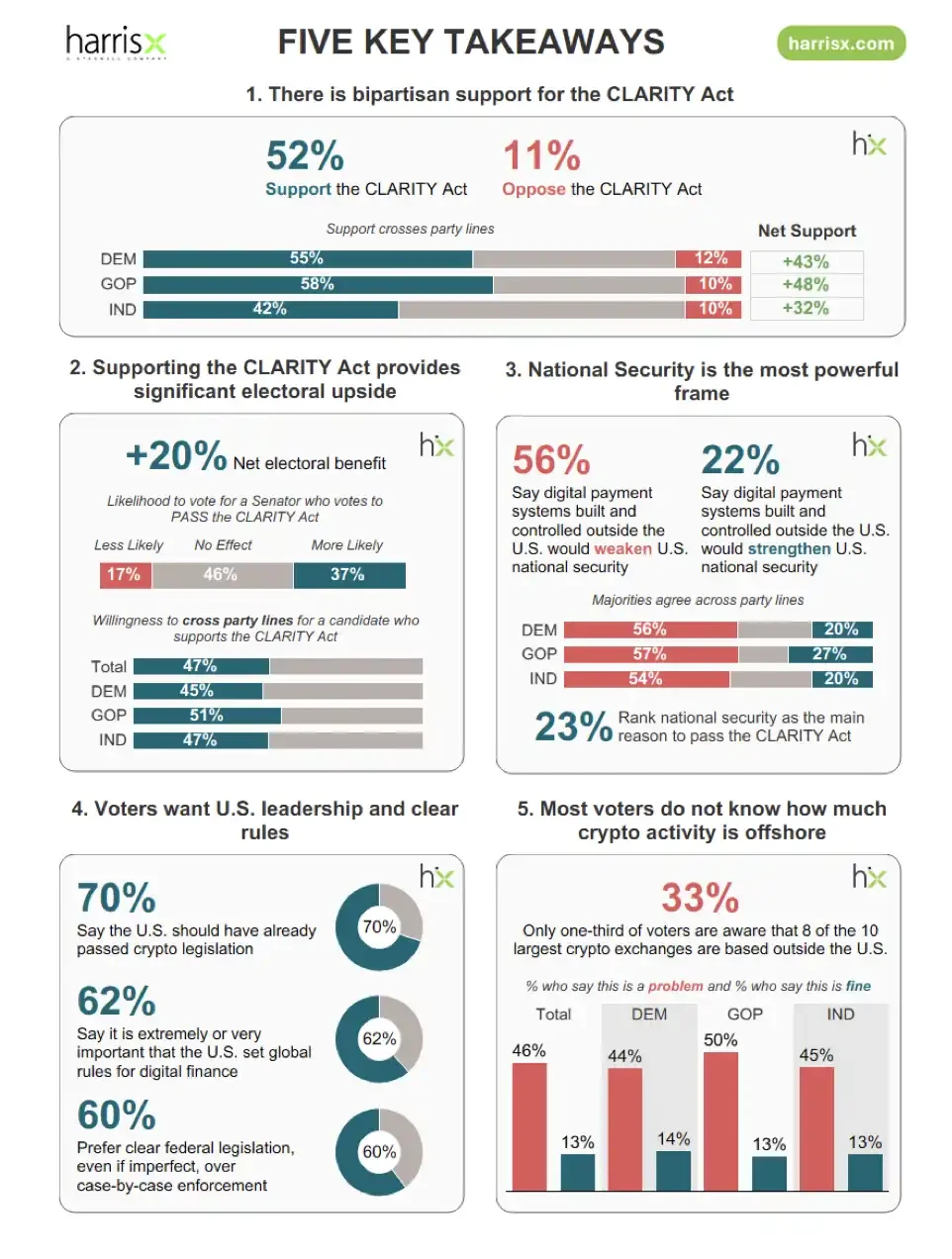
This is a voter poll conducted by HarrisX on the CLARITY Act (U.S. cryptocurrency market structure legislation). The five charts present five core findings:
Chart 1 | The bill enjoys bipartisan support. 52% of respondents support the CLARITY Act, while only 11% oppose it; the net support among Democrats, Republicans, and Independents is +43%, +48%, and +32% respectively, with Republican voters showing the highest support.
Chart 2 | Supporting the legislation provides a clear electoral advantage. The net electoral gain is +20% – 37% of voters said they would be more likely to vote for a Senator who helped pass the CLARITY Act, while only 17% said less likely; 47% of voters would cross party lines to vote for a candidate supporting it, with Republican voters the most likely (51%).
Chart 3 | "National security" is the most compelling narrative framework. 56% of respondents believe a digital payment system built and controlled outside the U.S. would weaken American national security, while only 22% believe it would strengthen it; this view is a majority consensus across all three major parties (DEM 56%, GOP 57%, IND 54%). 23% of voters cited national security as the primary reason for the bill's passage.
Chart 4 | Voters want the U.S. to take the lead and establish clear rules. 70% believe the U.S. should have already passed crypto legislation; 62% say it's "extremely important" or "very important" for the U.S. to establish global rules for digital finance; 60% prefer an imperfect but clear federal law over continuing the current "case-by-case enforcement" regulatory approach.
Chart 5 | The majority of voters are unaware of the offshore status of the crypto industry. Only 33% of voters know the fact that "eight of the world's top ten crypto trading platforms are headquartered outside the U.S." After being informed, 46% consider this a problem, while only 13% think it's fine; this concern is most prominent among Republican voters (50%).
U.S. Leadership and the Need for Clear Federal Rules
Voter awareness of digital assets remains limited, but their views are clear and consistent: The U.S. should establish rules for digital finance, and do so quickly.
Digital asset awareness is still low, but crypto holders are already a significant voting bloc
· 39% of voters say they are familiar with digital assets and blockchain technology, while 61% are not familiar.
· Two in five voters have purchased cryptocurrency, with 30% having done so in the past year.
· Familiarity and ownership are concentrated among male voters and those under 35.
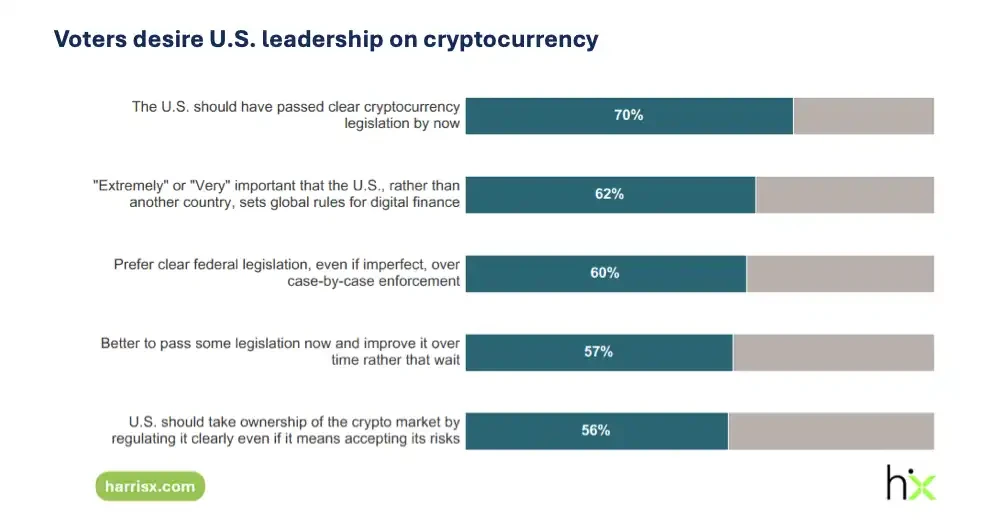
This chart focuses on a core issue – the strong desire among U.S. voters for their country to establish dominance in the cryptocurrency space. HarrisX, using five questions covering "urgency, global status, regulatory path, legislative pace, and risk-taking," paints a very clear picture of public opinion:
70% | Legislation should already be in place. Seven in ten voters believe the U.S. should have already passed clear cryptocurrency legislation. This is a judgment about "timing" – voters are no longer discussing "whether to act," but expressing anxiety over "why it hasn't happened yet."
62% | Global rules should be written by the U.S. Regarding the power to set global rules for digital finance, 62% of voters say it is "extremely important" or "very important" for the U.S. to lead, rather than another country. This effectively elevates crypto regulation from a "financial issue" to a "national competition issue."
60% | Prefer clear federal law over case-by-case enforcement. Six in ten voters explicitly state they would rather have an imperfect but clear federal law than continue operating in the gray area of "case-by-case enforcement by regulatory agencies." This is a direct rejection of the SEC's "litigation instead of legislation" approach over the past few years.
57% | Pass first, iterate later. 57% of voters believe it's better to pass the current version of the bill first and improve it gradually over time, rather than wait for a perfect bill. This echoes the legislative logic of "don't let perfect be the enemy of the good" and reduces political resistance during the legislative process.
56% | Willing to take risks for leadership dominance. Even if it means bearing the inherent risks of the crypto market, 56% of voters believe the U.S. should "take over" this market through clear regulation. In other words, voters' concern about "letting the market flow overseas" now outweighs their concern about "the trouble that regulation itself might bring."
Voters Want the U.S. to Maintain Leadership in Cryptocurrency
While most voters are not familiar with the technical details of digital assets, they demonstrate a strong, broad, and stable demand for U.S. leadership and clear federal rules.
A 70% majority of voters believe the U.S. should have already passed clear cryptocurrency legislation; 62% say it is important for the U.S. to establish global rules for digital finance.
Voters also do not favor continuing the case-by-case enforcement approach: 60% prefer clear federal legislation, even if imperfect; 57% believe it is better to pass some legislation now and improve it over time, rather than wait for a perfect law.
Even when trade-offs are clearly stated, voters lean towards action. 56% believe the U.S. should take control of the crypto market through clear regulation, even if it means accepting the associated risks.
Overall, these results indicate that voters are not asking Congress to continue debating "whether to act," but are demanding that Congress act quickly, clearly, and at the federal level.
Offshore Concentration is a Significant but Underappreciated Issue
Voters support U.S. regulation. The high concentration of crypto trading platforms overseas provides another concrete reason for voters to support federal crypto regulatory rules.
The survey shows voters are generally unaware of how much digital asset market activity occurs outside U.S. oversight; however, once informed of this fact, few find it acceptable.
· Only one-third of voters know that eight of the world's top ten crypto platforms are headquartered outside the U.S.
· Upon learning this fact, 46% of voters believe that most crypto trading occurring outside U.S. oversight is at least somewhat of a problem; only 13% think it is not a problem or is even a good thing.
National Security is a Key Driver for Voter Support of Federal Action
When this issue is framed within the context of national security, voter concerns about foreign-controlled digital payment systems potentially weakening U.S. security and the global standing of the dollar are further amplified.
· 56% of voters believe a future digital payment system built and controlled by a country other than the U.S. would weaken American national security. Only 22% believe it would strengthen it.
· Over two-fifths of voters believe that if foreign-issued stablecoins become dominant, it would weaken the global status of the U.S. dollar; only 17% believe it would strengthen the dollar's position.
Voters Have Long Desired Better Rules and Regulation for Digital Assets
The demand for federal action did not start with the current debate. Over the past three years, multiple HarrisX studies have consistently shown that voters have consistently preferred clearer rules, stronger safeguards, and a more proactive U.S. regulatory approach to digital assets.
Findings from our previous research include:
· Voters want clear crypto rules, not regulation by enforcement. In a 2024 study, voters preferred clear rules over enforcement regulation by a margin of 48% to 23%; by 2025, this gap remained largely consistent, with 49% supporting clear rules and 26% supporting enforcement regulation.
· Voters believe the U.S. is falling behind, creating a leadership gap. In both 2024 and 2025, only about one-fifth of voters thought the U.S. was leading in crypto regulation, while 36% thought it was falling behind.
· But voters want the U.S. to lead this field. In 2025, 69% of registered voters and 84% of crypto investors said it was important for the U.S. to lead the world in blockchain technology development; 82% of voters supported Congress establishing stricter rules for crypto trading platforms and brokers.
Note 2: Sources include a HarrisX/Blockchain Association survey of 1,717 U.S. registered voters conducted October 25–28, 2024, and a HarrisX/Blockchain Association survey of 1,861 U.S. registered voters conducted December 3–4, 2025.
The CLARITY Act Enjoys Bipartisan Support
After being presented with a neutral description, 52% of voters support the CLARITY Act, while 11% oppose it. Support is bipartisan, and the persuadable middle group is large.
Current voter awareness of the bill remains low
· 64% of voters have not heard of the CLARITY Act; 14% say they have heard a lot about it, and 22% say they have heard a little.
· The description of the bill that voters first hear will determine its ceiling of political support. The neutral description used in this survey generated solid majority support.
After hearing a neutral description, support is strong and opposition is limited
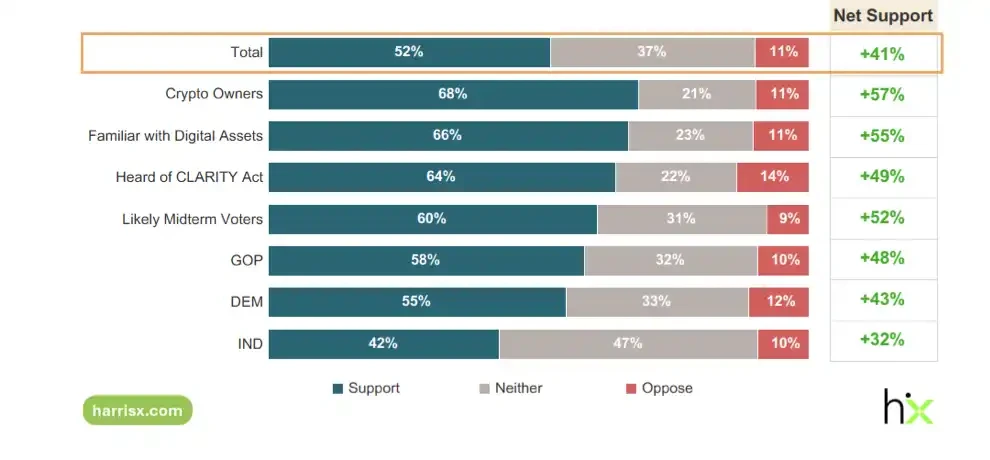
Survey Question CL12: The CLARITY Act would clarify which federal agency, the SEC or the CFTC, regulates different types of digital assets; establish registration rules for cryptocurrency trading platforms and custodians; and establish consumer protection standards for the industry. Based solely on this description, would you support or oppose this legislation?
The CLARITY Act has strong support among key demographics
· Support is clearly bipartisan: net support among Republican voters is +48, among Democrats +43, among likely midterm voters +52, and among Independents +32.
· Only 10% of Independent voters oppose the bill, with the vast majority occupying the persuadable middle ground: 47% neither support nor oppose it.
· Support is highest among those most familiar with the issue: net support among cryptocurrency holders is +57, among voters familiar with digital assets +55, and among those aware of the CLARITY Act +49. Higher education and information exposure correlate with increased support.
Support for the CLARITY Act is rooted in broader national security concerns
When asked which reason best supports passing the CLARITY Act, voters provided the following answers:
· National Security & Dollar Status (23%): "Keeping the U.S. dollar and U.S. payment systems at the center of global finance is a national security priority."
· Law Enforcement & Illicit Finance (17%)
· Consumer Protection & Fraud Prevention (16%)
· Jobs & Businesses Leaving the U.S. (11%)
Electoral Impact of Supporting the CLARITY Act
Voting for the passage of the CLARITY Act is a clear electoral asset across party lines. Nearly half of voters say such issues could prompt them to vote across party lines.
Senators voting for the CLARITY Act gain support among various voter groups
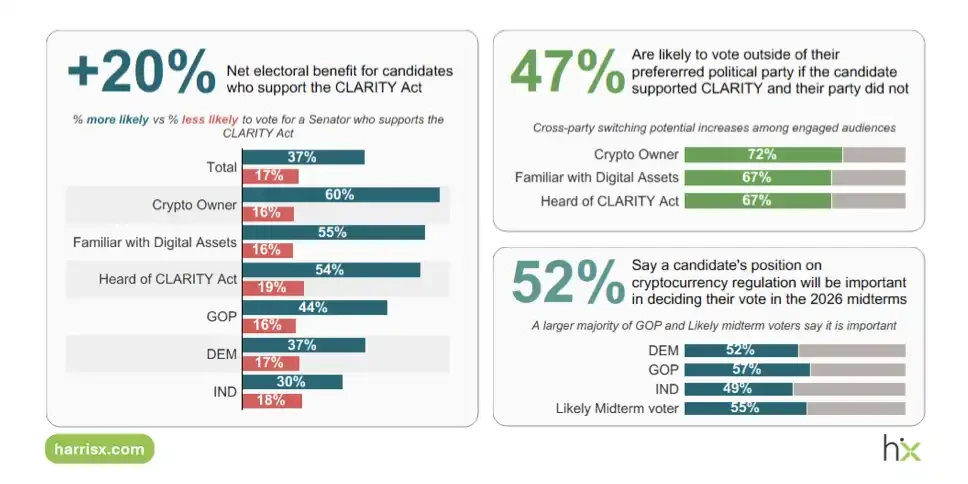
37% of voters say they would be more likely to support a Senator who voted for the passage of the CLARITY Act; 17% say less likely; 46% say it makes no difference. Overall, the net gain is +20.
This impact is strongest among Republican voters, with 44% saying they would be more likely to support such a Senator; it remains positive among Democratic voters at 37%; and among Independent voters at 31%.
Cross-Party Appeal: 47% of voters would consider crossing party lines to vote on this issue
· In a midterm election environment where most issues reinforce existing partisan divides, the CLARITY Act is one of the few legislative issues that could create cross-party flow.
· 47% of voters say they would at least somewhat consider voting for a candidate outside their preferred party if that candidate supported the CLARITY Act but their preferred party did not.
· This willingness to cross party lines is higher among cryptocurrency holders (72%), those familiar with digital assets (67%), and those aware of the CLARITY Act (67%).
A majority of voters say this issue will influence their 2026 vote
· 52% of voters say a candidate's stance on cryptocurrency regulation will be "extremely important" or "somewhat important" to their vote in the 2026 midterm elections.
· Among cryptocurrency holders, this percentage rises to 78%; among those familiar with digital assets, it's 74%.
· Issue intensity is moderate, with 16% of voters saying it is "extremely important." While it is not yet a top-tier voting driver, it has broad political reach: many voters are willing to factor crypto regulation into their 2026 voting decisions.
Crypto voters are a sizable and influential voting bloc
Beyond


