






Cobie mới nhất: Thị trường tiền điện tử đang trải qua 'Phân hóa hình chữ K'


- Quan điểm cốt lõi: Ngành công nghiệp tiền điện tử đang trải qua "phân hóa hình chữ K": các ứng dụng thực tế (stablecoin, thị trường dự đoán) đang tăng trưởng, nhưng hiệu suất của các tài sản token mà nhà đầu tư phổ thông có thể tham gia lại yếu kém, dẫn đến tâm lý thị trường ảm đạm. Sự khác biệt giữa các nguyên tắc cơ bản của ngành và cảm nhận thị trường bắt nguồn từ việc cấu trúc phân phối giá trị đang bị tư nhân hóa bởi hệ thống tài chính truyền thống, và các cá nhân nên định vị lại dựa trên niềm tin dài hạn thay vì biến động ngắn hạn.
- Các yếu tố chính:
- "Phân hóa hình chữ K" dẫn đến sự tồn tại song song của tăng trưởng ứng dụng và sự suy yếu của tài sản. Giá trị từ các ứng dụng như Polymarket, stablecoin đang bị tư nhân hóa (ví dụ: Stripe), và nhà đầu tư phổ thông không có được mức độ tiếp xúc token tương ứng.
- Về mặt lịch sử, mỗi làn sóng người dùng đổ vào đều dựa trên cùng một cơ chế: người bình thường kiếm tiền trong thời gian ngắn thông qua altcoin, ICO, NFT hoặc meme coin. Việc AI hiện tại thu hút nhân tài, về bản chất, là sự thể hiện của cùng một cơ chế trên các lĩnh vực khác nhau.
- Rủi ro lớn nhất của thị trường là giá trị bị "tiếp quản" và tư nhân hóa bởi hệ thống tài chính truyền thống (ví dụ: OpenAI, SpaceX), khiến thị trường công cộng trở thành lối thoát thanh khoản, thay vì điểm khởi đầu cho giá trị.
- Cobie cho rằng, tiền điện tử hoạt động tốt nhất vào "thời điểm tồi tệ nhất"; khi tất cả các yếu tố tích cực (quy định, ETF, sự tham gia của tổ chức) được hiện thực hóa, nó lại giống một đỉnh cao tạm thời hơn.
- Đối với cá nhân, nếu không tin vào giá trị dài hạn của ngành trong 5-10 năm tới, hãy rời đi; nếu tin tưởng, hãy phân bổ tài sản dựa trên niềm tin đó, thay vì cố gắng làm giàu nhanh chóng trong ngắn hạn.
- Cơ chế airdrop trên chuỗi có thể mở rộng thành một thí nghiệm phân phối giá trị mới - người dùng nhận được lợi tức vốn cổ phần trong quá trình tạo ra giá trị, điều này có thể trở thành một nỗ lực thể chế để chống lại việc tư nhân hóa tài sản.
- Lời khuyên cá nhân của Cobie: Giữ tư duy độc lập, liên tục cập nhật nhận thức, và học cách hài lòng với những gì mình đang có; những người thành công thực sự trong dài hạn không phải là những nhà giao dịch hung hãn nhất.
Video Title: An Unfiltered Conversation with Cobie – Crypto, Markets, AI, Coinbase
Video Creator: Thread Guy
Compiled by: Peggy, BlockBeats
Editor's Note: This article is a compilation of a long conversation between crypto trader Cobie and content creator Thread Guy.
Cobie (@cobie) is one of the most representative market narrators in the crypto community and a former co-host of the popular podcast UpOnly. Known for his understanding of market cycles, trading experience, and a relatively restrained yet penetrating communication style, he has established a stable influence of opinion within the industry. In 2025, the platform he founded, Echo, was acquired by Coinbase.
Thread Guy operates at the intersection of content and product within the crypto ecosystem, running multiple projects including CounterpartyTV, Phantom, and Polymarket, playing the dual role of content creator and builder.
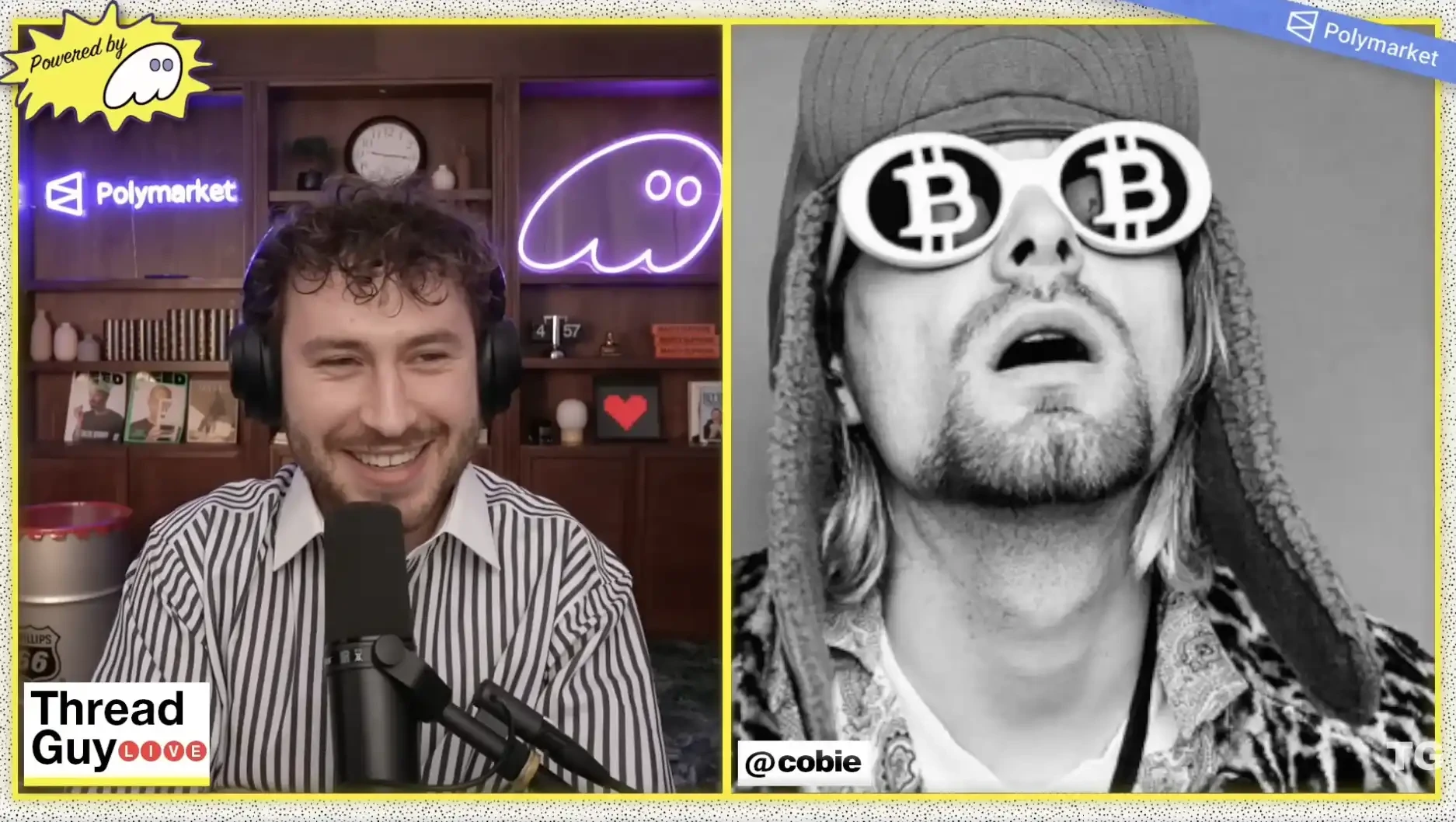
This conversation garnered significant attention in the community and was repeatedly praised as "a long-overdue, high-quality interview." The discussion didn't stop at market trends or short-term trading judgments but shifted to a more fundamental question: as the technical capabilities and institutional expectations of the crypto industry gradually materialize, why does the market still lack growth momentum? And, amid this structural misalignment, how should individuals reposition their own paths?
The conversation can be understood from three levels.
First is structural divergence. Cobie proposed a judgment that runs throughout the discussion: the crypto industry is experiencing a clear "K-shaped divergence." On one hand, applications like stablecoins, prediction markets, and on-chain trading are entering the real economy, with usage scenarios and user scale continuously expanding. On the other hand, the token assets accessible to ordinary investors are weak and seeing declining demand.
This misalignment – "applications growing, assets failing" – causes a disconnect between industry fundamentals and market sentiment, becoming a core source of the current low morale. For investors, the problem isn't "whether there is progress," but "whether the progress belongs to them."
Second is the repetition of paths. Looking back at the expansion trajectory of the crypto market over the past decade, a highly consistent cycle can be seen: from altcoins in 2013, ICOs in 2017, DeFi and NFTs in 2021, to the recent meme coin trend. Each wave of user influx relies on the same mechanism – ordinary people making significant gains in a short period, thereby creating a contagion effect.
The narratives change, but the driving force remains stable. From this perspective, the current rise of AI is not a competition with crypto but rather a continuation of the same mechanism: new tech narrative + lower barriers + the imagination of "getting rich quick." The migration of capital and talent is essentially a natural flow of cycles, not the failure of a single track.
Third is the reconstruction of distribution. Compared to the fluctuations of cycles and emotions, a deeper change is occurring in the value distribution structure. As companies like OpenAI and SpaceX accumulate massive value during their private funding stages, it's becoming increasingly difficult for ordinary investors to participate in the true wealth creation process. Public markets are gradually degrading into liquidity exits rather than value starting points. Against this backdrop, crypto's narrative of "open participation" faces the risk of being absorbed or even reconstructed by the traditional system.
However, Cobie also pointed out a potential path: if the current on-chain airdrop mechanism is expanded into a more universal form of "user value return" – where users gain equity distribution by contributing to a product's growth – crypto could still become an institutional experiment to counter this trend.
Amid all the structural discussions, Cobie's conclusion was the most direct: if you no longer believe in the long-term value of this industry, you should leave; if you still see its significance in five to ten years, you should allocate assets based on that judgment, rather than being repeatedly drained by short-term volatility.
The crypto market has never been a stable wealth generation system, but rather a series of constantly repeating experiments. Each narrative and each cycle reshapes the way participants and returns are distributed. When the short-term path is no longer clear, the question is no longer "what will happen next," but: Do you still believe that this system, at some point in the future, is still worth participating in?
The following is the compiled content of the conversation (some parts have been edited for clarity and readability):
TL;DR
- Current crypto is in a state of "misalignment." Truly valuable applications (stablecoins, prediction markets, on-chain trading) are developing rapidly, but ordinary investors cannot gain corresponding exposure, leading to extremely low sentiment.
- Historically, every wave of user influx stems from the same mechanism – ordinary people making money in a short period. From altcoins in 2013, ICOs in 2017, NFTs in 2021, to meme coins, the narratives differ, but the underlying logic is consistent.
- The market has already seen a "K-shaped divergence." On one side, applications and infrastructure are becoming more real and important; on the other, asset prices like tokens, memes, and governance coins are performing weakly, making investors feel worse.
- The most overlooked risk currently is: The value of crypto could be "taken over" and privatized by the traditional financial system, making it impossible for ordinary people to participate in true wealth creation (e.g., OpenAI, SpaceX).
- Counterintuitively, crypto often performs best in the "worst of times," and when all the good news is realized (regulation, ETFs, institutional entry), it often resembles a cyclical top.
- For individuals, if you no longer believe in the long-term value of crypto, you should leave rather than continue to drain yourself here; if you believe it will still be important in 5-10 years, allocate assets based on that judgment, rather than trying to get rich quick.
- Those who are truly successful in the long term are not the most aggressive traders, but those with independent judgment, continuously iterating on their understanding, and who are "content."
- Crypto still has potential long-term value: It could become a new distribution mechanism where users are rewarded for creating value (akin to an "on-chain equity/airdrop economy").
- Final conclusion: Crypto is not a short-term wealth-building tool, but a recurring systemic experiment. As long as it can create wealth and narratives, people will return.
Interview Content
Thread Guy:
Yo, what's up? How are you doing?
Cobie:
I actually just messed up. I was scrolling through Twitter and thought you were hosting a Space (maybe I'm just getting old), and I wanted to listen in. But when I clicked, I realized you were live streaming. I didn't even know Twitter had that feature. I was thinking, "Oh god, a nearly 40-year-old man is watching Thread Guy's live stream."
Thread Guy:
A lot of people are watching, not just you. The rich guys are watching too. So how have you been? You've been pretty quiet lately.
Cobie:
I'm not as funny anymore (laughs). But overall, I'm doing okay, not bad.
Thread Guy:
Everyone's asking when UpOnly is coming back. What have you been up to these past few months?
Note: UpOnly was a crypto podcast co-hosted by Cobie and Ledger from 2020 to 2022. It was primarily interview-based, focusing on market narratives, trading experience, and industry views. It was highly influential during the 2021 bull run and was considered a key discussion platform for the crypto community at the time.
Cobie:
Work, actual work.
Thread Guy:
The kind where you go to work at Coinbase?
Cobie:
Honestly, I'm working more now than I have in a long time. Actually, I wanted to join Coinbase a few years ago, even offered to work for free, but they didn't take me. From my perspective, there are "high-leverage" things in this industry that can change the entire trajectory, and making Coinbase successful is one of them, so I wanted to give it a shot.
Also, I've been on Twitter for 10 years. I need to do something more challenging and exciting than just thinking up jokes all day.
Note: Cobie tried to join Coinbase early on but failed. However, after his platform Echo was acquired by Coinbase in 2025, he re-entered this core institution by being "absorbed into the system."
Thread Guy:
I have a ton of questions for you, but let's start with the crypto market. The current state isn't that interesting, honestly. With the recent Arbitrum, Aave, LayerZero stuff, and the Drift issues, sentiment has hit rock bottom. How do you see crypto, especially DeFi, right now? Where is it heading?
Cobie:
I think we might be on the verge of DeFi 2.0.
For me, the thing that worries me most right now is that some models like Anthropic's (or that type of AI) seem to already be able to "participate" in these systems. This makes DeFi a bit of a "financial hunting ground." But conversely, once these models are more widely distributed, and not just attackers but also system builders can use them, the situation will be completely different. So I think this is an inflection point, and the future version of DeFi is actually quite exciting.
Sentiment in DeFi is very low right now. Besides a few projects like Hyperliquid and Trade.xyz, there's not much that's particularly interesting. But those examples themselves are very cool – really cool.
Thread Guy:
You're trading crude oil now, right?
Cobie:
You're trading crude oil? That's great. If you're making money, I'm happy for you.
Thread Guy:
Did you see the bear in my background?
Cobie:
You're starting to decorate, getting a bit of an American vibe.
Thread Guy:
Yeah, trading crude oil.
Cobie:
So you moved to New York to become a crude oil trader? That's an interesting life path.
K-Shaped Divergence: Applications Growing, Assets Failing
Thread Guy:
DeFi 2.0, AI... a lot of people even think you're AI now (laughs). But back on track, why are you still willing to invest your time in Coinbase? Haven't you become cynical about the future of crypto? A lot of people feel that way, including me – I'm trading crude oil, looking at stocks, doing all sorts of traditional assets.
Cobie:
You're essentially using crypto infrastructure to trade non-crypto assets, right?
I think crypto is undergoing a "K-shaped divergence." On one side, "crypto-native applications" are booming and more successful than ever, but this success isn't reflected in the asset prices that ordinary investors can buy.
For example, Polymarket is doing exceptionally well. Prediction markets have become a real sector, even forming a duopoly with Kalshi and Polymarket. Stablecoins are starting to be widely used; Doordash is even using stablecoins to pay its drivers. These things are happening in the real world and are important.
But the problem is, as an investor, you can't buy these things. You can't buy equity in Stripe – it's still private. You can't buy Polymarket. You can't buy the things that are actually doing well. Meanwhile, demand and attention for crypto assets themselves are declining. So you feel frustrated because you ask yourself, "What exactly should I buy?"
In fact, crypto is doing a lot of what it originally promised. Things like Hyperliquid, Trade.xyz, various on-chain markets – these are very cool. You can even predict Monday's opening price with an error of only a few basis points. This is already a "real market," running on-chain.
But the problem is the disconnect between market performance and real progress. Meme coins aren't up, governance tokens aren't up, so everyone thinks everything is terrible. But it's just that you can't get exposure to the things that are actually good.
From a broader perspective, I'm still bullish on crypto. If more and more capital flows on-chain, then sooner or later, another manic cycle will come – with excitement, bubbles, and a bit of "stupidity." But that's inevitable.
Thread Guy:
You sound surprisingly optimistic now, which is out of character (laughs).
Cobie:
I've always been relatively optimistic. Honestly, I've had many pessimistic periods in my life, but I've never really benefited from it.
Maybe if I had been more pessimistic about FTX back then, I wouldn't have lost so much. Maybe if I had been more pessimistic about those NFTs in 2021, I wouldn't have bought them.
But generally speaking, pessimism hasn't made me more successful.
Thread Guy:
Alright, let me ask a more realistic concern. Right now, Bitcoin's performance isn't that strong compared to assets like gold. People should be discussing its value and risk resistance, but the market is only talking about how much Bitcoin Saylor and MicroStrategy hold.
Do you see this as a real risk?
Cobie:
I wasn't worried at all until I went to the dentist the other day. My dentist asked me, "Do you buy stocks?" I said I don't really know much about investing. He said, "Have you heard of MicroStrategy?" I was a bit freaked out (laughs).
He's probably in his 70s and said he only holds two stocks: 80% MicroStrategy and 20% Palantir. I thought, "Oh no, I might need to find a new dentist."
That was the first time I realized this had "broken out" of the bubble. Before, people interested in MicroStrategy were mostly in the crypto space or on Twitter. But now, it's entered the real world.
Sometimes I even wonder if crypto exists at all, or if it's just a world I made up in my head. It wasn't until that moment that I realized, no, it's real, and other people know about it too.
Of course, it's also possible that my dentist is a hallucination (laughs).
Thread Guy:
So are you starting to get genuinely worried about Saylor and his strategy?
Cobie:
Not particularly worried, but it does feel like it's becoming "something hanging over our heads." Before, people thought Saylor was a buyer, bullish. Now, he feels more like a factor to be wary of.
But this sentiment is very price-dependent. When prices fall, people say, "Oh, Saylor is providing support." When prices rise, it becomes, "Go Saylor!" Think back to the last high point, maybe six months ago. Market sentiment then was completely different from now.
One of the magical things about crypto is that the emotion of the moment feels incredibly real, making you feel like you couldn't possibly feel any other way. But looking back three months, you realize the sentiment was completely the opposite.
I've always felt that pessimism doesn't help me, so I tend to zoom out and maintain some optimism. I might be wrong, but at least it's what I've always done.
Thread Guy:
Have you ever met Saylor in real life?
Cobie:
I recorded a podcast with him, about two and a half hours. Before the recording, a friend messaged me, "What are you guys going to talk about?" I said, "We'll just ask one question – 'Is Bitcoin good?' and then Saylor will talk for three hours himself."
And it really happened. We barely said anything; he just talked for hours. But it was pretty cool (laughs). I even tried to invite him to my New Year's party, but I didn't end up going myself.
Thread Guy:
Do you basically not go out anymore?
Cobie:
Honestly, I almost never go out now. If I do, I might, but most of the time I just stay home.
Thread Guy:
Are you one of those people who is totally "terminal online"?
Cobie:
Not completely. I go for walks sometimes – in my own garden. Mainly to avoid running into other people (laughs).
Why Did UpOnly Stop?
Thread Guy:
Is that why UpOnly isn't coming back? People really want to know.
Cobie:
You know the "sophomore album curse"? Like, some bands have a huge first album but the second one flops. It's common. I feel like I'm in that state right now.
Every time I think about restarting the podcast, I start to doubt everything: I don't know if I can still be as interesting; I don't know what to talk about; I don't know who to invite; and many of the guests I had before are now in prison (laughs), so I have to think twice even about inviting people.
More importantly, UpOnly happened during a "best market phase": everyone was stuck at home during the pandemic; Bitcoin went from $4,000 to its peak; Ethereum went from $80 to $4,000; then the NFT


