






年内通过概率仅50%,CLARITY法案能否在中期选举前闯关成功?


- Quan điểm chính: Đạo luật CLARITY, với tư cách là luật cấu trúc thị trường tiền điện tử quan trọng của Hoa Kỳ, hiện đang gặp phải những rào cản chính như phần thưởng stablecoin, các điều khoản DeFi và sự phối hợp nội bộ đảng trong quá trình thúc đẩy tại Thượng viện. Nếu không được thông qua trước cuộc bầu cử giữa nhiệm kỳ năm 2026, có thể sẽ bị trì hoãn đến sau năm 2030, xác suất thông qua hiện tại là khoảng 50%.
- Các yếu tố then chốt:
- Dự luật cần trải qua năm bước: Ủy ban Ngân hàng Thượng viện xem xét, toàn thể Thượng viện thông qua với 60 phiếu, phối hợp giữa hai viện và Tổng thống ký duyệt, nhưng đang phải đối mặt với sự cạnh tranh về thời gian từ các cuộc tranh luận quân sự với Iran, bế tắc ngân sách, v.v.
- Các điểm tranh cãi chính bao gồm điều khoản lợi suất stablecoin (báo cáo của Nhà Trắng cho thấy lệnh cấm toàn diện chỉ ảnh hưởng đến 0,02% các khoản vay), quyền miễn trừ của Đạo luật Chắc chắn Quy định Blockchain (BRCA) dành cho nhà phát triển phần mềm, sửa đổi về đạo đức và vấn đề miễn trừ của SEC.
- Thượng nghị sĩ Lummis cảnh báo nếu không được thông qua trong năm nay, việc lập pháp toàn diện có thể bị hoãn đến năm 2030. Liên minh lưỡng đảng hiện tại dựa vào các điều kiện chính trị đặc biệt và có thể tan rã sau đó.
- Galaxy ước tính xác suất dự luật được thông qua vào năm 2026 là khoảng 50%, Polymarket cũng dự đoán tương tự. Sự chậm trễ sau giữa tháng 5 sẽ làm giảm đáng kể khả năng thành công.
- Các mốc quan trọng sắp tới bao gồm Tillis công bố văn bản sửa đổi về lợi suất stablecoin, Scott công bố ngày xem xét và kết quả bỏ phiếu của ủy ban. Tỷ lệ ủng hộ của lưỡng đảng ảnh hưởng đến mức độ khó khăn để đạt được 60 phiếu sau đó.
Original Author / galaxy
Compiled by / Odaily Golem (@web3_golem)

As the 119th Congress's agenda draws near, crypto market structure legislation is nearing its final stages.
The CLARITY Act passed the House in July 2025 with strong bipartisan support (294-134) and has been the focus of intense Senate negotiations since January.The Senate Committee on Banking, Housing, and Urban Affairs is expected to announce a markup hearing this week, likely during the last week of April.
Committee Chairman Tim Scott (R) stated that three key issues remain unresolved:the stablecoin yield provision, the DeFi provisions, and securing the votes of all Republican committee members. Additionally, other outstanding issues, including the treatment of non-custodial software developers under the Blockchain Regulatory Certainty Act, ethics provisions related to government officials holding crypto, and matters concerning the SEC, could further complicate the legislative path ahead.
After passing the Senate Banking Committee markup, the bill still needs 60 votes to pass the full Senate, be reconciled with the Agriculture Committee's version and the House-passed bill, and finally be signed by the President. Each step takes time, andthe legislative calendar is rapidly shrinking: the CLARITY Act must compete for limited Senate floor time with debates on Iranian military authorization, the unresolved DHS funding stalemate, and a backlog of nominations.
On Monday, Punchbowl reported that Senator Thom Tillis (R-NC), a key negotiator on the Senate Banking Committee, called for postponing the committee's markup until May. If the markup is delayed past mid-May, the bill's chances of passing in 2026 drop significantly. Senator Cynthia Lummis (R-WY) warned that failure this year could delay market structure legislation until 2030 or later.
Galaxy believes the probability of the CLARITY Act being signed into law in 2026 is approximately 50%, or potentially lower. This uncertainty stems not from any single issue, but from the multitude of outstanding problems that must be solved sequentially under time pressure.

Treasury Secretary Scott Bessent (left) has called for a markup of the CLARITY Act. Senate Banking Committee Chairman Tim Scott stated three major issues remain.
CLARITY Act Progress Review
The "Digital Asset Market Transparency Act of 2025" (CLARITY Act) passed the U.S. House of Representatives on July 17, 2025, with a vote of 294-134. All 216 voting Republicans voted in favor, none opposed, with 4 abstentions. On the Democratic side, 78 members crossed party lines to vote in favor, while 134 voted against.
The bill was introduced by House Financial Services Committee Chairman French Hill (R-AR) on May 29, 2025, and passed a joint markup hearing of the Financial Services Committee (47-6) and the Agriculture Committee (32-19) on June 10.
The overwhelming House vote reflected a broad consensus on the urgent need for a federal digital asset regulatory framework: the bill clearly delineates jurisdictional boundaries between the SEC and the CFTC; establishes a "mature blockchain test" to determine if certain cryptocurrencies are securities; provides a path for token networks to be treated as non-securities after achieving sufficient decentralization; and, for the first time, subjects digital commodity intermediaries to federal registration and anti-money laundering obligations. The Senate Banking Committee released its draft in July; the bill was introduced in the Senate on September 18 and referred to the Banking Committee.
In the Senate, work on the CLARITY Act has proceeded in parallel. The Agriculture Committee released its discussion draft in November and on January 29 marked up the Digital Commodity Intermediaries Act, which primarily focuses on the CFTC's regulatory authority over digital commodity markets, including spot markets.
Furthermore, on January 12, the Senate Banking Committee, chaired by Tim Scott with Elizabeth Warren as Ranking Member, released a 278-page Manager's Amendment (ANS) serving as the baseline negotiating text for committee work. This text goes far beyond the House-passed bill, encompassing nine titles covering securities innovation, illicit finance, decentralized finance, banking, software developer protections (Blockchain Regulatory Certainty Act, or BRCA), customer property protection in bankruptcy, and other matters.
The bill was initially expected to be brought to the full Senate floor for a vote in mid-January but was delayed due to disagreements over stablecoin yield restrictions.A second attempt was also cancelled. Before the CLARITY Act can go to the full Senate floor, the Banking Committee and Agriculture Committee versions must be reconciled; the combined bill must also be reconciled with the House version; all of this must be completed before being sent to the President.
Since January, the main obstacle to the bill's progress has been the dispute between the banking industry and crypto companies over stablecoin rewards. (The GENIUS Act, signed into law last year, prohibits stablecoin issuers from sharing yields directly with holders but allows exchanges to pay rewards to users holding stablecoins on their platforms; banks want to ban such incentives.) On March 20, Senators Thom Tillis (R-NC) and Angela Alsobrooks (D-MD) announced a tentative agreement brokered by the White House. The agreement would prohibit rewards solely for holding stablecoins but allow well-defined rewards tied to activities like payments, transfers, or platform usage.
Since David Sacks' departure in March, Patrick Witt, Executive Director of the President's Council of Advisors on Digital Assets, has been the White House's primary point person for crypto legislation. He called the compromise enduring and confirmed that previously thorny issues have been resolved behind the scenes. Crypto industry representatives reviewed the text on March 23 and found its language too restrictive; Coinbase initially opposed it but reversed its position on April 10 after Treasury Secretary Scott Bessent publicly called for the bill's markup and the exchange's CEO, Brian Armstrong, expressed support.
On April 8, the White House Council of Economic Advisers released a 21-page analysis indicating that a full ban on stablecoin yields would only increase bank loans by $2.1 billion (0.02% of total outstanding loans) while costing consumers $800 million. This report weakened the banking industry's core argument that unrestricted stablecoin yields pose a structural threat to deposits. As of press time, Chairman Scott had not announced a markup date.
He told Fox Business on April 14 that three issues remain outstanding: the stablecoin yield provision, the DeFi provisions, and securing the votes of all Republican committee members. Senator Tillis, responsible for releasing the revised yield text, stated last week that it was unlikely to be released this week and on Monday called for postponing the markup until May. A markup cannot be scheduled until the text is released and the committee's mandatory 48-hour notice period expires.
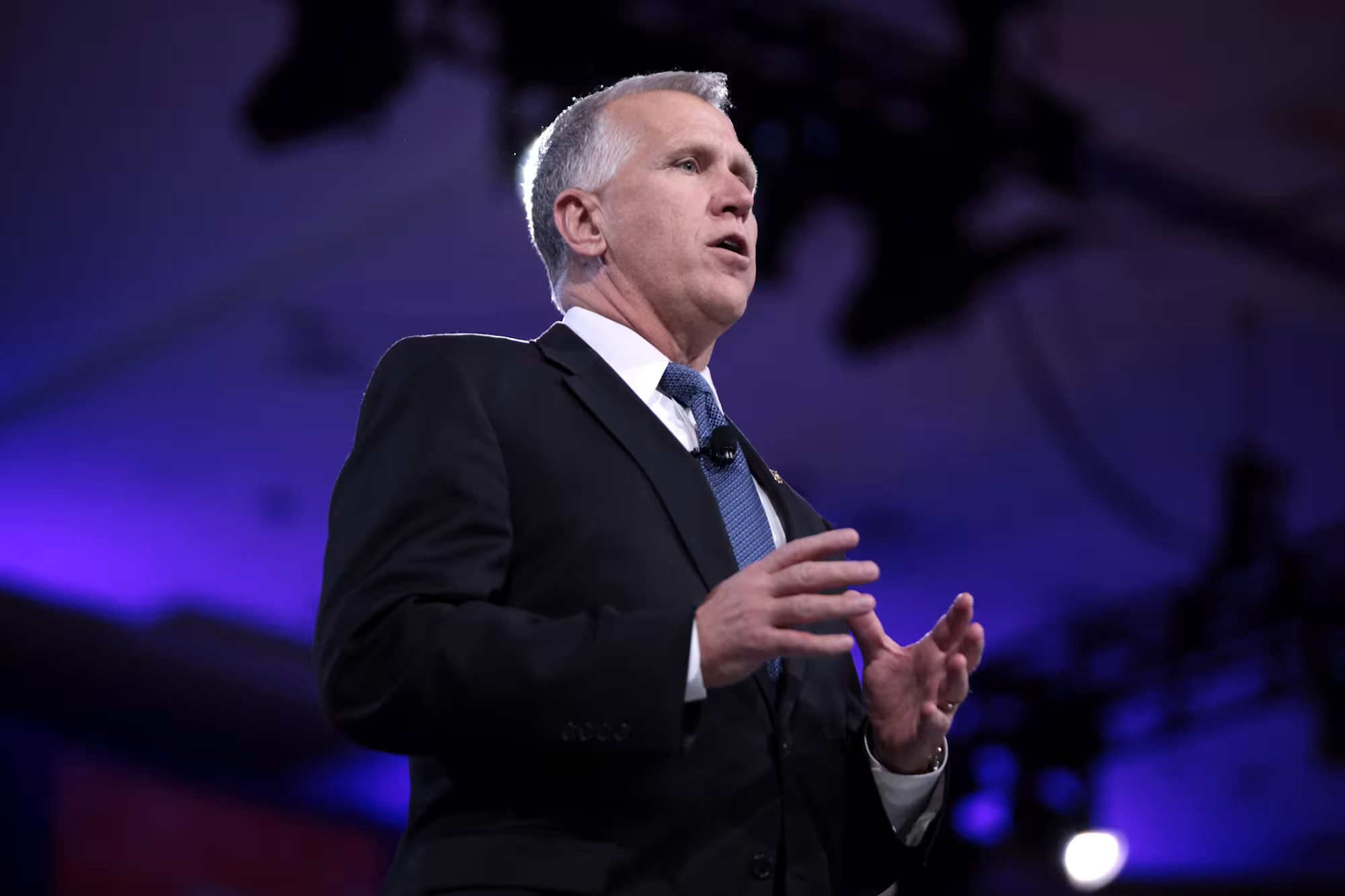
U.S. Senator Thom Tillis is a key negotiator on the Senate Banking Committee
The Importance of Passing the CLARITY Act Before the Midterm Elections
The CLARITY Act provides a crucial and durable legislative foundation for the digital asset industry: classifying different types of digital assets and their regulatory treatment; clarifying market regulator jurisdictions; protecting non-custodial developers; granting the Treasury new powers to combat illicit finance, and more.
The bill provides the legal and regulatory certainty necessary to continue integrating crypto markets with traditional capital markets, creates conditions for modernizing U.S. capital markets, and offers, for the first time, clear and substantial safeguards, information disclosures, and investor protections. It resolves many outstanding issues that previously hindered institutional capital and infrastructure from entering the market or drove them overseas.
Overall, the CLARITY Act is a strong bill, both technically and politically.
Given the balance of power in the House and Senate (Republicans hold razor-thin majorities), Galaxy believes it is critical for the CLARITY Act to pass and be signed into law before the November midterm elections. While the bill enjoys significant Democratic support (78 House Democrats voted for the CLARITY Act in 2025), a potential shift in the balance of power in the 120th Congress (convening in January 2027) would significantly reduce the likelihood of this legislation passing after November 2026.
If Democrats control one or both chambers, it would mean new committee chairs, new agenda priorities, and potentially a very different approach to crypto legislation. Specifically, the current version of the CLARITY Act is highly unlikely to pass a Senate Banking Committee chaired by senior members like Elizabeth Warren or Sherrod Brown.
Sherrod Brown, formerly Chairman of the Senate Banking Committee in the 118th Congress, was defeated by Bernie Moreno in 2024. Sherrod Brown is currently running in a special election in Ohio this November against Republican candidate Jon Husted. Jon Husted was appointed by Governor Mike DeWine following JD Vance's resignation to become Vice President; the winner of this election serves only until 2028, highlighting how unstable the Senate's power structure is about to become.
Brown's previous tenure might give him priority for the Senate Banking Committee chair over Warren, although this is unclear; both senators have historically been hostile to the digital asset industry's priorities.
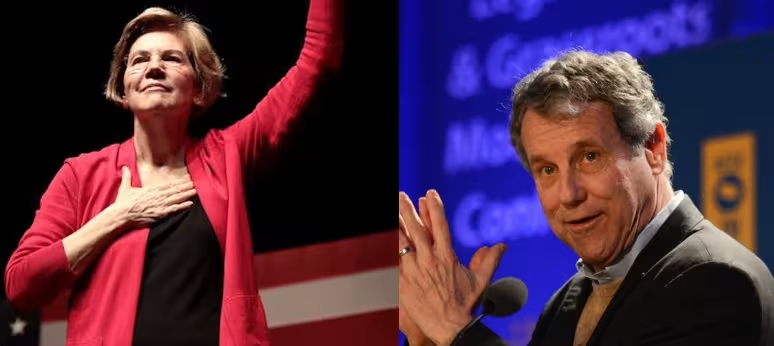
If the future Senate Banking Committee is chaired by Elizabeth Warren or Sherrod Brown, the current version of the CLARITY Act is highly unlikely to pass.
The current bipartisan coalition was forged under specific conditions: a crypto-friendly White House, a Republican Banking Committee chairman, the successful passage of the GENIUS Act (demonstrating bipartisan feasibility), and the crypto industry's aggressive lobbying and significant spending to elect crypto-friendly members and convert previously skeptical lawmakers in the 2024 election. These conditions may not persist in the future.
Senator Lummis has publicly warned that failure to pass the CLARITY Act this year could delay comprehensive market structure legislation until 2030 or later, as a new Congress would need to restart the legislative process from scratch, with new committee compositions and potentially very different political motivations.
Even if Republicans retain their majorities, political enthusiasm for complex, multi-stakeholder financial regulation may wane during a lame-duck session(Odaily note: the period between the congressional election and the formal swearing-in of the new Congress) or the first months of a new Congress, as leadership attention shifts to organizing committees, confirming nominees, and setting new legislative agendas. Therefore, the current window is extremely favorable and may not reappear soon.
Even without the CLARITY Act, the pro-crypto regulatory environment may only last until the end of the Trump administration. Regulators have shown willingness to advance the crypto industry through executive relief, interpretive guidance, and formal rulemaking. These developments have prompted major banks, brokerage firms, and exchanges to take concrete steps to build blockchain infrastructure and offer digital asset services. The level of integration achieved by traditional capital market participants over the next two and a half years might be sufficient to prevent significant regression in the crypto space even if a future administration is hostile.
However, the key is the duration and durability. Regulatory progress to date, including joint SEC/CFTC interpretive announcements, SEC no-action letters, and OCC guidance on bank crypto activities, exists outside statutory boundaries. Thus, a future administration could reverse these measures without congressional approval.
Even without the CLARITY Act in 2026, the crypto industry might not face a crisis, but its runway could be shortened. In the long term, a comprehensive market structure bill is essential for governing the digital asset industry's development for decades to come.
Issues in Ongoing Senate Negotiations
While the "stablecoin rewards" issue dominates headlines and is widely seen as the (perhaps only) major obstacle, several other critical issues are simmering beneath the surface. Here are the main sticking points:
Stablecoin Rewards
We await Senator Tillis releasing his compromise text with Senator Alsobrooks (D-MD).
Galaxy understands thatthe text still prohibits rewards "solely for holding" stablecoins but permits well-defined rewards tied to activities like payments, transfers, or platform usage.If true, this is essentially similar to the agreement Coinbase explicitly rejected in January.
However, we need to see the actual text, which senators have kept confidential. The White House CEA report released on April 8, indicating that a full ban on yield-bearing crypto would only increase bank loans by $2.1 billion (0.02% of outstanding loans) while costing consumers around $800 million, significantly undermined the banking industry's argument about deposit outflows.
The American Bankers Association almost immediately pushed back, arguing the CEA analyzed the wrong question by only studying impacts on the current ~$300 billion stablecoin market without modeling a future where yield-bearing stablecoins compete substantially with banks' $18 trillion deposit base. The framing of the debate differs significantly, and the scope of the analysis will likely determine the outcome.
Coinbase's CEO reversed his opposition to the bill on April 10, seemingly removing the industry's biggest obstacle. The substance may not change materially from what Coinbase rejected in January, but the politics have shifted: Bessent's public pressure, the CEA report, and Coinbase's pending national bank charter application (which could provide a federal regulatory pathway regardless of the final bill) may have influenced the change.
Nevertheless, the underlying commercial tension between exchanges and banks over stablecoin yields persists.
Blockchain Regulatory Certainty Act (BRCA)
BRCA, included as Section 604 of the Senate Banking Committee's ANS, clarifies that software developers and infrastructure providers who do not hold or control user funds are not money transmitters under the Bank Secrecy Act.
The crypto industry views this provision as a red line and crucial for keeping open-source development in the U.S. It faces opposition from law enforcement and bipartisan pushback from the Senate Judiciary Committee. In January, Judiciary Committee Chairman Chuck Grassley (R-IA) and Ranking Member Dick Durbin (D-IL) co-signed a letter to Banking Committee Chairman Scott and Ranking Member Warren opposing the inclusion of BRCA in federal law.
They argued that the Banking Committee, without consulting the committee responsible for federal criminal law, is amending Title 18 of the U.S. Code (specifically Section 1960, which prohibits unlicensed money transmission). They warned the provision would create "blind spots" for state and local law enforcement that rely on FinCEN registration information to track money flows when investigating potential money laundering, terrorist financing, and drug and human trafficking.
Furthermore, former Nevada Attorney General and Banking Committee member Catherine Cortez Masto (D-NV) has been pushing for modifications to address law enforcement concerns. The National Sheriffs' Association and the National District Attorneys Association have also weighed in, warning that provisions related to decentralized finance (DeFi) in the bill could limit prosecutors' ability to pursue financial crime cases.
The crypto industry counters that BRCA does not amend anti-money laundering statutes under Title 18 Sections 1956 and 1957; it does not limit prosecutions for fraud or sanctions evasion; and it merely codifies existing FinCEN guidance and the DOJ's recently clarified position that genuinely decentralized, non-custodial software does not constitute money transmission.
Satisfying Chuck Grassley and Catherine Cortez Masto without significantly weakening the provision is one of the most delicate negotiations in the bill.
Ethics Amendment
Democrats have sought to include provisions prohibiting high-ranking government officials, elected officials, and their families from holding or profiting from crypto assets while in office. This topic directly targets the Trump family's involvement in various crypto projects and has been a Democratic priority throughout the negotiations.
The issue was not included in the Senate Banking Committee's January draft ANS, but several Democratic senators have indicated they will push for an ethics amendment during the committee markup or on the Senate floor.While unlikely to be a roadblock in markup, it could become a focus during floor debate, as any senator can propose an amendment, and Democratic votes will be needed to reach 60.
SEC Exemptive Authority
Section 505 of the Senate Banking Committee's draft ANS deals with the tokenization of securities and other real-world assets. Some market participants and former regulators believe this section overly restricts the SEC's ability to use its exemptive and no-action tools to foster innovation in digital asset markets.
Simply put, many fear the provision would make the SEC's "innovation exemption" process unworkable or even illegal by imposing rigid statutory requirements that limit the Commission's traditional discretion under authorities like Section 28 of the Securities Act and Section 36 of the Exchange Act.
These concerns have been expressed by lawyers and compliance professionals working on tokenization projects, as well as some Democrats, who see the provision as an overcorrection to the SEC's current progressive stance


