






AI Bull Market's Sword of Damocles: Not Just South Korea, US Margin Debt is Equally Alarming


- Core Thesis: The current global stock market rally is highly dependent on leveraged capital, with both margin debt and leveraged ETF assets at historic peaks. This pro-cyclical structure, once deleveraging is triggered, will exponentially amplify downside risks, as the violent turbulence in the South Korean market has already served as a warning.
- Key Factors:
- US margin debt in May surged 54% year-over-year to a record $1.4 trillion. The total assets of leveraged ETFs ballooned from $115 billion to $220 billion in 70 days, with capital highly concentrated in the technology and semiconductor sectors.
- Barclays estimates that leveraged funds have bought approximately $300 billion in derivatives since the end of March. The hedging behavior of market makers creates a pro-cyclical effect, where a downturn triggers a negative spiral of "position reduction - selling pressure - further position reduction."
- Due to concentrated positions and high leverage, South Korea's KOSPI index triggered circuit breakers twice in a single week. Its broad leverage scale reached 271 trillion Korean won, and a 16%-36% decline in the underlying assets could trigger margin calls. Leveraged fund trading once accounted for 50% of the average daily trading volume of Samsung and SK Hynix.
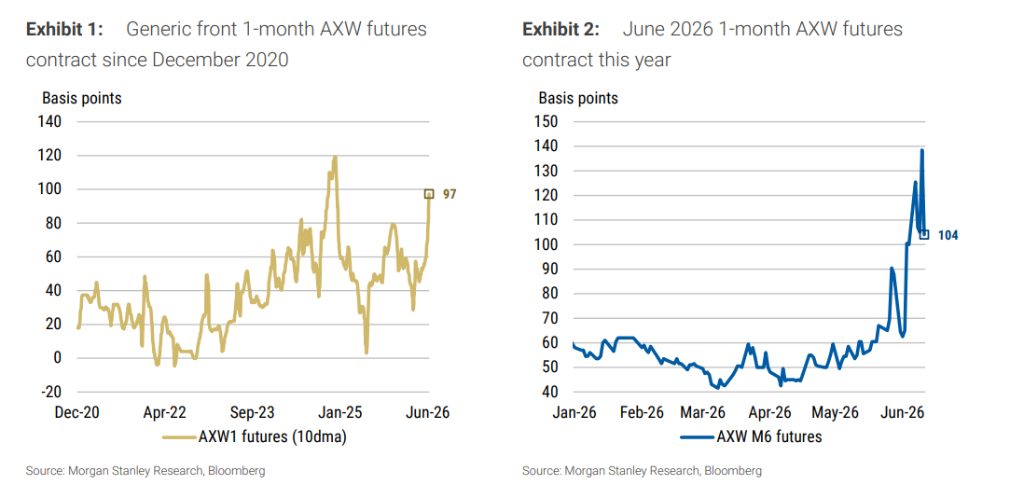
- Morgan Stanley pointed out that the reliance of marginal buyers in the US stock market on leveraged financing is unprecedented. The AXW futures spread, which measures financing costs, has surged to its highest level since December 2020, making financing both more expensive and scarcer.
- Financial conditions have already tightened by the equivalent of a 31 basis point rate hike, but the stock market rally has masked this pressure. Once deleveraging begins, investors will reassess the Fed's policy path, leading to a concentrated release of tail risks.
Original Author: Zhang Yaqi
Original Source: Wall Street CN
Global stock markets are hitting record highs driven by the AI wave, but the fuel supporting this rally is becoming increasingly dangerous—from the United States to South Korea, both margin debt balances and leveraged ETF assets have surged to historical extremes. The pro-cyclical nature of leverage itself is amplifying the tail risks of market volatility exponentially.
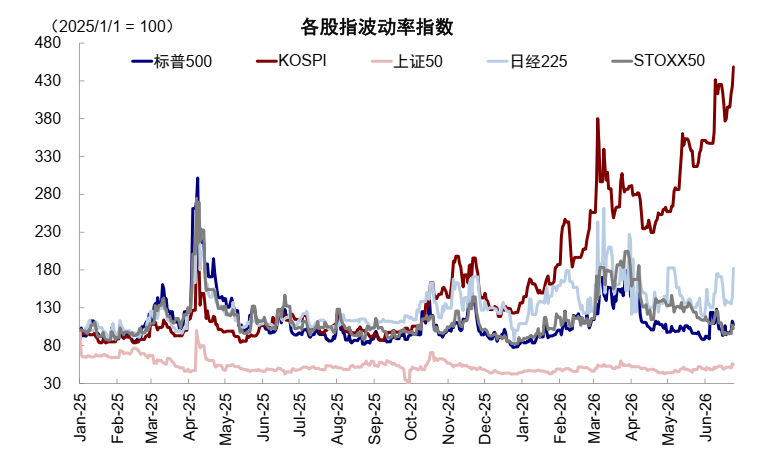
US margin debt surged 54% year-over-year in May, reaching an all-time high of $1.4 trillion. Concurrently, the total assets under management of leveraged ETFs nearly doubled in less than 70 days, surpassing $220 billion around June 3 (FactSet data). The risks of this leveraging frenzy have already manifested first in the South Korean market: The KOSPI index plummeted 10% last week, triggering a circuit breaker, rebounded sharply, and then hit another circuit breaker. This violent fluctuation dragged down AI-related stocks on Wall Street.
Alarms consequently sounded on Wall Street. Barclays analyst Alexander Altmann warned clients this week that leveraged funds have accumulated approximately $300 billion in derivatives linked to individual stocks and indices since late March. If this massive scale needs to be unwound in a concentrated manner over a short period, "its shock would be chilling," identifying it as "unquestionably the single largest source of non-discretionary risk in the market today." Morgan Stanley also warned on June 15, noting that the marginal buyers of US stocks are more reliant on leveraged financing than ever before, and such financing is becoming more expensive and scarce. Charles Schwab, one of the largest US brokerages, has already tightened margin requirements this month and issued margin calls to clients exceeding the new thresholds.
All this converges on the same logic: when a leverage-driven rally reaches its limit, the deleveraging backlash will amplify the decline by the same multiple.
US Stock Leverage: Scale and Intensity Reach Historic Levels
The enthusiasm of American investors for borrowing to buy stocks has reached an unprecedented level.
Data from the Financial Industry Regulatory Authority (FINRA) shows that US margin debt surged 54% year-over-year in May, hitting an all-time high of $1.4 trillion. Running parallel to this is the explosive growth of the leveraged ETF market—these products typically track two or three times the daily return of their underlying assets. According to FactSet data, total assets under management for leveraged ETFs skyrocketed from approximately $115 billion to $220 billion between March 30 and June 3.
The most sought-after products are concentrated in technology and semiconductor stock indices, as well as single-stock leveraged funds for companies like Tesla, Nvidia, and even recently SpaceX. The Direxion 3x Bull Semiconductor Index ETF, for instance, saw cumulative gains of roughly 700% from late March to late June—only to plummet 31% in a single day on June 5, magnifying the benchmark's decline three-fold proportionally.
Everyone from hedge funds to retail investors trading on Robinhood has piled in. Mark Hackett, Chief Market Strategist at Nationwide Investment Management Group, expressed concern:
"I worry we are accumulating a hidden layer of leverage that isn't well understood. There are people with a lottery ticket mentality, borrowing to buy options on leveraged ETFs—that's three or four layers deep."
Derivatives Mechanics: The Pro-cyclical Amplifier
The danger of leveraged ETFs lies not only in their own profit and loss amplification mechanism but also in their potential to inversely distort the price action of the underlying assets they track—what market participants call the "tail wagging the dog" effect.
Barclays estimates that to absorb the continuous influx of new capital, leveraged funds have accumulated approximately $300 billion in derivative contracts linked to individual stocks and indices since late March. After market makers take on these contracts, to hedge their own exposure, they must buy the corresponding spot stocks in the opposite direction, further boosting the gains of technology and semiconductor stocks this year.
The problem is that this mechanism works equally in reverse and is self-reinforcing. Once the underlying stocks decline, leveraged fund assets shrink, forcing position reductions, which in turn depresses stock prices, triggering more redemptions and position cuts, creating a negative spiral.
Dave Nadig, Research Director at ETF.com, warned about this:
"Any market where there are known buyers and sellers who are not price-sensitive creates problems. I'm really concerned about more and more money flowing into this levered single-stock product system, because the more money goes in, the stronger this pro-cyclical trading effect becomes."
South Korea's Warning: Extreme Concentration Coupled with High Leverage
The events unfolding in the South Korean market this week are seen by market participants as a stress test case worthy of study.
According to a CICC Research Report, the KOSPI index has surged 87% year-to-date, leading global markets, primarily driven by memory chip leaders like Samsung Electronics and SK Hynix. However, the highly concentrated holding structure combined with extreme leverage has sharply increased market fragility: On Tuesday, driven by market concerns over memory chip expansion plans and news of domestic discussions on taxing unrealized gains, the KOSPI plunged 10% in a single day, triggering a circuit breaker. It then staged a strong rebound over the next two trading days, returning to 9000 points, only to hit another circuit breaker on Friday.
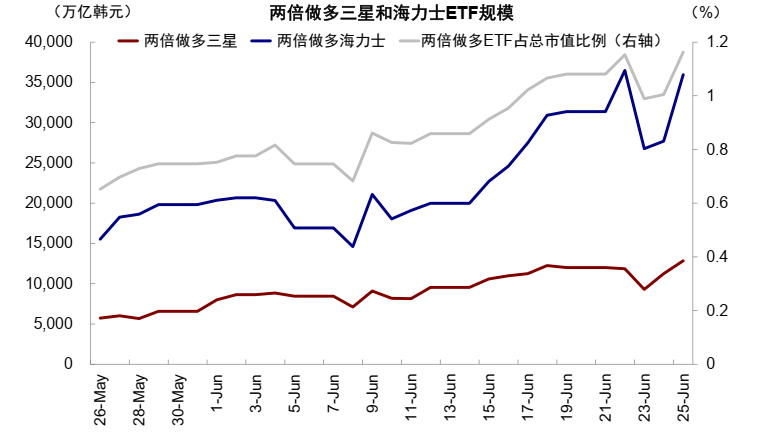
CICC estimates that the current on-exchange leverage multiple in the Korean market is between 2x and 5x, with broad leverage reaching 271 trillion Korean Won, an absolute level touching historical highs—theoretically, a 16% to 36% decline in the underlying assets could trigger margin calls. According to a Wall Street Journal report, trading related to leveraged funds tracking Samsung and SK Hynix recently accounted for up to 50% of the average daily volume of these two stocks, causing significant price disruption in both upward and downward directions.
Lee Chan-jin, Governor of South Korea's Financial Supervisory Service, openly regretted at a press conference last week the failure to prevent the issuance of leveraged single-stock funds. "These are high-risk products, and about 92% of holders are retail investors. Despite consumer warnings being issued, trading fervor has not cooled down," he said.
Soaring Financing Costs: Borrowing to Buy Stocks Gets More Expensive
According to a previous article by Wall Street CN, Morgan Stanley's analysis reveals pressure accumulation from another dimension.
A core metric measuring equity financing costs—the AXW futures spread (tracking the difference between the implied financing rate of S&P 500 total return futures and the benchmark SOFR rate)—for the one-month contract expiring in June surged to +140 basis points last week. Even after the S&P 500 retreated from its all-time highs, this metric remained at extremely elevated levels, recording the highest since December 2020 (excluding the year-end special period).
Meanwhile, data from the Federal Reserve Bank of New York shows that as of the week ending June 3, 2026, US primary dealers held $223 billion in equity exposure via securities financing methods like repos, an all-time high. Morgan Stanley's "equity financing dependency" indicator—calculated as primary dealer stock repo volume divided by the S&P 500 free-float market capitalization—has surged nearly 50% over the past year, approaching the historical peak from mid-March, meaning the accumulated borrowed capital behind each dollar of market cap is growing denser.
This financing demand is highly concentrated in a few sectors. Morgan Stanley's industry breadth data indicates that over the past three months, only the Information Technology sector among the 11 GICS sectors outperformed the S&P 500, gaining 24.2%, a 13.3% excess return. In approximately 70% of trading days over the past year, no more than five sectors outperformed the broader index. This means the overall market rally is effectively supported by leveraged capital in a very small number of sectors. Once this capital begins to withdraw, the impact on the broader market will be proportionally amplified.
Once Deleveraging Starts, the Impact Will Be Multiplied
Morgan Stanley warns that the current situation constitutes a potential non-linear risk: High financing costs force leveraged buyers to stop adding positions, the disappearance of marginal buyers robs the market of upward momentum, subsequent price declines trigger deleveraging, selling pressure is further amplified by leverage, ultimately leading to a decline greater than expected. Historical data shows that interim peaks in AXW futures often closely align with interim tops in the S&P 500.
More concerning, Morgan Stanley's Financial Conditions Index shows that from the outbreak of the Iran conflict to June 11, financial conditions tightened by an equivalent of a 31 basis point rate hike, primarily driven by a rise in the 10-year Treasury yield and a stronger US dollar. However, because the stock market index was still rising, most investors were oblivious to this tightening—the stock market rally itself contributed roughly -21 basis points of easing to financial conditions, partially masking the pressure from other factors.
Morgan Stanley's base case forecast is for the Fed to cut rates by 25 basis points each in March and June 2027, bringing the terminal federal funds rate target range to 3.00%–3.25%. However, the bank warns that if deleveraging triggers a stock market decline, investors will be forced to reassess financial conditions and consequently reprice the Fed's policy path. The previously priced weight for tail risks of rate hikes would be the first to unravel.
Alexander Altmann wrote in a client note: "The technical forces that previously amplified upward momentum through leverage expansion could begin to cut in the opposite direction."


