






Korean Seniors' "Last Stand": Surrendering Insurance, Borrowing Money, Going All In on Samsung


- Core Viewpoint: South Korean retail investors, particularly seniors, are massively borrowing money to trade stocks, fueling a stock market surge. The root cause lies in anxiety stemming from inadequate pension security and risk appetite amplified by previous successful "bottom-fishing" experiences, forming a dangerous leverage cycle.
- Key Elements:
- South Korean retail investors' margin loan balance surged to a record high of 36.47 trillion won (approximately $170 billion USD) in mid-May, with the debt growth for those aged 60 and above being the fastest, accounting for over 60% of new loans.
- To raise funds for stock trading, the surrender value of policies at South Korea's three major life insurance companies reached 4.9 trillion won (approximately $23 billion USD) in Q1. The surrender rate for savings-type life insurance increased by 23.2% year-on-year, indicating a massive flow of funds from insurance to the stock market.
- During the stock market circuit breaker in March this year, leveraged accounts experienced an average loss (-19%) that was 2.3 times that of non-leveraged accounts (-8.2%). The 60-and-over age group suffered the most severe losses (-19.8%). However, the subsequent rapid market rebound reinforced retail investors' confidence to continue leveraging.
- South Korean retail funds are highly concentrated in a few stocks. Samsung Electronics and SK Hynix account for over 43% of the KOSPI index weight, with a quarter of retail net purchases flowing into these two companies. The gains of other stocks were limited to only 30%.
- The relative poverty rate for South Korea's population aged 65 and over reaches 40% (the highest in the OECD), and the national pension replacement rate is only about 31%. This forces many retirees to continue working or seek additional income sources, making stock trading a desperate gamble.
Original Author: Kuli, Shenchao TechFlow
How manic has the Korean stock market become recently?
The KOSPI surged from 4,000 points to nearly 8,000 points in six months. According to the JoongAng Ilbo, the employee restrooms at a department store in Seoul's Gangnam district are completely full every day at the 3:30 PM market close, as employees hide inside to check their portfolios.
As of mid-May, the balance of margin loans taken out by Korean retail investors from brokerages hit a record high of 36.47 trillion won (approximately 170 billion RMB), doubling in a year.
But in this frenzy, the source of the money is a bit peculiar.
According to The Korea Herald, the three major life insurance companies in South Korea saw a total of 4.9 trillion won (approximately 23 billion RMB) in surrendered policies in the first quarter, a 16.3% increase year-on-year. Savings-type life insurance policies saw the sharpest surge in surrenders, rising 23.2%.
Savings-type life insurance is inherently a product designed to leave money for one's family. Surrendering a policy guarantees a loss, as the cash value is lower than the total premiums paid. Yet, more people are choosing to take the loss and surrender.
Where does the surrendered money go? Most likely into another stock account.
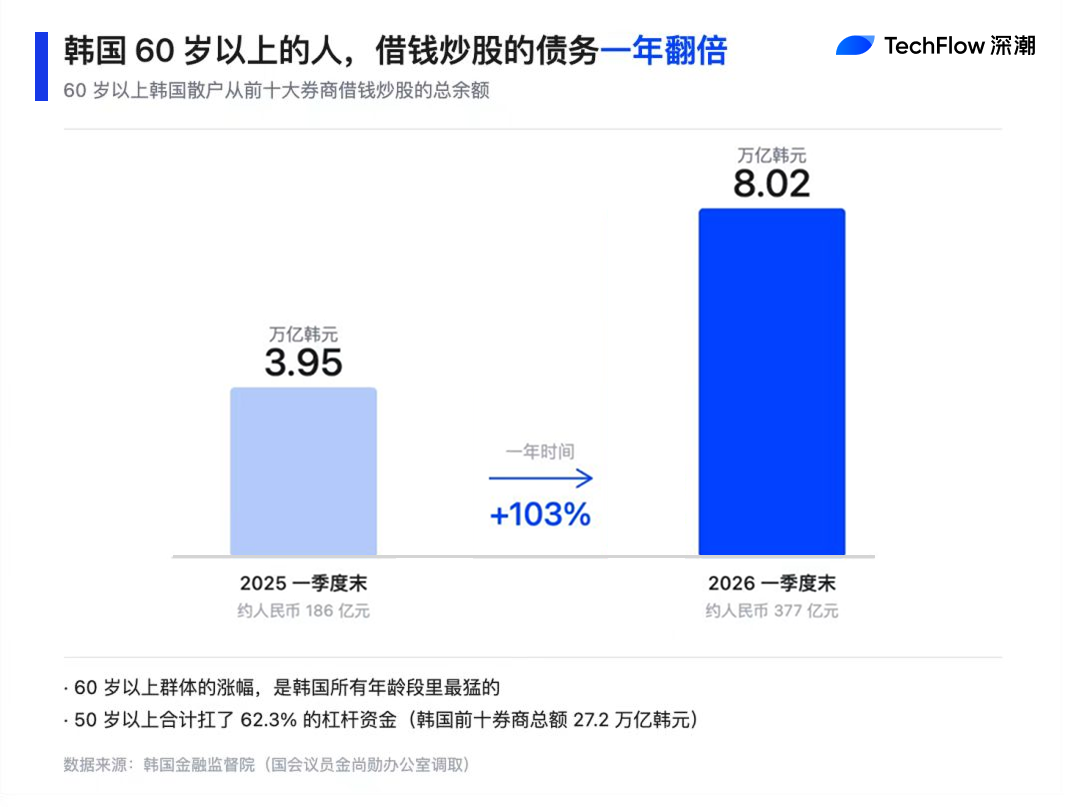
Data obtained by a member of the National Assembly from the Financial Supervisory Service shows that as of the end of the first quarter, Korean retail investors had borrowed 27 trillion won from the top ten brokerages to trade stocks. Over 60% (62.3%) of this money was borrowed by people aged 50 and over.
Debt for the over-60 age group doubled from 3.95 trillion won to 8.02 trillion won in a year, the sharpest increase among all age groups.
Surrendering insurance to buy stocks – an entire generation of Koreans is using future money to try and catch the bottom of today's market.
Borrowing Because of a Bull Market?
Using leverage in a bull market is called "amplifying gains," but in a bear market, it's "accelerating losses to zero." Korean seniors have already experienced this rollercoaster once.
In early March this year, the US and Israel launched a joint airstrike on Iran, causing global market panic. The Korean stock market triggered circuit breakers for two consecutive trading days, with the KOSPI plummeting nearly 13%.
According to a late March report by the Financial Supervisory Service, during that downturn, among the 4.6 million retail investor accounts nationwide, those using margin loans experienced an average loss of 19%, compared to an 8.2% loss for those who didn't. Investors who borrowed lost 2.3 times more than those who didn't.
Broken down by age, the leveraged account group aged 60 and over suffered the most, with an average return of -19.8%, the lowest among all age groups.
The worst was yet to come: margin calls.
Leveraged accounts have a margin call line. When the market value of stocks in the account falls below this line, the brokerage sells them without consultation. The Financial Supervisory Service received numerous complaints from retail investors at the time, such as "my stocks were sold without my knowledge" and "I was charged exorbitant interest."
A considerable number of these complaints came from elderly people unfamiliar with trading rules. However, in retrospect, the retail investors who held on through the March circuit breakers ultimately won.
The Korean stock market fully recovered all those losses in just over two months and has been rising ever since. Those who weathered the storm in March saw their accounts rebound completely, and some may have even made a profit.
Volatility, with upward potential, meant it was a successful "entry" experience, even if it was done with borrowed money.
Consequently, this successful experience becomes an excuse for more audacious moves next time. After the March circuit breakers, margin loans taken by Korean retail investors didn't shrink; instead, they rose steadily. Public data shows that total margin loan accounts hit 25 trillion won at the end of April, a record high, before surging further to 36.47 trillion by mid-May.
In just a month and a half, Korean retail investors borrowed an additional 11 trillion won (approximately 52 billion RMB).
At the individual level, a Korean civil servant posted a screenshot on the workplace community Blind in early May:
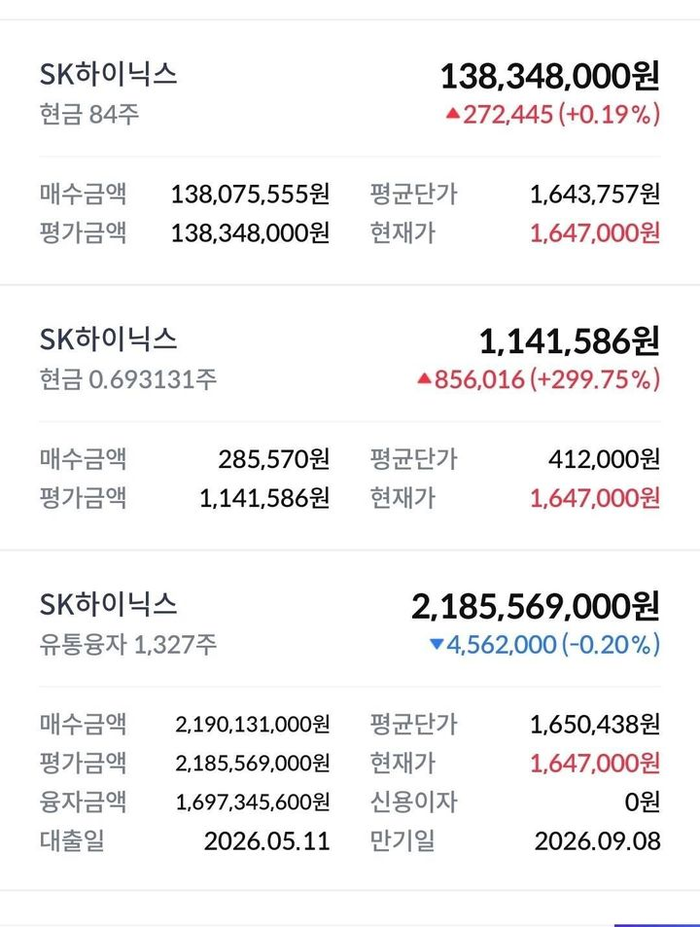
His account showed a 2.3 billion won (approx. $1.7 million) all-in position on SK Hynix, with 1.7 billion won borrowed from the brokerage. In other words, he had 600 million won of his own money, leveraging 1.7 billion won.
Four days later, he updated that he had already made 267 million won.
The same day, another employee in his 20s working for the Seoul Metro posted that, rather than miss this wave, she would rather "see it all crash" and go all in, using 150% margin financing to buy SK Hynix. She was effectively borrowing money as collateral to borrow even more.
Such posts are discussed daily on the Korean Blind community.
Regulators are not unaware of this FOMO-driven frenzy. The Financial Supervisory Service convened major brokerages in late March to strengthen risk controls, and some brokerages temporarily restricted new margin loans for overheated stocks. But the money already lent out is there, accruing annual interest at 7% to 9% daily.
At an 8% interest rate, Korean retail investors as a whole would pay nearly 3 trillion won (approx. 14 billion RMB) in interest to brokerages each year.
However, a 60-year-old using leverage is different from a 30-year-old doing so. A 30-year-old who gets liquidated still has decades of salary to slowly recover. A 60-year-old could be liquidated of their entire pension, left with depleted physical strength and the harsh reality of being unable to earn it back.
If the next circuit breaker comes, it might not end with a "recovery in two months."
Information Flow Among Seniors at Tapgol Park
Like all Korean retail investors, seniors borrow money to bet on the same stocks: Samsung Electronics and SK Hynix.
Samsung Electronics is up 138% year-to-date, while SK Hynix has risen 189%. The KOSPI is up 80% overall, but excluding these two stocks, the remaining market has gained only 30%.
These two companies together account for over 43% of the KOSPI's weight. Simply put, if these two rise, the entire Korean stock market rises.
The money borrowed by seniors largely flows into these stocks. Of the net purchases by Korean retail investors this year, a quarter went into these two companies. The remaining three-quarters were spread across other stocks, which have only gained 30% overall this year.
Tapgol Park in Jongno-gu, Seoul, is one of the city's oldest public parks. Young people rarely come here. Its regulars are groups of retired seniors who come every morning for free coffee, to chat, to play chess – time flows slowly, as if standing still.
According to the Kyunghyang Shinmun, the topics of conversation at Tapgol Park have changed this year.
Amid the coffee drinking, you'll hear a phrase like "My Samsung account is up again." Chess players might ask, "Did you buy Hynix?" A 77-year-old man told his middle school classmate that Samsung and Hynix have been performing well lately, and his account has made a bit of profit.
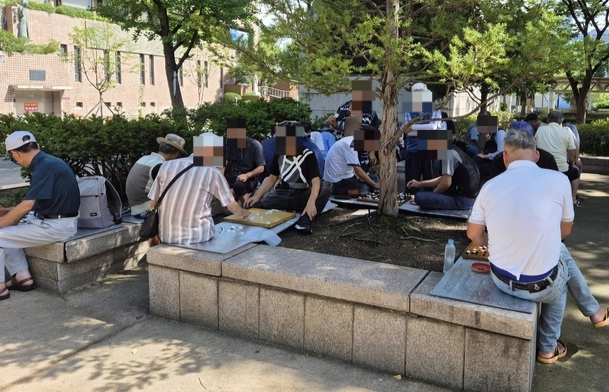
A corner of Tapgol Park, gathering many elderly people playing chess
Source: Seoul Shinmun
But he didn't mention whether he borrowed money, or how much.
The topics circulating in the senior park aren't born out of thin air; they are akin to information exchange at a village gossip hub. For instance, one senior hears another say they made money, and the next day checks their own account. Then they try borrowing a little. Eventually, they might borrow more and more.
But if you ask why Korean seniors end up in leveraged stock accounts, it's related to their retirement security.
According to OECD data, the relative poverty rate for South Koreans aged 65 and over is about 40%, the highest among OECD member countries. The income replacement rate of the National Pension Service (South Korea's version of a pension) has been chronically low. While the OECD average is around 50%, South Korea's is only about 31%.
Conversely, the labor force participation rate for those aged 65 and over is the highest in the OECD, meaning a significant portion of Korean seniors have to continue working after retirement.
So, the free coffee typically available at Tapgol Park is essentially a form of social relief. A cup of coffee costs less than 500 won – for a senior with a monthly pension of less than a thousand USD, it's a part of daily life.
But the seniors at Tapgol Park are no longer just there for free coffee and chess. They might have the KOSPI ticker open on their phones.
After taking office, South Korean President Lee Jae-myung aggressively pushed for universal stock investment. He publicly called himself a "Big Ant" ("ant" being the Korean nickname for retail investors) and made achieving a KOSPI of 5,000 points a policy goal.
In other words, the act of seniors borrowing to buy stocks is, to some extent, officially encouraged in South Korea.
What the seniors are truly betting on is a sense of anxiety. If they don't get in now, they'll miss out forever.
This is their last chance before retirement. The Korean semiconductor industry is cyclical, having experienced many violent boom-and-bust cycles over the past three decades.
SK Hynix was still posting a loss of 4.26 trillion won in 2023, its worst performance in a decade. Going from a massive loss to a quarterly operating profit margin of 72% (surpassing Nvidia) in just two years – the speed of this cyclical shift itself serves as a reminder: the cycle could turn back.
And time, for these elderly people borrowing to trade stocks, might be the most precious thing.
The seniors at Tapgol Park are desperately trying to seize the zeitgeist's windfall. The coffee is still free. The stock ticker on their phones hasn't paused for a moment.


