






茅台时刻:When liquidity dries up, everyone is flocking to HYPE and ZEC


- Core Thesis: In May 2026, the crypto market experienced an extreme "core asset herding" phenomenon amid liquidity contraction, with capital flowing from mainstream assets like ETH and SOL towards HYPE and ZEC, leading to severe market divergence and shattered convictions.
- Key Elements:
- Bankless co-founder David Hoffman liquidated all his ETH, marking a complete collapse of faith in Ethereum. ETH's price has halved from its 2025 high of $4,946 to around $2,100.
- The market presents "two different climates": HYPE is just a stone's throw away from its all-time high, ZEC is up over 1,400% year-to-date, while ETH and SOL are struggling.
- Hyperliquid (HYPE) has risen against the trend on the back of its "cash flow narrative." Its decentralized perpetual contract exchange generates over $1.2 billion in annual revenue and has reached a USDC revenue-sharing agreement with Circle, providing a stable buyback cash flow.
- ZEC (Zcash) has become the core asset of the "fear narrative": Heavily backed by Arthur Hayes and Multicoin Capital, demand for privacy has surged due to AI deanonymization and quantum computing threats, while the closure of an SEC investigation and Robinhood's listing have reinforced its legitimacy.
- Institutional views are bearish on ETH: Citi and JPMorgan have lowered their price targets, and Culper Research published a short report, pointing out that the Fusaka upgrade weakens the deflationary mechanism.
- Solana's high-beta characteristic has become a liability, as its early backer Multicoin Capital has shifted its allegiance to ZEC, marking a capital flow from ecosystem infrastructure towards privacy narratives and cash flow projects.
- The risks of herding are accumulating: ZEC's open interest in futures has surged 40% to $1.3 billion, and HYPE's funding rate remains consistently positive, with rising financing costs, hinting at the risk of a long-squeeze stampede.
Original Author: ShenChao TechFlow
David Hoffman posted a tweet in the early hours of May 21, 2026.
Just one sentence: "Has the vibe on Crypto Twitter genuinely changed in the last two weeks, or did I just sell my last bit of ETH too?"
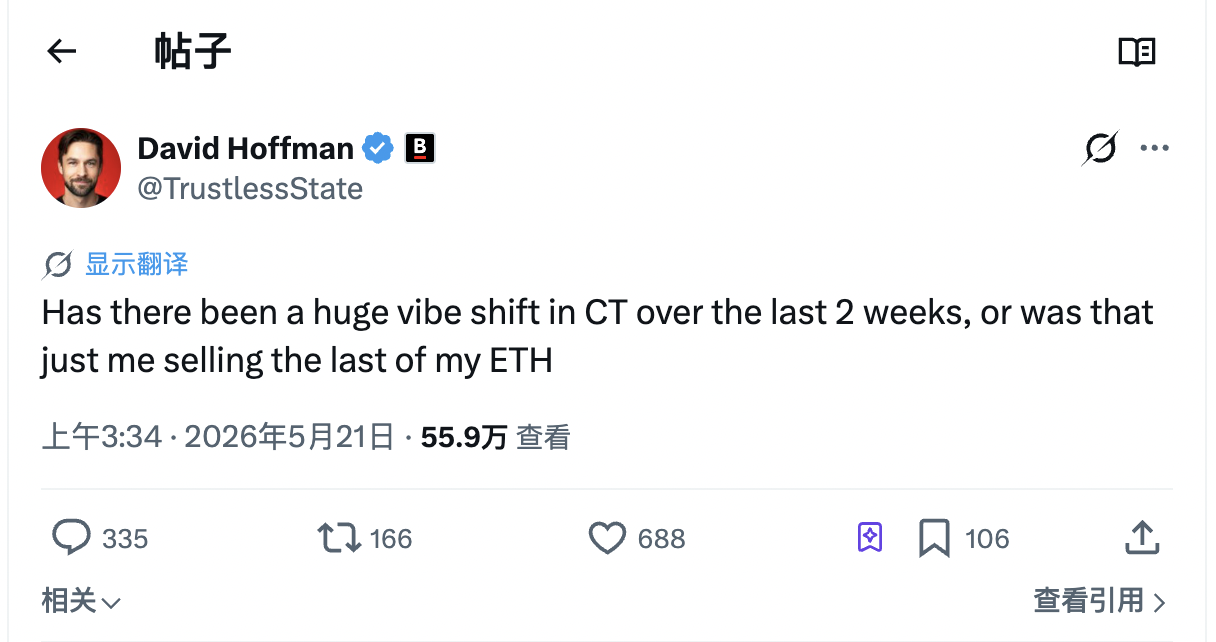
David Hoffman is the co-founder of Bankless and has been one of Ethereum's most prominent public advocates over the past six years. He once wrote on his personal page, "99% of wealth is not in banks, but on Ethereum." He authored *Ether: The Triple Point Asset* and is one of the core evangelists of the narrative defining ETH as "ultrasound money."
Now he has liquidated his position.
If last year people still viewed ETH as "the bond of the future world" and SOL as "a high-speed Nasdaq," by May 2026, the market has voted decisively with price, completing a thorough de-faithing. ETH is currently struggling around $2,100, down by half from its peak of $4,946 in August 2025.
Yet in the same market, HYPE is just a stone's throw away from its all-time high of $59.39, up 15% in the past seven days; ZEC has more than doubled in the past month, with year-to-date gains exceeding 1,400%, pushing its market cap into the top 20.
One market, two climates.
Once Upon a Time, Baijiu
This isn't the first time the crypto world has experienced such fragmentation. But you need to temporarily look away from the screen and return to China's A-share market in 2020.
From the second half of 2020 to early 2021, A-share liquidity peaked and began to decline. Mutual funds were forced to make a choice: either spread their positions evenly across over 3,000 stocks and accept mediocre beta returns, or concentrate their ammunition on a few core assets with clear future cash flow narratives. Everyone chose the latter. The result was that Kweichow Moutai and Wuliangye were driven sky-high, while the remaining stocks were cast by the market into "garbage time."
That year saw a very precise term: "core asset clustering." Its essence wasn't fund managers colluding, but an inevitable reaction in an environment of shrinking liquidity. When the water in the pond decreases, all the fish will swim towards the deepest corner.
The crypto market is now swimming towards that deepest corner.
What happened over the past year? Bitcoin ETFs absorbed approximately $70 billion in funds from 2024 to 2025, transforming Bitcoin into an "asset priced by Wall Street." But this also meant that Bitcoin's marginal buying power became constrained by macro interest rates and equity market risk appetite. When Q1 2026 inflation data exceeded expectations, combined with ETFs seeing $1 billion in net outflows in a single week, the entire market trembled.
More critical was the collapse on the narrative front. Citi cut ETH's 12-month target price from $4,304 to $3,175 in early 2026, citing "stalled market structure legislation and weakening on-chain activity." JPMorgan put it more bluntly in its May 19 report, stating "ETH needs stronger network growth and DeFi adoption to reverse its weakness relative to Bitcoin." Short-side research firm Culper Research even publicly shorted ETH, publishing a report arguing that the Fusaka upgrade weakened the EIP-1559 burn mechanism, stripping ETH of its previous deflationary properties.
Solana faced a different kind of predicament. It remains the best chain for DePIN, meme coins, and on-chain trading experience. But when the market enters a risk-averse phase, its biggest former asset, "high beta," became a liability. Tushar Jain of Multicoin, the man who once carried Solana back from the brink, publicly announced at Consensus Miami in May that Multicoin had taken a significant position in Zcash.
This was a landmark moment. Solana's earliest and largest backer began shifting its faith to another chain.
Clustering Around HYPE and ZEC
So where did the capital go?
The answer is surprisingly consistent: HYPE and ZEC.
Hyperliquid's story was set in motion since its near-perfect airdrop in November 2024. Led by Harvard alumni Jeff and Iliensinc, with a team hailing from Caltech/MIT/Citadel/Hudson River Trading, they achieved something hardly anyone in the crypto space had done in the past decade: distributing 76% of tokens to users, with zero VC allocation.
If you only see this, you only see its "moral story." What truly drove HYPE's countertrend rally during the 2026 liquidity drought was its "cash flow story."
Hyperliquid isn't a traditional "narrative token." It's a complete chain, or more accurately, a high-speed on-chain cash machine: As the largest decentralized perpetual exchange, it generates over $1.2 billion in annual protocol revenue. It struck a deal with Circle to share 90% of USDC reserve yields, contributing $135 million to $160 million in annual cash flow for token buybacks alone. This week (May 19), Bitwise announced adding HYPE to its balance sheet and launched an HYPE-based ETF product.
HYPE's open interest currently stands at $2.1 billion, with funding rates turning positive. This indicates genuine new long capital flowing in, not the false prosperity of short squeezes.
ZEC's story belongs to a completely different dimension. It's not a "cash flow story"; it's a "fear story."
Arthur Hayes wrote directly in his latest essay in January, "The dominant narrative this year is privacy. ZEC will be the privacy beta. To outperform Bitcoin and Ethereum, I will sell BTC to fund my privacy position." His fund, Maelstrom, began building positions in Q3 2025.
Then in early May, Multicoin Capital's Tushar Jain doubled down publicly at Consensus. CoinDesk, in its March research, tagged ZEC with "encryption supremacy," arguing that privacy networks have become a dominant infrastructure. The logic chain behind this involves three simultaneous developments: AI's ability to batch de-anonymize user identities on transparent chains, quantum computing threats creating long-term uncertainty for existing wallet encryption systems, and on-chain quarterly transaction volume surpassing $100 billion for the first time, turning "wealth under the scrutiny of the entire network" into a genuine fear.
The proportion of ZEC's supply locked in shielded addresses has reached 30%, an all-time high. This represents quantifiable evidence of real privacy demand on-chain, no longer just literary narrative. The SEC formally closed its two-year-long investigation into the Zcash Foundation on May 20, without any enforcement recommendations. Robinhood has already listed ZEC, and expectations for Grayscale's ZEC ETF are building on the horizon.
Hayes predicts ZEC's market cap will ultimately reach 10% of Bitcoin's, implying a token price 15-20 times above its current level.
Unraveling the Cluster?
When will the cluster break?
The baijiu cluster broke in the A-share market after the 2021 Chinese New Year. The catalyst wasn't fundamental deterioration, but a shift in central bank policy, turning the market from a zero-sum game back into an incremental one. When the water in the pond starts increasing, no fish needs to crowd into the deepest corner anymore.
When will the crypto world's pond expand? This depends on when the Fed cuts rates, when ETF funds return, when stablecoin market caps hit new highs, and when traditional finance moves more money onto the chain.
But another possibility requires vigilance: the cluster might self-destruct due to being "too tightly clustered." ZEC's open interest surged 40% in the past 24 hours to $1.3 billion. Such concentration itself is a risk signal. Hayes, Multicoin, retail traders, Robinhood users—everyone packed into the same trade—means any withdrawal of marginal buying power could trigger a cascading long squeeze. HYPE's funding rate has turned positive and continues to rise, with financing costs piling up.
The endpoint of a cluster is either the tide lifting all boats, with everyone taking profits together, or a stampede for the exit, where the last person in catches all the falling knives.
Where are we right now? No one can give a definitive answer. But there's one question worth asking for everyone reading this article:
If even David Hoffman has sold, that ETH still sitting in your wallet—do you hold it because you believe in it, or because you simply forgot it was there?
The next question is more practical: When a market only has two names left to cluster around, what will be the third name? Is it Aave? Maker? An undiscovered privacy L2? A high-performance chain that hasn't launched a token yet?
Those who think this through will be the first ones into the next cluster.
Those who can't figure it out will be the last ones holding the bag when the next cluster collapses.


