Circle首席经济学家访谈:USDC入局Hyperliquid利好Circle与HYPE


Compiled & Edited by: Odaily TechFlow
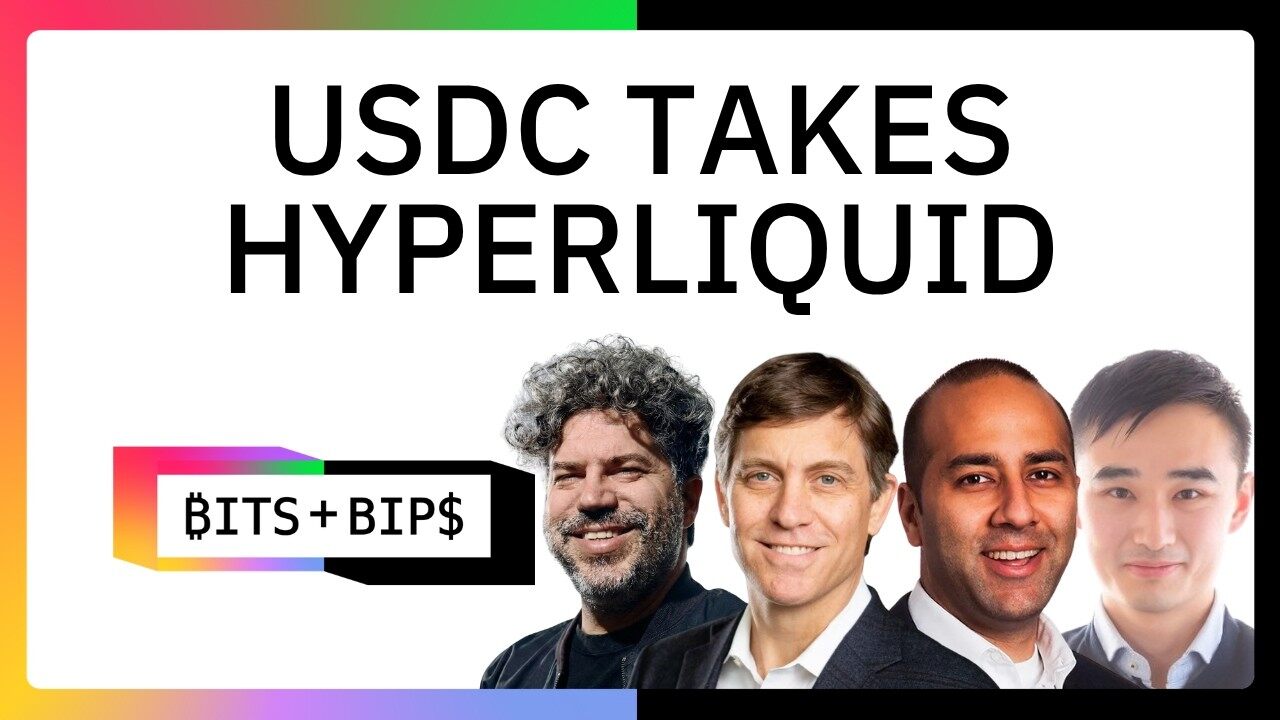
Guests: Gordon Liao (Chief Economist at Circle), Ram Ahluwalia (Co-founder & CEO of Lumida Wealth), Chris Perkins (Managing Partner at CoinFund)
Host: Austin Campbell
Original Title: The Fed, China, and CLARITY + Coinbase Eats USDH
Podcast Source: Unchained
Release Date: May 19, 2026
Editor's Introduction
In this episode, Circle Chief Economist Gordon Liao systematically elaborates for the first time on the market structure logic behind USDH being replaced by USDC. The balance of USDC on the Hyperliquid platform has doubled over the past year, with 90% of reserve income flowing back to Hyperliquid for HYPE buybacks. Coinbase acts as the treasury deployment partner, while Circle handles the technical deployment and has staked 500,000 HYPE.
Gordon also deconstructs long-end Treasury yields. The current 30-year yield breaking above 5% is primarily driven by the term premium. Meanwhile, stablecoins are quietly becoming marginal buyers of U.S. Treasuries. In Q1 2026, on-chain settlement volume for USDC alone reached $21 trillion. Stablecoins' concentrated buying of short-term Treasuries effectively lowers the overall weighted duration of U.S. government debt, potentially providing countervailing support for long-end rates.
Furthermore, the podcast's assessment of the key hurdles for the CLARITY Act and the divergent views on where value is captured in AI following the OpenAI lawsuit are worth noting.
Key Quotes
USDH Replaced by USDC
- "This is essentially a liquidity supernova event. As the dominant on-chain perpetuals platform, the collateral asset it uses will radiate throughout the entire on-chain economy."
- "The governance vote eight or nine months ago selected a different reference asset. But as the platform grows and matures, it also needs to interact with more traditional institutions, and using high-quality, institutional-grade collateral assets is a key part of that."
- "Anywhere that can lock up TVL – be it an exchange or a prediction market – will find a way to monetize that floating rate income. Why should they leave that money for a third party?"
- "For Coinbase and Circle, this is a strategic move to neutralize an emerging competitor. Coinbase, as the collateral manager, positions itself at the critical node of this new infrastructure."
The Multi-Faceted Nature of Stablecoins
- "On whether stablecoins are a medium of exchange or a store of value, we see they can be multiple things simultaneously. In payment scenarios, they're a medium of exchange; in this scenario, they are carriers of capital liquidity and collateral liquidity. As the system scales and becomes more institutionalized, the latter will become increasingly important."
- "An agent would probably want a money market fund that pays interest on idle cash. But the moment it needs to make a payment, it will want that money packaged as a stablecoin. The compliance paperwork for paying with securities alone would be unbearable."
The OpenAI Case and AI Value Capture
- "There's almost no value capture at the LLM layer. These AI labs spend tens of billions of dollars to provide us with free services; essentially, they're doing public service. The value of an LLM lies in the model weights, which is IP."
- "Whoever controls the end-user delivers the most value. Value primarily accrues to the application layer, cloud businesses, and AI implementation service providers like Accenture. They will do well."
- "I think it's a barbell structure. Besides the distribution end, the other end is energy. Whoever can get nearly free energy and cheap compute wins. Elon has an advantage there."
On the CLARITY Act
- "The compromise by Thom Tillis and Angela Alsobrooks essentially separates the store of value function, settlement function, and unit of account function of money."
- "We are approaching the Hillary Step of this mountain. There are still the committee seat issue, and the ethics issue. The ethics hurdle will be very difficult to overcome."
- "I've felt from the beginning that the banking industry's fight is very Don Quixote-like. What exactly are you trying to get out of this? Are you just stabbing each other, or are you handing a huge gift to asset management companies?"
Long-term Treasuries and Interest Rates
- "Most of the upward momentum in the 30-year yield comes from the term premium, which is now around 80 bps, quite high relative to two years ago when it was negative. This indicates the market is reflecting supply-demand dynamics, rather than expectations for future short-term rates."
- "The narrative that stablecoins are marginal buyers of Treasuries has more substance than people give it credit for. Their duration is very short, concentrated in T-bills and reverse repos. This effectively frees up the Treasury to issue more short-term debt. When weighted by dollar duration, it reduces the supply of long-term Treasuries in the market."
- "Investors are saying: I need more compensation to hedge against higher inflation risk. That's it. They know the Fed is not inclined to cut rates."
Coinbase and Circle Join Forces on USDH
Austin Campbell (Host): Hello everyone, welcome to Bits + Bips, where we explore how crypto and macro collide, one basis point at a time. I'm your host, Austin Campbell. Our guests today are Ram Ahluwalia, Co-founder & CEO of Lumida Wealth, Chris Perkins, Managing Partner at CoinFund, and Gordon Liao, Chief Economist at Circle. There's a lot to discuss in rate markets and the news today, and I'm particularly looking forward to Gordon's perspective.
Let's start with Circle. Coinbase and Circle have essentially "eaten" USDH. USDC will be crowned as the aligned quote asset for Hyperliquid, the leading on-chain perpetual DEX. Native Markets, which won the governance competition eight months ago, is being acquired by Coinbase. USDH holders will redeem their tokens for USDC during a migration period. Coinbase will become the official reserve fund manager/deployment partner for USDC on Hyperliquid. Circle will handle the technical integration and operational infrastructure for USDC on Hyperliquid and stake 500,000 HYPE towards being a validator. 90% of the reserve income will flow back to Hyperliquid, presumably to be used for HYPE buybacks via an aid fund.
Roughly calculated, there's about $5 billion USDC on Hyperliquid right now. At just under 4% yield, that's an annualized amount close to $200 million. Most of this will go to Hyperliquid, Coinbase takes a cut, and Circle gains a new USDC deployment front, continuing its quest to close the gap with Tether in scale.
The bullish logic sees deeper order books, less friction on conversions, faster fiat on/off ramps, and better market maker support. HYPE is tied to platform fees, staking, and Builder activity. Bitwise is simultaneously applying for a spot HYPE ETF. On the bearish side, concerns like ZachXBT worry that if Hyperliquid's core collateral, quote asset, and liquidity become increasingly dependent on USDC, it gives Circle/Coinbase/regulatory orders a critical lever over the entire system. There are also governance issues with Native Markets. Chris, as an investor in this space, what's your take?
Chris Perkins: I think this is one of a series of moves we'll see, and the key term is "net interest income." If you step back and look at the traditional exchange model: you make money on ticket fees, skimming a bit off every trade; usually, clearing isn't profitable, though in our space it's become a new line of business, sometimes making a little from data. But the real money is in net interest income.
In traditional finance, the model is: a customer gives you dollars as collateral, you give the dollars to the clearinghouse, the clearinghouse invests it, keeps a big chunk, and gives you a small piece back. That's your net interest margin. It's a fundamental part of any exchange's business model. A lot of decentralized applications have ignored this in the past, essentially giving away this beautiful revenue stream for free. Now they're waking up and want to capture it.
I can tell you, anywhere that can lock up TVL – exchanges, applications, prediction markets – will find a way to monetize that floating rate income. Why should they give it to a third party?
If you look at it from the exchange's perspective, this is the bullish thesis – Hyperliquid went up after the news, because this circle is closed (pun intended with Circle). You've solved the net interest income problem, and the returns flow back to token holders. If you look at it from Circle/Coinbase's side, you're also a winner. The details are in the terms, of course – the length of the peg, how often the rate gets renegotiated – I don't know if Gordon can share those. But what you get is stablecoin adoption. USDC is fungible; the more it circulates, the more likely end-users accept it as a payment method.
So USDC wins too. Maybe both sides will adjust the economic terms in the future. Hyperliquid is a big winner, having solved net interest income; Circle gains greater adoption, larger scale, wider distribution, and hopefully, incremental utility. I see this as a win-win.
Austin Campbell: Gordon, I'd like to toss the ball to you. I've been familiar with Circle for a while. USDC has many different facets in the current market. From a market structure perspective, Americans are used to thinking of money in layers – the money you use to buy coffee isn't the same as the money you use to settle derivatives. But now we're starting to see USDC used for many things simultaneously; its fungibility is increasing. How do you see this from Circle's perspective? And zooming out to your economic background, how do you view the market structure?
Gordon Liao: A few observations. First, we are witnessing the overall maturation of infrastructure. Hyperliquid is the dominant on-chain perp platform today, and its scale has grown significantly. The balance of USDC on the platform has roughly doubled year-over-year.
The governance vote eight or nine months ago did select a different reference asset. But as the platform grows and matures, it also needs to interact with more traditional institutions, and using high-quality, institutional-grade collateral assets is a key part of that. Choosing USDC is a recognition of its underlying security and its commitment to 1:1 reserves.
As Chris said, it's a win-win, and it's also a liquidity supernova event. As the dominant on-chain perp platform, the collateral asset it uses will radiate throughout the entire on-chain economy. So this is a major liquidity event that will encourage the use of USDC and other associated infrastructure.
We deployed USDC on Hyperliquid last September, along with CCTP. So it's been there for a while, but this is a great "re-affirmation" event.
On whether stablecoins are a medium of exchange or a store of value, we see they can be multiple things simultaneously. In some scenarios, they're a medium of exchange for payments; in others, they are carriers of capital liquidity and collateral liquidity. As the system scales and becomes more institutionalized, the latter will become increasingly important.
A similar trend is evident in settlement volumes. Our recent earnings report disclosed Q1 USDC on-chain settlement volume was $21 trillion. This reflects the expansion of infrastructure and improving liquidity on the largest platforms, both centralized and decentralized.
Austin Campbell: Following that line, USDC's circulation is actually highly tied to Coinbase. Coinbase has many products built on USDC, like debit cards, credit card payments, and business payments. Now we're using it as a core asset for exchanges like Hyperliquid. Ram, from a market perspective, does this make you more bullish or bearish on Coinbase and Circle's stock?
Ram Ahluwalia: It's positive for everyone, especially for Hyperliquid. For Coinbase and Circle, they've successfully neutralized an emerging competitor. Coinbase, as the collateral manager, positions itself at the critical node of this new infrastructure. This is a very strategic move.
For Hyperliquid, retaining 90% of the revenue is a payoff for its achievements over the past few years. We talked about Hyperliquid three or four weeks ago; it's one of the assets you want to hold this cycle. Coinbase's move was very forward-looking, as Hyperliquid is becoming the core of decentralized trading venues. Circle secures a substantial stream of recurring net interest income. So it's a win for everyone, but the benefit is particularly significant for Hyperliquid.
This brings us back to another topic we've discussed: distribution will eventually drive most of the profits in this system. Gordon, you also mentioned Hyperliquid is the emerging perp DEX in crypto. The fact that these parties are coming together essentially acknowledges the importance of distribution and users. This theme will keep recurring when determining winners and losers down the line.
The OpenAI Lawsuit
Austin Campbell: Speaking of users and winners, Elon Musk lost today, and Sam Altman won, at least the first round. A federal jury in Oakland unanimously rejected all of Musk's claims in under two hours. The core of the verdict was the three-year statute of limitations. The jury believed Musk knew OpenAI had transitioned to for-profit by 2021, but he didn't sue until February 2024.
He originally sought $134 billion in "ill-gotten gains" and the removal of Altman and Brockman from leadership, citing the 2025 for-profit restructuring. However, the substantive issues of the case, including charitable trust breach and unjust enrichment, were not decided. Musk's team has announced an appeal. Wired magazine noted that during the trial, both sides painted the other as self-serving, and neither Musk nor Altman came out looking great. The subsequent interpretation is that, at least during the transition period, OpenAI might be able to proceed with an IPO.
A few reactions on X are worth noting. Structural skeptics say that legally, this is a big win for OpenAI, but the larger political and institutional question remains: what does it mean when an organization builds public legitimacy on a "non-profit, humanity-first" mission and then becomes one of the world's most valuable commercial platforms? News24 said a non-profit machine created for the benefit of humanity forcibly pivoted into a closed, Microsoft-backed for-profit machine. The trial did reveal broken promises regarding openness and safety. Chris, what's your take?
Chris Perkins: It seems the statute of limitations had expired, which is quite clean. I don't know how Musk's lawyers will appeal, but they're smart; they'll find a way.
At this point, Ram would usually say something negative about OpenAI, calling it a tempest in a teapot. Before I let him speak, the bigger issue in the crypto space is that due to regulatory pressure over the past four years, many foundations have been structured as non-profits, alongside Labs. I hope this case sets a clear precedent to sort out the relationship between foundations and Labs. Many protocols are currently confusing about who is responsible for what and who is who.
I'm not saying foundations are useless; they absolutely have non-profit ideals to pursue, like Ethereum's cryptography research. But the motivation for establishing many foundations might have been to seek protection from a very aggressive regulator. So this case will have profound implications for the crypto space. Sam is also increasingly involved in this circle now.
Ram Ahlu