






好的,这是根据您的要求翻译后的内容: 何一最新访谈:我的野心,是有一个配得上我的世界


- 核心观点:何一分享其从农村女孩到币安联席CEO的成长历程,强调主体性、野心与执行力的重要性,认为认知、执行力、勇气和野心是成长四大支柱,并解释比特币如何重塑了她对金钱和金融未来的认知。
- 关键要素:
- 何一的早期经历(如4岁主动要求上学、输钱后坚持还赌债)塑造了其强烈的主体性和主动争取意识。
- 她将成长动力归纳为“认知、执行力、勇气、野心”四支柱,认为它们相互推动,并强调“敢想”与“从结果倒推过程”的方法论。
- 2013年研究比特币后,她认知被重塑,将其视为基于全球共识的信任网络,而非国家信用背书的货币,从而决定all in区块链行业。
- 在主持事业上升期辞职加入币圈,何一认为其核心能力是“把已有东西优化迭代到最大”,而非从0到1创新。
- 针对女性成长,她建议“先去试,清楚代价”,并否定“雌竞”标签,强调在竞争中靠实力(“雄竞”)取胜。
Original Source: Money-Making Girls
Compiled by: Shenzhen TechFlow
Key Takeaways
In this episode of "Money-Making Girls," the host had a far-reaching conversation with He Yi, co-founder and co-CEO of BINANCE. They discussed everything from childhood, growth, and career choices to ambition, cognition, execution, and how women can uplift themselves.
He Yi recalled how, as the second child in the family, she learned to proactively fight for what she wanted – clamoring to attend school at age 4, reading martial arts novels and Yi Shu in her youth, and refusing to settle for becoming a teacher back home after teacher's college. These experiences collectively shaped her strong sense of agency.
She also talked about why she went all in on Bitcoin during the peak of her hosting career: Bitcoin made her rethink "what money really is" and showed her a financial future based on a global consensus and network of trust. For ordinary people, her answer is not complex: first, understand the cost, then bravely try; iterate your cognition through action. In life, you either get it or learn from it.
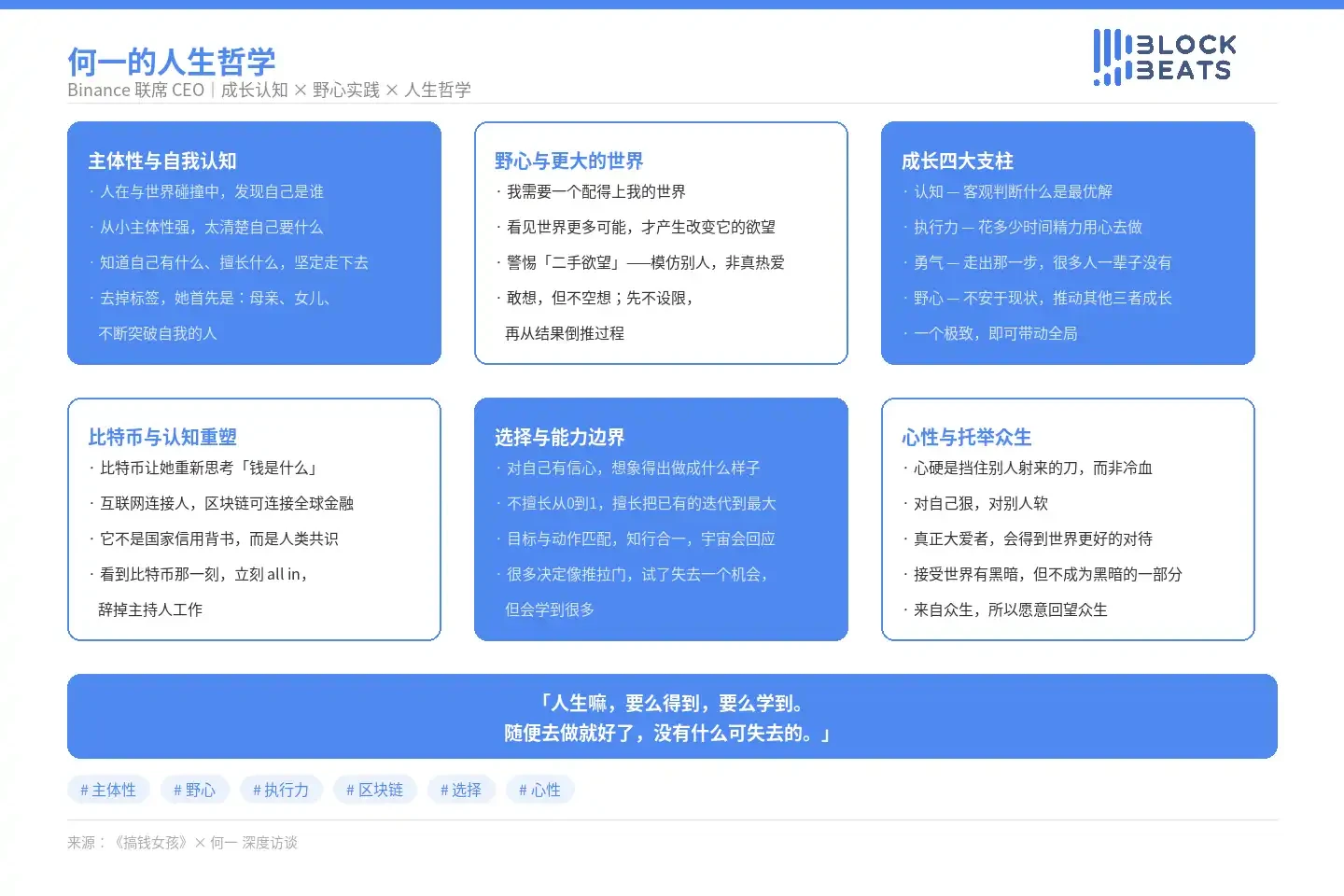
Key Insights Summary
On Agency and Self-Awareness
· "People don't exist in isolation. You ultimately discover who you are through every collision with this world. You come to understand yourself better through each interaction, by seeing how you face it and how you handle it."
· "I think I've had a strong sense of agency since I was a child, to use today's lingo. I've always been very clear about what I want."
· "Why is it that only city kids can like beautiful things, like flowers and plants? Why can't I?"
· "Do you truly know what you have and what you don't, what you're good at and what you're not? And can you firmly walk that path, even when things get tough?"
On Ambition and a Bigger World
· "I've always been a bit ambitious, always feeling I needed a world worthy of me."
· "When you see there are so many parts of this world you want to try and change, you start to wish for a bigger world to go and try it out."
· "A lot of the time, our desires are second-hand. We just see others doing something and then we copy them."
· "You have to dare to dream, but not just fantasize. First, set no limits, then work backward from the result."
On Cognition, Execution, Courage, and Ambition
· "The so-called four pillars are cognition, execution, courage, and ambition. If one of these corners is extremely strong, it can push the others to grow. If two grow, it can further propel you forward."
· "Knowing yourself means being able to objectively judge if something is the best choice for you, and if you genuinely like it – enough to keep doing it even if it doesn't make money."
· "Execution isn't just about doing it; it's about how much time and energy you invest. Are you truly dedicated? Can you endure the long, painful process of self-iteration before success?"
· "Many people think they know a lot and are just unlucky. But they might not even have the courage to take the first step."
· "If you truly love it, doing what you love feels effortless."
On Bitcoin and Reshaping Financial Understanding
· "Bitcoin made me rethink what money really is. That's what moved me the most."
· "If the internet can connect everyone in the world, then there could also be a global network based on trust that connects the world's finances."
· "It's not paper money printed by a country or government based on credit; it's a human consensus."
· "The moment I saw Bitcoin, I felt this was the right direction. I wanted to get into this space and do this."
On Choices, Mission, and Ability Boundaries
· "I have confidence in myself. If I joined BINANCE, I could figure out what to do and turn it into a world-class platform. It's just a matter of time to see it through."
· "I might not be the best at creating something from 0 to 1, but I'm very good at continuously optimizing and scaling something that already exists to its maximum potential."
· "Everyone will eventually get a response from the universe for who they want to become and where they want to go. You just need to align your actions with your goals and be consistent."
· "Many decisions in life are like sliding doors; you can still change your mind after making them. It's okay to try. You might lose an opportunity, but you'll learn a lot."
On Success, Toughness, and Uplifting Ordinary People
· "Being tough doesn't mean being cold to others. It means being able to stand firm when faced with different opinions or arrows aimed at you."
· "I'm quite tough on myself, but soft on others."
· "If there is a truly divine hand, it probably favors those who have great love for the world."
· "The world has light and darkness, good and evil. You must accept it's part of the world, but that doesn't mean you choose to become part of the darkness."
· "In life, you either get something or learn something. Just go for it. There's nothing to lose."
If you strip away all social labels, who are you?
Just call me Xiaohui: Today, Xiaohui is in Hong Kong, China, interviewing a truly legendary woman. Born in a rural village in Yibin, Sichuan, she ended up becoming a location host for Travel Channel by chance before becoming known as "Customer Service Xiao He" to many users in the blockchain industry. Now, her latest title is Co-CEO of BINANCE, the world's largest blockchain trading platform and ecosystem.
Life can turn around this way. I'm very curious about how she grew up. Today, we have BINANCE co-CEO He Yi, welcome Yijie.
He Yi: Hello everyone, I'm He Yi from BINANCE, also your customer service representative, Xiao He.
Just call me Xiaohui: Most people imagine a CEO or female president to be domineering and imposing. But you give off a gentle, approachable vibe. So today, I'm curious to look back and see how "Xiao He" became the Yijie she is today.
A popular self-introduction game lately is: If you take away all your social labels, how would you introduce yourself?
He Yi: I think, first and foremost, a mother, a daughter, and someone who constantly pushes her own boundaries.
Just call me Xiaohui: That's a very humble expression. As for me, it feels like I need a lot of external validation and dimensions. If I can't define myself, I wonder how others will define me. I've received a lot of feedback saying Xiaohui is also approachable, probably because I do interviews, so people say I'm good at making others open up.
But that's me through the eyes of others. It's like I need others' confirmation to know who I am.
He Yi: That probably means you're still navigating your life's journey. People don't exist in isolation. You ultimately discover who you are through every collision with this world. You come to understand yourself better through each interaction, by seeing how you face it and how you handle it. It shows you're still young.
The "Second Child Syndrome" meant He Yi learned to fight for things from a young age
Just call me Xiaohui: Before coming here, I did my homework and found out we share a similarity: you're the second of three kids, and I'm the third. There's a psychological concept called the "Second Child Syndrome," and it made me think of my second sister.
My second sister is very different from you. She's bossy, loud, and mischievous – giving my parents headaches. I was the well-behaved one, more like the "daughter" role. Looking back, did being the second child leave a mark on your personality?
He Yi: I think it's quite evident. I have three kids myself now. Usually, parents are very attentive with the firstborn, stressed over every little thing. So the eldest gets all the love, the most love. By the second, parents relax a bit. They know how to handle fevers and all. The youngest is usually the baby of the family, everyone's darling. So growing up, parents would often tell the older sister to give in to the younger brother. Even if you don't compete, they'll reflexively say to give it to him. The eldest has assured love, the youngest has assured love. The middle child has to proactively fight for attention, or else they might feel forgotten.
Sometimes, what looks like rebellion in a child is really a cry for help. Relatively speaking, they might become more independent and self-reliant.
The earliest awakening of agency: Clamoring to start elementary school at age 4 and getting "exceptionally" admitted
Just call me Xiaohui: When did you realize you had to fight for things yourself?
He Yi: My earliest memory is probably wanting to go to school at age 4. My sister is 6 years older, so I watched her go to elementary school. I thought, why can she go and I can't? I'd cry every day at home, "I want to go to school!" I pestered the adults so much that they finally gave in and sent me.
My elementary school homeroom teacher was a friend of my parents. He asked how old I was. My parents lied and said 6. Back then, they didn't check IDs or household registrations. The teacher said we'd see how my grades were; if they were bad, I could repeat a year. So I was thrown into school. I never had to repeat a year and did pretty well.
Just call me Xiaohui: Because it was something you wanted to do, you could do it well. That might be the core of your personality: you're very bold in expressing what you want. If your current environment isn't what you want, you feel you need to find a suitable one.
He Yi: I have another vivid childhood memory. We lived in the countryside in Sichuan, surrounded by wildflowers and weeds. In elementary school, I'd pick wildflowers daily. My mom would laugh at me, saying, "Why does a country kid like these flowers and plants?" To them, wildflowers were common and unremarkable, something they thought was a privilege for city kids.
But I have a very clear memory of disagreeing. Why is it that only city kids can like beautiful things, like flowers and plants? Why can't I?
I think this was my first step towards taking the initiative or persisting in my own identity. To use today's popular phrase, I had a strong sense of agency, an early awareness of self. I was born with a rebellious streak, I guess.
Just call me Xiaohui: I have a similar experience. I'm a lefty. I write with my left hand. My parents tried to switch me when I was young, but luckily my kindergarten teacher was open-minded. She said let her be; her writing was fine, no need to change. There's a folk saying that lefties are smarter. So the teacher protected my preference, and my parents accepted it.
I was very stubborn about it too. I wouldn't change when they asked. But they didn't force me. Were your parents hands-off, or was there pressure from your environment?
He Yi: My mom was very strict. But I think, using today's words, I had a strong sense of agency and was too clear about myself.
I did something pretty outrageous as a kid: I gambled before I was 10. We'd play for pocket change with older kids. I ended up losing 5 yuan I didn't have. My mom found out and gave me a beating with bamboo branches. It hurt. She asked, "Will you gamble again?" I said no.
But then I thought, that's not right, I still owe money. A person needs to be trustworthy. How do I pay back 5 yuan? So I found a new group to gamble with. My mom caught me again, and I got another beating. But by that time, I was already in the process of paying off my debt, slowly winning back. I kept playing until the debt was paid off, and then I never gambled again.
Before I was 10, I already understood gambling: you lose and want to win it back; you win and want to keep winning. It's an endless cycle. So I have zero interest in gambling. I guess I got it out of my system by age 10.
Just call me Xiaohui: So you endured beatings from your strict mother while figuring out how to pay off your debt. How many beatings did you end up with?
He Yi: Not too many. Besides gambling, there was also reading novels. There was a junk collector in our village with lots of books. I'd borrow them from him, and later I'd rent novels. In middle school, just over 10, my mom caught me again.
Just call me Xiaohui: What were you reading? Qiong Yao stuff?
He Yi: I didn't really read Qiong Yao. I read more martial arts novels and some semi-classical stuff like Strange Tales from a Chinese Studio. Options were limited back then; you read whatever the junk collector had. Later, I rented books. I read a lot of Lilian Lee and Yi Shu. These two Hong Kong authors influenced me a lot.
Lilian Lee has a dark, gothic style. I still remember a line of hers: "Sixteen-character mantra for navigating the world: Murder pays with life, debts must be repaid, you bet, you lose, you bear the consequences yourself." I used it as my QQ status.
Yi Shu's novels can be a bit melodramatic, being young adult fiction, but they have a very important theme: buying your own flowers. They feature strong female protagonists. These 70s and 80s works shaped the independence and agency I see in Hong Kong women, and it all became part of my personality.
Just call me Xiaohui: Let's go back to your career. It seems like your life is full of unexpected twists. Whenever an opportunity came, you just went for it without much planning. I'm curious: before being a host, you wanted to be a model. I remember you mentioned in an interview that you wanted to be a model before you were 16.
He Yi: Right. I was in teacher's college because my parents were teachers and thought it was a good choice. After graduating, I'd be a teacher. My teacher once said, "It's a shame you don't become a teacher." I said in front of the whole class, "I think it would be a shame if I became a teacher."
Ambition awakened during teacher's college: "I think it would be a shame if I became a teacher"
Just call me Xiaohui: You're naturally rebellious. But because your grades were good, the teacher probably didn't mind. Why were you so sure you weren't suited to be a teacher?
He Yi: It wasn't that I wasn't suited; it's that I didn't want to settle for just being a teacher.
Just call me Xiaohui: Why? It was a good job back then.
He Yi: Maybe because I read a lot and saw a broader world beyond the one in front of me. I went to Yibin College. Going back likely meant teaching in a village school. I didn't want that.
Reading Lilian Lee and Yi Shu showed me descriptions of a different world, a more open one, and I wanted to see it for myself.
"Second-hand Desires": A lot of our desires are just mimicking others
Just call me Xiaohui: So you didn't want to be a teacher, but then you wanted to be a model. How did that happen?
He Yi: This is a bit embarrassing. I read a book called "The Mimetic Desire." For example, seeing someone with a Hermes bag makes you want one; seeing someone buy art makes you want it. But is that really your desire?
A lot of the time, it's a second-hand desire. You just see others doing something and you copy them. That's mimetic desire.
Back then, I didn't know who I was or what my potential or talents were. In middle school, my deskmate was the best speaker in the whole school; I never tried. In teacher's college, I tried public speaking and found I was pretty good, winning first place my first time.
A friend next to me dreamed of being a model. Seeing her try, I


