






「TACO」is outdated; Wall Street embraces the 「NACHO」trade


- Core Insight: Wall Street's trading paradigm has shifted from "TACO" (anticipating Trump backing down) to "NACHO" (betting on a prolonged Strait of Hormuz blockade). The market now prices high oil prices as a structural norm, validated through derivatives markets rather than treating it as a one-off shock.
- Key Factors:
- From the US-Israel airstrikes on Iran on February 28 to early May, oil prices surged over 50%. The S&P 500 hit record highs, but its correlation with oil prices decoupled, indicating the market no longer sees falling oil prices as a prerequisite for stock market gains.
- Trump's "ceasefire" announcement on March 23 was invalidated after Iran denied it, marking the critical inflection point for the TACO model. Since then, all "ceasefire headlines" have failed to bring oil prices back to the pre-war baseline ($67).
- Three derivatives markets support NACHO: War risk insurance premiums for the Strait of Hormuz surged to 1%-8% of vessel value; Brent crude's near-far month spread (June 2026 vs. December 2030) reached $28.5, forming the steepest backwardation structure; the market has priced in zero Fed rate cuts for the entire year 2026.
- Significant divergence within the broader market: The energy sector ETF (XLE) gained 31.63% year-to-date, the only sector in positive territory; the transportation sector ETF (IYT) rose only 8.79%, underperforming the broader market by 15 percentage points, reflecting the direct impact of high oil prices on cost structures.
- NACHO has a physical expiry point: JPMorgan estimates that 280 million barrels of global commercially available inventories have been drawn down, with approximately 520 million barrels remaining. Operational pressure levels are expected to be reached in early June, and European aviation fuel inventories may fall below the 23-day警戒线 in June.
- Prediction market data aligns: Polymarket shows only a 28% probability of normal navigation through the Strait of Hormuz by May 31, and a 2% probability by May 15, with active positions betting the blockade will extend into June.
On Wall Street, the "TACO trade" is outdated, and a new trading pattern has emerged: the "NACHO trade."
Since the US-Israel airstrikes on Iran on February 28, the Strait of Hormuz has remained closed. Now, oil prices have surged over 50% from pre-war levels, and expectations for a Federal Reserve rate cut in 2026 have been crushed from two pre-war cuts to zero currently. Yet, during the same period, the S&P 500 hit an all-time high, rising for six consecutive weeks—its longest winning streak since 2024.
Wall Street has dubbed this seemingly contradictory market state "NACHO," an acronym for "Not A Chance Hormuz Opens." It is the inverse of TACO (Trump Always Chickens Out). The TACO trade bet on "people backing down," specifically that Trump would flinch at a critical moment. The NACHO trade bets on "situations becoming entrenched," that the Strait of Hormuz cannot be reopened this time with a single Truth Social post.
Zavier Wong, market analyst at eToro, describes the shift this way: "For most of the crisis, every ceasefire headline triggered a sharp drop in oil prices, as traders repeatedly bet on a resolution that never came. NACHO means the market acknowledges that high oil prices are not a temporary shock, but a fundamental characteristic of the current market environment."
Two diverging lines in early April
March 23 marked the tipping point where the TACO model failed. That morning, Trump announced on Truth Social having a "very good and constructive dialogue" with Iran, ordering the Pentagon to pause strikes on Iranian energy facilities for five days. S&P 500 futures rebounded nearly 4% from lows within minutes, instantly adding $1.7 trillion in market value. Brent crude dropped from $109 a barrel to $92.
Then, Iranian officials denied any dialogue took place. An unnamed "senior security official" told Iranian state media it was market manipulation, stating no conversation occurred. The gains were halved within two hours; the S&P 500 closed up only 1.15%, and Brent crude bounced back to $99.94.
That was the first time in 14 months that a Trump "backdown" proved ineffective for markets. The reason is simple: under the TACO model, backing down was unilateral—a single post sufficed. But the March 23 backdown required Iranian cooperation. When the counterparty doesn't cooperate, backdown becomes a lie.
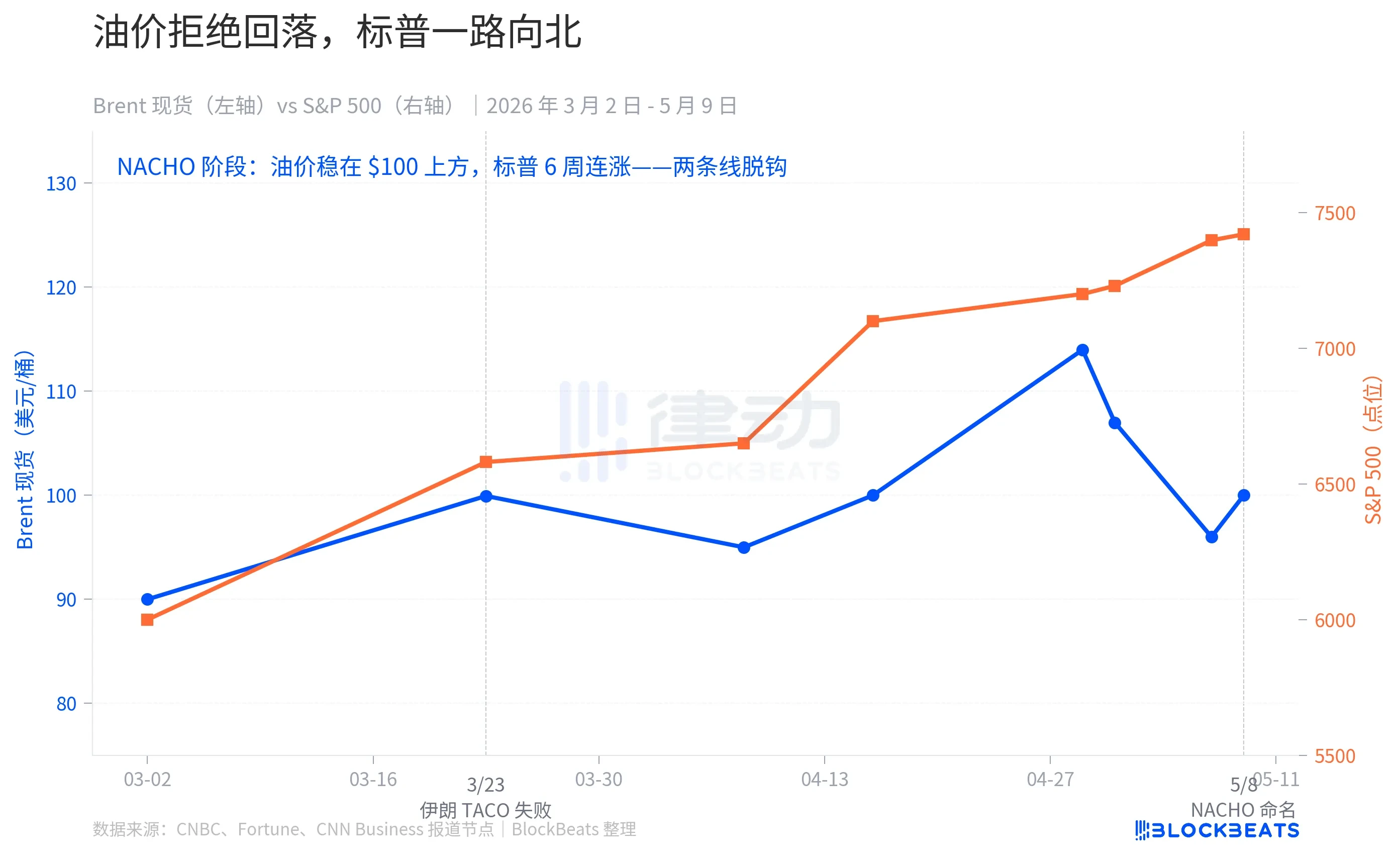
From that day, market behavior fundamentally changed. For the next six weeks, Brent crude never fell back to its pre-war level of $67, averaging $109.57 in May. Despite a US-Iran ceasefire agreement on April 7 and 8, oil prices temporarily returning to "early-war levels" on April 17, and reports of a nearing US-Iran deal on May 7, every "ceasefire headline" failed to push oil prices back to their baseline.
But the S&P 500 moved steadily higher. It rose 10% in April alone, its strongest month since November 2020, hitting seven intraday all-time highs. It broke 7,230 points intraday on May 1 and closed at 7,398 on May 7.
The two lines completely decoupled in early April. During the TACO era, they moved in sync: threats drove oil and the S&P down, backdowns drove them up. In the NACHO era, they speak different languages. Oil says, "Hormuz is closed for good," while the S&P says, "That's not my problem."
Three markets, three reactions
NACHO is not just rhetoric; it's a massive bet placed across three independent derivatives markets with real money.
First, insurance. According to historical data from the Strauss Center, war risk insurance premiums for the Strait of Hormuz spiked to 3.5% of vessel value during the 2003 US invasion of Iraq and reached 7.5% at the peak of the 1984 "Tanker War" attack on the Yanbu Pride. The pre-crisis baseline was 0.125% to 0.25%. By early May, this rate had entered the 1% range, with some specific policies surging to 3% to 8%.
Translated into the cost for a single Very Large Crude Carrier (VLCC) transit, insurance has jumped from approximately $250,000 pre-war to between $800,000 and $8 million currently. Insurers' job is to price risk. The practical implication of this layer is that if insurers refuse to underwrite, shipowners won't risk uninsured transits. "Physical opening" and "actual navigation" of the strait are two different things.
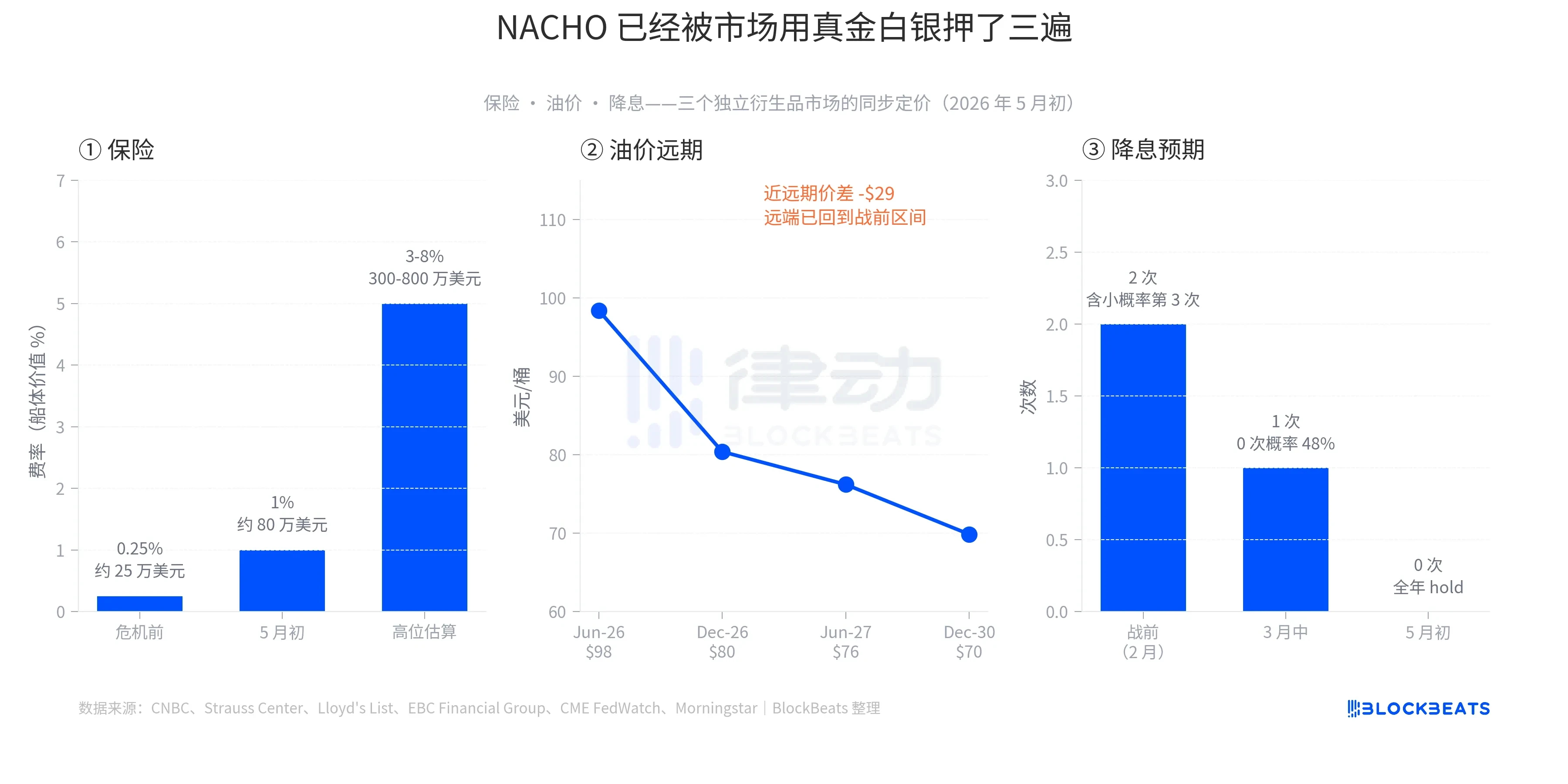
Second, oil prices. Data from early May shows Brent crude at $98.41 for the Jun-26 contract, $80.39 for Dec-26, $76.20 for Jun-27, and $69.85 for Dec-30. The spread between the near-month and Dec-30 contract is about $28.5, one of the steepest backwardation (near-term higher than long-term) structures in the past five years. This curve tells a very specific story: the market believes supply is tight now but will eventually ease, with long-term prices returning to the pre-war range of $60 to $70. In other words, high oil prices are not permanent, but a bounded window. However, this window is long enough that traders aren't betting on a sudden end.
Third, interest rate cuts. In early February 2026, the market expected two Fed rate cuts for the year, with a slim chance of a third. After oil prices surged in mid-March, expectations were compressed to one cut, with the probability of zero cuts reaching 48%. On April 29, the Fed held rates at 3.50% to 3.75%. On May 6, CME FedWatch showed a 70% probability of a hold at the June meeting, and the market has fully priced in zero cuts for the entire year of 2026. Legendary hedge fund manager Paul Tudor Jones even said in a May 7 CNBC interview, "Even [Kevin] Warsh can't make the Fed cut rates."
All three layers have left their mark on derivatives markets. This isn't a narrative; it's real money.
A differentiated market
A second less obvious detail of NACHO is that it has already led to differentiated pricing within the broader market.
As of the close on May 7, the Energy Select Sector SPDR Fund (XLE) is up 31.63% year-to-date, the only major sector to be positive for all of 2026. The S&P 500 is up about 24% over the same period. Meanwhile, the iShares Transportation Average ETF (IYT) has gained only 8.79% year-to-date, underperforming the broader market by more than 15 percentage points.
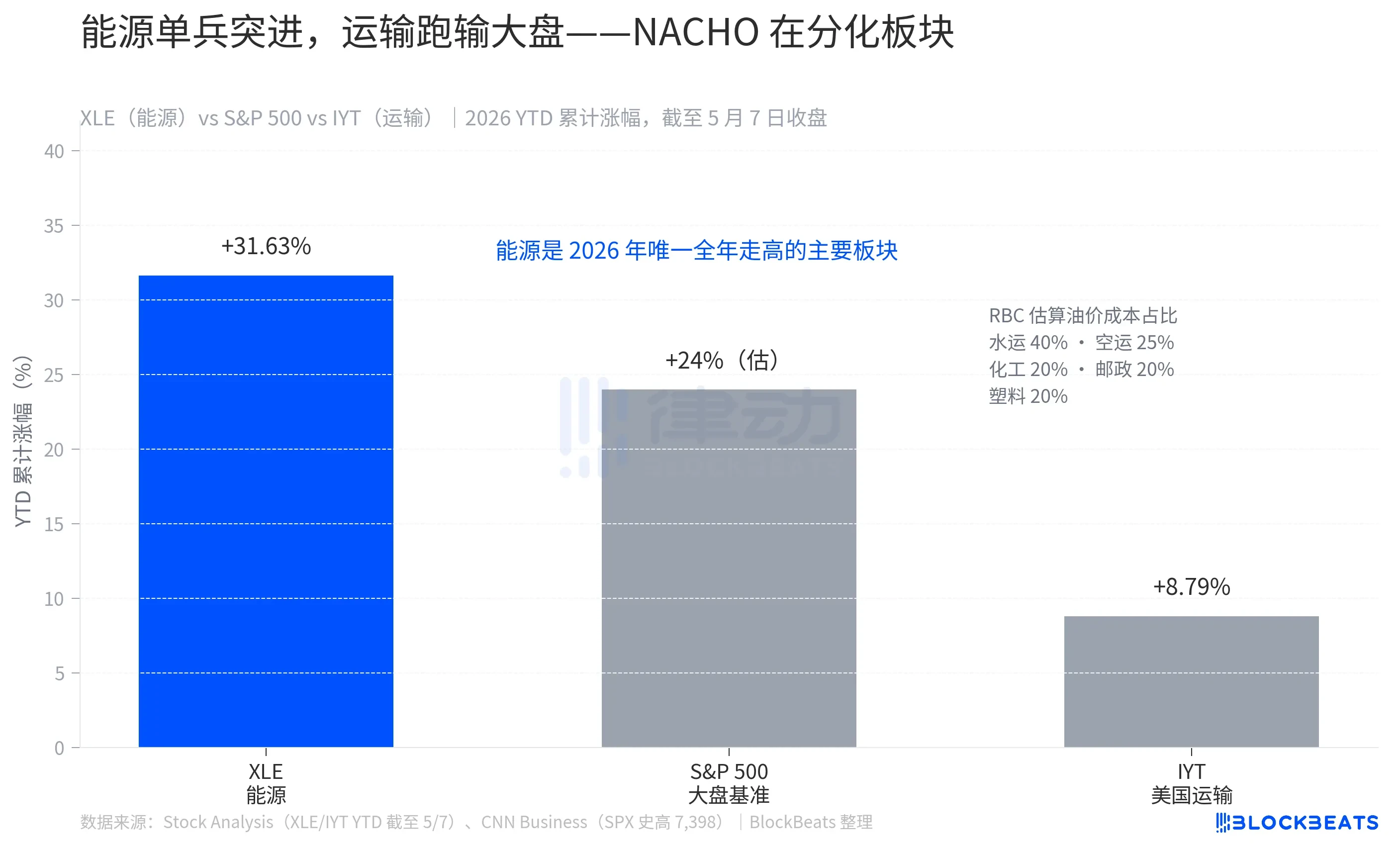
This gap is not random. According to RBC Capital Markets, fuel accounts for 40% of operating costs for the maritime shipping industry, 25% for air transport, and 20% for chemicals, postal/parcel delivery, and rubber/plastics. If oil is a major cost line in your business, NACHO hits you directly.
XLE's 31.63% gain isn't a short-term bounce; it's the result of eight consecutive weeks of outperformance. IYT's 8.79% gain isn't weakness; it's the market moving up while being partially eroded by higher oil costs. The market has clearly told investors how to calculate NACHO's odds—just look at the underperformance of the transportation ETF relative to the market.
But NACHO is not an open-ended bet. It has a very specific expiration date: June 1st.
According to estimates by JPMorgan's commodities research team, global commercial crude oil inventories at the start of 2026 were about 8.4 billion barrels. However, only around 800 million barrels were "readily available." The rest comprises pipeline fill, tank bottoms, minimum terminal reserves—the minimum required to keep the system running. Since the crisis began, about 280 million barrels of this available supply have been drawn down, leaving roughly 520 million barrels. JPMorgan's exact wording was, "Commercial inventories are expected to approach operational stress levels in early June."
"Operational stress levels" is a concrete physical concept. JPMorgan explains, "The system won't collapse because oil disappears. It will collapse because the distribution network no longer has enough working inventory." Once this line is crossed, companies and governments have only two choices: either draw down essential minimum inventories (damaging infrastructure itself) or wait for new supply. If Hormuz remains closed until September, OECD commercial inventories could fall to the so-called "operational floor." According to Fortune, European jet fuel inventories are expected to drop below the 23-day supply threshold by June—a key industry red line.
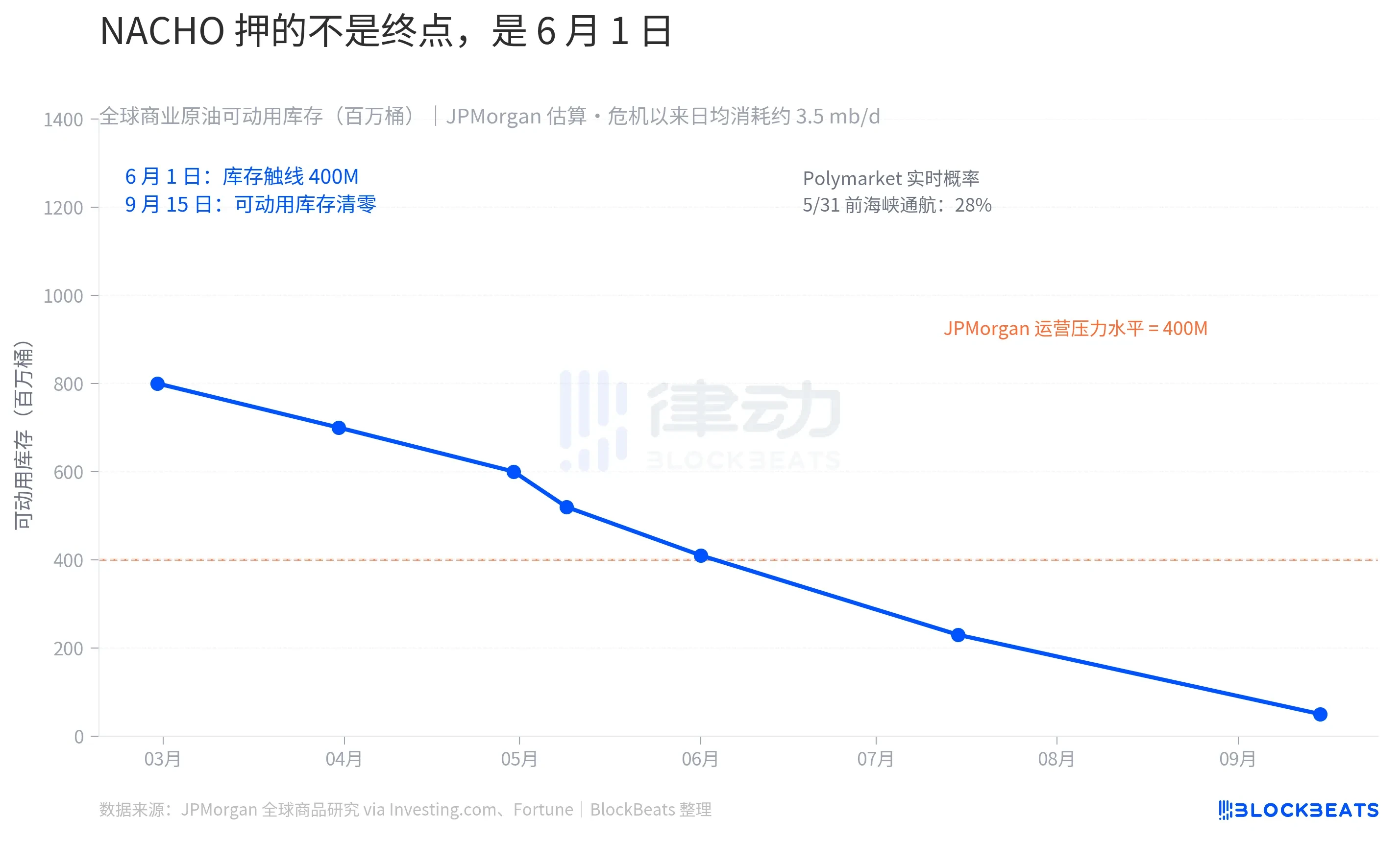
Prediction market odds align with this physical clock. Data from Polymarket on May 9 shows a 28% probability of "normal navigation through the Strait of Hormuz before May 31," and only a 2% probability before May 15. Nearly $9.92 million in active positions on the market are betting that NACHO won't fail, at least throughout May.
The market has stopped trading the next Truth Social post from Trump and has started trading the early-June inventory data for the Strait of Hormuz.


