






329 traders prop up Anthropic's 1.2 trillion "valuation" – AI anxiety finally has a price


- Core Thesis: The article reveals that Anthropic's "1.2 trillion USD valuation" in the on-chain Pre-IPO market is an "illusion" built on extremely low liquidity and a tiny number of traders. It lacks the legal binding force and market depth of traditional valuations, making it highly prone to misjudgment and speculative bubbles.
- Key Elements:
- The daily trading volume of Anthropic's on-chain Pre-IPO tokens is only $1.39 million, involving 329 traders. The ratio of the liquidity pool to the implied valuation is approximately 1:1,200,000.
- In contrast, Anthropic's Series G funding round was completed by professional institutions like sovereign wealth fund GIC and hedge fund Coatue at a $380 billion valuation, backed by legal obligations and in-depth due diligence.
- The article draws parallels with historical phenomena such as the Tulip Mania, the South Sea Company bubble, and the Japanese real estate bubble, noting a common characteristic: a very small number of participants produce extreme prices in a thin market, which are then amplified into a consensus by the media.
- The author explains that the headline-driven propagation mechanism of business news and the market structure lacking short-selling correction make it easy for such fundamentally disconnected prices to emerge and persist.
- The article argues that this "valuation" is essentially an anxiety premium paid by the crypto community for "missing the AI wave," and their purchasing behavior is a hedge against the psychological fear of missing out (FOMO).
Original author: Sleepy
Yesterday, I came across an article with the headline: "The New King of Global AI is Born! Anthropic's Valuation Surges Past $1.2 Trillion, Surpassing OpenAI for the First Time."
This headline perfectly captures the spirit of our times. It has AI, an underdog story, a new king crowned, and a number so large it defies imagination. It's like a gong. When the gong sounds, it's hard not to look up.
So, how did this $1.2 trillion valuation come about? It actually originates from the on-chain Pre-IPO market.
This so-called on-chain Pre-IPO market doesn't trade the common stock you'd see in a securities account. It's more like a designed "pre-IPO risk exposure." Through tokenization, SPVs, or synthetic structures, someone slices the future listing expectations of a private company into small pieces and facilitates trading on-chain. It opens a window that was previously difficult for ordinary investors to access and provides a real-time price to the market. Anthropic was priced at $1.2 trillion in this market.
Over the past two years, the feeling AI has left on ordinary people often isn't "I am part of a new era," but rather "The new era has passed me by." Nvidia went up, cloud providers went up, and large model companies went through rounds of fundraising. But the real core equity remained mostly locked in the private market. We could see the ship, but we couldn't touch the ticket. So, any ticket that might lead to companies like OpenAI or Anthropic naturally gets a filter applied.
But precisely at such moments, you need to take the number out of the headline, put it on the table, and see exactly where it comes from. Anthropic is arguably one of the most worthy AI companies to study right now. The problem, however, is that a good company, a great era, and an aggressive price don't automatically merge into the same thing.
On the crypto trading platform Jupiter, Anthropic's Pre-IPO token had a daily trading volume of only $1.39 million, with only 329 traders in the past 24 hours. And it's this $1.39 million and 329 traders that reflect a trillion-dollar illusion.
But I don't want to discuss whether Anthropic is worth that much, nor do I want to talk about whether trading Pre-IPO assets on-chain is a problem. I want to first understand a more fundamental question: What conditions must a price meet to qualify as a "valuation"?
The Birth Certificate of a Price
In February 2026, Anthropic completed its Series G funding round. It raised $30 billion at a $380 billion valuation, led by Singapore's sovereign wealth fund GIC and hedge fund Coatue Management. A month later, OpenAI also announced the completion of its latest funding round, raising $122 billion at an $852 billion valuation, with major investors including SoftBank, Microsoft, and other institutional investors.
How were these numbers generated?
Take Anthropic's Series G round as an example. GIC is a sovereign wealth fund managing over $700 billion, and Coatue manages over $60 billion as a global tech-focused hedge fund. They each have teams of dozens conducting due diligence, spending months analyzing Anthropic's technology architecture, revenue curves, customer retention, and competitive landscape. The final $30 billion investment came with a full set of legal terms, including anti-dilution protection, liquidation preferences, information rights, and board observer seats. If Anthropic underperforms or heads downward, these terms ensure GIC and Coatue can recover their principal first.
What they bought wasn't just a number, but a complete legal structure of enforceable rights.
What about the $1.2 trillion on Jupiter? Over three hundred traders, just over a million dollars in daily volume, and the token carries no commitment or obligation from Anthropic. What you buy isn't a small piece of the company, but merely an on-chain betting receipt.
Both prices are presented identically in reporting headlines: "Valuation XX Billion."
In 1985, financial economist Albert Kyle published his seminal paper "Continuous Auctions and Insider Trading," introducing the concept of "market depth," measuring the price impact per unit of capital inflow with λ (lambda). In a deep market, a $100 million buy order might only cause a 0.1% price movement. In a shallow market, $50,000 can move the price by 20%. The larger the λ, the greater the impact of a single trade on price, and the thinner the consensus information the price carries.
For Anthropic on Jupiter, a liquidity pool depth of one million dollars supports an implied valuation of $1.2 trillion. The ratio of liquidity to valuation is roughly 1:1,200,000. If someone tried to sell a position worth $10 million at this $1.2 trillion valuation in this market, they would drain the entire liquidity pool ten times over. This price is unexecutable. It exists only on paper and cannot be realized in the real world.
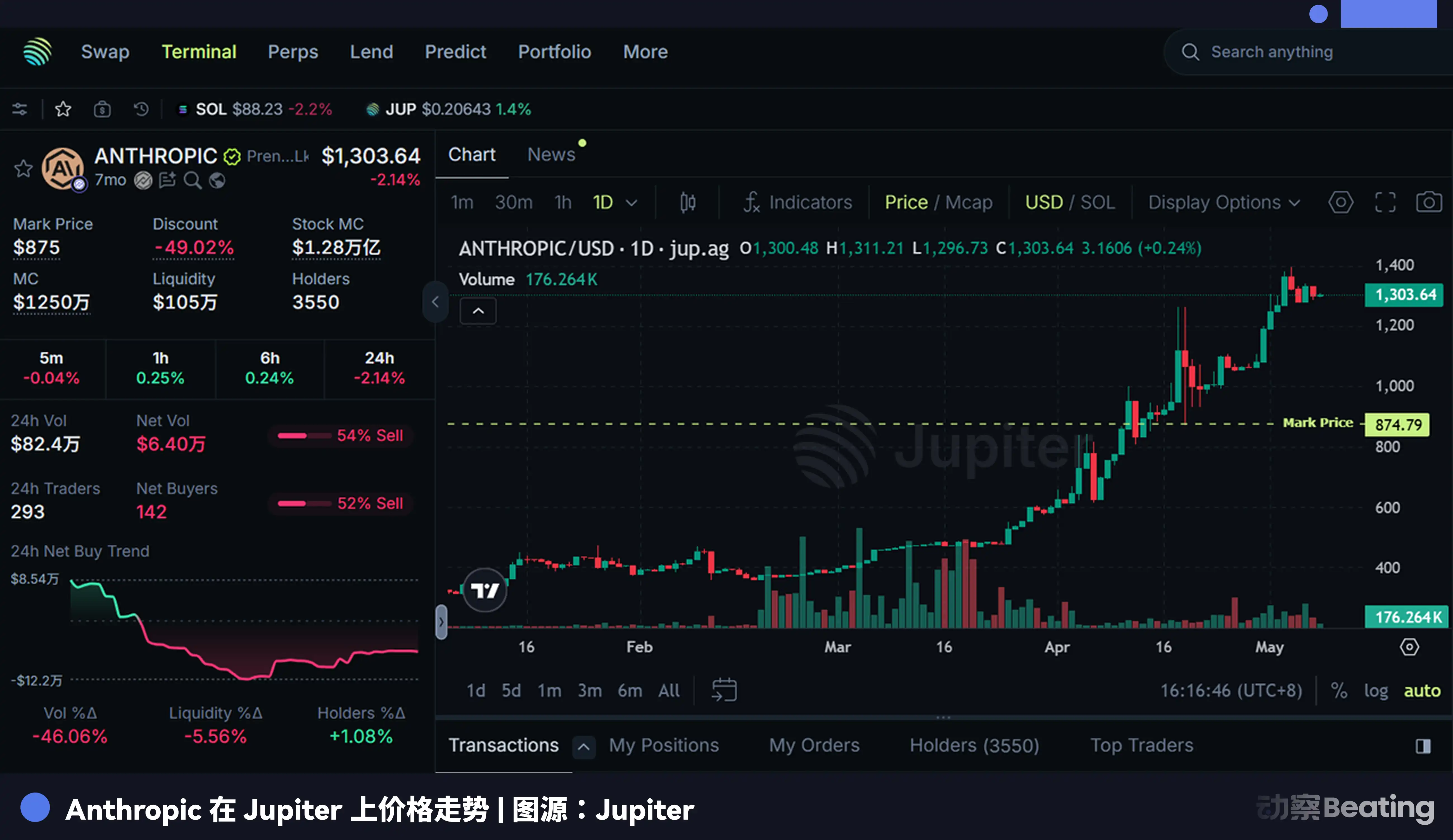
If it were merely treated as a reference indicator for observation, there's no harm. The problem is it wasn't treated that way. It became the argument for "officially surpassing OpenAI," the headline for "the birth of a new global king," and cognitive input for countless readers.
This packaging of marginal prices from thin markets as broad consensus isn't new. It has been happening for nearly four hundred years.
The Tavern in Haarlem
February 3, 1637, Haarlem, Netherlands.
In a small tavern, about thirty people sat around a long table. Following the customs of Amsterdam and Haarlem at the time, these informal tulip bidding gatherings were held several times a week, usually in the back room of the tavern. Participants were merchants and flower brokers from the circle who knew each other well.
The lot for the day was a Semper Augustus bulb. Its red and white petals were considered a masterpiece of creation. Only about a dozen were known to exist in all of the Netherlands. Bidding lasted all evening, and the final price was 10,000 guilders.
In 1637 Amsterdam, a canal-side townhouse sold for about 5,000 guilders, and a skilled craftsman's annual income was about 300 guilders. One bulb was worth two mansions, equivalent to 33 years of a craftsman's wages.
And this price was born from just thirty people, in a closed space, fueled by alcohol, with no external constraints, market maker obligations, or information disclosure requirements. Bidders spurred each other's emotions and bore no obligation beyond paying.
The next day, the transaction price was recorded in pamphlets printed in Haarlem. The pamphlets were carried by post to Leiden, Rotterdam, Utrecht, and other cities. Farmers and small merchants who read them had no way of knowing how the number was generated. To them, the printed price equaled the market price. Some began hoarding ordinary varieties of bulbs based on this, believing the entire market would rise.
On February 6th, at a tulip auction in Alkmaar, suddenly no one bid higher. Then Haarlem, then Amsterdam. Within a day, buy orders across the Netherlands vanished. Those who had hoarded bulbs based on the "market price" found no one to take them off their hands. Prices collapsed, falling over 90% within a week.
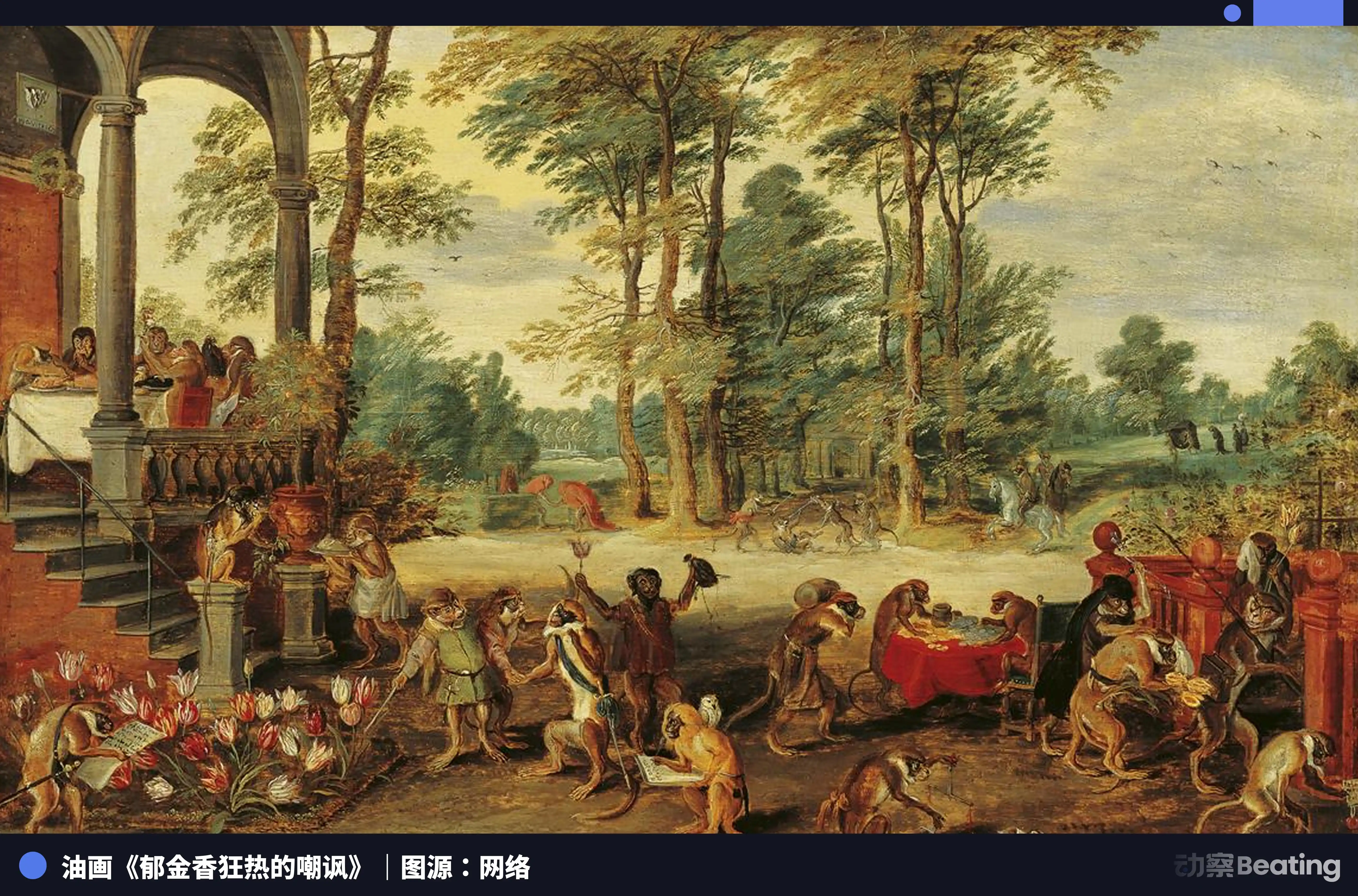
In hindsight, that 10,000 guilders for the Semper Augustus wasn't the judgment of a market, but the judgment of a room. Amplified by the printing press, the room's judgment became the nation's perception.
Eighty-three years later, 1720, London.
The South Sea Company's stock rose from £128 at the beginning of the year to £1,050 in June. Founded in 1711, this trading company held a monopoly charter for British trade with South America, but actual trading profits were meager. The real driver of the soaring stock price was a complex debt-to-equity swap plan. The company proposed taking over government debt and converting it into company stock, then continuously pushing up the stock price to sustain the cycle.
Newton sold his South Sea Company shares when they hit £300, making a profit of £7,000. But the price continued to surge. In July, Newton bought back in, this time catching the top of the market. When the crash came that autumn, his total losses amounted to £20,000, roughly ten years' salary as Master of the Royal Mint.
Newton likely never bothered to understand how that reference price of £1,050 was generated.
1720 had no electronic trading systems, no central counterparty clearing. Buying or selling South Sea Company shares required going to the company's London office to transfer ownership or finding a broker in one of the coffeehouses on Exchange Alley. Daily trades might have been only a few dozen to a few hundred, involving directly only about a hundred counterparties.
These prices were recorded on the price sheets at Jonathan's Coffee House. When newspapers reprinted these sheets, they didn't add a footnote saying, "12 trades today, total volume of about £8,000." All readers across England saw was the single number: "South Sea Company: £1,050."
When the panic selling began in late July, the price generated by the limited game of a hundred people was shattered instantly. No market maker was obligated to buy, no circuit breakers existed, no central bank intervened. By December, the stock had fallen back to £124, almost back to where it started the year.
Jump forward another two hundred and sixty years. Tokyo, late 1980s.
"The land of the Imperial Palace is worth more than the entire state of California." This claim was widely cited by global media in 1989. By estimates at the time, the total value of the 2.3 square kilometers of land occupied by the palace, projected from nearby land prices, was around $850 billion, while the assessed value of all land in California was around $500 billion. But this estimate only referenced the unit prices of a few actual transactions in the Ginza and Marunouchi districts.
Japan's land market had a unique structural characteristic: extremely low turnover. Japanese landowners viewed real estate as a family asset passed down through generations, not for trading and arbitrage. At the peak of the bubble in 1989, the annual number of land transactions in central Tokyo's commercial districts was very limited. The plots that occasionally came to market were often due to owner bankruptcy or family inheritance disputes, with a large pool of cash-rich, eager buyers competing for a tiny supply.
Prices generated under this extreme supply-demand imbalance were extrapolated by real estate appraisal agencies as the "fair value" for all land in the area. Their logic was: if this small plot is worth 20 million yen per square meter, then every adjacent plot should be worth the same amount.
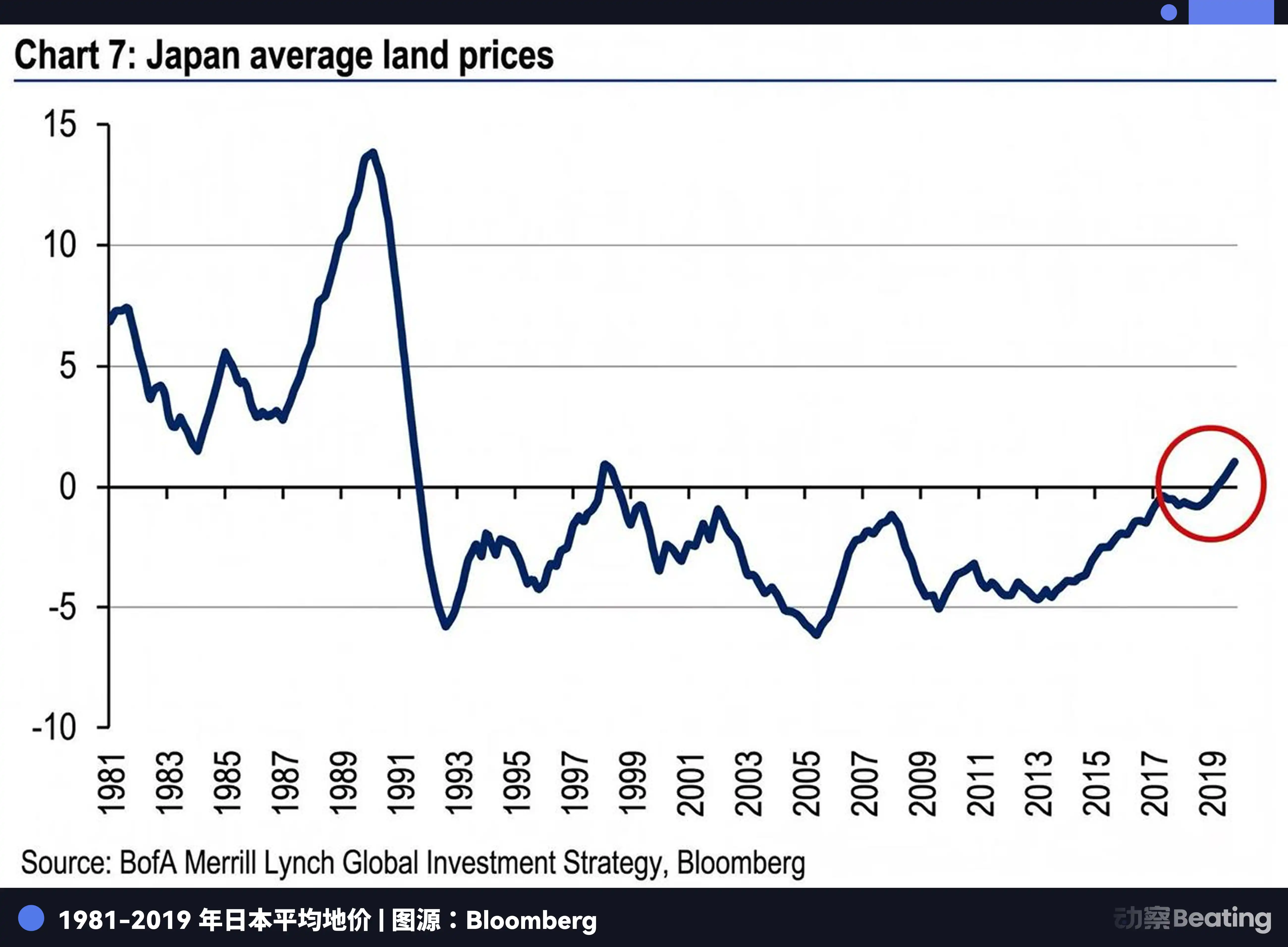
In 1990, the Bank of Japan raised interest rates repeatedly, and banks tightened lending standards. When companies were forced to sell real estate to repay loans, the real liquidity test began. Sell orders flooded in, buy orders were thin. Actual liquidation prices were 50% to 80% lower than the so-called market valuation.
Japan's national land price index then fell continuously for 26 years, only seeing its first modest recovery in 2016.
The Haarlem tavern, the London coffeehouse, the Tokyo real estate appraiser's office, the Jupiter DEX on Solana. Four scenes spanning almost four hundred years, sharing the same narrative structure:
A very small number of participants generate an extreme price in a very thin market → The medium spreads it as broad consensus → A wider public makes decisions based on it → When liquidity is truly tested, the price reverts.
The media evolves: pamphlets, newspapers, telegraph, television, WeChat public accounts. But that core flaw has never been fixed. When a price is transmitted, the conditions of its birth are systematically omitted.
Why?
Complex Stories Always Get Compressed Into a Spreadable Number
Business reporting faces an inherent challenge: the real world is too complex, and the window for dissemination is too short.
To explain what's really happening with a company, you often need to cover funding structure, product progress, revenue quality, competitive landscape, equity rights, exit paths, and market sentiment. But a headline has only one line, and a reader's attention lasts only a few seconds. So expressions like "valuation breaks a hundred billion," "market cap evaporates by a trillion," "unicorn is born," "super platform rises" become an easily chosen form of compression. It's the narrow gate complex business information must pass through when entering public discourse.
Writers are, of course, also stuck in this gate. We all know that explaining the birth conditions of a valuation is much harder than writing an impactful headline. The former requires patience, space, and the reader's willingness to stay. The latter only needs a bright enough number to immediately let people know "something is happening here." If a headline reads: "Marginal price of Anthropic's on-chain Pre-IPO synthetic asset in a low-volume market, projected to imply a $1.2 trillion valuation," it might be more accurate, but it might also exhaust its spreadability before it even reaches the reader.
If it reads "The New King of Global AI is Born," things are different. It has drama, winners and losers, a throne, and the power transitions humanity never tires of. Communication isn't a mover of facts. It's more like a juicer. You throw facts in, and emotions come out.
The second reason is market structure. The Chinese commercial information environment lacks a key player: short sellers.
In the US capital market, a high price detached from fundamentals doesn't stay safe for long. The business model of short-selling research firms like Muddy Waters, Citron, and Hindenburg is to identify assets whose prices far exceed what their liquidity or fundamentals can support, then publicly release a report while simultaneously shorting to profit.
They have a strong economic incentive to show the public the birth conditions of a number. Muddy Waters' 2020 report shorting Luckin Coffee was 89 pages long, deploying 92 full-time and 1,418 part-time investigators, recorded over 11,000 hours of store footage across 981 stores nationwide, and meticulously verified 25,843 receipts. All of this just to prove one thing: Luckin's reported number of cups sold per store per day was fake; the real number was about half of what was claimed.
This level of adversarial research requires two prerequisites. First, a short-selling mechanism exists to profit from "price reversion." Second, legal protections exist so short-selling reports are not suppressed. In the US stock market, both are present. In China's A-share market and primary market, both are essentially absent.
The result is that no one can make money by questioning valuations, so no one has the incentive to ask under what conditions a price was generated.
Short sellers aren't destroyers. They are a corrective mechanism within the pricing system. The consequence of removing the corrective mechanism is that price deviations can expand continuously without resistance until they collapse under their own weight one day. And every day before the collapse, the market looks normal.
The combined effect of these two forces is not without precedent in Chinese business history.
In June 2015, LeEco's stock on the Shenzhen ChiNext board hit its peak, giving it a market cap of about 170 billion RMB. Jia Yueting's depiction of the LeEco ecosystem spanned phones, TVs, cars, sports, and film. The concept of synergies between the seven sub-ecosystems led investors to believe that the synergies of these businesses shouldn't be valued by sum-of-the-parts, but by the exponential growth of the entire ecosystem.
No one questioned how much capital was actually driving this 170 billion RMB market cap. While LeEco's average daily trading volume in 2015 was indeed high, over 70% of the shares underlying this 170 billion market cap were locked up. The actual float was far smaller than what the total market cap suggested. Tradable retail investors and small institutions pushed up the price based on this limited float, and this price was automatically multiplied by the total shares outstanding to get "170 billion."
Large number produced → Enters ranking → Provides certainty → No one has incentive or ability to question → Even larger number produced.
Viewed this way, Anthropic's "$1.2 trillion" isn't surprising. It's just the output of a system operating normally.
Anxiety, Anxiety
Let's look at that $1.2 trillion from a different angle.
What kind of person would buy a synthetic token with no legal guarantees, at an implied valuation three times higher than the latest institutional round, in a market with a liquidity pool of just over a million dollars?
The answer is someone whose FOMO is strong enough to pay the anxiety premium.
When Anthropic's Series G closed in February 2026, the valuation was $380 billion. Two months later, the implied valuation of the token on Jupiter was already more than three times that.
Is this 3x premium driven by information advantage? Are traders on Jupiter more knowledgeable about Anthropic's business than GIC's due diligence team? Clearly not. This premium buys not informational edge, but a psychological insurance policy against the fear of "missing out."
If you were active in cryptocurrency in 2025-2026, what did you witness? Anthropic's annualized revenue skyrock


