






จากผู้ช่วย AI สู่ Agent บนเครือข่าย: วิวัฒนาการครั้งต่อไปของกระเป๋าเงิน Web3 คืออะไร?


- แนวคิดหลัก: ในปี 2026 การผสานรวมระหว่าง AI และ Crypto ได้เปลี่ยนจากแนวคิดเชิงวาทกรรมไปสู่การใช้งานจริง โดยยักษ์ใหญ่ในอุตสาหกรรมกำลังสร้างโครงสร้างพื้นฐานสำหรับการดำเนินการบนเครือข่าย เช่น กระเป๋าเงินและโปรโตคอลการชำระเงิน สำหรับ AI Agent หัวใจหลักของการแข่งขันในอนาคตจะเปลี่ยนจากความสามารถของโมเดลไปสู่วิธีการทำงานที่นำกลับมาใช้ใหม่ได้ (Skills) และการสร้างสรรค์ร่วมกันของชุมชน กระเป๋าเงินจะกลายเป็นพื้นที่ทำงานที่ผู้ใช้สามารถสะสมประสบการณ์และสร้างสรรค์ร่วมกัน
- องค์ประกอบสำคัญ:
- Binance, TON, และ OKX ได้เปิดตัว Agentic Wallet หรือโปรโตคอลการชำระเงินภายในหนึ่งสัปดาห์ ซึ่งส่งสัญญาณว่าการแข่งขันของยักษ์ใหญ่เริ่มต้นจากโครงสร้างพื้นฐานแบบ托管 (托管) ที่ "ให้ AI ควบคุมการดำเนินการบนเครือข่าย" (แรงจูงใจหลัก: สิทธิ์ (权限), การนำกลับมาใช้ใหม่ (复用), และการสร้างสรรค์ร่วมกัน (共创))
- การพัฒนา AI+Crypto แบ่งเป็นสองระยะ: ระยะแรก AI ทำหน้าที่เป็น "ผู้ช่วยวิจัย" (研究助手) เพื่อช่วยทำความเข้าใจข้อมูล (เช่น Binance Social Hype); ระยะที่สอง AI กำลังกลายเป็น "ผู้ดำเนินการบนเครือข่าย" (链上执行者) ซึ่งดำเนินการธุรกรรมโดยตรงผ่าน Agentic Wallets และ Skills
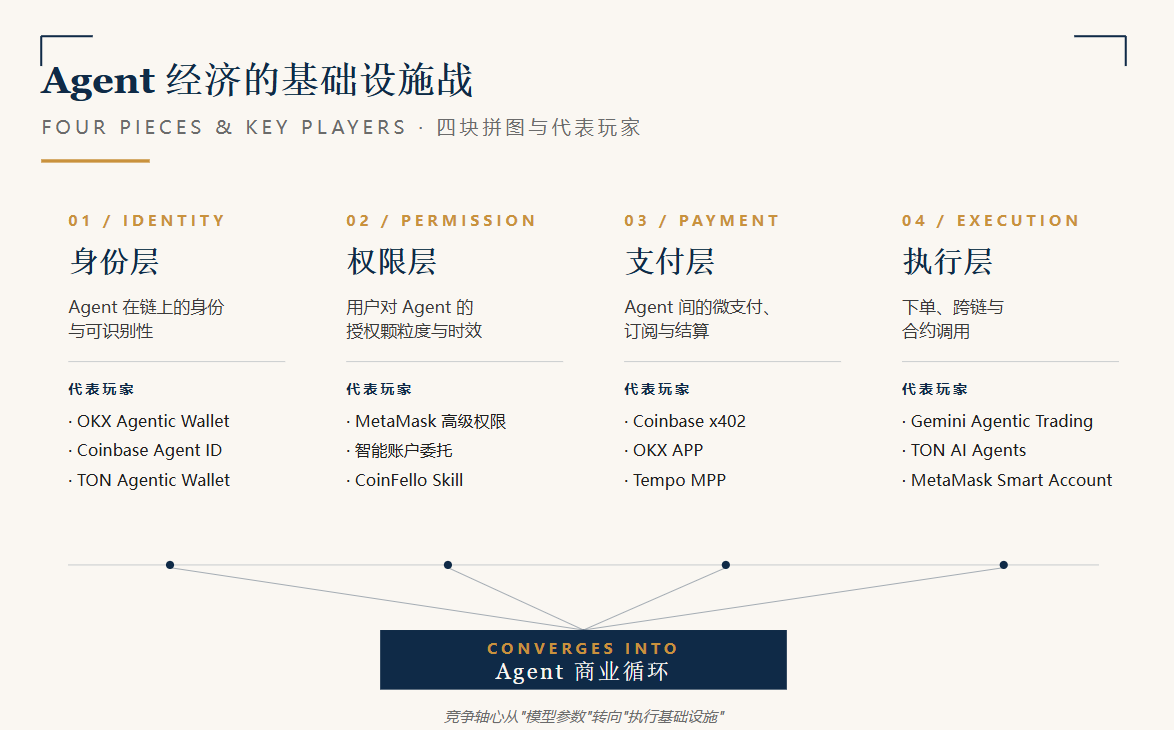
- ยักษ์ใหญ่ในอุตสาหกรรม (Cobo, Coinbase, Gemini ฯลฯ) มีความสอดคล้องกันอย่างมากในสี่ส่วนประกอบสำคัญ: ชั้นระบุตัวตน (身份层), ชั้นสิทธิ์ (权限层 เช่น ERC-7715), ชั้นการชำระเงิน (支付层 เช่น x402), และชั้นการดำเนินการ (执行层) เพื่อสร้างโครงสร้างพื้นฐานบัญชีการเงินที่ AI สามารถเรียกใช้ได้โดยตรง
- แนวคิด Skill กำลังเติบโต โดยการห่อหุ้มการดำเนินการบนเครือข่ายที่ซับซ้อน (เช่น Swap, การเข้าร่วม DeFi) ให้เป็นหน่วยความสามารถมาตรฐานที่นำกลับมาใช้ใหม่ได้ ทำให้การแข่งขันในระบบนิเวศของ Agent เปลี่ยนจากพารามิเตอร์ของโมเดลไปสู่การแข่งขันด้านวิธีการทำงานและความรู้ของชุมชน
- ปัญหาหลักที่กระเป๋าเงินต้องแก้ไขในทศวรรษหน้า: เมื่อ AI Agent ดำเนินการ ผู้ใช้จำเป็นต้องมีความสามารถในการตรวจสอบความถูกต้องของอินเทอร์เฟซอย่างปลอดภัย (Verifiable UI) และสามารถรวบรวมประสบการณ์การดำเนินงานเป็น Skill หรือเทมเพลตที่แบ่งปันได้ กระเป๋าเงินจะเปลี่ยนจาก "สมุดที่อยู่ + อุปกรณ์เซ็นชื่อ" (地址簿+签名器) ไปเป็น "ทางเข้าสำหรับระบุตัวตน การอนุญาต ความรู้ และการสร้างสรรค์ร่วมกัน" (身份、授权、知识和共创入口)
Over the past year, AI + Crypto has been one of the most crowded narratives in the crypto industry.
Initially, the market was more concerned with AI tokens, decentralized computing power, data networks, and various AI Agent concept coins. However, entering 2026, projects are no longer just discussing "how AI will change Crypto," but are beginning to embed AI into wallets, exchanges, payment protocols, and on-chain execution processes.
Within a single week, three landmark events occurred in succession:
- On April 24, Binance Wallet launched Agentic Wallet, an independent, non-custodial wallet specifically designed for AI Agents, featuring independent balances, configurable permissions, real-time monitoring functions, and a built-in default of Agentic Wallet Skills, allowing Agents to perform automated operations within preset boundaries;
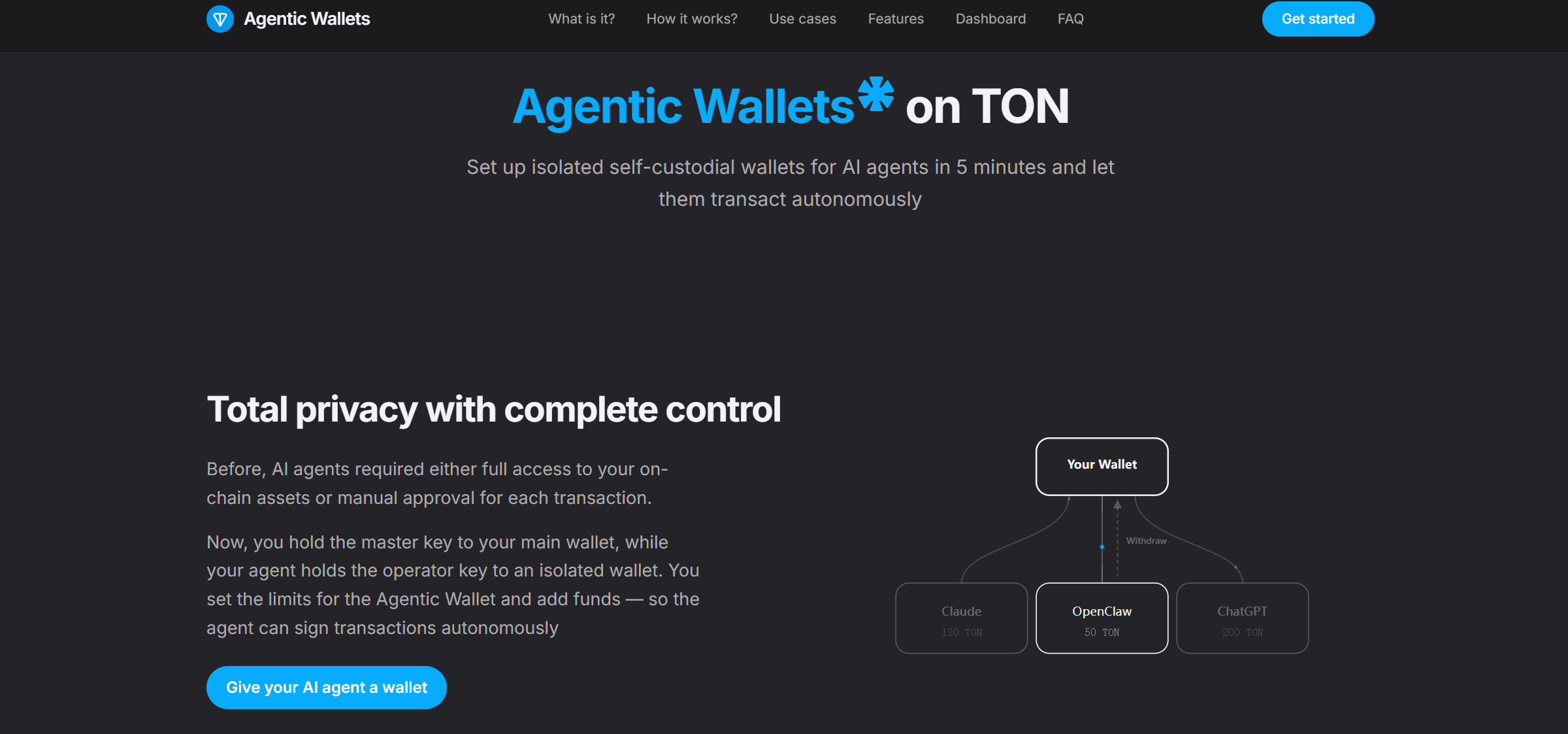
- On April 28, TON launched Agentic Wallet, a self-custody wallet contract for AI Agents, enabling users to set up independent wallets for AI Agents within minutes, allowing Agents to autonomously complete on-chain operations such as transfers, swaps, and staking without touching the user's private keys;
- On April 29, OKX released the Agent Payments Protocol, an open payment standard designed for AI Agent commercial activities, covering the complete business process of quoting, negotiation, escrow, metering, settlement, and dispute resolution, attempting to provide a practical payment and settlement framework for the future Agent economy;
On the surface, this is a giant competition centered around "letting AI take over on-chain execution." But if we zoom out, the true throughline of this competition lies in permissions, reuse, and co-creation.
This may also be the most significant change for Web3 wallets in the next decade.
1. The Evolution of AI + Crypto
We can first review the evolution of AI + Crypto over the past few years.
As we know, for most average users, the biggest problem with the on-chain world has never been a lack of information, but too much and too messy information. For example, a token might simultaneously appear on 𝕏, Telegram, DEX Screener, block explorers, project documentation, and various KOL discussions, making it very difficult for most users to pinpoint its potential profit and risk points within a limited timeframe.
Therefore, the AI features first implemented by many wallets and trading platforms revolve around "information comprehension."
Take the several AI features launched by Binance Wallet in January of this year as typical examples: Social Hype attempts to rank token hype based on social attention and interaction data; Topic Rush generates theme cards for emerging narratives and categorizes them according to capital inflow stages; AI Assistant provides summaries of narratives, sentiment, event timelines, etc., on token pages.
In fact, the value of such features lies not in making decisions for the user, but in helping users lower the barrier to understanding. After all, for newcomers to the chain, a sufficiently clear AI summary can be more helpful than dozens of fragmented tweets. Even for experienced users, AI can act as an information filter, helping them quickly locate clues worth further investigation.
But this is only the first step. In the Crypto world, after "understanding," users often need to consider how to operate, such as authorization, cross-chain, slippage settings, risk control, permission revocation, and identifying phishing pages. This means that if AI only stays at the level of "helping users summarize information," it still cannot truly enter the core process of on-chain interaction.
So, if the first phase of AI was more like a research assistant, the second phase of AI is moving closer to being an executor (see related reading: "New Tickets for the AI Agent Era: Pushing ERC-8004, What is Ethereum Betting On?").
Gemini's launch of Agentic Trading is a highly representative signal. According to Gemini, users can connect an AI Agent to their trading account via MCP, allowing the Agent to call trading-related APIs to perform actions like reading market data, placing orders, monitoring the market, and managing risk. Gemini has also designed some trading capabilities as Trading Skills, such as fetching real-time quotes, checking bid-ask spreads, and reading candlestick chart data, enabling the Agent to call these modules like tools.
This indicates that exchanges are rethinking how users will interact with trading systems in the future. It may no longer be about clicking buttons, entering prices, and confirming orders, but rather users setting goals in natural language, with AI assisting in breaking down the path, invoking tools, and completing execution.
Similar changes are also occurring at the wallet layer.
Cobo's Agentic Wallet introduces the Pact protocol to define what an Agent can and cannot do, and under what conditions it must stop. It also uses a Recipe-driven skill layer to provide Agents with preset execution paths for actions like lending, swapping, DCA, grid strategies, and micropayments. Coinbase is also developing Agentic Wallets and Agent Skills for AI Agents, combining them with machine payment protocols like x402, allowing Agents to send, trade, earn yields, and even automatically pay for resources like APIs, computing power, data, and storage within set limits.
The core change behind all this is that Crypto is providing AI with a set of financial and account infrastructure that can be directly invoked. Looking at all these actions in a single picture reveals a high degree of structural convergence. Each player is assembling the same four puzzle pieces:
- Identity Layer: The on-chain identity and recognizability of the Agent (OKX's Agentic Wallet, Coinbase's Agent identity);
- Permission Layer: The granularity and duration of user authorization for the Agent (MetaMask's ERC-7715 Advanced Permissions, Coinbase's guardrails);
- Payment Layer: Micropayments, subscriptions, and settlements for Agents (x402, APP, MPP);
- Execution Layer: Agents placing orders, cross-chaining, and calling contracts on exchanges/public chains (Gemini Agentic Trading, TON Agentic Wallet);
In the traditional internet, an AI Agent can help you search, summarize, write emails, and generate code. However, when it comes to payments, authorizations, and asset operations, it encounters issues of identity, trust, accounts, and settlements. Blockchain, on the other hand, naturally provides accounts, signatures, assets, payments, contracts, and traceable records, allowing AI Agents to evolve from "digital assistants" into "on-chain executors."
However, execution capability is only the first step.
If this infrastructure is "building hands" for Agents, then another more important, and often overlooked, question arises: Where do Agents get their "working methods"?
2. AI Agents Need More Than Just Wallets; They Need Reusable Skills
This is why the concept of Skills is worth paying attention to.
How to understand Skills? Essentially, it's a unit of capability that encapsulates specific working methods. For example, each Skill is a folder containing a SKILL.md file that tells the AI what the Skill is for, when to use it, and how to operate it specifically.
When running, large models like Claude only need to load the corresponding Skill on-demand based on the user's intent, transforming from a general model into an Agent specialized in a specific task.
This design seems very simple, even somewhat "anti-high-tech," but the truly important aspect behind it is that the emergence of Skills means that competition in the Agent ecosystem will no longer be just about model parameters, reasoning capabilities, and call speed, but will also become a competition of working methods, community knowledge, and reusable capabilities.
The moat of an Agent platform may no longer be "my model is bigger, faster, and smarter," but rather "can experts, enterprises, developers, and ordinary users on my platform encapsulate their experience into reusable assets that can be called upon by others and other Agents repeatedly."
Applying this judgment to the wallet industry yields an even more interesting proposition: after wallets enter the Agent era, the competition in the second half won't just be about executing well, but about becoming a workbench where users can deposit methods and co-create.
In fact, whether it's Gemini's Trading Skills, Coinbase's Agent Skills, or Cobo's Recipe-driven skill layer, they are all essentially doing the same thing: breaking down complex operations into standardized, modular, and callable capability units.
This is particularly important for ordinary users because on-chain operations are rarely simple instructions. An seemingly ordinary Swap might involve token identification, contract address verification, approval limit management, slippage setting, gas estimation, phishing risk identification, and transaction confirmation. A cross-chain operation might involve bridge selection, arrival time, fees, target chain asset display, and failure handling. Participating in DeFi might involve understanding yield sources, smart contract risks, liquidation risks, and exit paths.
If this experience only exists in an individual's mind, it's hard to transfer. If it's only written as a regular tutorial, it's hard to be automatically invoked during real operations. But if it can be distilled into Skills, templates, checklists, or interactive works, it could become a reusable knowledge asset for every user in the AI era.
This is the new value of wallets in the AI era.
Overall, what's really worth watching in the future wallet track isn't just "can AI help me complete an operation," but whether the experience behind these operations can be distilled, reused, and jointly improved.
This is precisely the direction imToken can further explore when proposing UI 3.0.
3. The Next Decade: The Long-term Vision of Wallets in the AI Era
Objectively speaking, over the past decade, the wallet industry has undergone multiple rounds of iteration, from seed phrases to multi-chain asset management, from DeFi to NFTs, from L2 to account abstraction, and now to AI Agents.
But no matter how the industry narrative changes, wallets have always faced the same fundamental question: how to allow users to manage their on-chain lives more securely, autonomously, and clearly. In the AI era, this question becomes even more complex and important.
Because when users start involving AI in on-chain operations, the wallet must answer not just "can this transaction be signed," but also what does this transaction mean? Does it align with the user's true intent? Is the authorization scope reasonable? Are the risks adequately explained? Especially if the Agent makes a mistake, does the user still retain ultimate control? If this operation was valuable, can the user capture the experience and share it with others?
This is the new direction UI 3.0 can convey. The future wallet interface will not just be better looking and smoother, but will understand the user better, explain risks better, carry knowledge better, and be more suitable for user co-creation.
From this perspective, imToken's reflections on Verifiable UI over the past year form the first line of defense for wallets in the AI era (see related reading: "From the Kelp DAO Incident to Verifiable UI: Why a 'Verifiable Interface' Could Be the New Decentralized Security Baseline?").
This is a crucial and somewhat counterintuitive judgment. In most industry discussions, AI often implies more natural input, smarter parsing, and smoother human-machine dialogue. But from a wallet perspective, the smarter the AI, the more the interface needs to be verified.
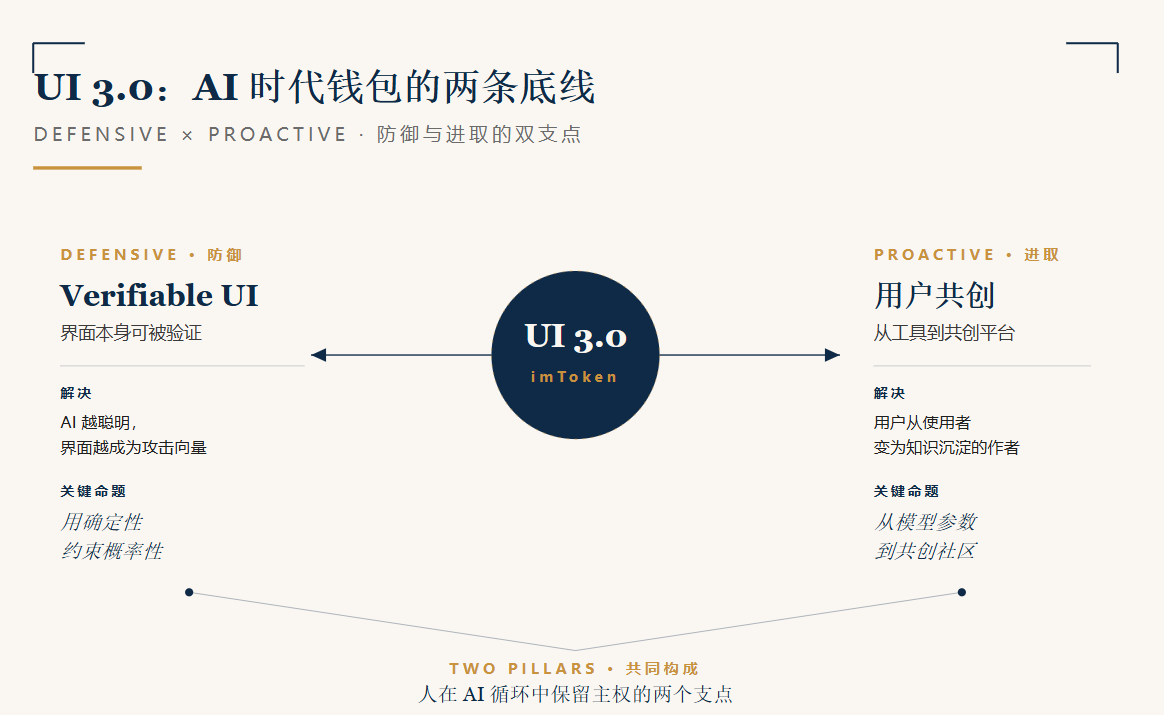
What Verifiable UI aims to solve is precisely that users must have the ability to verify the authenticity of the interface itself. Even if a centralized service goes offline, or if the Agent's interpretation is biased, the user should still retain ultimate control over their assets and interaction process. This aligns with the same principle of non-custody that imToken has championed for years.
Non-custody solves the problem of "who holds the private keys," while Verifiable UI further solves the problem of "is what I see truly what I am about to sign?"
It is precisely under this baseline that imToken believes "using determinism to constrain probability" is more suitable for wallet judgment in the AI era. No matter how smart the AI or how powerful the model, the final execution of a transaction must still be subject to the deterministic code, rules, and permission boundaries within the wallet. The wallet is not a subordinate entry point for AI, but should be the ultimate checkpoint for user asset security in the AI era.
But beyond defense, UI 3.0 has another, more ambitious mainline: evolving from a tool to a co-creation platform. As execution is gradually taken over by Agents and interfaces become verifiable, the question wallets must answer next becomes: what else can users create here? The logic behind this is isomorphic with the logic of Skills.
As more and more wallets integrate Agents, design permissions, and provide execution capabilities, long-term differentiation may not come from "who integrated AI first," but from whether users can deposit their own works within that wallet. For example, an on-chain strategy, a security rule template, a wallet application for a specific scenario, a shareable operation checklist, or a Skill that can be invoked by other users and Agents in the future.
Overall, the evolution of wallets over the past decade has gone from "address book + signer," to "DApp browser," to "multi-chain entry point." The question for the next decade might be: when an Agent executes for me, and the interface is verified by me, what can I co-create here?
Because when users start involving AI in on-chain operations, the wallet must answer not just "can this transaction be signed," but also what does this transaction mean? Does it align with the user's true intent? Is the authorization scope reasonable? Are the risks adequately explained? Can the user capture the experience from this operation and share it with others?
This is the new direction UI 3.0 can convey: the future wallet interface will not just be better looking and smoother, but will understand the user better, explain risks better, carry knowledge better, and be more suitable for user co-creation.
This means users aren't just coming to share stories; they can also co-create works together. For example, a Skill on "how to safely add a token," an interactive guide for "using Layer 2 for the first time," a risk checklist for "identifying phishing approvals," a process template for "hardware wallet cold storage," or even a wallet learning path suitable for beginners.
These works don't have to be complex from the start. They could be an image, a tutorial, an operation checklist, a security reminder template, or even a Skill prototype that can be called upon by AI Agents in the future.
What's important is that users have transformed from "being educated" to "co-creators."
This may be the most promising change in user education in the AI era: knowledge is no longer unilaterally output by projects, but is constantly supplemented, corrected, verified, and reused by real users in real-world scenarios.
In Conclusion
Looking back, the combination of AI + Crypto is rapidly moving from concept to product.
Exchanges are starting to let AI access accounts and trading capabilities. Wallets are beginning to design asset permissions and execution boundaries for Agents. Payment protocols are exploring automatic settlements between machines. Skills and Recipes are starting to turn complex operations into reusable modules.
Ultimately, these changes may not point towards a world where "everything is done by AI," but a world where user capabilities are amplified. In this world, wallets remain the entry point, but no longer just an entry point for assets. They become the entry point for identity, authorization, knowledge, operations, and co-creation.
For imToken, the tenth anniversary is not just about looking back at the on-chain journey taken with users over the past decade, but can also serve as an invitation to the future, inviting every user to deposit their experiences, questions, methods, and works, and to participate together in building the wallet knowledge network of the AI era.
After all, in a truly vibrant Agent ecosystem, the competition is not just about models, but about the co-creating community.
And the wallet might just be the most natural starting point for this community, and the path we will walk together for the next decade.


