十期收官:Ju.com第二轮Meme打新计划全景回顾


- 核心观点:Ju.com 第二轮“Meme十期打新计划”通过无锁仓、动态中签率等机制设计,实现了十期平均收益率超42%、累计认购资金超10亿 USDT 的业绩,验证了一套以散户利益为核心的正和博弈打新模式。
- 关键要素:
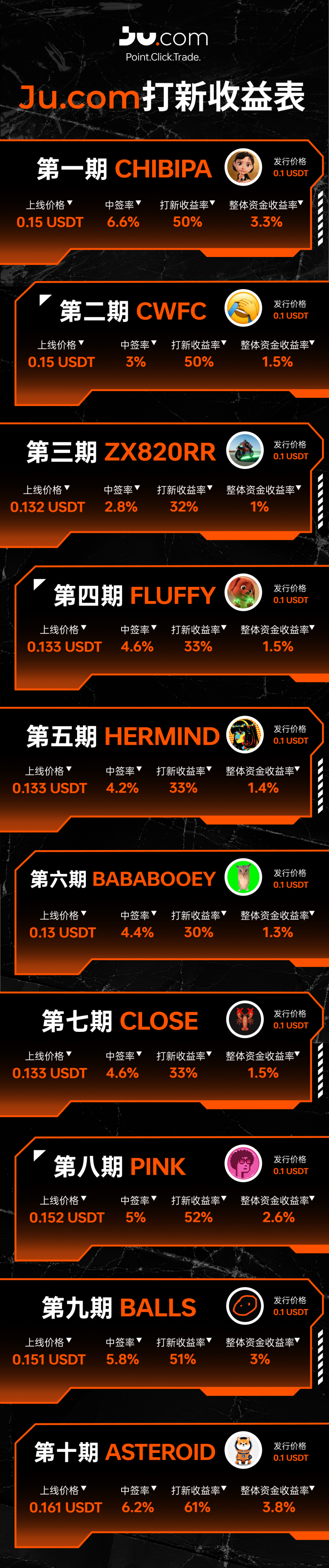
- 十期打新累计认购超10亿 USDT,总参与人次超47万,前九期平均收益率42%,第十期以61%创下新高。
- 动态中签率机制:初始1%,每多500万 USDT 上调0.2%,无上限,资金越多中签率越高,激励用户早参与。
- 无锁仓机制:TGE 后即到账现货,所有期次上线价均高于认购价(0.1 USDT),确保用户“中了就是正收益”。
- 三重收益体系:即时的打新直接收益、资金到账后复利滚动参与下一期、以及使用平台币 JU 参与带来的资产增值。
- 行业对比显著:与主流交易所 Launchpad 10%-40%的收益率相比,Ju.com 以平均42.5%的正收益率实现领先。
From the first subscription of CHIBIPA on March 28 to the TGE of the tenth issue ASTEROID on April 29, spanning over a month, Ju.com's "Second Round Meme Ten-Issue Subscription Plan" has drawn to a successful conclusion. This round of subscriptions not only set multiple new records for the platform itself but also validated a subscription mechanism truly designed to "let retail investors make money" with solid data:
No lock-up period throughout, credited as spot immediately, dynamic allocation rate increases with fund size, multi-currency uniformly converted based on USDT value, and referral rewards up to 20% of the issuance volume.
The total cumulative subscription funds for the ten issues exceeded 1 billion USDT, total participation exceeded 470,000, the average subscription return rate for the first nine issues surpassed 42%, and the tenth issue achieved the highest return of this round at 61%.
Quick Overview of Core Data for the Ten Issues
Trends from the Data: Capital Scale and Participation Heat Rise in Tandem
Looking at the data across all ten issues reveals several clear trends:
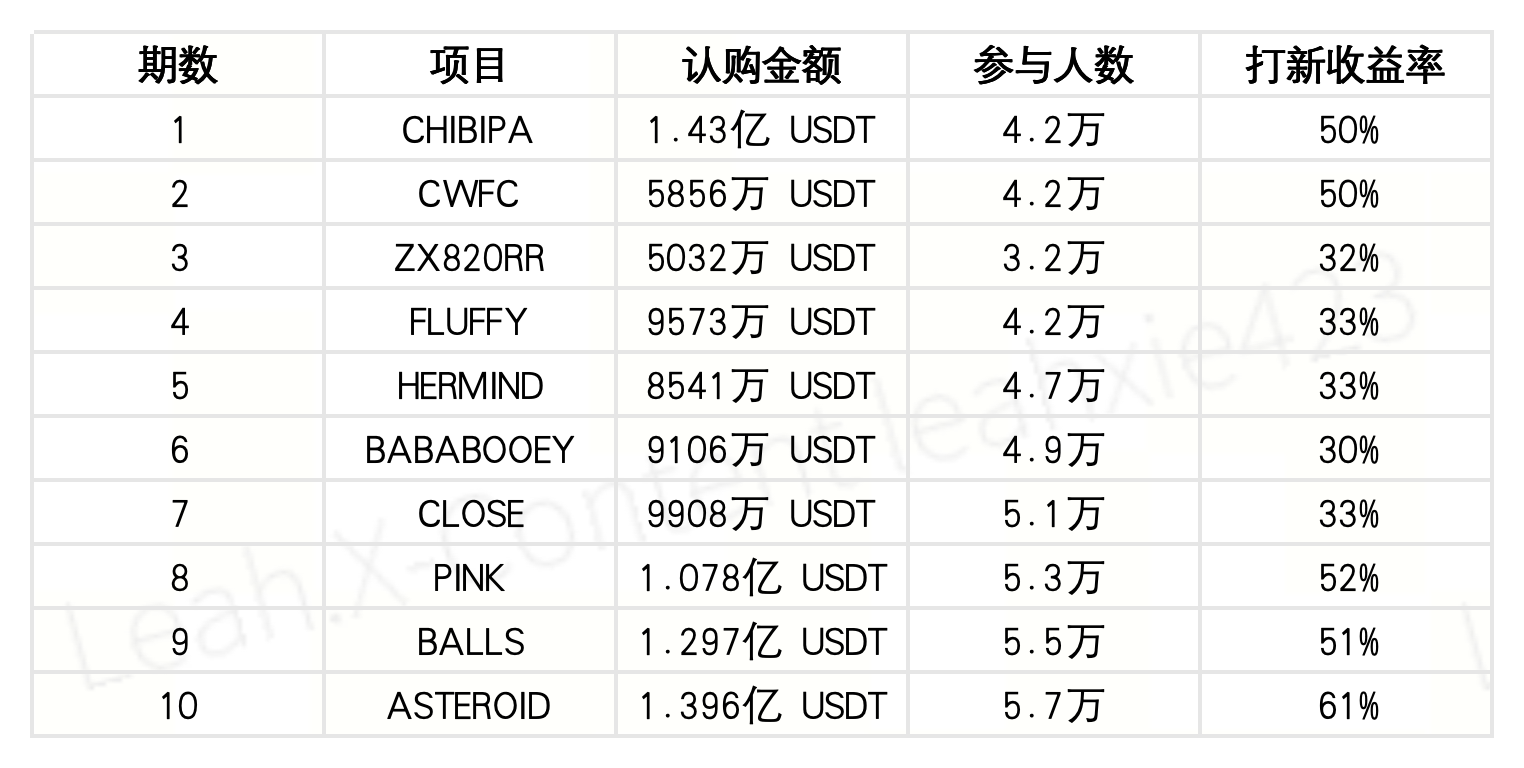
The overall capital scale trended upward. The 143 million in the first issue was a particularly high start; issues two through five fluctuated between 50 million and 95 million. Starting from the sixth issue, the scale stabilized above 90 million, with issues eight, nine, and ten all exceeding 100 million, and the tenth issue setting a new high of 139.6 million. This "wavelike progression" curve indicates a gradual accumulation of user trust in the mechanism, rather than a one-off impulsive participation.
The number of participants continued to grow. Starting at 42,000 in the first issue and reaching 57,000 in the tenth, the cumulative participation across ten issues exceeded 470,000. Against the backdrop of fierce competition for existing users in the crypto industry, a subscription plan maintaining continuous growth in participant numbers for ten consecutive issues speaks volumes about the formation of positive word-of-mouth.
Subscription returns differentiated but remained positive. The lowest return was 30% for BABABOOEY, and the highest was 61% for ASTEROID, with all issues yielding over 30%. This means that even in the worst-case scenario, where you only get allocated the lowest-yielding project, your principal remains intact. In the highly volatile crypto market, this represents a rare form of certainty.
Dynamic Allocation Rate: Ensuring Retail Investors Don't Lose Out and Whales Don't Monopolize
The most frustrating aspect of traditional subscriptions for retail investors is that larger capital has an advantage. Whales pile in funds, the allocation ratio stays the same, and smaller investors get diluted. Ju.com's dynamic allocation rate logic reverses this: starting at 1%, it increases by 0.2% for every additional 5 million USDT, with no upper limit.
Taking ASTEROID as an example, the initial 5 million corresponded to a 1% rate. The excess amount totalled 134.64 million, comprising 26 increments of 5 million USDT. The final allocation rate = 1% + 26 × 0.2% = 6.2%. In other words, the more funds committed, the higher the allocation rate. Everyone benefits proportionally, and the marginal effect of whales pouring in money diminishes.
This mechanism also has a side effect: it encourages early entry and sustained participation. Early on, the capital base is lower, and the allocation rate is lower, but competition is also less. As participation grows, the allocation rate increases accordingly. Whales who rush in later with large amounts objectively help everyone else's allocation rate rise.

No Lock-up Period: The Value of These Three Words
After TGE, tokens are credited directly to your account as spot, available for trading anytime. There is no lock-up period, no linear release schedule, no "we'll talk in three months."
This might sound obvious, but in a market flooded with "18-month linear unlocks" and "only 5% unlocked at TGE," it is not. Users don't need to gamble on whether the project team will dump, nor do they need to calculate what percentage of the market price will remain when the lock-up expires. If the listing price is higher than the subscription price (0.1 USDT), sell. If you want to hold, no one stops you.
Across all ten issues, every project's listing price was higher than its subscription price (0.1 USDT). The lowest was 0.13, and the highest was 0.161. This means regardless of which issue you participated in, getting an allocation meant a positive return, without exception.
Triple Returns: Subscription Profits, Compound Interest, and JU Appreciation
The biggest difference between Ju.com's subscriptions and traditional ones is that it is not just a single event of "earning money from allocations." Instead, it builds a "triple return" stacking system.
The first layer is the direct return from each subscription. Take the tenth issue as an example; the overall fund return rate was 3.8%. This means if you invested 1,000 USDT, the return on the allocated portion would be approximately 38 USDT. This number might seem small, but remember, this is just the return for a single issue.
The second layer is compound interest rolling over. Because settlement for each issue is immediate, funds can be used to participate in the next issue right away. When users reinvest both principal and profit from the previous issue into the next, capital utilization efficiency is amplified significantly. The average subscription return rate for the first nine issues was about 42%, and the average fund return rate was about 2%. The cumulative effect after nine consecutive rolls is quite substantial.
The third layer is the appreciation of JU. During the second round of subscriptions, JU's price rose from approximately 1.9 USDT at launch to over 4 USDT. For users who used JU to participate in subscriptions, they not only earned profits from the subscriptions but also benefited from JU's price increase. More importantly, a significant portion of the funds raised in each subscription is in JU, which gets locked in the subscription pool, reducing the circulating supply on the secondary market and further driving up JU's price. This positive feedback loop – "subscription demand drives JU higher → JU's price increase attracts more users to participate in subscriptions" – persisted throughout the entire second round.
Industry Comparison: 42.5% Average Return Rate Significantly Leads
To understand the value of Ju.com's second-round average subscription return rate of 42.5%, one must first look at the overall industry level.
According to CoinGecko and various crypto data platforms, the average subscription return rate (calculated based on the opening price on TGE day) for mainstream exchange Launchpads ranges between 10% and 40%.
The key characteristics of Ju.com's second round of ten subscription issues are: all issues had positive returns, with a minimum of 30%, a maximum of 61%, and an average of 42.5%. More importantly, the no-lock-up mechanism allows profits to be realized immediately, avoiding the classic tragedy of "paper wealth turning to zero upon unlock." Simultaneously, the dynamic allocation rate model places retail investors and whales on the same allocation rate curve, unlike the "money rules all" dynamic in traditional subscriptions. These design elements collectively transform subscriptions from a zero-sum game of "competing on capital and luck" into a positive-sum return system of "competing on participation and patience."
True Barrier to Subscriptions is Not Capital, But Mechanism
The second round of ten subscription issues, backed by over 1 billion US dollars and 470,000 participations, has validated a simple truth: In the subscription arena, what users truly need is not more complex financial tools, but a fair, transparent, low-barrier, and straightforward mechanism. The dynamic allocation rate prevents retail investors from being crushed by whales. No lock-ups ensure profits are genuinely realized. Multi-currency participation lowers the entry barrier. Referral rewards turn every user into a node for dissemination.
The true barrier to subscriptions has never been capital, but the mechanism. Ju.com has proven through two rounds of subscriptions that it knows how to design a mechanism that keeps users willing to participate continuously.
All data in this article is sourced from Ju.com official announcements and activity pages. Historical returns do not guarantee future performance. Digital asset investment carries high risk with volatile prices. Please participate rationally based on your own risk tolerance and do not invest funds beyond your capacity to bear losses. Ju.com assumes no responsibility for any losses incurred by users participating in subscriptions.