






Iran opened fire on an oil tanker that paid fake Bitcoin transit fees to scammers


- Core Takeaway: After Iran announced that the Strait of Hormuz would accept Bitcoin transit fees, scammers quickly exploited the narrative to impersonate authorities, leading to at least one oil tanker that had paid fake fees being fired upon by Iranian forces when attempting passage. This incident highlights the risk of cryptocurrency being weaponized in conflict scenarios.
- Key Elements:
- In late March, Iran passed a law requiring laden oil tankers to pay transit fees of $1 per barrel in Bitcoin, USDT, or RMB (potentially up to $2 million for 2 million barrels). The news briefly drove Bitcoin up 5%.
- Greek firm MARISKS warned that scammers are impersonating Iranian authorities, demanding BTC or USDT from stranded vessels in exchange for safe passage, precisely targeting shipowners' anxiety.
- On April 18, Iran briefly opened the strait. At least one tanker that had already paid scam fees attempted to pass but was fired upon by Iranian Revolutionary Guard gunboats and forced to turn back.
- Blockchain analytics firms TRM Labs and Chainalysis both stated that on-chain data does not show Iran collecting large-scale cryptocurrency transit fees, with its affiliated entities primarily relying on USDT on Tron.
- Legal risks are increasing: Regardless of whether funds enter Iranian accounts, the act of a payer intending to make payment to a sanctioned regime can already constitute a violation of OFAC and other sanctions regulations.
- The irreversibility of cryptocurrency becomes a flaw: Once sent, it cannot be recovered, starkly contrasting with the freeze and recovery mechanisms of traditional bank transfers.
Original Author: TechFlow
Introduction: Less than two weeks after Iran announced it would accept Bitcoin as a toll payment for the Strait of Hormuz, scammers impersonating Iranian officials have been sending fake messages to stranded oil tankers, demanding BTC and USDT.
At least one oil tanker that paid the fraudulent toll came under fire from Iran's Islamic Revolutionary Guard Corps (IRGC) while attempting to transit. On-chain analytics firms TRM Labs and Chainalysis both stated that they have found no on-chain evidence of large-scale cryptocurrency toll collection to date.
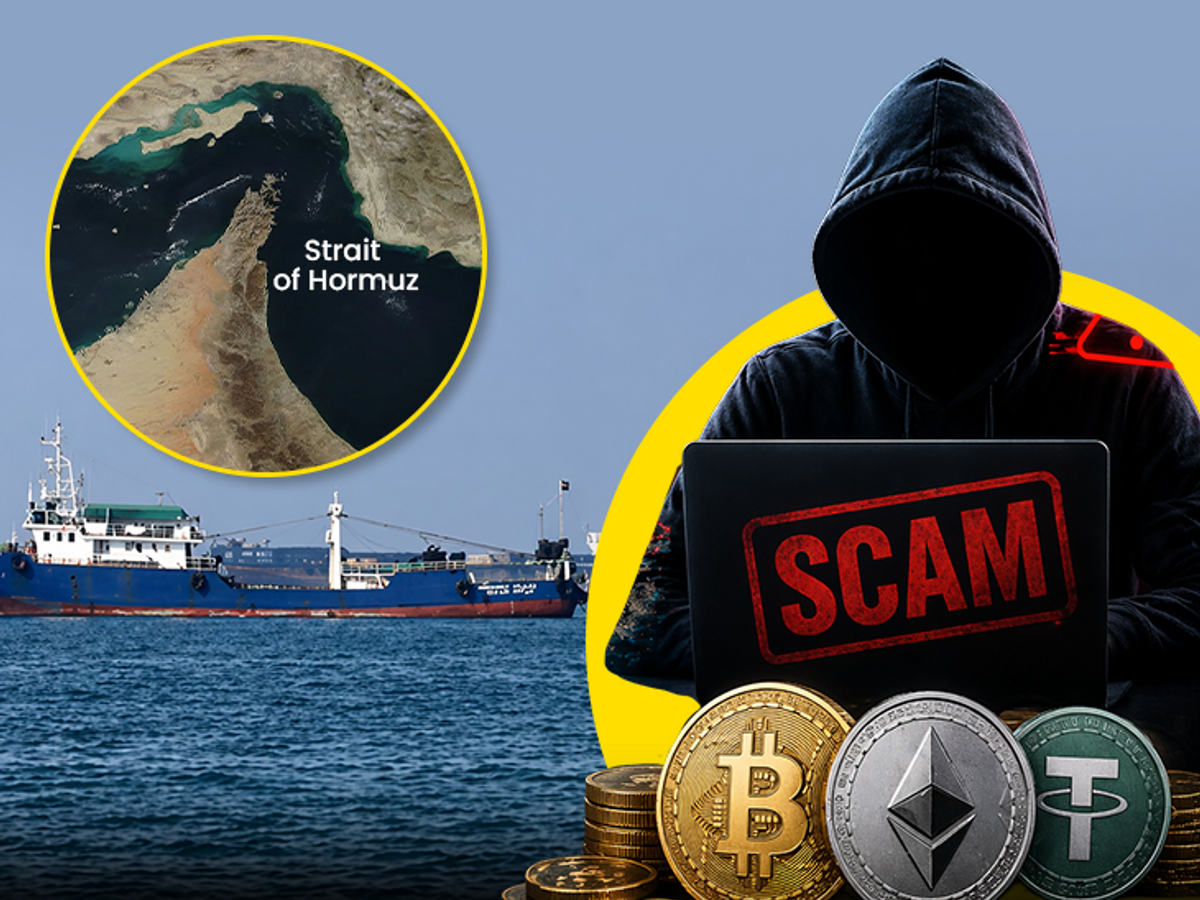
Iran's announcement of using Bitcoin for tolls turned into a weapon for scammers within two weeks.
According to a Reuters report on April 21, Greek maritime risk management company MARISKS issued a warning: unidentified individuals, posing as Iranian authorities, sent false messages to vessels stranded off the western side of the Strait of Hormuz, demanding payment in BTC or USDT for "tolls" in exchange for safe passage. MARISKS believes that at least one vessel, which came under fire from IRGC gunboats during a brief opening of the strait on April 18, was a victim of this scam.
The absurdity of the event lies in the entire chain of causality: a sovereign state announces it will collect Bitcoin tolls, scammers copy this narrative to defraud, ship owners believe it and pay, only to be shot at by the actual Iranian military.
From a "National Settlement Tool" to a Scammer's Attack Vector
The story begins in early April.
On March 30-31, the Iranian parliament passed the "Strait of Hormuz Management Plan," formalizing into law the toll system that the IRGC had been enforcing since mid-March. According to the Financial Times, Hamid Hosseini, spokesman for the Union of Iranian Oil, Gas, and Petrochemical Exporters, confirmed that laden oil tankers must pay a fee of $1 per barrel, with payment options including Bitcoin, USDT, or Chinese Yuan. For a very large crude carrier (VLCC) loaded with 2 million barrels of oil, a single transit toll could reach $2 million.
Upon the news, Bitcoin's price jumped 5%, briefly breaking through $72,700. The crypto community quickly interpreted this as a milestone validation of Bitcoin as a "neutral settlement layer for international trade." Institutions like Bitwise even linked it to predictions of Bitcoin surpassing $1 million.
But skeptics were not few.
In an April 15 report, Sam Lyman of the Bitcoin Policy Institute pointed out that large-scale collection of Bitcoin tolls with current technology is "virtually impossible to achieve." Ari Redbord, Global Head of Policy at TRM Labs, told Fortune magazine that on-chain data does not show toll payments occurring on a large scale. Chainalysis, in its analysis report, noted that on-chain activity by Iran-linked entities primarily relies on USDT on the Tron network, not Bitcoin.
Scammers don't care about these technical debates. They only need a credible narrative, and the Iranian government had already written the script for them.
Ships That Paid Fake Money Got Hit by Real Bullets
According to Reuters and DL News, the wording of the scam messages closely mimicked official channels. Scammers demanded ship owners submit vessel documents, claiming they would be assessed by "Iranian security authorities." Upon approval, payment was required in BTC or USDT, after which the vessel could "safely pass through the strait at a scheduled time."
Approximately 400 ships and 20,000 crew members are currently stranded in the Persian Gulf. With the US blockading Iranian ports and Iran repeatedly opening and closing the strait, the anxiety among ship owners under this dual blockade is palpable. The scammers precisely exploited this anxiety.
On April 18, Iran briefly opened the strait, and some vessels attempted to transit. According to the UK Maritime Trade Operations (UKMTO), two IRGC gunboats opened fire on an oil tanker trying to exit the strait, forcing it to turn back. MARISKS believes this tanker had previously paid the cryptocurrency "toll" to scammers, believing it had obtained passage clearance.
They paid, but the money didn't reach Iran. The ship was still attacked.
Paying Scammers Could Also Violate Sanctions Law
More ironically, even if ship owners realize they've been scammed, the legal risks do not disappear.
Xue Yin Peh, Director of Investigation Strategy at Chainalysis, told Decrypt that regardless of whether the recipient is actually the Iranian authorities, if the payer intends to make a payment to a sanctioned regime, it could constitute a violation of OFAC, EU, and UK sanctions regulations. In other words, even if you think you are paying Iran, and the money ends up in a scammer's pocket, regulators can still pursue your "subjective intent."
Isabella Chase, Head of Policy for Europe, Middle East, and Africa at TRM Labs, also warned that any wallet addresses associated with such demands should be considered "high-risk," and cryptocurrency payments offer no "safe harbor" regarding sanctions compliance.
This creates a nearly unsolvable dilemma for ship owners: paying Iran is a sanctions violation, paying scammers might also be a sanctions violation, and not paying means continuing to drift in the Persian Gulf.
Bitcoin's Irreversibility: From Advantage to Flaw
The aspect most worthy of reflection for the crypto industry is how Bitcoin's core characteristic performed in this scenario.
Benzinga's report highlighted the key issue: cryptocurrency payments, once sent, cannot be reversed. Traditional bank transfers at least offer the possibility of freezing and recovery, but once Bitcoin or USDT is transferred out, the funds are gone. In a normal business context, this characteristic is called "trustless settlement," but in the superimposed scenario of war and scams, it becomes a "loss with no recourse."
This might be the most absurd crypto story of 2026... Iran's plan to collect Bitcoin tolls may have never truly materialized, but scammers have already profited from this story, and an oil tanker got shot because of it.


