4D talks about whether the new game-breaker ChatGPT can subvert Google search?



Original title: "Google Search: The possibility of being subverted by ChatGPT"
Author: Mario Gabriele
Related Reading:
Related Reading:
ChatGPT Evolution: Envisioning 7 Potential Functions of GPT-4
The Rise of ChatGPT: Development History, Technical Principles and Limitations
The Generalist recently posted an article about Google, ChatGPT, and the future of search. It explores several issues: Since the launch of ChatGPT late last year, OpenAI products have been hailed as: the future of search and a potential Google killer. So, will Google be gradually subverted like Encyclopaedia Britannica and Yellow Pages, or will the emergence of ChatGPT only drive Google's transformation?
“The reason for Google’s success is simple: It shortened the distance from question to answer and found a way to monetize it.”
first level title
Content Outline & Highlights
*This article is about 9000 words, relatively long, but very useful, you can read it in the WeChat reading mode, combined with the outline
"The history of human information—
The distance between question and answer gradually shortens. "
1. The history of human beings is the history of constantly searching for the most accurate information
2. Google and sorting algorithms
The Power of Google's Sorting Algorithm
Will AI Revolutionize Google Search?
Why is Google winning?
How big is Google's search business?
3. New competitor: ChatGPT's break
Could ChatGPT Revolutionize Search?
Limitations of ChatGPT
Advantages and disadvantages of ChatGPT
Understanding Search Scenarios
4. Looking ahead: what will happen?
Summary:
Summary:
Google, which has a market value of 1.4 trillion US dollars, earned 163 billion US dollars in revenue from the search business last year. Google, which has been in operation for more than 20 years, has maintained a market share of up to 91% in this search field-until ChatGPT appeared. Many rivals have tried to compete head-on with Google, but they have all failed. But at the end of 2022, OpenAI's ChatGPT was born, which is tantamount to a direct confrontation with Google.
Of course, although ChatGPT is not a pure search engine, ChatGPT can provide more accurate answers to many complex questions. Within a few months, ChatGPT attracted more than 100 million users. However, ChatGPT has limited knowledge of events beyond 2021 due to data timeframe issues, so it cannot answer the latest search requests in the world.
There is another problem, which was mentioned in our previous article: ChatGPT's answers sometimes look very serious and formal, like real ones, but they are actually made up and not necessarily accurate.
Still, it looks like most of ChatGPT's flaws can be fixed. Of course, advertising is still a viable model. While ChatGPT is accepting a $20 per month subscription model, other conversational search products may be available via advertising. The large amount of unused space, and the immediate nature of the chat, make for an effective business channel.
first level title
The history of human beings is the history of constantly searching for the most accurate information
How much effort has human beings made to get an accurate answer?
Here we first tell a story: Croesus, the Lydian king, sent seven envoys to travel the whole country in order to find the real oracle. When the Delphi oracle correctly speculated that Croesus was making mutton soup, the king was stunned. Delphi was part god, part advisor, wielding mystical powers as well as weighing in on practical matters such as military strategy.
Because even for the wealthiest men in the ancient world, gathering the best quality information required many days of travel.
Finding information is the dilemma of almost all human beings: our ancestors crossed oceans, climbed mountains, and risked disease to visit places full of light. Whether it is to appreciate the wisdom in the library of Alexandria or to participate in the study of institutions of higher learning, all these need to pay the cost of time and travel.
Because of the human quest for knowledge, commercial businesses that provide answers are a good fit.
Note that the Yellow Pages and Encyclopaedia Britannica used to be famous businesses. For decades in the 20th century, the businesses of these two companies were used by everyone on a daily basis. Whether it's the Yellow Pages, or the Encyclopedia Britannica, they provide basically the same value:
That is, faster access to information. For most transactions, consumers who need utility and transactions can get the value they need through their products.
first level title
Google and sorting algorithms
In 1996, the above speculation (the distance between the question and the answer gradually shortened) was verified in the history of business. Sergey Brin and Larry Page, PhD students at Stanford University, officially released"BackRub "The first version of , although there were other Internet search engines before, none of them organized information by the number of backlinks received through the source.
Today, Google's market cap is $1.4 trillion, with a peak of $2 trillion in 2021. Google Inc. will generate $283 billion in revenue in 2022, up 10% from the previous year, with search contributing 57%.
Although Google is most notable for its financial prowess, in essence, Google search represents a secular omnipotent science capable of producing answers in fractions of a second, even the ancient Greek almighty God may not necessarily be able to match.
For the relationship between humans and Google: Google is the place we go to find almost any problem imaginable, whether sacred, secular or otherwise.
Google is almost a destination for all kinds of human whimsy:
secondary title
Google and sorting algorithms
Since the launch of ChatGPT late last year, OpenAI's product has been hailed as: the future of search and a potential Google killer. Former Coinbase CTO Balaji praised ChatGPT as a "historic achievement" that "is already better than Google on many queries." Y Combinator Partner and Gmail Creator Paul Buchheit Announces Google"Still a year or two away from being completely disrupted"secondary title
So, will AI disrupt Google Search?
From many angles, Google Search looks like an unassailable and irreplaceable product.
Its revenue and finances are very dazzling, its market share occupies a leading position in the market, and it has been recognized by users. However, we are discussing "Is AI going to disrupt Google search?" "When making the argument, we need to study the past and present of Google search: If we look back in the past, it may not be possible to see that Google will become a multi-trillion-dollar enterprise. For example, when Google was first established in 2002, it was questioned:
An article in The New York Times titled"Google』s Toughest Search Is for a Business Model", summed up the market's concerns. Analyst Salomon Smith Barney pointed directly to Wall Street's verdict on Google:
Here's what the article says: "For all the praise people have for Google, as a business, I think it will take a lot of effort for Google to catch up to Overture."
Overture, creator of the GoTo search engine, isn't Google's only competitor. Companies like Lycos, Excite, AltaVista, and AskJeeves fought for share after dot.com's Internet crash around 2000. So, why did Google win later? Google has better technology. According to Sergey Brin and Page,"The popularity of the resulting link given by the search"is an indicator of the quality of the search results. And their cognition was proved to be correct.
Based on search, inspired by"PageRank "(Alfa Rabbit Note: The sorting algorithm, PageRank, was developed by Larry Page in 1997 when he was studying for a Ph. All links are analyzed. The popularity of web pages is rated based on the number and importance of incoming links, as well as anchor text, which is to determine which sites are the most useful through the collective wisdom of the network.) Algorithms enable Google to provide better results than its competitors Better and more accurate results, which is a testament to Google's technological prowess and has played a big role in Google's growth.
This was a very sharp technology for its time, resulting in a superior product: that is, Google was not only the most useful search engine, it was also fast and intuitive. However, Brin and Page did not waver in the face of commercial temptations and insisted on their own advantages.
For example, other search engines allow advertisers to use images in their posts, but Google does not. Quite simply, images slow down the loading speed of web pages and degrade the user experience.
Later, Google launched its own advertising model. Google's advertising model avoided pictures and only allowed small text ads. The point is that Brin and Page only offer ad space above and to the side of search results. Compared with search companies like Overture, Google's choice represents a major shift:
In other words, Google only provides sponsored search results, B-end customers pay for the ranking of certain search terms, and the company with the highest bid will get the highest position. And Google borrowed this auction-based system.
Of course, Google's success does not only depend on better technology, superior products, and a more institutional business model. If Eric Schmidt hadn't been CEO in 2001, Google might have been completely different from what it is today.
However, looking back at the past from today's perspective, these factors are just the foundation. From the standpoint of the other information innovations we mentioned, the reason for Google's success is simple: it shortened the distance from question to answer and found a way to monetize it.
Perhaps even Brin and Page would not have imagined that their search engine would have such a large profit margin today. Google Search today is not only a large business, but one of the most powerful in the world.
Google search is the economic engine behind the entire Alphabet group, the organizational principle and the meaning of existence of Alphabet. Google's other businesses, such as the Chrome browser, maps, and Android, exist largely to augment the power of Google's search, while Google's business plans, such as biotechnology, self-driving cars, and satellites, is based on Google Search Productivity.
How big is Google's search business? In 2022, Google search will generate $163 billion in revenue, accounting for 57% of Google's total turnover. Google's entire advertising division generates $224 billion, or 79% of all revenue.
Here comes the question, is it healthy for a business to rely so heavily on one product (Google search)? Should a $1.4 trillion business place most of its weight on a single revenue stream? Historically, search has looked like an indestructible business because all internet users around the world need it, however, over time, Google has moved to reduce its reliance on search. For example, in 2017, search accounted for 63% of revenue, which has declined in recent years. While search remains Google's most important line of business, growth in the company's cloud services and YouTube's advertising unit has helped diversify revenue across the business.
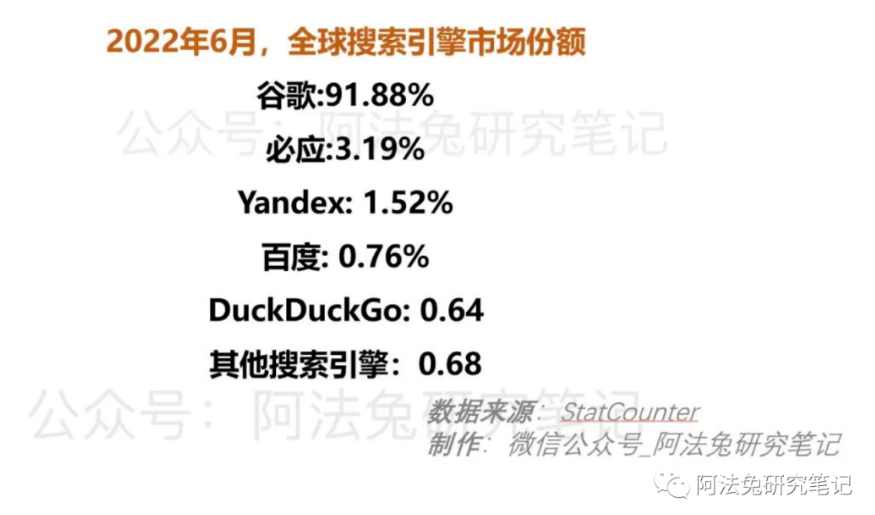
Google Search's share of the market is equally impressive. Google holds between 84% and 91% of the market, and other search engines are in the single digits. Of course, depending on the statistics, this share may have declined slightly in the past few years, but the overall magnitude is not large. Google has done a very good job of building other ecological advantages around the search business. Google, for example, basically fixes the inevitability of using its own search engine every time a user downloads the Chrome browser or buys an Android phone.
picture
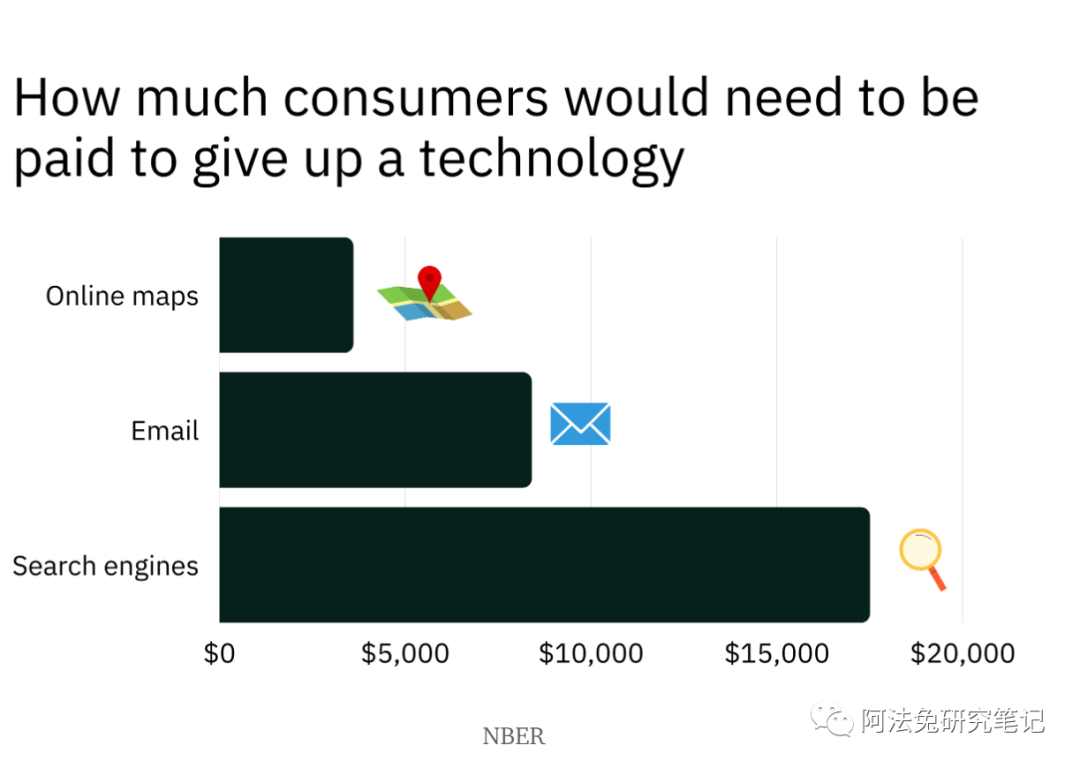
In theory, consumers show a high willingness to pay for the digital experiences of modern life, for example, surveys show that people would have to give up $3,600 to give up online maps, $8,400 to give up email, Give them $17,500 to give up using a search engine. (Ben Rabbit’s voiceover: I can’t give up how much money you give me...) Although the above data only represent product categories in consumers’ perception, not a specific technology company. However, the above data can still represent the importance of Google products in people's lives.
Of course, many people may think that Google products have degenerated, but it is still the world's preferred search engine. Of course, there are reasons for Google's many degradations in [products], either for more income or for thwart your competitors.
The most obvious example: the increase in the number of search + advertising stores. Today a user may have to scroll through 42% of the results pages to get the search results they think they should. The Google of today, which is nothing like circa 2000, that is, the minimalism and efficiency of the time, has morphed into a page full of sponsored links and full of misinformation and distractions.
The entire search product went from great art to a mess.
Google has not only increased the number of ads, but also camouflaged them, but, you know, users are not stupid: if users find out how many pages are consumed by commercial activities, they will choose a provider with a simpler product. More spam comes from links generated by Google's internal products for promotion. Google Hotels, Flights and Shopping, for example, are often placed first for related queries, and while doing so may sometimes improve the user experience, it also means Google is competing with the advertisers it serves. All of this today is a far cry from the original intention of Brin and Page - the willingness to put the needs of consumers first and forego the easy money of ubiquitous advertising.
Google did find ways to make more money from the distance between the question and the answer, but these manipulations made the journey longer and more convoluted.
Today, when we evaluate the strength of Google search, we need to point out: Google has a lot of investment in research and development. Google invests tens of billions of dollars in cutting-edge technology every year. In 2022, it will invest 39.5 billion dollars in research and development, an increase of nearly $8 billion.
first level title
New Competitors: ChatGPT's Breakthrough
Continue the previous story: Later, when Croesus, the Lydian king, asked Delphi if he should attack Persia, Delphi replied to him: You will"destroy a great empire"; and Croesus took this reply as good news, a sign of the impending decline of Persia.
Then the question arises: which empire did the oracle reply to? It says empires will be destroyed, but it doesn't say which empires will be destroyed. The Persian army completely wiped out the Lydian army, and when the king Croesus, who was once astonished, was burned to death at the stake, he might have a moment to reflect on what information was conveyed to him, and what is high-quality information.
Over the years, Google has taken many opponents head-on, conquering them all. Whether it's Bing, Yahoo or Yandex, or Baidu, DuckDuckGo. Although the revenue of these companies is also good, for example, Bing’s revenue is 11.6 billion U.S. dollars, but in 2021, Yahoo will be acquired for 5 billion U.S. dollars, Baidu and Yandex are the leading brothers in the region, but from a global macro perspective, these companies are very good. The difficulty lies in the head-on confrontation between the search business and Google.
At the end of last year, ChatGPT, a new opponent, appeared. Although this thing seems novel, its powerful AI capabilities allowed it to quickly accumulate more than 100 million users, and even rank as the fastest growing CGPT in history. end products, surpassing TikTok and Spotify, etc.
We found that generative AI is a technology that will improve the way we create and consume content. But what if ChatGPT could disrupt search? There is a view that ChatGPT will subvert the search industry. For example, Paul Buchcht, a key figure involved in building the Google empire, sees ChatGPT as a threat. Why? Because in the few short days since ChatGPT was released: various examples of ChatGPT's abilities as poets, historians, programmers, teachers, and mathematicians have popped up on Twitter.
Many people are addicted to ChatGPT and cannot extricate themselves. However, if you want to study the threat of ChatGPT to Google, you need to study the advantages and disadvantages of ChatGP more carefully: Advantages and disadvantages of ChatGP: From the perspective of experience: using ChatGPT feels like you input requirements into a smart box , and then receive a thoughtful, written response that isn't influenced by images, ads, and other links, and the simplicity feels appealing. From the perspective of pure interface design, ChatGPT feels like returning to a simple and free interface, which is clear, focused, and simple.
In addition to a cleaner interface, ChatGPT can answer some queries more efficiently than Google. Considering the newness of ChatGPT technology and its iteration, it is difficult to fully describe its advantages in this article, but we can consider the following points:
1. Creating original content
ChatGPT does not simply search the web and return a response. The power of its artificial intelligence is that it will"think"and generate content it thinks answers your questions. Whether this counts as a job for search engines is another matter, but we need to admit that this feature of ChatGPT is very useful for generating original content like code snippets, blog posts, email drafts, or social media posts. Useful.
2. Modifying the delivery style of iteration information (Modifying delivery style.)
For example, ChatGPT allows users to control how they want their answers to be delivered, and whether they will modify the generated answers, depending on the purpose of the answers. For example, writing a trademark application in Old English style sounds interesting, but has no particular value. But if it is to let it generate a trademark application for a legal document, it will be of practical use.
3. Ask background questions.
secondary title
Limitations of ChatGPT
However, like any intelligence, ChatGPT has limitations. First, it's not clear what ChatGPT's search patterns are:
For example, part of the function of ChatGPT will be search, which can become the main destination of certain types of search behavior, but search will not necessarily be the main application scenario of ChatGPT.
From Google's point of view: Whether ChatGPT will be used as a search engine is very important. Because if this is the case, ChatGPT will build its own product to serve this use case and compete head-to-head with Google.
However, if the focus of ChatGPT's development is elsewhere, it may ignore the search business and focus on other parts. And as ChatGPT comes out of the laboratory and gradually develops to the business level, Google will pay close attention to its development direction.
Still, if ChatGPT is truly a new kind of search engine, there are more problems to be solved. Among them, the most important thing is AI information, which is a limited aggregation within a certain period of time.
(For example, ChatGPT currently mainly finds information about 2021. ChatGPT has no way of knowing who won the midterm elections, whether the World Cup team won or lost, and whether Elon Musk is the CEO of Twitter) Of course, the whole world didn't start in 2022, and the previous information is also meaningful, but if we look back at the most popular Google searches in the world, we will find that humans need the latest information, including various hot spots.
picture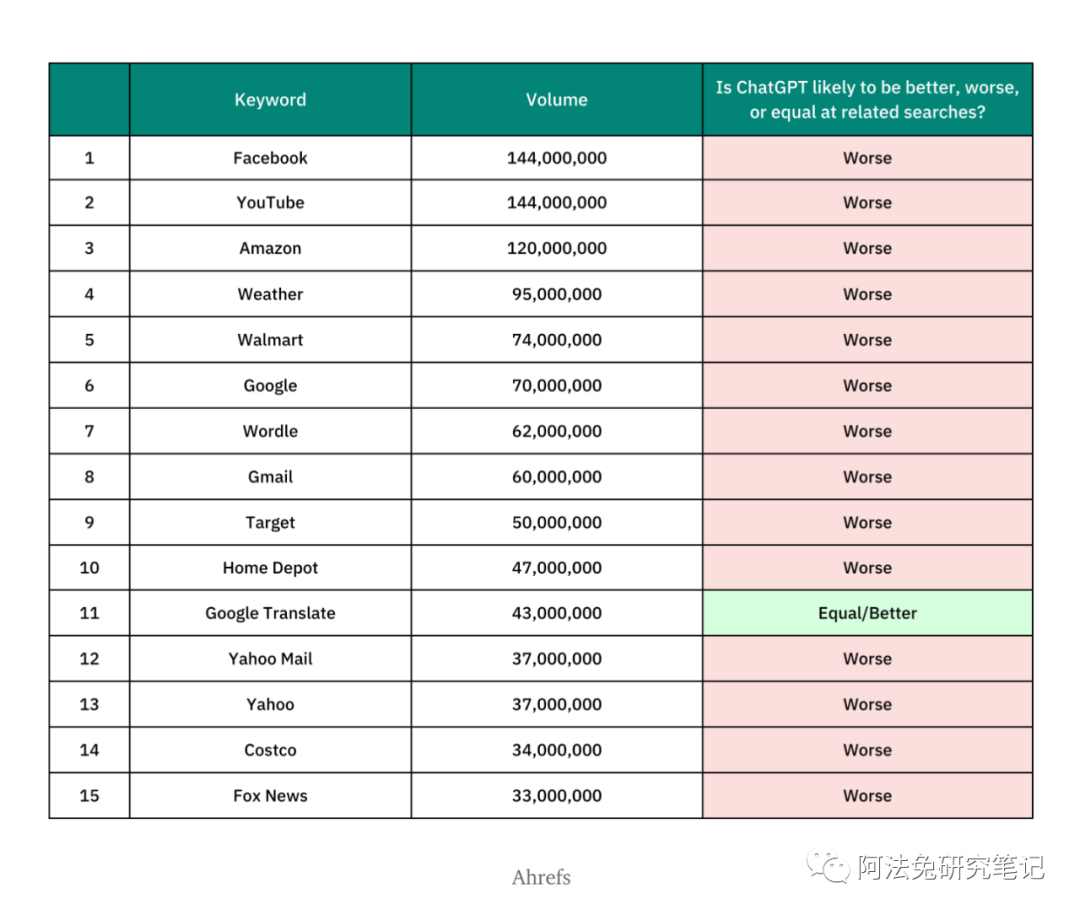
In what ways will ChatGPT beat Google? It currently cannot provide maps and current news, but it can give some website links and has certain advantages in translation. ChatGPT shines in solving complex problems, but what about simple ones.
Another question about ChatGPT is, is it reliable?
ChatGPT is a lot of talking, and it is estimated that 20% of ChatGPT's answers are fabricated out of thin air, for example, it will make up a list of academic papers, or devise a theorem that does not exist.
Of course, this is the mapping given by our current era: when news is swallowed by countless fake news, swallowed by pure fabrications, although Google will also give wrong search results, the results of the two are completely different in structure: specific Let's say:
Google sometimes shows users a fabricated list of answers; ChatGPT sometimes provides serious nonsense and some small product problems:
First of all, ChatGPT does not support image search. Second, it doesn't try to connect the request to the user's potential actions, basically without citations. Here's an example: It's common practice for people to include a link to reserve a table in restaurant recommendations. However, ChatGPT does not display any supporting sources nor provide any citations. Also, ChatGPT is expensive: while traditional search engines spend $1 billion a year to index the web, artificial intelligence companies like ChatGPT are more expensive, which is why OpenAI must not place restrictions on product usage and is working on Seek further investment.
(The previous Rabbit article mentioned that it had raised prices)
So, the above disadvantages of ChatGPT, are they permanent? Or ephemeral? Can the product be equal to or better than Google's where it counts? Given that Google itself has recently been experimenting with its own chatbot (covering current events) it's possible that ChatGPT could do the same. Over time, we can expect ChatGPT to reduce the probability of serious nonsense, and adding pictures + sources of supporting news seems to be feasible.
Of course, ChatGPT is not likely to build maps, bookings or shopping anytime soon compared to Google. Although ChatGPT can integrate with other players, doing so may affect users.
Whether a more restrictive chat interface can combine these commercial services is unclear. Fundamentally speaking, chat interface-style search means that users cannot click to enter new pages, nor can they easily switch back and forth between multiple windows.
How to understand the nature of these scenarios? Here it refers to: when the user needs a more dimensional experience, that is, when you want to search for the new clothes you want to buy, or when you are in the small supermarket near the dentist office you have booked , this behavior pattern refers to when you are investigating rather than looking for an immediate and certain answer.
Over time, AI may become personalized enough that perhaps it will surface customized options better than humans browse the results. Over the next few years, more modular interfaces will soon become popular.
first level title
Looking ahead: what will happen?
In 1998, Google founders Sergey Brin and Larry Page received their first venture capital funding. But today, human beings are drowning in information all over the sky, and what everyone needs is insight.
The world of the future will be in the hands of integrators, humans able to put together the right information at the right time, think critically about it, and make informed choices that matter. Google's success is that it is a special synthesis of the information world, and ChatGPT takes this positioning to the next level (although it leaves a lot to be desired)
So, from the perspective of market composition, Google's development history and its strength, and the current shocking strength of ChatGPT, where will the future go?
First of all, you can look forward to Google's response and actions, how Google will deal with the current "self-revolution" matter. Google's current CEO, Sundar Pichai, must ensure that Google will not fall behind. For more than a decade, Google has been In the field of AI, it is time to show the fruits of this labor.
In fact, internally at Google, management refers to its release as"code red", and has taken swift action to initiate and accelerate corresponding projects. On the company's most recent investor call, the CEO emphasized the importance of AI to Google, saying users"soon"You can use Google's LaMDA (Language Model for Conversational Applications) mask, as well as Google's:"Apprentice Bard "chatbot, is being tested.
Launching a product like the bot Bard can redefine how users view ChatGPT. Yann LeCun, head of artificial intelligence at Meta, said that OpenAI's products"nothing revolutionary"While this could be peer-to-peer blackmail, it could also be true.
Beyond showing off, Google has to make sure it doesn't cede the underlying market to OpenAI.
image description
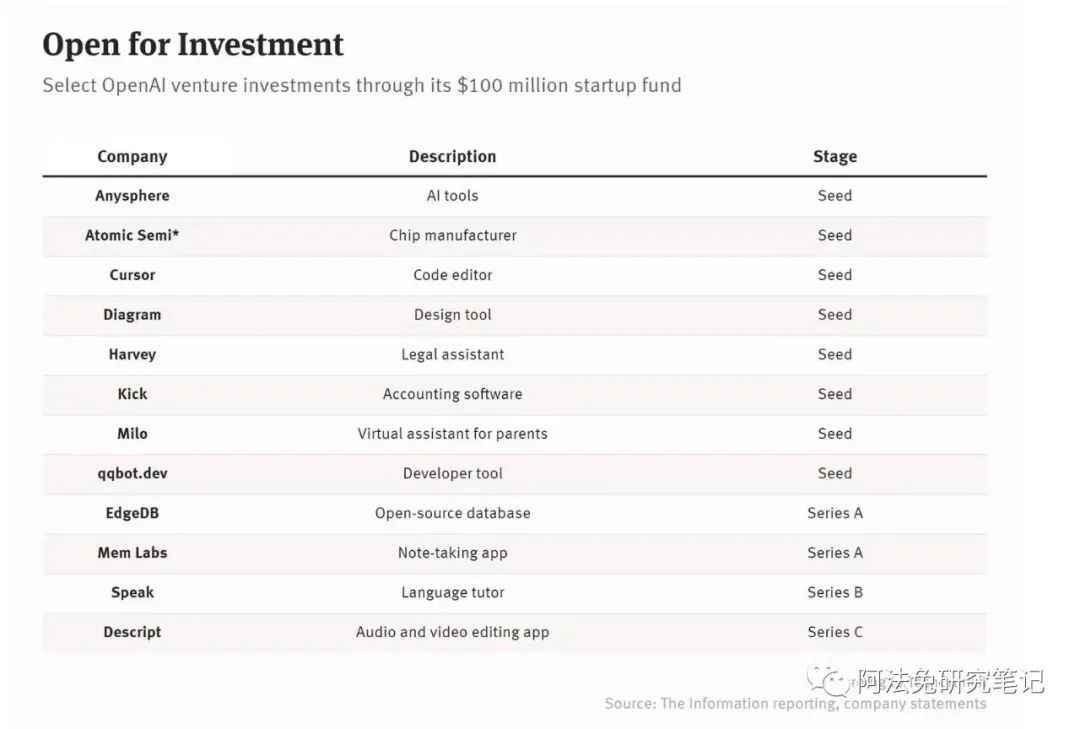
Image source: Information
Not only does this build relationships with other AI companies in the industry, but it also puts OpenAI in a strong position: Startups use its models first, and OpenAI can hear innovation and related consumer demand elsewhere in the market. And Google chose to invest about $400 million in Anthropic, for details, please see: $300 million, Google just announced investment in AI company Anthropic We may see that in 2016 and 2017, the dominant technology industry"AI and Chatbots"The recurrence of the boom. The success of ChatGPT proves the usefulness of the interface. Currently, there are several startups offering chat-based search engines in the market, You, Andi Search and Perplexity, Neeva, etc. Big companies will also enter the game, Microsoft is expected to introduce ChatGPT technology into Bing (reference: Integrating ChatGPT: Microsoft and Google's search battle), and Baidu is developing its own chatbot.
The question is, how will these AI companies make money?
There is a basic premise behind the argument that ChatGPT will make Google obsolete:
Ad-based model that doesn't work, or hardly works in a chat-based world. The piece that could hurt [Google] is a potential shift in the interface, that is, moving the search industry away from pay-per-click ads and links.
Here it may be: the innovator's dilemma -- that a response to a competitive threat kills one's own core business. It may take time to fully replicate the complexity of Google ads and revenue-generating links in a new interface, and the different space constraints of the chat interface will likely reduce the overall ad volume.
Still, chat interfaces don't seem to necessarily be at odds with complex advertising models. There is room to run ads, such as introducing a pay-per-click system in conversational interfaces. In this area, chatbots have even more obvious advantages, because if the direct conversation feels like a conversation with a real person, there will even be a higher business conversion rate.
In addition, users turning to the chatbot for help with more complex queries may provide additional context, improving targeting. For example, come to a chatGPT version of the "Wolf of Wall Street" version that can speak well, and trick consumers into making purchases.
Currently ChatGPT has taken the subscription route and is testing a premium service at $20 per month, and while this is a savvy way to monetize its power users, this price point is not aimed at a mass-market audience.
Of course ChatGPT at this price, or a similar AI, would have enormous appeal to an enterprise audience, even if it were more expensive: vertical chatbots for law, medicine, engineering, software development, sales, real estate, and other industries would be very attractive. valuable. While ChatGPT does well on a range of topics, providing more upfront background and training could iterate its utility to higher levels.
Although the chat interface can meet some needs at present, in the next few years, we will most likely see further innovations around the search interface. By leveraging general artificial intelligence, we could see new vertical search engines combined with apps like YouTube, Pinterest, and Reddit.
And future voice assistants may go beyond their inability to understand even basic compound questions and become more useful.
We can summon our word processor to help us find the right citation, find the latest financial results in our spreadsheet, or find the right words in our email inbox...
Author Neil Gaiman believes: "Google can give you 100,000 answers, but a librarian can give you the most accurate answer."
In the past two decades, Google has won by providing the shortest path between questions and answers, through a large number of network resources, advanced sorting algorithms, and become the king of the search field, which seems invincible.
But the recent success of ChatGPT shows that disrupting Google is not difficult to do. OpenAI's products convert Google's ocean of data into clear answers, and answer dimensions are easier to change.
ChatGPT = librarian for the information age, which can use vast amounts of human knowledge to provide a definitive answer (even if it is currently wrong)
Original link