Flow, not just an NFT public chain



Author | Qin Xiaofeng
Editor | Hao Fangzhou
Produced | Odaily
Author | Qin Xiaofeng
Editor | Hao Fangzhou
Produced | Odaily
When it comes to Flow Network, what do you think of? The first reaction of many people is the underlying network of "NBA Top Shot", which is popular all over the world.
From the perspective of NFT only, Flow has reached cooperation with many world-renowned brands, IP and musicians to issue digital art souvenirs, including the International Olympic Committee, NBA, UFC, NFL, ICC (International Cricket Council) Club), global music labels Billboard, Universal Music Group, Warner Music, Attack on Titan, rock artist David Bowie, and more. Because of this, Flow is also called "NFT public chain".
However, NFT is far from the only thing on the Flow chain. DeFi and DAO are also gaining momentum, including stablecoins FUSD and USDC, DeFi facilities Increment.Fi, cross-chain bridge cbridge, and Emerald DAO, DAO collective, Thing.fund, etc. are doing around DAO Organization of innovative practices and various DAO governance tools. Data shows that as of now, there are more than 1,000 applications on the Flow mainnet, covering collections, art, games, DeFi, Metaverse, sports, music, DAO and many other fields. Moreover, the Flow mainnet wallet addresses exceeded 4.3 million, and the single-day transaction volume exceeded 1 million (February 18).
As early as the beginning of its creation in 2018, the Flow public chain and its developer, Dapper Labs, aimed at mainstream users, with the goal of continuously introducing increments to the encryption market, rather than competing with other public chains for stock. After three years, Flow has initially realized the idea, but it still has a long way to go to achieve the ultimate goal of building a richer Web3 world for billions of users.
secondary title
1. Facing the mainstream, Flow builds a new bridge to Web3
In the past year, the concept of NFT has continued to ferment.
As the transaction prices of various NFT artworks continue to break historical records, NFT has stepped out of the small circle and moved to the big stage, attracting the attention of mainstream society. According to a report by NFT data company Nonfungible.com, NFT transaction volume will reach US$17.6 billion in 2021, a 21,000% increase from US$82 million in 2020. 2021 can be said to be the first year of NFT.
Although many phenomenal projects such as "Boring Ape" have also been born in the NFT market, "NBA Top Shot" has always been an "unavoidable mountain", not only out of the circle, but also always among the best in various rankings. According to the data, "NBA Top Shot" currently has a cumulative transaction volume of more than 1 billion US dollars, ranking fifth in the NFT artwork rankings, but its number of buyers (670,000) ranks second, second only to "Axie Infinity".
The success of "NBA Top Shot" is inseparable from the high-performance support of the underlying infrastructure Flow, which can achieve higher throughput and lower latency, and support online transactions of millions of simultaneous users.
In 2017, Dapper Labs' "Crypto Kitty" caught fire and once blocked the Ethereum network. The transaction speed of tens of minutes at every turn also made the Dapper Labs team aware of the importance of the underlying infrastructure, and strengthened its determination to independently develop a high-performance and easy-to-use public chain. In September 2019, Dapper Labs announced the creation of the public chain Flow, filling the gap in the market. Flow aims to build a connection between the traditional Internet and the decentralized web3.0 era through technology, build a digital economy era, and bring billions of Web2 users into the Web3 world.
However, only relying on scalability, Flow cannot really attract mainstream users, and ease of use is Flow's trump card.
You should know that there are currently dozens of "high-performance" solutions on the market. The more representative ones are Layer 1 such as BSC, Fantom, Solana, Avalanche, and WAX, and Layer 2 such as zkSync, Optimism, or Polygon. However, these solutions did not capture mainstream users like Flow, but engaged in a battle for encrypted stocks.
Flow's so-called ease of use means that the system can be easily used, not only for end users, but also for developers, creators, product owners and other parties who interact with the network. Good ease of use is also a key factor for truly popularizing the blockchain and attracting mainstream users.
Below, we will illustrate the ease of use of Flow with an example:
Previously, traditional users who wanted to buy NFT needed to register an encrypted wallet, record the mnemonic, buy cryptocurrency from the exchange with fiat currency and then withdraw the currency, and then buy NFT for storage. The above steps need to be repeated for the second transaction... the whole process It is cumbersome and poses a big obstacle to novice users outside the circle.
At the same time, every transaction is transparent and checkable on the Flow chain. In addition, users can also interact with other projects in the Flow ecosystem through Dapper Wallet. It can be said that Dapper Wallet is both a fiat currency channel and a custody solution for storing user NFT.
It is these advantages that have won the market for "NBA Top Shot" and Flow, and are favored by many traditional mainstream users. Data shows that even in the current bear market, Flow’s on-chain transactions in February 2022 will still be three times higher than in September last year. In total, Flow has processed more NFT transactions than any other blockchain to date.
In general, a high-performance public chain is an important basis for promoting the development of the industry, and ease of use is the key to determining whether the public chain can be accepted by mainstream users. From the perspective of long-term development, introducing incremental users from the mainstream society into the encryption market is a necessary condition for promoting the prosperity of the industry.
As a bottom layer that focuses on mainstream strategies and has successfully brought mainstream users to the blockchain, Flow can meet the above conditions and build a new path to Web3 for Web2 users.
secondary title
2. Not only the NFT public chain, but also the blockchain of the open world
Nowadays, there are more and more NFT-focused infrastructures, and Flow, as the leader, has attracted much attention from all parties.
In particular, the success of "NBA Top Shot" made more traditional IP brands see the charm of encrypted assets and began to seek cooperation with Flow. The Olympic Committee is one of Flow's many collaborators. During this year's Winter Olympics, the International Olympic Committee officially authorized the Bingdundun digital blind box to be sold on the Flow chain trading market nWayPlay, with a maximum price of 560,000 yuan per piece.
In addition to the Olympic Committee, Flow has also launched in-depth cooperation with other influential traditional IPs to jointly issue digital art souvenirs:
Last May, the Ultimate Fighting Championship (UFC) announced a licensing partnership with Dapper Labs to develop and deploy UFC-branded digital collectibles on Flow, providing UFC fans on the web with the ability to buy, trade and own UFC-branded digital collectibles. Opportunities for collectibles; after the UFC Strike platform was launched in January this year, the first batch of 200,000 NFTs were sold, and the current transaction volume has exceeded 10 million US dollars.
In September last year, Dapper Labs announced its cooperation with La Liga to create a football version of "NBA Top Shot" for football fans, and plans to log in to Flow in the summer of 2022;
In December last year, YouTube made its first foray into the blockchain field and announced the issuance of NFT on Flow and airdropped it to the top creators on the platform;
In February of this year, Dapper Labs and the National Football League Players Association (NFLPA) jointly announced the launch of NFL ALL DAY, a digital art collection platform focusing on the moments of football players scoring goals; 80,000 collectors, more than 46 million US dollars in transaction volume.
In February this year, Japanese media giant mixi Corporation and the world's leading sports streaming service company DAZN Japan Investment GK announced that they will launch DAZN MOMENTS, a sports NFT marketplace on Flow, a leading Web3 platform designed for user-friendly applications. platform;
……
In February of this year, FanCraze and ICC (International Cricket Council) announced that they have jointly created ICC Crictos. In this series, legendary moments and memorable events become digital collections based on the Flow chain, and users can permanently With these collections, the number of subscribers reached 750,000 before the launch.
In March of this year, the global music brand Billboard and Universal Music Group (Universal Music Group) announced the launch of ChartStars, an NFT project based on the Flow blockchain, which is Billboard's first scalable NFT project for music lovers;
In March this year, the "Attack on Titan" blockchain service company announced that it will release the Attack on Titan: Legacy platform based on the Flow public chain. The trading platform provides the exciting scenes in the "Attack on Titan" animation as NFT for sale, and its copyright is authorized by Kodansha (Kodansha) and Anique USA;
“Flow is another blockchain favored by NFTs.” Payment giant Visa spoke highly of Flow in its first NFT white paper, “Flow was built to increase throughput and enable energy-efficient blockchain transactions The verification method reduces the challenges brought about by high Gas fees. Flow is allowing NFT to gain more recognition, and more and more important mainstream brands are building platforms on Flow.”
Through NFT cooperation with a series of traditional IPs, Flow is introducing more Web2 users into the Web3 world, and the speculative nature of this part of users for NFT will be much smaller than that of public chains such as Ethereum, and has a wider range of economic popularization. moderate. Because of this, Flow is also labeled as "NFT public chain".
However, NFT is just an entry point for Flow to open up the traditional Web2 world, but Flow's ambition is not limited to becoming an NFT blockchain. It is building an "open world blockchain".
Taking the game track as an example, the officially authorized mobile game "Olympic Games Jam: Beijing 2022" of the 24th Beijing Winter Olympics is based on the Flow chain. The game allows players to pay for in-game items with credit cards and transfer winning tokens and NFTs to external wallets and various DEXs.
Furthermore, Flow also has an in-depth cooperation with Ubisoft (Ubisoft), and plans to develop corresponding 3A masterpieces on the Flow chain. Ubisoft has many years of development experience in the field of traditional games, and has produced many classic game works. For popular popular games such as "Assassin's Creed" and "Far Cry", the cooperation between Flow and ubisoft will further enhance the diversified development of Flow's ecological games.
Taking DeFi as an example, considering that users need to use a stable unit of denomination in the Flow ecosystem, Dapper Labs also launched a dollar-backed stablecoin FUSD on Flow, which is backed by US dollars deposited into Prime Trust at a 1:1 ratio. As a veteran stablecoin issuer, Circle also released USDC, a USD stablecoin on Flow, at the beginning of the year. The emergence of FUSD and USDC not only reduces the cost of one-stop transactions for users, but also makes it easier for traditional users to accept, expand Flow's potential target audience, and further enhance Flow's ease of use.
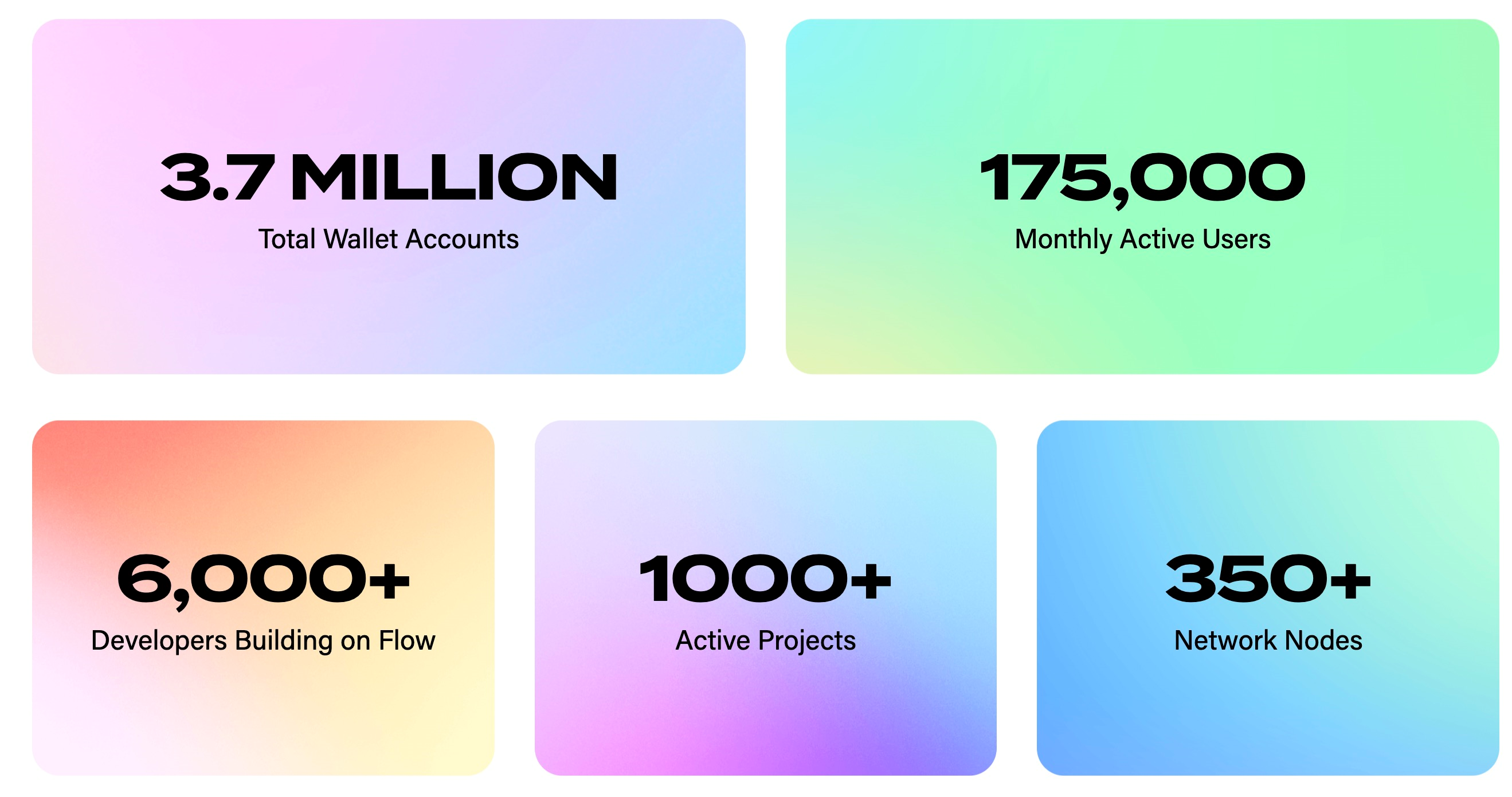
Flow's entire ecosystem is growing, covering collections, art, games, DeFi, Metaverse, sports, wallets, and DAOs. In December 2020, there were just over 50 projects on the Flow network, today this number has increased to over 1000, which equates to about 25% growth per month; this includes metaverse projects Matrix World, Some.place, games Chainmonsters, Zeedz, Can Portfolio avatars Flovatar, Goatedgoats, GenZ-oriented killer app Genies, Cryptoys, etc. Flow-based projects have also raised more than $1.2 billion in funding in 2021, while Dapper Labs, the developer of the Flow blockchain, has raised more than $600 million.
In addition, the Flow mainnet wallet addresses exceeded 3.7 million, monthly active users reached 175,000, and the daily transaction volume exceeded 1 million (February 18).
“What do these apps have in common? They all belong to the thriving, rapidly growing Flow ecosystem, an open world of limitless possibilities,” says the Flow team. “Ultimately, as the ecosystem grows, everyone can Enjoy your digital life on Flow."
secondary title
3. The outstanding advantages of Flow in public chain competition
The success of Flow has also provided some thoughts for other public chains: what conditions are needed to bring billions of Web2 users into the Web3 world?
(1) Scalability
 The bottom-level requirement of the public chain is to improve efficiency and performance. The current feasible solutions include: block expansion, limit the number of nodes, horizontal fragmentation (such as ETH 2.0) and Layer 2, where the limit of the number of nodes and block expansion will affect the public chain. Horizontal sharding and Layer 2 are more advantageous, but smart contracts will be more complex, and it will be difficult to call data, which will increase the technical threshold for DApp development on the chain.
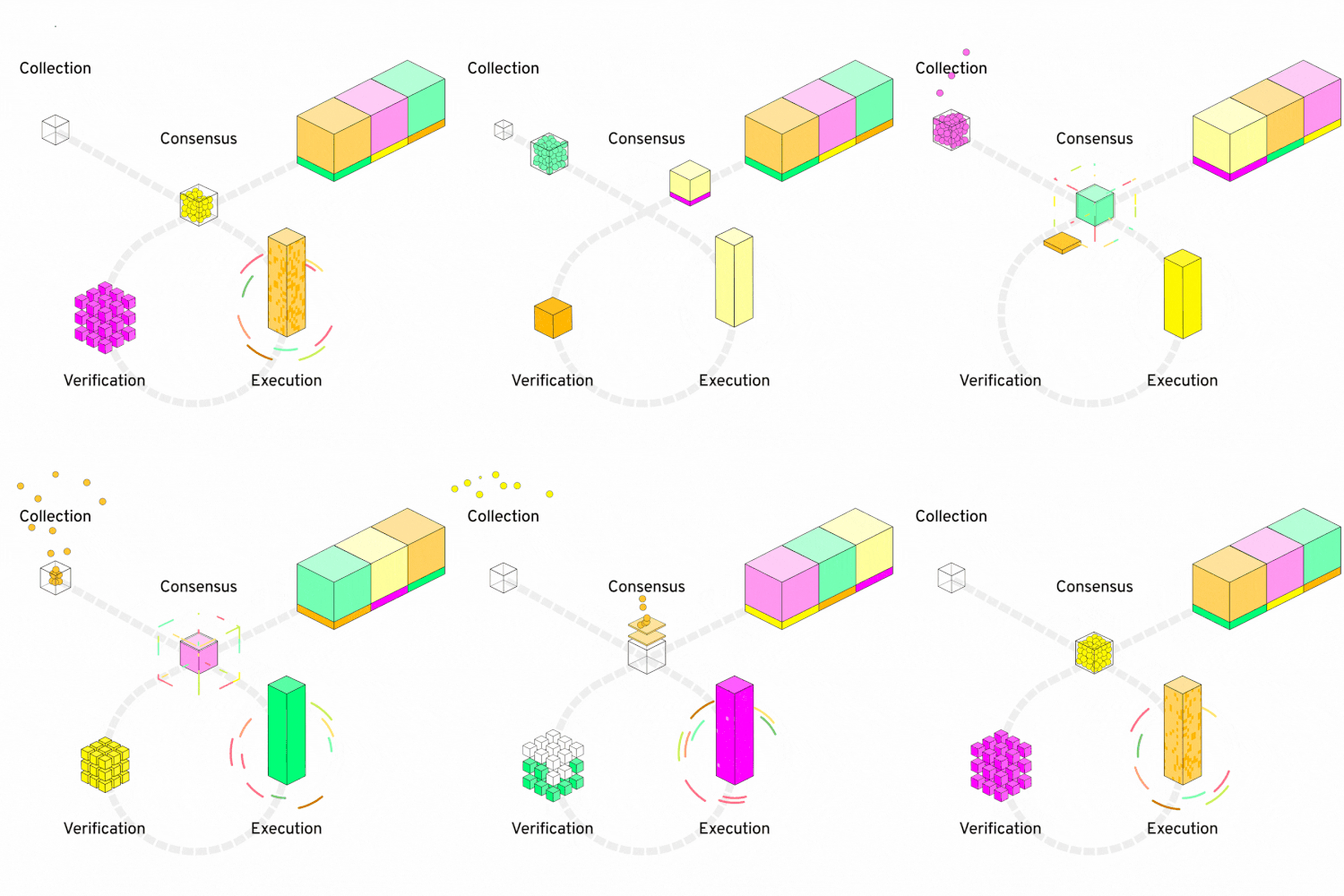
However, the scalable multi-node architecture proposed by Flow takes into account security, efficiency and developer friendliness. The Flow public chain is a pipeline design method, which can greatly improve the processing capacity of tasks on the chain.
For the first time, Flow allows nodes to specialize according to their respective capabilities and ability to process transactions, so these nodes in the network are very powerful, and they play an important role as execution nodes; while other light nodes, they are not so powerful but more in number, The node completes the verification work, joins the consensus algorithm, maintains the security and decentralization of the network, and carefully checks the computer's blockchain network.
This simple architectural change has greatly optimized scalability and performance. Flow can be as decentralized as Ethereum and other networks, even without the need for sharding.
(2) Ease of use
The first stop for many people entering the Web 3 world is "NBA Top Shot". The success of "NBA Top Shot" has proved Flow's ease of use. While ease of use is difficult to quantify, Dapper Labs CTO Dieter Shirley provides a framework for the system along three dimensions: functionality, economics, and technology.
(1) Functional ease of use (also known as usability) describes the ability of the blockchain and its ecosystem to provide simple usage guidance and good user experience, so that the way users interact with protocols or applications can be simple enough And efficient, including "use guidance", "wallet interaction", and "fiat currency payment entry and exit channels". Taking Flow as an example, its network currently supports legal currency deposits in almost all regions of the world.(2) Economic ease of use is based on the general affordability of the protocol and digital products built on it, specifically including "on-chain transaction fees", "application layer products" (such as floor price indicators) and node operating costs. Taking Flow as an example, currently a single transaction charges a fixed fee of 0.00001 FLOW, which is almost negligible. The average price of NBA Top Shot card packs is $8, and active users trade an average of 5 times a day, which is impossible on a high-threshold blockchain.。
(3) Technical ease of use describes how easy it is for developers to build applications on a given chain. This concept is also known as developer engineering. For example, what language is used for programming, whether there are developer tools, whether these tools and the source code of the main project are open source, etc. For example, Flow has created its own language, Cadence, which is designed with developers in mind and is easier to learn.
Regarding usability metrics, interested readers can read the article
"From the perspective of blockchain and human nature: is your blockchain really easy to use?" "
(3) Brand effect
The brand effect of Flow mainly comes from two aspects: one is itself, and the other is from partners.
"Crypto Kitties" in 2017 introduced the digital commodity framework (ERC-721) for the first time, which is still the gold standard for NFT, and Dapper Labs has also become the pioneer of NFT.
This brand effect has also become an important cornerstone for various IPs (NBA, CNN), major traditional institutions, etc. to cooperate with Dapper Labs & Flow. At the same time, it has also attracted giant companies such as Google Cloud and Samsung to participate in the decentralized foundation of Flow facilities, and received capital injections from industry leaders such as a16z (Andreessen Horowitz), Coinbase Ventures, and Google Ventures.
Today, Flow still maintains close cooperation with many IPs and continues to bring their users into the Web 3 world. It is conceivable that traffic will inevitably become Flow's moat and barrier in the future. Moreover, the introduction of traditional users through IP will also feed back the development of Flow's own ecology, attracting a large number of project developers, and various applications will also usher in a blowout explosion.
“Top Shot would not have been possible without Flow designing a blockchain from scratch for mainstream users,” said a16z, an investment firm at Dapper Labs.
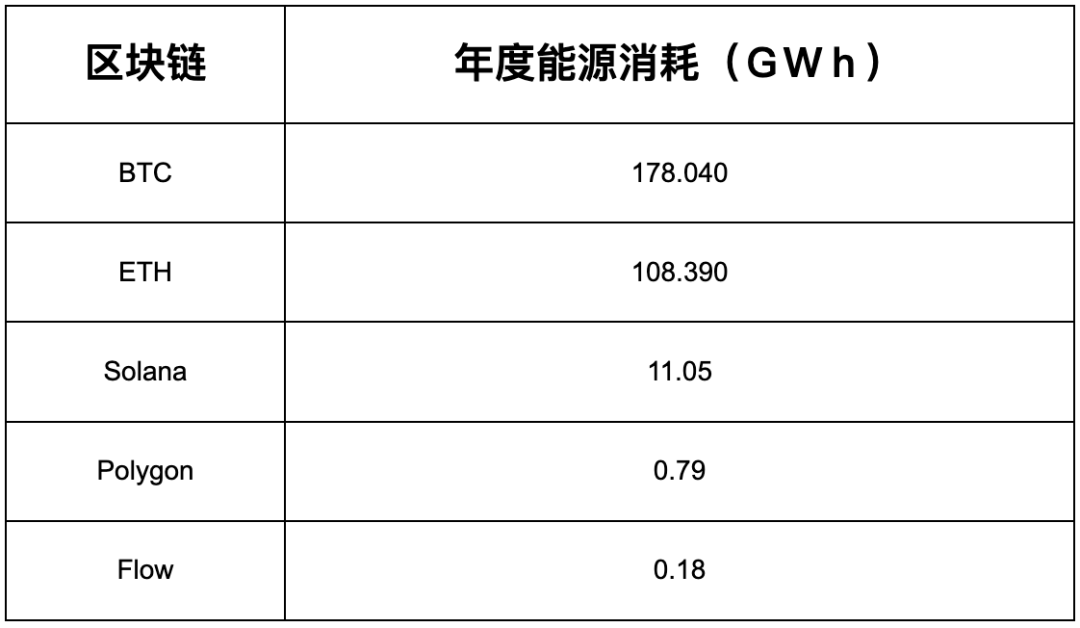
At present, carbon emissions have become a hot topic in the world, and the blockchain working mechanism of POW is controversial. Tesla founder Musk has previously accused Bitcoin of being unenvironmentally friendly and suspended accepting Bitcoin payments.
Compared with Bitcoin and Ethereum, Flow is obviously greener in terms of carbon emissions. According to the Deloitte Canada report, Flow will only use 0.18 GWh per year in terms of Web3. few.
“Based on our analysis and survey of the entire network, we found that Flow uses significantly less energy than other protocols. This is due to Flow’s use of a proof-of-stake consensus (POS) system rather than proof-of-work, which typically It is more energy-intensive and has a higher carbon footprint," said Nathan Steeghs, partner and national climate lead at Deloitte Canada.
secondary title
4. Progressive decentralization
In terms of the strategic setting of target users, Flow is different from other general public chains targeting users in the circle, aiming to attract mainstream users. In fact, the encryption market has always been eager to introduce traditional traffic, users, and funds, but very little has been achieved.
Flow is making great strides towards this goal, has initially achieved its goal, and is entering a stage of high growth. Of course, this also leads to a new question: how to solve the impossible triangle problem, taking into account the three elements of scalability, security and decentralization? In particular, Flow targets mainstream users, and the degree of decentralization has been questioned.
The strategy adopted by the Flow team is "gradual decentralization", that is, to reduce the degree of decentralization in the early stage, build benchmark products and ecology, and gradually increase the degree of decentralization over a longer period of time.
Specifically, this progressive decentralization is implemented at various levels:
Nodes: Flow was upgraded in October last year, and the consensus nodes are more decentralized. Dapper Labs reduced its consensus node operations to less than 1/3 of all consensus nodes, with the community running 68% of consensus nodes. The further decentralization of consensus nodes this time also means that Flow is ready to officially enter the market and accept verification from a wider range of users/developers. Also, as another major update to increase participation in the core infrastructure layer of the network, anyone in the community will be able to launch new Flow access nodes without permission.
Development level: The initial applications on Flow, such as "NBA Top Shot" and Dapper wallet, were completely developed by Dapper Labs, but now thousands of teams have independently developed applications on Flow, as long as they pass the official or authorized agency code audit . According to the official plan, future projects can go online without code review, further promoting ecological development and decentralization.
User experience level: Flow is oriented to mainstream users. In order to meet the usage habits of Web2 users, Dapper wallet adopts a managed model; then the blocto team developed a semi-managed wallet, which is friendly to Web2 users and can also be switched to a non-custodial model; the ecological team outblock A completely non-custodial wallet has been developed to better support the usage habits of encrypted native users.