「소문글」또다시 공포 조장: 구글이 AI 지출을 삭감하는 첫 번째 거대 기술 기업이 될까?


- 핵심 의견: 구글 모회사 Alphabet은 재정적 제약(조정 후 잉여 현금흐름이 보고된 수치보다 현저히 낮음)으로 인해 AI 자본 지출 가이던스를 삭감하는 최초의 대형 기술 기업이 될 수 있다. 이러한 움직임은 거시적 신호로 작용해 AI 거품 붕괴에 대한 시장의 우려를 가속화하고 AI 관련 반도체 섹터에도 영향을 미칠 수 있다.
- 핵심 요소:
- Alphabet은 여러 제약에 직면해 있다: AI 투자 수익률 불확실성, 데이터센터 건설의 에너지 및 규제 제한, 주식 기반 보상 조정 후 자체 잉여 현금흐름이 약 62~67% 허위 감소할 가능성.
- AI 자본 지출을 유지하기 위해 Alphabet은 이미 300억 달러 이상의 채권을 발행하고, 800억 달러 규모의 신주 발행을 발표했으며 자사주 매입을 중단하는 등 자금 조달 압박이 상당하다.
- 실적 발표에서 검색 수익 19% 증가, 클라우드 수익 63% 증가를 보였음에도 불구하고, 조정 후 잉여 현금흐름의 급감은 자본 지출 지속 가능성에 대한 의문을 불러일으키기에 충분하다.
- 보고서는 현재 약 7000~8000억 달러에 달하는 AI 자본 지출 예측(주로 최첨단 모델에 집중)이 부적합하다고 본다. 기업 수요는 값싼 오픈소스 모델을 더 선호하고, 중국의 저비용 모델 Kimi K3가 과잉 투자 가능성을 입증했기 때문이다.
- 시장은 이미 선제적으로 반응하고 있다: SMH 등 AI 자본 지출 수혜주는 최근 약세를 보이고 있으며, 투자자들은 Alphabet의 가이던스 삭감 가능성에 대비하고 있을 수 있다.
Original title: AI Bubble Burst: Alphabet Could Be The First To Cut AI Capex
Original Author: Damir Tokic, Seeking Alpha
Original Translation: Surge
Editor's Note: Damir Tokic, a Seeking Alpha columnist, professor of finance, and CTA, published a forward-looking analysis of Alphabet's earnings on Monday, sparking widespread discussion in the US stock investment community. The article suggests that Google's parent company, Alphabet, could be the first among big tech firms to cut AI capital expenditures. Notably, Alphabet will hold its Q2 2026 earnings call on July 23 at 4:30 AM Beijing time.
Fueled by this thesis and market sentiment, debates over AI capex and the "AI bubble" have reignited, with multiple AI semiconductor stocks such as SK Hynix turning from gains to losses during the session. Below is the original content.
Alphabet Leads Earnings Season
Alphabet (GOOG) (GOOGL) will be the first to report earnings, with the market's core focus being its AI capex guidance. In April, Alphabet raised its 2026 AI guidance and signaled a significant increase in AI capital spending for 2027.
However, growing market concerns suggest that AI capex is unsustainable on multiple fronts, and hyperscalers may be forced to slow down or even cut AI capital spending for the remainder of 2026 and into 2027. Given that Alphabet reports Q2 earnings first, it could be the first hyperscaler to lower its AI capex expectations, with others—Meta (META), Microsoft (MSFT), Amazon (AMZN), and Oracle (ORCL)—likely to follow.
In fact, the recent weakness in AI capex beneficiary stocks, such as the semiconductor sector (SMH), reflects market anxiety over AI spending.
As detailed below, Alphabet is particularly vulnerable due to issues with its adjusted free cash flow and the need to issue debt and new equity to fund AI capex.
Even a hint from Alphabet of slowing its AI capex guidance could accelerate the bursting of the AI bubble—making this a macro signal as well.
The Big Picture
First, consider the big picture. The U.S. economy, and especially the stock market, is currently heavily dependent on AI capital expenditures. Estimated AI capex for 2026 is around $700-800 billion, projected to far exceed $1 trillion in 2027, primarily focused on data center infrastructure.
However, this projected AI capex faces several constraints that make it difficult to materialize fully.
· Tokenomics and Return on Investment (ROI): The most significant constraint is the uncertain ROI of AI capex, which is likely far below the cost of capital—implying it may be a wasteful investment. Specifically, U.S. data centers are designed for expensive frontier models, while enterprises adopting AI demand cheap open-source models. This creates a mismatch. Due to model substitution effects (from expensive to cheap), token prices are continuously declining, compressing the per-token profit margins for hyperscalers and making the entire project financially unsustainable. China's new open-source model, Kimi K3, demonstrates that powerful LLMs can be built at a fraction of the cost—rendering much of this AI capex unnecessary.
· Energy and Water Constraints: Data centers require vast amounts of energy for power and water for cooling. These are real physical constraints that limit the further expansion of data center infrastructure.
· Regulation and Backlash: New York State pioneered a one-year moratorium on new data center construction, and several other states are considering similar measures. In the U.S., it seems "red states" like Texas permit data center construction, while "blue states" like New York oppose it. Consequently, AI infrastructure has become a politicized issue. Even in Texas, consumer backlash against data centers is growing, potentially becoming a problem for Republicans in upcoming elections.
Thus, AI infrastructure faces real financial, physical, and political constraints, making it difficult to see how current AI capex guidance can be sustained.
As noted, even signs of slowing AI capex could accelerate the bursting of the AI bubble.
Alphabet's Position
The market narrative surrounding Alphabet has been:
· "The risk of under-investing is greater than the risk of over-investing" – This suggests Alphabet is aware of the possibility of over-investment but is willing to continue AI capex for competitive and strategic reasons.
· "Demand for compute power exceeds supply" – This implies Alphabet hasn't seen overcapacity and has explicitly stated that building more capacity would lead to higher revenue.
Therefore, there have been no indications that Alphabet would slow down or cut its AI capex guidance.
However, problems are emerging on the financing side of AI capex – these are real funding constraints.
Specifically, Alphabet appears to have significant issues with its free cash flow; consequently, it has been forced to sustain AI capex through debt issuance (over $30 billion in bonds in Q1) and equity financing (announced over $80 billion in new share issuance) – even halting share buybacks in Q1.
In fact, Alphabet's free cash flow problems may be more severe than reported. A Wall Street Journal article titled "How Big Tech's Financials Mask the True Cost of AI Buildout," citing "Heard on the Street" columnist Jonathan and Purdue Professor Kevin Koharki, points out that after adjusting for economic costs like stock-based compensation, Alphabet's 2025 free cash flow could be 67% lower than reported, and Q1 2026 could be 62% lower. This means the reported $73 billion in FCF for 2025 would drop to $24 billion, and the reported $10 billion FCF for Q1 2026 would fall from $10 billion to about $4 billion.
The key implication is that Alphabet cannot sustain its AI capex without borrowing and issuing new shares – increasing debt exposes it to credit risk (especially with low ROI), while new share issuance dilutes existing shareholders.
Now, heading into the Q2 earnings report, Alphabet must update its AI capex guidance – a tricky situation for investors.
· If Alphabet raises AI capex guidance despite financial (tokenomics, ROI), physical (energy, water, backlash), and financing (FCF, debt, equity) constraints, investors will question management's motives and prudence – the stock price is likely to fall.
· If Alphabet cuts AI capex guidance, it will be interpreted as a macro signal, likely accelerating the AI bubble's burst, severely impacting AI capex beneficiary stocks like SMH.
· Even if Alphabet merely reiterates its 2026 guidance with a cautiously strong signal for 2027 AI capex, it could be read as a slowdown in AI capex growth, producing the same macro effect as a cut.
Therefore, this is a genuine dilemma for Alphabet and the broader market. Investors are unlikely to reward increased spending, and a cut in capex would likely lead to punishment in AI capex beneficiary sectors.
Based on the recent performance of the semiconductor sector, investors seem to be preparing for a slowdown or cut in AI capital spending.
Alphabet's Financials
Approximately 80% of Alphabet's revenue comes from its services business (ad-driven), primarily Google Search, and about 20% from Google Cloud.
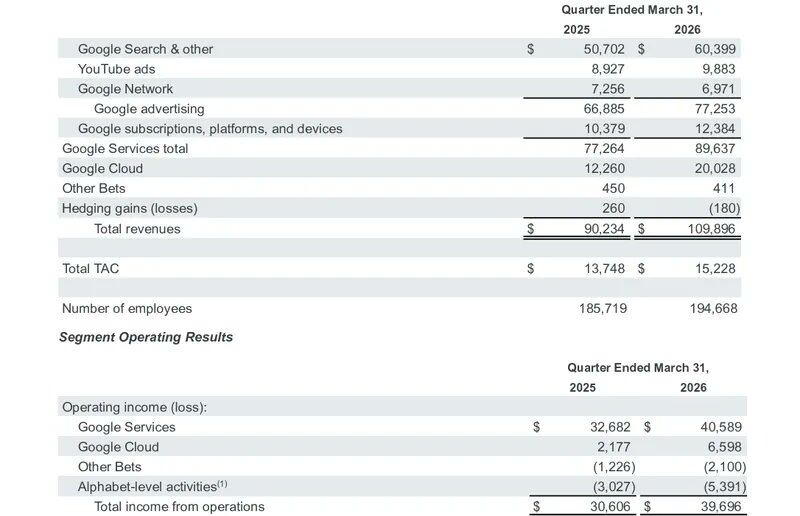
Alphabet Q1 Earnings
Alphabet CEO Sundar Pichai stated after the Q1 results:
An excellent start to 2026. Our AI investments and full-stack strategy are activating every part of the business. Search had a strong quarter, with AI experiences driving usage growth, query volumes hitting all-time highs, and revenue growing 19%. Google Cloud revenue grew 63%, with backlog almost doubling quarter-over-quarter to over $460 billion. Driven by the Gemini app, this was our strongest quarter ever for consumer AI. Total paid subscriptions reached 350 million, led by YouTube and Google One. Gemini Enterprise is gaining strong momentum, with paid monthly active users up 40% quarter-over-quarter. Lastly, I'm delighted to see Waymo completing over 500,000 fully autonomous rides per week. These excellent results are built on our differentiated full-stack strategy. Our proprietary models like Gemini now process over 16 billion tokens per minute via direct customer API calls, up 60% quarter-over-quarter. It's very exciting to see our AI investments creating value for users, customers, and the business.
Thus, Google Search grew by about 19%, overall margins improved from 34% to 36%, and AI Overviews have not yet eroded advertising revenue.
Google Cloud grew 63%, with compute demand remaining strong – this is Alphabet's primary growth driver. Additionally, Gemini's API usage increased, with token usage up 60%, so the model substitution effect has not yet materialized.
These are positive signals, and there is nothing in the financials pointing towards a downgrade – in fact, Alphabet is seen as an AI winner, with even Berkshire Hathaway investing in it.
However, problems are surfacing in the cash flow statement, even without adjusting free cash flow. With declining free cash flow, Alphabet cannot achieve its guided AI capex without taking on significant credit risk or diluting existing shareholders.

Alphabet Q1 Earnings
Impact and Implications
Alphabet reported strong Q1 financials, with the only red flag being the decline in free cash flow – especially the adjusted decline – which is a major warning sign sufficient to downgrade GOOG to a "Sell" rating.
Alphabet cannot achieve its AI capex guidance without additional debt and equity issuance, which not only increases credit risk and dilutes shareholders but also reduces buybacks. Against the backdrop of the big picture, this is negative.
If Alphabet cuts or slows its AI capex guidance, investors would have to lower growth expectations, implying multiple contraction – also negative. It's worth noting that GOOG trades at a GAAP P/E of 26x, which is not particularly expensive. However, given concerns about inflated overall earnings, the actual P/E ratio could be much higher.
Please note, this is also a macro call – as the AI bubble burst accelerates, the S&P 500 (SPY) (SP500) and Nasdaq 100 (QQQ) could face significant corrections, and Alphabet might be the first hyperscaler to cut its AI capex guidance.