






Kalshi, 10억 달러 추가 조달… 예측 시장, 자본에 힘입어 금융의 메인 테이블로


- 핵심 요점: 예측 시장 업체 Kalshi가 10억 달러 규모의 자금 조달을 완료하며 기업 가치 220억 달러를 인정받았다. 이는 예측 시장이 주변부 사건 거래 도구에서 주류 금융 인프라로 진화하고 있음을 의미하며, 자본은 실제 세계의 불확실성을 거래 및 헤징 가능한 위험 자산으로 전환할 수 있는 가능성에 베팅하고 있다.
- 핵심 요소:
- Kalshi의 기업 가치는 7개월 만에 20억 달러에서 220억 달러로 10배 이상 급등했으며, 이번 라운드는 Coatue Management가 주도했다.
- 예측 시장의 가치는 선거, 경제 지표, 정책 변화 등 가격 책정이 어려운 불확실성을 거래 가능한 계약으로 세분화하여 새로운 '이벤트 거래 시장'을 형성하는 데 있다.
- Kalshi의 핵심 경쟁력은 CFTC(미국 상품선물거래위원회)의 규제를 받는 합법 라이선스로, 기관 자금을 유치하고 예측 시장을 연방 금융 규제 프레임워크 내에 편입시킬 수 있게 한다.
- 규제 논쟁의 핵심은 이벤트 계약의 성격 규정, 즉 이것이 금융 파생상품인지 변형된 도박인지에 있으며, 이는 업계의 확장 한계와 제품 범위를 결정할 것이다.
- 내부자 거래는 예측 시장이 직면한 핵심적인 공정성 문제로, 정보 보유자의 참여는 정보 효율성을 높일 수 있지만 시장의 공정성을 해칠 수 있어, 기관들은 보다 강화된 모니터링 및 처벌 메커니즘을 요구하고 있다.
- 2026년 4월 기준 예측 시장의 월간 거래량은 약 300억 달러에 달하며, Kalshi가 50%의 점유율로 선두를 달리고 Polymarket이 34%를 차지하고 있다. predict.fun 등 다른 플랫폼들도 성장을 가속화하고 있다.
Original | Odaily星球日报 (@OdailyChina)
Author | Asher (@Asher_0210)

Kalshi has once again thrust the prediction market into the spotlight of the capital markets.
Last night, prediction market platform Kalshi announced a new $1 billion funding round, led by Coatue Management, at a post-money valuation of $22 billion. Prediction markets are moving from being niche event trading tools into the purview of mainstream capital and institutional finance.
In the past, prediction markets were mostly discussed in the context of elections, sports, entertainment, and short-term hot topics. This latest Kalshi funding round shows that capital is no longer just looking at how hot a particular market is, but rather whether the uncertainties of the real world can be transformed into a long-running trading mechanism. If this path is cleared, prediction markets will no longer just be a traffic business, but move closer to becoming a piece of financial infrastructure.
Behind the $1 Billion Fundraise, Capital is Betting on a New Market Category
Kalshi's latest funding round is not an isolated high-valuation event.
Over the past seven months, Kalshi has completed three consecutive funding rounds, with its valuation nearly doubling each time. In June 2025, Kalshi completed an $185 million Series C at a valuation of approximately $2 billion; in October, a ~$300 million Series D at a valuation of $5 billion; in December, a Series E raised another $1 billion at a valuation of $11 billion. Following this latest round, Kalshi's post-money valuation has reached $22 billion. In just a few months, its valuation has surged from $2 billion to $22 billion, an increase of over 10 times.
It would be difficult to sustain such a valuation simply by attracting users to bet on elections, sports, and hot topics. The real story Kalshi is telling is that prediction markets have the potential to evolve from a niche trading venue into a new market for event trading.
Traditional financial markets allow for trading stocks, bonds, commodities, currencies, interest rates, and volatility. But the real world is filled with vast uncertainties that are difficult to price directly. Election outcomes, policy changes, economic data, weather events, and geopolitical shifts all impact corporate decisions, asset prices, and public expectations, yet have long lacked standardized trading tools.
Prediction markets aim to break down these uncertainties into tradable contracts, allowing prices to directly reflect the probability of a specific event occurring. This is where Kalshi's potential lies. It's not just about enabling more people to bet on the future, but attempting to turn future uncertainties into risk assets that can be traded, managed, and hedged.
From Election Betting to Pricing Real-World Risk
Prediction markets first gained widespread attention through elections. Compared to polls, they offer a more direct mechanism, compressing disparate judgments into a real-time price. Candidate win probabilities, policy passage odds, and whether economic data will surprise can all be quickly expressed through market prices.
But relying solely on elections and sports is insufficient to support today's valuations. The real story Kalshi aims to tell is whether prediction markets can enter broader risk-pricing scenarios. Things like interest rate decisions, CPI reports, employment data, weather disasters, policy changes, and supply chain shocks – risks that were previously mostly tradeable indirectly could now be broken down into individual event contracts.
Therefore, the long-term value of prediction markets doesn't lie in enabling more people to correctly guess outcomes, but in whether they can transform the inherently difficult-to-trade uncertainties of the real world into a continuously updating set of prices that the market can reference.
Kalshi's Most Valuable Asset is Its Regulatory License
In Kalshi's growth narrative, trading volume and fees are important, but its position within the U.S. regulatory system is even more critical.
Unlike platforms like Polymarket, which are more crypto-native and focused on global liquidity, Kalshi pursues a U.S. domestic compliance route. It is a Designated Contract Market (DCM) regulated by the CFTC. This means Kalshi attempts to place prediction markets within the federal financial regulatory framework, rather than just operating as an open event betting platform.
For ordinary users, prediction markets are just platforms for trading event outcomes. But for institutional capital, compliance is the first hurdle. Before hedge funds, asset managers, and market makers can participate, they need to be clear about contract specifications, clearing and settlement procedures, audit trails, and risk control processes.
Therefore, part of Kalshi's valuation prices in its growth, and another part prices in its license. The closer prediction markets move to mainstream finance, the more important regulatory status becomes. For Kalshi, which has secured a federally compliant entry point, regulation isn't just a constraint; it could become its most formidable moat.
The Biggest Controversy Remains: Are Prediction Markets Finance or Gambling?
The core question for prediction markets remains whether event contracts are financial derivatives or a form of disguised gambling. Markets focused on sports, entertainment, and elections, in particular, easily create boundary conflicts with traditional gambling. Regulators in multiple states argue that some of Kalshi's products circumvent state-level gambling regulations. Kalshi, however, maintains that event contracts are financial products under CFTC oversight and should be handled within the framework of the Commodity Exchange Act.
This battle affects not only Kalshi but also the entire prediction market industry's ceiling. If state-level gambling regulatory logic prevails, prediction markets could be forced into a model of applying for licenses and seeking product approval on a state-by-state and product-by-product basis, limiting expansion speed and product scope. If federal financial regulatory logic is further established, event contracts could gain recognition as independent financial products, further amplifying the value of Kalshi's license.
Therefore, the regulatory dispute is not a side issue in Kalshi's story; it's part of the valuation logic. Capital is willing to give Kalshi a high valuation precisely because it believes Kalshi has the opportunity to win this regulatory battle and convert its compliance advantage into market share.
Insider Trading: The Inescapable Dark Side of Prediction Markets
Beyond regulatory classification, prediction markets face another, more difficult issue: insider trading.
The value of a prediction market comes from information being incorporated into prices. The more informed participants trade, the closer the market price might get to the true probability. However, information distribution regarding real-world events is inherently unequal. Politicians, campaign staff, athletes, show producers, and corporate insiders often know outcomes earlier or are closer to them than ordinary users.
This creates a paradox. If insiders don't participate, the market's information efficiency might decrease. If they participate heavily, ordinary users may feel they are just being used as exit liquidity. The more prediction markets emphasize information efficiency, the more they cannot avoid the fairness issues arising from information advantages.
Currently, Kalshi has strengthened its monitoring and penalty mechanisms, including restricting related parties from trading markets they are involved in, investigating suspicious trades, and penalizing violative accounts. But this is likely not enough. If prediction markets want to evolve from traffic-generating platforms to financial markets, they must prove not only that they can attract trading activity, but also that they can handle insider trading, information asymmetry, and market fairness issues. Otherwise, it will be difficult for institutional capital to truly view them as serious markets for long-term participation.
Kalshi is Not Alone; the Prediction Market Sector is Heating Up Overall
Based on data from April 2026, the prediction market is no longer just a two-horse race between Kalshi and Polymarket. Kalshi captured approximately 50% market share with a trading volume of $14.8 billion, becoming the first platform in a single month this year to secure over half the market share, and has maintained a volume lead for eight consecutive months. Polymarket's volume for the same period was $10.2 billion, representing a 34% share, making it still one of the most important competitors. Notably, predict.fun and Limitless also recorded trading volumes of $1.5 billion and $1.7 billion respectively.
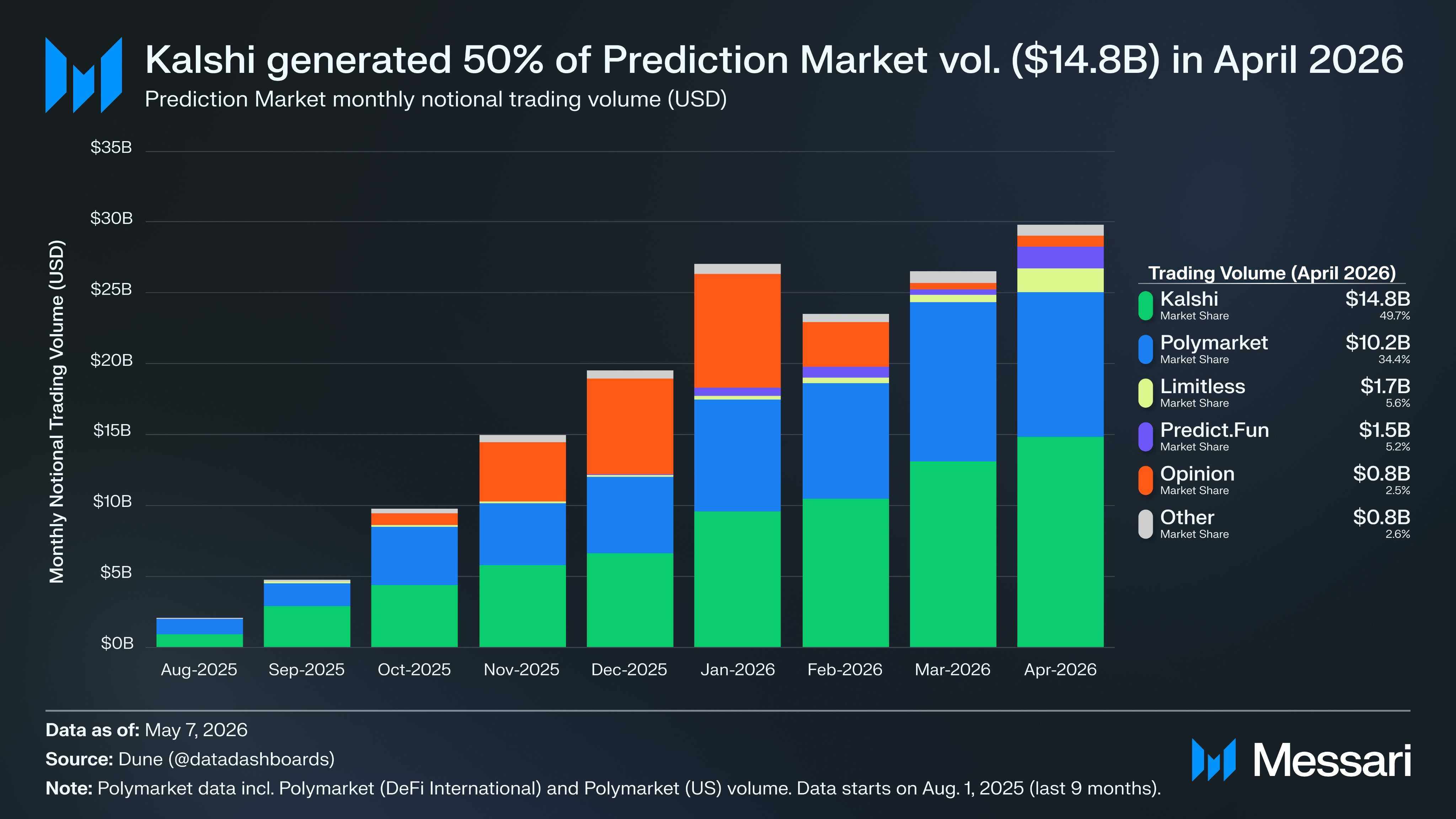
Prediction market platform trading volume data for April
While Kalshi has established a leading advantage, the prediction market hasn't become a one-company show; other platforms are also accelerating their efforts. More accurately, Kalshi's lead hasn't suppressed the growth of other platforms. Instead, it suggests that demand for prediction markets is spreading from the top-tier platform to more entry points.
The future of prediction markets likely won't have just one winner. Compliant institutional markets, crypto-native markets, exchange integrations, and vertical event markets may all coexist. The battle isn't just for users; it's for the liquidity and pricing power of real-world events.
Capital Has Entered; Prediction Markets Must Prove They Belong at the Main Table
Funding is not the finish line; it's the beginning of a much bigger test.
The significance of Kalshi's latest fundraise is not just pushing its own valuation to $22 billion, but for the first time so clearly placing prediction markets within the mainstream financial narrative. Previously, it was more of a trading portal for elections, sports, and hot topics. Now, capital is beginning to believe that the uncertainties of the real world can be turned into a continuously operating price system.
But Kalshi cannot achieve this alone. Platforms like Polymarket, predict.fun, and Limitless are also expanding liquidity, improving user experience, and exploring different market entry points. Kalshi represents the compliant institutional route; Polymarket represents the crypto-native, global liquidity route; predict.fun, leveraging Binance's resources, brings prediction markets to exchange users while fostering discussion and virality on X (formerly Twitter) through differentiated events.
Only when prediction markets are used not just for chasing hot trends, but also for hedging by institutions, decision-making by corporations, and as signals for observing real-world risk by markets, will they truly earn a seat at the financial main table.
Capital has already priced in this potential ahead of time. Now, Kalshi and the entire prediction market industry must prove that prediction markets are not just about turning news into trades, but genuinely transforming the uncertainty of the real world into prices that can be trusted and utilized.


